Skip to content

Tag: simon & schuster

Q & A with Jennifer Heuer

Jennifer Heuer is a book designer based in Brooklyn. Formerly a designer at HarperCollins and Simon & Schuster, she now runs her own studio out of the Pencil Factory. Jen’s striking inkblot design for 1000 Black Umbrellas by Daniel McGinn, published by Californian small press Write Bloody, was one of my favourite covers of last year. As Jen was in a list with many of the usual suspects — several of whom have already been interviewed here — it only seemed appropriate to feature more her excellent work on The Casual Optimist and interview her as well.

Jen and I corresponded by email earlier this year.

When did you become interested in book design? Where did you start your career?

In college I always thought that I wanted to design either album covers or book covers. I didn’t really know how to get into either field after I graduated, but I was fortunate to have Dave Caplan hire me over at HarperCollins. It was a great place to start and Dave was an awesome boss. I was in the children’s department there, and worked on a wide range of covers as well as interiors. It was boot camp in learning how to package an entire manuscript — all the way down to the binding specs and headbands. It was a great way to start thinking beyond the cover and the spine.

I spent about 4 years there learning the ins and outs of book design with a great team. My next goal was to move over to adult book cover design. Simon and Schuster became my new home where I was able to have a blast creating fiction and nonfiction covers for five super talented art directors.
Why did you decide to go freelance?

It’s funny, I’d always dreamed of taking the freelance plunge, but had planned on staying in-house for a few years more before doing so. Thankfully, my husband, Jed, and I shook up our lives a bit and moved to Portland, Oregon for a year. He was joining the experimental team of WK12 at Wieden+Kennedy and I figured I’d be miserable if I sat around Brooklyn without him. So we packed up, and took a few weeks to drive across the country and try something new. The best and scariest decision I’ve made in a long time.

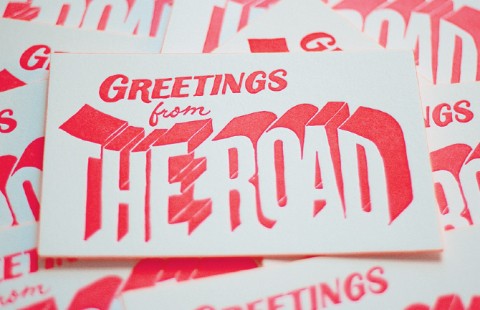
I set up a studio in town and biked to work most days. I worked on building up clients and challenging myself with new projects and classes in and around the area. I even learned how to letterpress! In the end, I’m so glad I took the freelance jump when I did.

Who are some of the publishers you work with?

Just over a year out on my own I’m so thankful to say I’ve worked with HarperCollins, Random House, Little Brown, Grand Central, Penguin, Thomas Nelson, Simon & Schuster, Scribner, Freepress, Ecco, Columbia University Press, Write Bloody, Harvard Business Review Press, and W.W. Norton & Co.

Could you describe you book cover design process?

Each book is different, so the process can vary. But ideally, this is how I hope I’m working:

Naturally, I read the manuscript if there is one. While I’m reading I keep a running list of keywords, signifiers, and themes in my notebook. From there I create some free-association lists of words, trying to decide on a general direction for the look. Then I head to the Pratt library. As an alumni, I have access to the remarkably eclectic collection. The library is where I tend to sketch out ideas. I made these simple worksheets, basically 6 book shaped rectangles on a sheet of paper to knock around some layouts before using the computer. When I’m back in the studio I set up a moodboard on imgspark.com to organize the artwork I’ve created and keep track of art I’ve collected. That’s kinda the whole shebang. I do a lot of prep work before starting the actual design, although you need to be wary of overthinking a project. Sometimes it’s nice to have almost no time at all and just go with my gut. I recently got to do that with the 30 Books in 30 Days project and the Lolita Project.

What are your favorite books to work on? The most challenging?

Well, this may sound super obvious, but I really don’t care what the subject matter is — from brain eating aliens to a medical history, or a memoir on life abroad, to a beautiful love story — as long as it’s a smart, well-written book that I want to pass along to friends and family. Those are the best books to work on. The ones where you don’t feel like you’re doing work while reading the manuscript. The most rewarding projects present a conceptual design challenge, similar to editorial illustration.

Do you see any current trends in book design?

I feel like I’m hearing more and more about making the book an object of desire — something that will be coveted and gift-worthy. And I love seeing smart special effects on covers these days. While this may be the knee-jerk reaction to e-books, I hope it will be something that holds on long enough to make everyone appreciate the object of the book. There also seems to be more attention paid to detail throughout the entire book — from the cover to the end paper to the title page. It’s a great thing to see these days, and solidifies the purpose of the designer.

Where do you look for inspiration and who are some of your design heroes?

Inspiration honestly comes from everywhere. The important part is to pay attention. I try to to get away from my desk and go to the library, museums, read fashion magazines, the newspaper, listen to the radio, watch documentaries and observe closely. I tend to find that when I’m not consciously searching for a design solution, I’m inspired by things happening around me. These things are often times closely related to the project at hand. Perhaps its all synchronicity, but either way, paying attention to what’s around me seems to work well.

As far as heroes go, it’s the people around me that inspire me the most. Friends I’ve known over the years who keep me on my creative toes are an incredible source of inspiration. Of course there are greats throughout the history of art and design, but I feel like I look up to a different person or group of people depending on what I’m working on.

OK, that’s annoyingly vague. Here are some examples: I just watched Senna, and loved the Formula One graphics and footage from the 80’s; the silk screen posters from Slavs and Tatars in the Print/Out show at MoMA were wonderfully fresh and fun to read; found this amazing book of South African block prints while searching for artwork at the library; was settling into the new studio and read an interesting article about brainstorming and the chance creative interactions that were coming out of MIT’s make-shift Building 20.


Who else do you think is doing interesting work right now?

I mentioned earlier that my husband and I spent some time living in Portland last year, and the WK12 group was a big influence. Not necessarily in how I work visually, but in thinking beyond the assignment. While I love spending hours in bookstores oohing and aahhing over the beautiful covers, I’ve been trying to look elsewhere when it comes to interesting work.

It spans from the gorgeous Alexander McQueen textiles, to the beautifully clever industrial design of Joey Roth (I love these speakers!). I’ve been looking at the photography of Todd Hido, and love the eye of Jason Fulford. But I try to pull inspiration from the world outside of design and art. Shows like The Moth, Radiolab, and TED are obvious ones, but incredible resources. The people who are doing the most interesting work are those promoting solid ideas and telling those stories in brand new ways.

What books have you read recently?

Non-work related reading? I’ve been really into Aravind Adiga’s novels. I randomly picked up Between the Assassinations from the free book shelf when I used to work at S&S a couple of years ago and loved it. Right now I’m in the middle of his latest. I’m also in the middle of Chronic City which is a blast to read. I tend to be in the middle of a lot of books when it’s not work related, and always seem to lose track of what I was last reading.

Work related, I enjoyed reading Alexi Zentner’s Touch—lovely story! And a soon-to-be-released collection of short stories by Lucia Perillo was a truly good read (got to use a photo by Todd Hido!).

Do you have a favorite book?

That’s a tough one… It used to be A Farewell to Arms, but it’s been so long since I’ve read that. I did a piece for a gallery show based on Leaves of Grass and found it to be amazingly relaxing to read. And a recent favorite (before any hint of a movie, which I think I’ll skip) is Extremely Loud and Incredibly Close. I loved the combination of visual narrative and traditional narrative to tell a story.

What does the future hold for book cover design?

Oh, I’m sure it’s adorable puppies on every cover. I think my mom would be happy with that! Who wouldn’t?!

Thanks Jen!

You can read more about Jen’s design process in this interview for Faceout Books.

2 Comments

Why don’t you take the comfortable chair?

Colin Robinson, former editor at Scribner (a division of  Simon & Schuster) and previously at The New Press and Verso,  has written an excellent diary piece for the London Review of Books on Publishing’s Demise.

It’s always interesting to read an experienced insider’s take on the state of the industry, and although it covers some very familiar ground, Robinson’s article is particularly  comprehensive and thoughtful (and, given he was fired by Scribner in December 2008, dignified).

It is also interesting that Robinson notes — as Allan Kornblum of Coffee House Press did in his recent interview with Scott Esposito at Conversational Reading (mentioned yesterday)  —  that electronic communication has made  “life easier for writers and harder for readers.”   As more and more stuff is published fewer of us are actually reading. We’re  becoming more concerned with being  heard than with listening, with being read rather than reading:

Books have become detached from meaningful readerships. Writing itself is the victim in this shift. If anyone can publish, and the number of critical readers is diminishing, is it any wonder that non-writers – pop stars, chefs, sports personalities – are increasingly dominating the bestseller lists?

And yet, Robinson doesn’t think the book is doomed. Publishers just have to change the way they do business:

A system that requires the trucking of vast quantities of paper to bookshops and then back to publishers’ warehouses for pulping is environmentally and commercially unsustainable. An industry that spends all its money on bookseller discounts and very little on finding an audience is getting things the wrong way round.

According to Robinson, the opportunity is in curating the mass of material that is out there and finding niche audiences:

The roles of editor and publicist, people who can guide the potential reader through the cacophony of background noise to words they’ll want to read, will become ever more important.

Sounds about right.

Link (via @sarahw)

Comments closed

The e-book Revolution Favours the Agile (But Deep Pockets Help)

The publishing industry is finally turning toward “mass digitization”, Matthew Shaer reports in The Christian Science Monitor .

But “it’s not the bigger houses, such as Macmillan or HarperCollins, that are moving the fastest” he says. It is agile independent presses — who can make decisions quickly  and are “more open-minded when it comes to distribution and marketing” — that are “making the most extensive restructuring efforts” according to Schaer.

Independent presses are undoubtedly innovating — necessity is the mother of invention after all — and I would really love to believe that they can steal a march on the big publishers in the “e-book revolution”. Unfortunately I just don’t think it’s true. Or, at least, that simple.

Even if you ignore the Schaer’s assertion that the “typical” independent press can make quick decisions “without much internal friction” (in theory yes, in practice I’m not so sure), the ability to adapt is not just about a “fast and light ethos”, it is also about resources. It actually takes a great deal of time and expertise — often in short supply at small presses — to put a digital program in place. And although the cost of creating, marketing, and selling e-books may be low once the infrastructure is there, getting to that point requires a lot investment.

Soft Skull’s ambitious aim to have its entire list available digitally by the end of the year is a huge step for an independent publisher. But the two publishers Schaer specifically identifies as being behind the times are, in fact, already on this track. In November last year, Pan Macmillan made books available for the Stanza e-book reader for iPhones, and they currently offer a large, large number of downloads in different formats from their  web site, as do  HarperCollins .

In fact, ALL of the other major publishers — Random House, Penguin, and Simon & Schuster — offer e-books to download from their web sites in the US. Not that you would know from Schaer’s article.

And HarperCollins has been trailblazing with creative online initiatives in the past year. They set up Authonomy, a community site for writers, and are launching BookArmy, which Victoria Barnsley, chief executive of HarperCollins UK, describes as a “social networking site organised around books and authors.” . They’ve collaborated with if:book London and Apt to create an online, annotated version of Doris Lessing’s The Golden Notebook , and in December they released a charming online video, This Is Where We Live, to celebrate the 25th anniversary of their 4th Estate imprint, that quickly went viral.

In April 2008, HarperCollins also acquired The Friday Project — originally set up to find  web based material and turn it into books — as an “incubator for fostering new talent, and finding new markets.”

And let us not forget HarperStudio who may not be offering e-books yet, but have firmly established themselves on online.

Penguin have not been idle either. In December, Penguin US launched Penguin 2.0 to boost their web presence with an iPhone app and other downloads. Penguin in the UK — who sponsored in the recent BookCamp on technology and the future of the book — not only offer over 1,000 e-books on their website, they have an online dating service (no, really), and have created SpineBreakers, a web site with teenage contributors. And there is, of course, the ever-popular Penguin Blog.

The same day as Penguin 2.0 was announced, PW also reported that Random House would be partnering with Stanza and making select titles available for iPhones, and in January, Simon & Schuster relaunched their website with all the whistles-and-bells — such as blogs and author videos (outlined by PW here) — that one would expect from a publisher who knows their audience is online.

Of course none of  these strategies is perfect and the major publishers still have work to do on their e-books programs (there have been complaints about the  pricing in particular), but this is a period of experimentation and, with the best will in the world, it’s simply absurd to suggest, that the big publishers are “dinosaurs” who “think people are just sitting down in leather chairs and reading hardcopy books.”

Independent publishers may have “the most to gain from electronic publishing” as Richard Nash of Soft Skull says, and I genuinely hope that e-books usher in a renaissance of independent publishing. But the big publishers are not blind to the possibilities that technology is opening up and they have the resources to move quickly and boldly, and, in some cases at least, they are doing so. Let’s just give credit where it is due.

1 Comment

Whiskey Tango Foxtrot?*

There has been relentless torrent of grim publishing news coming out of New York the last few days.

It has, at times, been hard to keep up with it all, and I don’t know the people involved well enough or understand the machinations sufficiently to offer much in the way of trenchant analysis. I hope that a summary of ‘Black Wednesday’ and the rest of this week’s events — with appropriate links — will, at least, offer some kind of context.

The details are sketchy, but Houghton Mifflin Harcourt acknowledged that there would be further changes at the company, including job-cuts. According to Publishers Weekly, at least eight people have been let go including executive editor Ann Patty, senior editor Anjali Singh and legendary editor Drenka Willen. GalleyCat has spokesman Josef Blumenfeld’s full statement about the changes.

Personally I’m stunned that the recipient of the 2007 Maxwell E. Perkins Award Drenka Willen, the US editor of Günter Grass, José Saramago and Umberto Eco, has been let go by HMH. PW profiled Willen in 2002, and, after pointing out that she has edited four Nobel Prize winners, MobyLives asked, pertinently, “do the proprietors of Houghton Mifflin Harcourt really know what they’re doing?”

I think my favourite quote, however, came from an unnamed ‘publishing veteran’ who told GalleyCat:

“Those fuckers have destroyed two venerable publishing houses in less than a fucking year.”

Elsewhere things are not much better.

Earlier in the week, Christian publisher Thomas Nelson announced it would be laying off 54 employees, or about 10% of its workforce. CEO Michael Hyatt said in a statement on his corporate blog From Where I Sit :

This was the second round of reductions this year. Unfortunately, this one was no less painful. We did the first round after significantly cutting our SKU count. However, this second round was purely a result of the slowdown in the economy.

According to GalleyCat , Hyatt apparently first made the announcement by Twitter. Stay classy Michael, stay classy…

After Doubleday cut 16 jobs in October, the “long anticipated” restructuring of Random House was announced on Wednesday. Maud Newton offered some bleak analysis and reprinted the full memo from Random House CEO Markus Dohle. Sarah Weinman has questions. Kassia Krozser at BookSquare thinks it’s all irrelevant:

“Who really cares if Crown or Knopf or Ballantine or Bantam Dell survives? I’m serious. Who. Cares… Focusing on imprints is focusing on the wrong problem.

The hyperbole-prone New York Observer called it “The End of an Era”.

In addition to the upheaval at Random House, Simon & Schuster announced it was eliminating 35 positions on Wednesday. Publishers Weekly reported that the Rick Richter, the president of the company’s children’s book division, and Rubin Pfeffer, senior v-p and publisher of the children’s group, would also be leaving.

On Thursday, Penguin Group chairman and CEO John Makinson announced the company will not give pay raises to anyone earning more than $50,000 in the new year. PW quoted Makinson as saying: “I cannot of course guarantee that there will be no job losses in Penguin in 2009. In this financial climate that would be plain foolhardy.”

And, according to a recent wire story from the AP on this week’s events in publishing, pay raises at HarperCollins have been delayed until next July. Spokeswoman Erin Crum says that “no decisions had been made” on job cuts, whatever that means…

All in all, it’s been quite a week. Thursday’s New York Times had a thorough summary and postmortem, and Andrew Wheeler has been keeping a running tab of the changes on his blog if you want more details.

Do I see a silver lining? Well, my hope is that all the talented, smart people who got unceremously dumped this week will stay in publishing (but who could blame them if they don’t?) and take their brilliance and vast experience to smaller more flexible companies and deliver a resurgence of creativity in New York. That would be nice wouldn’t it?

UPDATE:

Ron Hogan has posted some that trenchant analysis that I was talking about over at GalleyCat.

Also, what are the implications of all this, if any, for Canadian publishers? Anyone…?

*Thanks to Pete for the best blog post title ever.

Comments closed

Not Quite A Crisis

According Carolyn Reidy, president and CEO of Simon & Schuster, a worse publishing environment may be on the way, reports Publishers Weekly:

Reidy said she hesitated to use the word “crisis” but “there is no question that we are currently dealing with a set of problems that will test us to our limits.” Critical issues facing publishers included: significant decrease in retail traffic, less consumer purchasing, a gloomy economic forecast, declining backlist sales, brand name authors continuing to sell but “everything else is far off normal levels,” and retail partners who demand more favorable terms and concessions “as if we are the answer to their problems,” she said. Other pre-existing problems she enumerated include retailers competing with publishers, low barriers to self-publishing, and the economics of digital publishing that appear to bring in less revenue.”

Tough times indeed, but it is not quite the end of the world apparently. Although publishers must adapt to new realities, and change business practices, the current situation is an opportunity rather than a threat:

“now we have the chance to actually find the reader where they are spending their time—in front of a screen—and cement a relationship with them through e-mail newsletters, viral marketing, mobile delivery and other tools.” Publishing survives, she noted, because readers have a fundamental need for information, inspiration, and entertainment, “and they get that in a book, directly from an author, in an unfiltered way that they cannot get from any other medium.”

Notably, Reidy urges publishers to make entire catalogues available as e-books and to create adopt print-on-demand when a title’s  sales begin to slow.

Link

Comments closed