Skip to content

Tag: shortcovers

Midweek Miscellany

Eye, Eye! — The Creative Review looks at the vibrant work of printing studio/small press Nobrow.

It’s an Anagram! — Indigo’s e-book initiative Shortcovers has become ‘Kobo’. Much fuss has been made about the name (and the slightly iffy redesign), but what’s more interesting is that Kobo is being spun-off from its parent company in an attempt to expand its global reach… The intrepid Mark Bertils and PW have more on the international angle; Wired think Amazon should be worried; and The National Post have a good Q&A with Kobo CEO Michael Serbinis…

Collector’s Items — Vote for your favourite Nabokov cover from John Gall‘s set of individually commissioned redesigns for Vintage.

The Decade of Dirty DesignSteven Heller, author of Handwritten and New Vintage Type (to name just a couple) on the “anti-digital” Oughts (via Charles Brock):

With the increase of the D.I.Y. sensibility, with renewed emphasis on “making things from scratch,” designers were feeling a need to make physical (not virtual) contact with their materials and outcomes…

[Perhaps less “anti-digital” than “post-digital“? Any thoughts designers?]

And finally…
ryan-tym

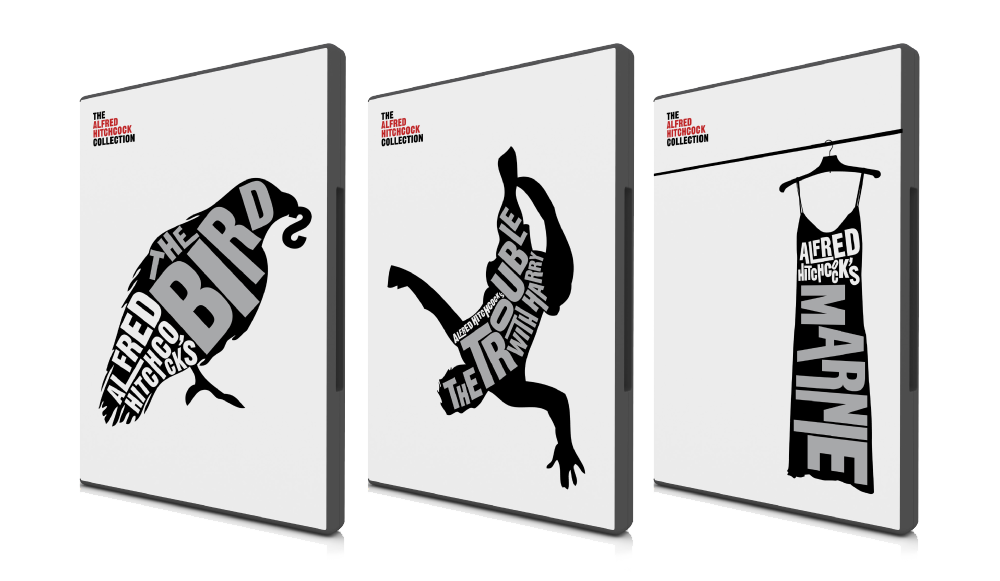
The Hitchcock Collection — a self-initiated project by London-based graphic designer Ryan Tym (via FormFiftyFive):

After recently purchasing a badly designed Alfred Hitchcock
DVD box set, I set to work on creating my own collection of
original covers. Each design features an iconic image related
to the film it represents and includes a bold typographic
title.

I would love to see Ryan design some book covers… Wouldn’t you?

3 Comments
E-Reading the Tea Leaves

While The Wall Street Journal recently suggested that e-readers are more eight-track than iPod and Forrester Research predicted that B&N will steal market share from Amazon and Sony in 2010, Joe Wikert, General Manager & Publisher at O’Reilly Media, made the even bolder prediction that Amazon — in the face of stiff competition from other e-readers and multi-use devices like the iPhone — “will completely exit the Kindle hardware space within the next 3 years”.

Although predicting the future is a mug’s game (and Amazon are particularly adept at being at least 2 or 3 steps ahead of the pundits), I think that Joe — an early Kindle advocate — might actually be onto something and Amazon really might be prepared to let the device, if not the format or apps, die quietly.

Does this mean that Amazon made a mistake in launching their own e-reader?

I don’t think so.

If publishers had rushed to embrace the Kindle, Amazon would have completely pwned the distribution of e-books (and had publishers even further over the proverbial barrel).

But even though this hasn’t quite worked out, Amazon are still sitting pretty. The Kindle has undoubtedly increased the popularity of e-books and Amazon — the best known and largest online bookstore — is the natural beneficiary. Even if manufacturing the hardware becomes too much like hard work, Amazon will still sell a lot of e-books and the Kindle will surely have served its purpose as a beachhead…

Kindle and Shortcovers

And on the subject of the Kindle, it’s been interesting to see Indigo, Canada’s biggest book retailer, respond to Amazon launching their e-reader north of the border.

Joel Silver, President of Indigo, — who apparently reads on his Blackberry — discussed e-readers and e-books on Business News Network last week (there’s also an interesting follow up interview with the estimable Jason Epstein) and Michael Serbinis, President of Indigo’s e-book initiative Shortcovers, took a few (slightly uncharitable) pot-shots at the Kindle in a recent interview with The National Post.

But, as Shortcovers clearly demonstrates, Indigo have been preparing for the arrival of the Kindle for a while, and — if you have a spare hour — it worth listening to Michael Tamblyn, their VP of Content, Sales & Merchandising, re-enact his Tools of Change presentation Your Reading Life, Always With You to see where they are going…

So what do you think is the future of e-readers? Any thoughts?

Comments closed

Something for the Weekend, June 5th, 2009

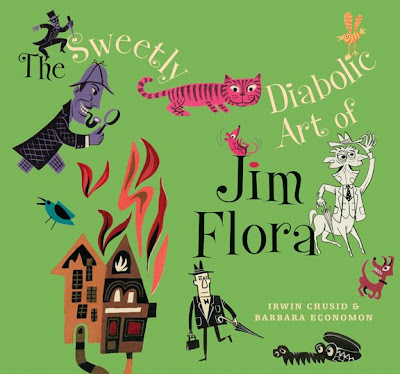
Sweetly Diabolic — A new Jim Flora compendium from Fantagraphics.

I really, truly, wasn’t going to link to any BEA autopsies — and there are plenty out there — but on the eve of BookCamp Toronto I thought Brian O’Leary’s post seem pertinent:

It would be more than nice, more than fun, more than illuminating, if we as an industry could use events like BEA as less an opportunity to predict the future and more a forum in which to examine the options. Okay, piracy is bad, but.. what if it helped sell books? Okay, we love long-form fiction and we think it should survive, but what if the people who read it now just stopped? Okay, a trade publisher provides value in choosing and curating content, but what if the world turned upside down and everyone were a writer, a publisher, a reader… Wouldn’t that be really cool?

Fingers crossed for tomorrow… Follow along on Twitter. The event account is @BookCampTO. The hash-tag is #bcto09.

Access of Evil — More on Google’s big e-book adventure at Business Week. The ‘news’ is that Google will be offering online access to e-books rather than downloads. Which, if I understand it correctly, is what Shortcovers does already. Not that anyone is giving them credit for it.

The ALPHABET chest of drawers by Kent and London, inspired by vintage printing blocks: “The perfect place to file everything from A-Z!” (via source of all good things swissmiss).

The George Orwell Archive at the BBC (via The Book Depository blog):

For two years, between 1941 and 1943, George Orwell – real name Eric Blair – was BBC staff member 9889, hired as a Talks Producer for the Eastern Service to write what was essentially propaganda for broadcast to India.

From recruitment to resignation, this collection of documents reveals the high regard in which Orwell was held by his colleagues and superiors and his own uncompromising integrity and honesty.

The Wickedest Man in the World — Jake Arnott, author of The Long Firm, on how the very real Aleister Crowley became the archetypal fictional 20th century villain. Sadly Arnott doesn’t mention that Oliver Haddo, W. Somerset Maugham’s literary Crowley, appears in the latest League of Extraordinary Gentlemen adventure.

The Future of Mainstream Media — a fascinating article about the success of National Public Radio (NPR) by Josh Catone for Mashable:

NPR’s amazing growth over the past 10 years prompted FastCompany magazine in March to call NPR the “most successful hybrid of old and new media,” and wonder if NPR could be the savior of the news industry. [T]hey owe that success to the culture of open access and audience participation that they’ve cultivated over the past decade.

And… OK I just can’t not link to Design Assembly‘s post about design-hero Wim Crouwel’s ISTD lecture.

Note: if you want me to link to your site, you just need to include a brilliant photograph of Wim Crouwel looking cool as f*ck and then use a genius soccer analogy:

“(For me) a grid is like a football pitch. You see a beautiful game of football, and then you see a not so beautiful one, but it all takes place on the same pitch”.

Yes. I am a cheap date.

4 Comments

Something for the Weekend, Feb 27th, 2009

The 5 Rules of Book Cover Design Book — John Gall, VP and art Director at Vintage, talks about designing books at Barnes & Noble (video). There is also a nice print interview with John Gall from 2007 at STEP Inside Design magazine and another interview with the designer from the same year  at fwis Covers website (which is worth it just for the immortal line: “I want a telepathic dog.”) (John Gall at the Book Cover ArchivePragmatism: A Reader designed by John Gall,  pictured above)

Fear, panic, and a little bit of hope — Sarah Weinman discusses the perilous state of  the publishing industry on NHPR’s Word of Mouth.

Chapters-Indigo‘s move into e-books, Shortcovers, goes live to much curiousity and twittering. The Globe and Mail has the basics, The National Post’s The Ampersand rounds up some of the reactions, but O’Reilly’s TOC seems to sum up the general mood: “A Good Start, But Room for Reader Improvement”. Michael Serbinis, the executive VP, writes about the first day on the Shortcovers blog.

(NB – I’ve sort of been ignoring the Kindle2 stuff as it’s not available in Canada, but — just to have some balance — E-Reads has a nice round up of the coverage).

Influence the futureAnthro Goggles lists the first 4 SF books you should read if you work in social media.

Jacket Copy — An interesting interview with David L. Ulin, book editor of the Los Angeles Times (who folded their standalone book section 6-months ago), in PW:

Ulin takes a realistic, broad-ranging view of how book coverage will be presented in the future. “I’m committed to both print and Web. There are two readerships, and I’m not sure they’re the same. My main interest is, how do we get the most book coverage to the most people?” Ideally, Ulin would welcome a return to the stand-alone book review. “But we don’t have one now, and we’re not going to have one,” he says.

modernism 101 : from aalto to zwart — “We specialize in rare and out-of-print design books and periodicals. Our carefully-selected online inventory spotlights both famous and forgotten modernist architects, photographers, typographers, and industrial designers in all their published glory.” How could I not link to this? Even if you can’t afford the books (which I can’t) you can at least look at the covers! (The Twentieth Century Book by John Lewis pictured above). (via ISO150)

And on a related bookporn note, Grain Edit has some rather nice pictures of Typographica, the design journal edited by Herman Spencer…

Comments closed