Designer Jon Gray (AKA Gray318) has launched a new website.
Jon has also been interviewed by We Love This Book:
A book cover only becomes iconic because the book that it covers becomes iconic. The cover is just a face for the content. I have been lucky to work on some really great books and have benefitted from their success. People often assume that by copying the cover of a successful book it will help their book sell, and are always surprised when it doesn’t work. It always has to start with the content.
The Browser — Author Anthony Daniels on the digital challenges faced by books, at The New Criterion:
An intellectual might be defined as someone who elaborates justifications for his own tastes and preferences, as metaphysics was once defined as the finding of bad reasons for what we all believe on instinct. And so the reader of books soon finds reasons for the supposed superiority of the printed page over the screen of the electronic device: for nothing stimulates the brain quite like the need for rationalization. The dullest of minds, I have found, works at the speed of light when a rationalization is needed…
Whether the book survives or not, I am firmly of the opinion that it ought to survive, and nothing will convince me otherwise. The heart has its beliefs that evidence knows not of. For me, to browse in a bookshop, especially a second-hand one, will forever be superior to browsing on the internet precisely because chance plays a much larger part in it. There are few greater delights than entirely by chance to come across something not only fascinating in itself, but that establishes a quite unexpected connection with something else. The imagination is stimulated in a way that the more logical connections of the Internet cannot match; the Internet will make people literal-minded.
And finally…
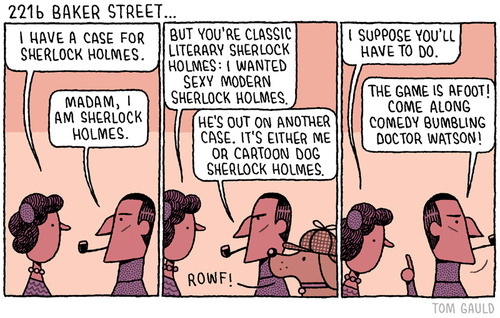
As am I, as am I — Edward Docx on the Sherlock Holmes ‘pilgrims’ and a re-enactment of The Final Problem organised by The Sherlock Holmes Society of London:
I have come to like the pilgrims a good deal. They’re warm-hearted, engaging and amusing people, which is more than can be said for the moped brethren. There are many from the legal profession—Moriarty is a practising barrister; Cardinal Tosca and Queen Victoria (who are married) are retired from the bar. Sherlock Holmes, I learn, is an ex-head teacher—and is (disconcertingly) married to Mrs Hudson. Watson works for Lloyd’s of London. The strangest and most impressive folk are those who have come the furthest—not least the two ladies from the aforementioned Japan Sherlock Holmes Club (founded in 1977; about 1000 members), who do not, I think, speak English and who are posing as “Baritsu Assistants”—this being some kind of martial art that Holmes knew and that saved him in his struggle with Moriarty on the falls. There are also policemen, toxicologists, bookmakers, engineers, historians, and many who—nobly—refuse to admit to any other existence save that of their character. If these people have anything in common, beyond the obvious, it is that they are all comfortable with a very elastic sense of reality… As am I, as am I.
Like this:
Like Loading...