Tom Gauld’s first picture book for children, The Little Wooden Robot and the Log Princess, is out this month! According to the publisher blurb, the book is inspired by a bedtime story he made up for his daughters:
“I was trying to make a book inspired by three different sets of books: The books that I remember enjoying as a child, the books that I watched my daughters enjoying, and the books I enjoy now as an adult. I wanted the book to have its own quirky feeling but also to function like a classic bedtime story.”
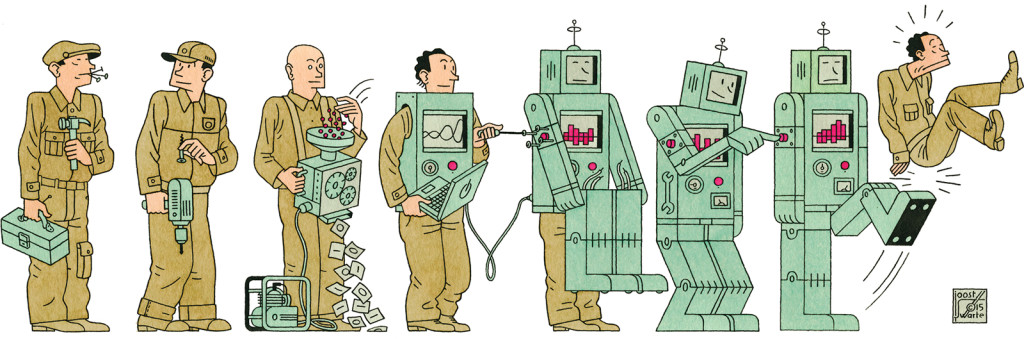
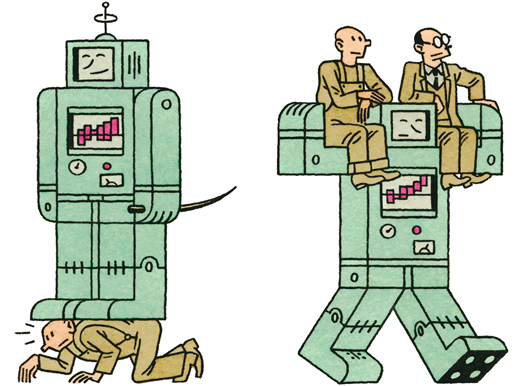
Writing at the MIT Technology Review, David Rotman looks at the impact of automation and digital technology on jobs with reference to a number of recent books related to the subject including Rise of the Robots: Technology and the Threat of a Jobless Futureby Martin Ford, The Great Divide by Joseph Stiglitz, and The Second Machine Age by Erik Brynjolfsson and Andrew McAfee. But if you find that all too depressing to contemplate — and who doesn’t? — you can at least enjoy the wonderful Joost Swarte illustrations that accompany article …
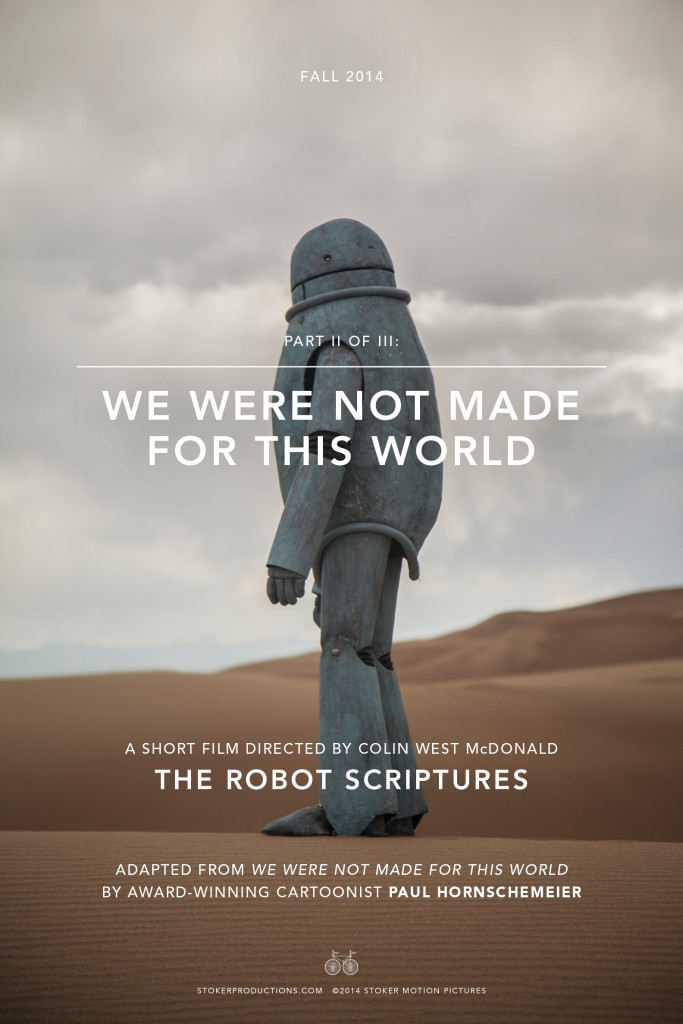
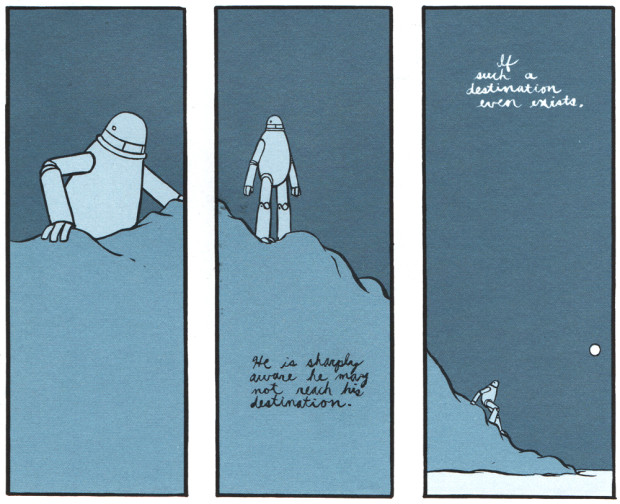
Directed by Colin West McDonald, We Were Not Made For This World is a short science fiction film based on the comic strip of the same name by cartoonist Paul Hornschemeier about a robot searching for his creator:
‘We Were Not Made for This World’ was first published in Project Telstar by AdHouse and later collected in Let Us Be Perfectly Clear by Fantagraphics.
Hornby Cover Versions — Some rather beautiful student work by Barcelona-based graphic designer Lucía Castro (although my inner-bookseller gets very twitchy at the thought of those soft off-white covers!). (via Cosa Visuales)
Full of Refusals — Tom McCarthy interviewed for More Intelligent Life:
[C]ontemporary literature has to deal with the challenges laid down by modernism. The most exhilarating and unsettling upheavals took place in the early 20th century, and to ignore them and go back to writing some kitsch version of the 19th-century novel is ostrich-like… I’m suspicious of the term ‘avant-garde’. I think it should be restricted to its strict historical designation: Futurists, Dadaists, Surrealists etc. “Tristram Shandy” and “Motherless Brooklyn” aren’t avant-garde novels; they’re novels.
C by Tom McCarthy will finally available in the US and Canada on September 7th.
[P]ublishers are competing against both established players and new entrants at the same time. The newer players often have much lower costs than we’re used to, making them potentially tough competitors… I’ve been thinking lately that publishers need to work more aggressively on creating agile content that can be discovered and easily reused or recombined. Creating content that is sold in one format just won’t be cost-effective in the future.