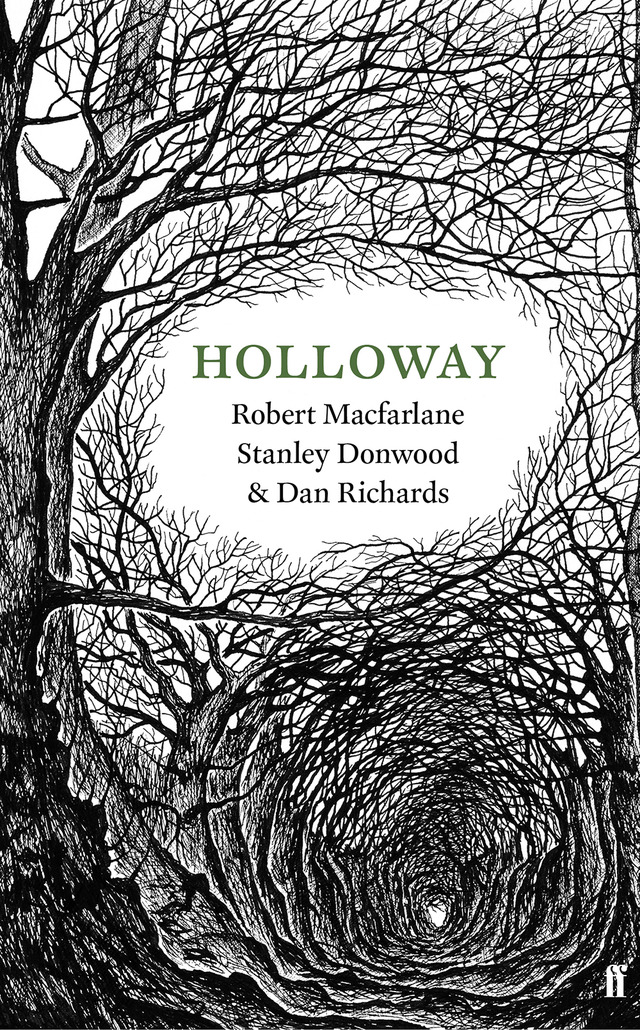
Artist Stanley Donwood talks about his artwork for Radiohead, his collaboration with author Robert MacFarlane on Ness, and his own book Bad Island, published earlier this year by Hamish Hamilton (and slated to be published in the US by W.W. Norton this fall).
Robert Macfarlane, whose new book Landmarks was published in the UK last month, has a fascinating essay in The Guardian on the writer M. R. James, and the eerie horror of the English countryside:
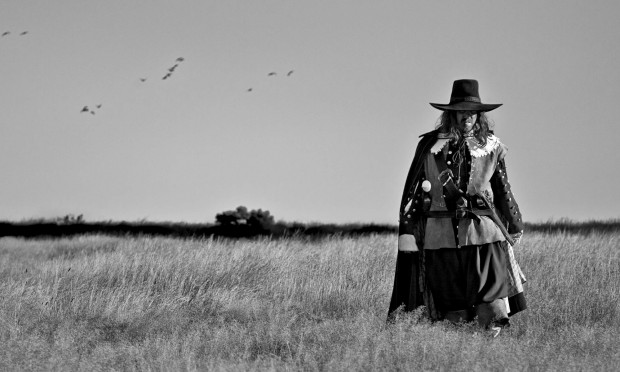
We do not seem able to leave MR James (1862–1936) behind. His stories, like the restless dead that haunt them, keep returning to us: re-adapted, reread, freshly frightening for each new era. One reason for this is his mastery of the eerie: that form of fear that is felt first as unease, then as dread, and which is incited by glimpses and tremors rather than outright attack. Horror specialises in confrontation and aggression; the eerie in intimation and aggregation. Its physical consequences tend to be gradual and compound: swarming in the stomach’s pit, the tell-tale prickle of the skin… James stays with us is his understanding of landscape – and especially the English landscape – as constituted by uncanny forces, part-buried sufferings and contested ownerships. Landscape, in James, is never a smooth surface or simple stage-set, there to offer picturesque consolations. Rather it is a realm that snags, bites and troubles. He repeatedly invokes the pastoral – that green dream of natural tranquillity and social order – only to traumatise it.
James’s influence, or his example, has rarely been more strongly with us than now. For there is presently apparent, across what might broadly be called landscape culture, a fascination with these Jamesian ideas of unsettlement and displacement. In music, literature, art, film and photography, as well as in new and hybrid forms and media, the English eerie is on the rise. A loose but substantial body of work is emerging that explores the English landscape in terms of its anomalies rather than its continuities, that is sceptical of comfortable notions of “dwelling” and “belonging”, and of the packagings of the past as “heritage”, and that locates itself within a spectred rather than a sceptred isle.
I think the eerie is also a theme that runs through English comics, although Macfarlane doesn’t mention it, and I’m hard pressed to think of specific examples. Gothic psychogeography is very much Alan Moore territory, and it feels like it should be in Warren Ellis’s wheelhouse too, but have either of them written anything explicitly about the horror of the English countryside?
Gormenghast is a vast “labyrinth of stone”, in Peake’s phrase—except that it has no centre, for there is always another chamber to reach or further annex to access. In this respect it is less a castle, more a city—and an infinite city at that. I grew up at the end of a country lane in the English Midlands, and it was in Peake’s writing that I first sensed (fearfully, fascinatedly) what a city might feel like to inhabit.
Cities are, like Gormenghast, excessive and connective. They spawn, proliferate, self-generate: and they are sites of encounter and overlap. For every story you overhear in a city, every conversation you catch, myriad more are in the making at that moment. This is the affront that cities offer to reason, and the excitement they provoke in the mind: that they surpass all possible record. They are places of—to borrow again from Peake—intense “circumfusion”.