Whereas Black Hole, which takes place in the early 1970s, examines the dread and confusion of adolescence using the tropes of a horror film, X’ed Out, which is set in the late 1970s at the height of punk music, is an exploration of young adulthood and the anger, uncertainty and experimentation that comes with aging.
“I definitely started out wanting to do my punk story,” says Burns, 55. “As typically happens, you start with one idea and it spreads.”
A House Full of Books — The LA Times book critic David L. Ulin on the gift of books:
We have a rule in our house: My wife and I will always pony up for books. It’s not even a subject of discussion — if either of our kids wants a book, we will buy it, no questions asked. This is equally true of the books we have at home, which are equally available to everyone, regardless of subject matter or degree of difficulty. Whatever else they are, after all, books are gifts (for the mind, the eye, the hand), which makes it downright uncharitable to deny them to anyone.
This, I should say, is how I was raised too, in a house full of books, by parents who put a premium on the written word. I was allowed to pick up everything — and often did. When I was in third grade, I checked out “War and Peace” from the school library (I was looking for the longest book in the world), and although I never actually opened it, I remain thrilled by the idea that no one told me not to try.
Mr Carter doesn’t own an iPad, Kindle, or other reading device, as he is waiting for them to mature. (He does own an iPhone.) He frets that, as things stand, reading devices and programs homogenise all the tangible aspects of a book, like size or shape, as well as font. They are also poor at hyphenation and justification: breaking words at lexically appropriate locations, and varying the spacing between letters and between words. This may sound recondite but it is a visual imprint of principles established over the entire written history of a language. “Maybe people who grow up reading online, where every book is identical, don’t know what they’re missing.”
On a sort of related note… Mashable talks to designer Susan Kare about her icon designs for the original Apple Macs.
And finally (as we’re talking about typography)…
Jean-Luc — A free display typeface in two styles designed by Atelier Carvalho Bernau to celebrate Jean-Luc Godard’s 80th birthday.
Limits and Boundaries — Peter Mendelsund, associate art director at Knopf, discusses his cover design for Jo Nesbø’s The Snowman with The New Yorker’s ‘The Book Bench’:
[O]ften my favorite jackets are the ones done after repeated rounds of failure and rejection. There’s something to be said for the desperation that rejection engenders in me. Sometimes, when the process feels most intractable and hopeless, a kind of last-ditch clarity appears. That being said, it’s also nice when you get it on the first stab.
And on the subject of super-talented book designers… A short Q &A with Coralie Bickford-Smith, Penguin senior cover designer, at 10 Answers.
I, Reader — Alexander Chee on e-books and life spent reading for The Morning News:
Many ponderables remain regarding the e-book. At a personal level, I am someone who has read books in poor light for decades without hurting my vision (despite what my mother claimed), and I’m keeping, well, an eye on that—the iPad gives me headaches in ways reading on paper never did. As a writer and former bookseller, I understand the e-book’s imperfections and limits, and monitor the arguments that it will end publishing or save it, and potentially kill bookstores, which would kill something in me, if it were to happen. But I also believe that the book as we know it was only a delivery system, and that much of what I love about books, and about the novel in particular, exists no matter the format. I’ve lately been against what I see as the useless, overly expensive hardcover, and I admit I enjoy the e-book pricing over hardcover pricing. Still, I’ll never replace the books on those shelves, and there’ll always be books I want only as books, not as e-books, like the new Chris Ware, for example, which would be pointless on an e-reader. This really is just a way for me to have more.
Rage Against the Machine — Onnesha Roychoudhuri’s long and much talked about article on Amazon for the Boston Review:
What happens when an industry concerned with the production of culture is beholden to a company with the sole goal of underselling competitors?…
The conceit is that that $9.99 price tag is what the market demands. But in this case Amazon is the market, having—with no input from its suppliers—already dictated the price and preempted the standard fluctuations that competition and improved efficiency impose on prices…
Cheap books are easy on our wallets, but behind the scenes publishers large and small have been deeply undercut by the rise of large retailers and predatory pricing schemes. Unless publishers push back, Amazon will take the logic of the chains to its conclusion. Then publishers and readers will finally know what happens when you sell a book like it’s a can of soup.
[T]he trick, the secret of “Doonesbury,” that, in its topicality, its ongoing dailiness, it is really about something more profound. Trudeau highlights that in his introduction: “It’s not about Watergate,” he writes of the collection, “gas lines, cardigans, Reaganomics, a thousand points of light, Monica, New Orleans, or even Dubya.” No, indeed, although such elements do show up here, more important are the people, the dance of generations, their humanity. This is where “Doonesbury” is at its most compelling…
I’m something of skeptic when it comes to Nick Hornby (to put it politely)but the “Ministry of Stories” is, despite its Orwellian moniker, clearly a well intentioned venture, and the design of its Hoxton Street Monster Supplies storefront by We Made This is pretty stellar.
There is more on the Ministry of Stories, which is based on David Eggers 826 project, at The Guardian.
Elsewhere…
Largehearted Boy is doing everyone a favour by aggregating every online “Best of 2010” book list he can find.
AND Design Observer’s contributing writers recommend books for the holidays. While The Bygone Bureau asks some stellar bloggers for their Best BLOGS of 2010.
In one of her memoirs, [Doris] Lessing suggests: “Writers, and particularly female writers, have to fight for the conditions they need to work.” This sounds like an understatement, particularly in relation to the last pre-feminist generation, to which she belonged. Dipping into it, we see that Penelope Fitzgerald, a mother of three, did not publish until the age of 58, that Iris Murdoch and Flannery O’Connor and Patricia Highsmith were childless. Spark may not have been alone in associating motherhood with artistic and personal annihilation. (Other patterns emerge. Highsmith, Lessing, and Spark all loved cats, and in fact Spark received a cat from Highsmith, with whom she also shared itinerancy and a gleefully vicious imagination. If you took scoops of the temperaments of Doris Lessing and Patricia Highsmith and added a dollop of Flannery O’Connor—for the cold Catholicism—the resulting gelato would taste a lot like Muriel Spark.)
Where does this stuff come from? It comes from sensory deprivation. It comes from turning down all the volume knobs to the one setting—or somewhere between zero and one—on everything, so I can actually hear myself think and I can actually poke around inside myself. We’re all so used to cultural noise being played at full volume. It can come as a surprise, even to myself, how much you can know about what’s going on by listening to almost nothing. It’s important, because if you have it up at full volume, you can’t hear yourself think, and all you want to do is chase after the stuff that’s going on.
And if you think Mr Franzen might have got a little too big for his boots, then following Emperor Franzen on Twitter might be for you (“I was on the cover of TIME. That’s TIME magazine, bitches…”).
“I was laughed at, in a way, when the Cold War ended and the wall came down… ‘Poor old Le Carre, what will become of him? Nobody’s spying anymore.’ The reality is, the budgets have never been bigger, the recruitment has never been more wholesale.”
Boredom — Lee Rourke, author of The Canal, interviewed for 100th issue Bookslut:
We’re in constant thrall, either waiting to be used by technology or desperately trying to catch up with it. Boredom is the realization of an acute emptiness caused by this widening void… There’s nowhere for us to go now. We are stranded. We have been marooned. My novel, The Canal, is a summation of this sense of dread: this slow realization that things, everything, is speeding up and moving away from us. We have been left with the inability to deal with what this distance creates within us…
In cultural terms, we live in deeply conservative times… We shouldn’t imagine, though, that things were that different in the golden age of modernism. Ulysses was printed, in 1922, on a small, private press in Paris, in a run of 1,000; Kafka’s Metamorphosis, on its small-press publication in 1915, sold 11 copies – of which 10 were bought by Kafka. Yet can anyone, now, name the successful middlebrow writers of 1922 or 1915? Of course not.
(And, as this is a blog for people who like to live under rocks, Tom’s novel Cwas shortlisted for the 2010 Man Booker Prize yesterday.)
In spite of the hardcover’s beautiful jacket design (by Paola Ecchavaria), it was a citation in Nicholas Carr’s recent book The Shallows that finally got me to read Proust and The Squid by Maryanne Wolfe.
It is a fascinating if, at times, academic book that examines the history of written language and the corresponding development of our ‘reading brain’. In a chapter on reading development, Wolfe includes a charming, witty poem on the vagaries of English pronunciation that I wanted to share. Wolfe says the poem is anonymous, but I have subsequently seen it attributed to T.S. Watt. Please let me know if you have any further details…
I take it you already know
Of tough and bough and cough and dough.
Others may stumble but not you,
On hiccough, through, lough and through.
Well done! And now you wish, perhaps,
To learn of less familiar traps.
Beware of heard, a dreadful word
That looks like beard and sounds like bird,
And dead; it’s said like bed, not bead;
For goodness’s sake, don’t call it deed!
Watch out for meat and great and threat,
(They rhyme with suite and straight and debt).
A moth is not a moth in mother,
Nor both in bother, broth in brother,
And here is not a match for there,
Nor dear and fear for bear and pear,
And then there’s dose and rose and lose–
Just look them up–and goose and choose,
And cork and work and card and ward,
And font and front and word and sword,
And do and go and thwart and cart.
Come, come, I’ve hardly made a start.
A dreadful language? Man alive,
I’d mastered it when I was five.
And yet to read it, the more I tried,
I hadn’t learned it at fifty-five.
Photographer Steve McCurry, best known for his iconic National Geographic portrait ‘Afghan Girl’, recently posted twosets of beautiful photographs on his blog of people reading books. Publishing Perspectives spoke to McCurry about the ongoing project:
As a photographer, McCurry is always on the hunt for the “unguarded moment,” that slice of time that reveals something personal and honest. “I have another gallery of people sleeping and of couples interacting. There’s an intimacy people have with a book and its author that is similar,” he says, adding. “We’re all different and we’re all the same. It amuses me that whether you’re fabulously rich and sophisticated or you happen to be someone on the street in the third world or a classroom in some remote area, reading is all the same act. It’s a common link in our shared humanity, a thing we all do that is regardless of where we are economically or socially.”
The first selection of McCurry’s photographs of readers, titled ‘Fusion: The Synergy of Images and Words’, can be seen here. The second set is here.
I am very aware of how much product gets put out there that is completely unnecessary, be it music, movies, books, whatever—it seems that for every good piece of culture we experience, we are bombarded with 99 pieces of redundant crap. I’ve been in the industry for awhile, and of course want to show off the great work we do here, but was not going to put out yet another design book and take your money—you can get that in any annual. To me, often more interesting than the covers are the stories, the psychology that created all the variables that led to this cover over the 20 other proposed covers.
Paul has recently updated his Flickr with new covers from the Penguin Ink series, which utilizes art by tattoo artists, as well as the latest additions to the excellent Penguin Graphic Classics series, which have art by contemporary cartoonists.
My interview with Paul and Penguin 75 designer Christopher Brand is here.
Writing on the Wall — Andrew Franklin, publisher and managing director of Profile Books, offers an overview of the current state of the book business in the UK (via Dan Mogford):
Bookshops enliven high streets, create communities of readers and stage author events, while good booksellers encourage reading and shape taste. For most readers, browsing is a key part of deciding what to read, and publishers put huge effort into packaging and presenting their books. Of course many of these activities can migrate online with Facebook groups, online forums, feeds and websites helping to steer readers to the books they will most enjoy. For some online shoppers bookshops are part of this process: they browse in bookshops, write shopping lists and then buy (perhaps more cheaply) online. But no bookshop can be in business as a shop window for other retailers. You don’t have to be hopelessly nostalgic or sentimental to believe something very precious is lost with every bookshop that closes.
The situation really is that the first generation of printers, encouraged by scholars, naturally produced the sort of books these people wanted. But it’s hard to apply this sort of commercial model—this small, bespoke model used for manuscripts—to a new process that produces 300 or more identical items. The irony is that there were plenty of other readers out there. The first printers ignored the groups that we might call pragmatic readers. Literacy was already widely-disseminated in the fifteenth century. There were lots of people who could read but did not habitually buy books, so the trick was to discover how to reach them.
The cover for The Disappearing Spoon designed by the amazing Will Staehle. To quote Tal Goretsky at Book Covers Anonymous: “Holy Mother God!”. Apparently it’s printed on uncoated paper.
You can see some of Tal’s own rather nice design work here.
I think most literature works perfectly well without illustrations and I have seen some truly awful images put on the cover (used as illustrations) of great books. As for comics, I’m more often frustrated by comics which are too wordy than too visual. I think the balance between words and pictures is very important in a comic and though the ratio doesn’t always have to be the same, my heart sinks when I see a page which is filled with writing.
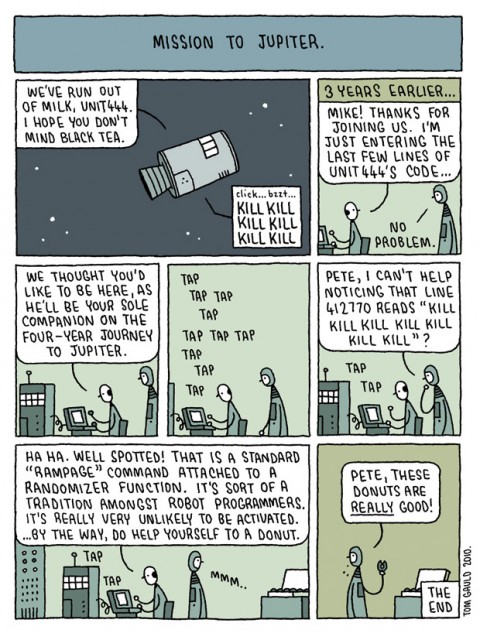
Taking a summer break from his regular illustration gig at The Guardian, Tom is currently producing a weekly comic and posting it to Flickr:
Real Editors Ship — I linked this on Twitter already, but it’s kind of great so what the hell… Paul Ford on getting stuff out the door and the value of editors (and I would suggest Production Managers):
People often think that editors are there to read things and tell people “no.” Saying “no” is a tiny part of the job. Editors are first and foremost there to ship the product without getting sued… This is not to imply that you hit every sub-deadline, that certain projects don’t fail, that things don’t suck. I failed plenty, myself. It just means that you ship…
Editors are really valuable, and, the way things are going, undervalued. These are people who are good at process. They think about calendars, schedules, checklists, and get freaked out when schedules slip. Their jobs are to aggregate information, parse it, restructure it, and make sure it meets standards. They are basically QA for language and meaning.
Amazon and other online merchants have harnessed mighty algorithms to run their “If you enjoyed that, you might like this…” suggestion engines, but these are still crude instruments. Practically any novel you plug into Amazon’s search engines at the moment returns the robotic announcement that people who bought it also bought one of Stieg Larsson’s “Girl” thrillers — because seemingly everybody in America is buying those books. It’s not like you need the world’s most sophisticate e-commerce servers to tell you that.
Spend an hour with Jim Steranko and, if he’s in the mood, he’ll regale you with the most extraordinary tales. Are they true, I have asked myself more than once, or is he a fantasist? Has his love of storytelling and the creation of modern myths bled into his own life story until he can no longer tell the two apart? Well, now that I’ve met him, I believe them all to be true, just as I believe it when he tells me he still runs miles every day, pumps iron, and fornicates blissfully like a man a third his age. He is unique. He is Steranko. He is the greatest.
Thriller writer Jason Pinter recently rattled some publishing china by suggesting that a stubborn belief that Men Don’t Read is alienating male readers:
I’m tired of people saying Men Don’t Read. Men LOVE to read… But the more publishing repeats the empty mantra that Men Don’t Read the less they’re going to try to appeal to men, which is where this vicious cycle begins.
Publish more books for men and boys. Trust editors who try to buy these books, and work on the marketing campaigns to hit those audiences. The readers are there, waiting, eager just under the surface… They’ve been alienated for a long time and might need to be roused from their slumber. But as I’ve always said the biggest problems facing the publishing industry are not ebooks, or returns, but the number of people reading. This is a way to bring back a lot of readers who have essentially been forgotten about.
Pinter is right in a sense. The idea that men don’t read books is a glib generalization and publishers really should be worried about literacy and declining readerships. But are men really turning away from reading because the book trade isn’t trying to reach them?
The scandal engulfing former Penguin Canada CEO David Davidar is a prickly reminder that the upper echelon of publishing is still largely a boy’s club. And even if you accept Pinter’s assertion that “that most editorial meetings tend to be dominated by women”, Rebecca Smart, Managing Director at Osprey Publishing, ably demonstrates that women can publish effectively for a predominantly male readership.
And even if you ignore all the books on football mentioned last week (not to mention the endless number of books on baseball and cricket), and the entire output of writers like Cormac McCarthy, George Pelecanos and the late (but still in print) Patrick O’Brian, the New York Times best seller lists reveal more than a few new books have been successfully published for men.
The perception that publishers are marginalizing men is just as much an illusion as Men Don’t Read. At least if men read the NY Times and like books on economics, war and expletives. (And who doesn’t?)
But this is, of course, completely subjective. The New York Times bestsellers — war, history, politics, and angry (funny) old men — may not be the kind of books Pinter had in mind. I certainly didn’t read the book that caused Pinter so much angst, A Lion’s Tale by pro-wrestler Chris Jericho, but then I don’t read much Roth, Amis, or Coetzee either, though I suppose plenty of men do. Perhaps the real problem is publishing along stereotypical gender lines? Not all men (or women) want to read the same books…
I was thinking about this because of two books I finished recently: War by Sebastian Junger (Twelve 2010) and Colony by Hugo Wilcken (Harper Perennial, 2007). Both are books by men about men — and I enjoyed them both — but otherwise they have almost nothing in common.
Full of piss, vinegar, and shit blowing up, War is a nonfiction account of Junger’s time embedded with the Second Platoon of Battle Company in the Korengal Valley, eastern Afghanistan.
At one level, Junger’s book is a chronicle of Second Platoon’s days. He takes us up the mountains, along the valley floor, on helo-lifts, into firefights. We sit with the men in their bunks — infested with fleas and tarantulas — and we listen to their low-grade (and sometimes hilarious) philosophizing as they pass the hours… But Junger is aiming for more than just a boots-on-the-ground narrative of the travails of American fighting men. As the book’s grandiose title suggests… “War” strives to offer not just a picture of American fighting men but a discourse on the nature of war itself.
With it’s acronyms, hot military hardwareand bunker philosophizing War is, without question, a compelling read. But it is also a deeply troubling book. Junger’s intimate dependence on this closely knit platoon clearly affects his journalistic perspective, and Junger’s narcissism aside, I was left wondering whether there is a psychological condition in embedded journalists similar to Stockholm Syndrome.
Lewis Manalo, a former sapper in 82nd Airborne Division, describes Junger as a “war tourist” in a scathing review of the book for Publishing Perspectives:
[W]hat a fantasy it is. All the thrill of being in combat with none of the responsibility of knowing what to do. He endows the different engagements with the excitement and clarity of a Hollywood action film… As Junger paints them, these fights are where all those big words like “heroism” and “courage” and “sacrifice” come into play, where men achieve amazing things and where they die dramatic deaths. Over and over, Junger and the men he depicts rave about how exciting battle is. In Junger’s world, war is a glorious thing where everyone should want to be.
“Fantasy” is an interesting choice of words. Certainly, the phrase ‘war-porn’ came to mind when I was reading it. Perhaps not surprisingly then, Junger’s experiences in Korengal are also the basis for a feature-length film called Restrepo co-directed with photographer/filmmaker Tim Hetherington:
If War is a dirty nonfiction hypemachine, Colony by Hugo Wilcken is a beautifully constructed — if largely ignored — literary novel.
With echoes of Conrad and Camus, Colony is a sophisticated post-modern adventure story. Sabir — a war veteran and petty criminal — finds himself on a boat to a brutal penal colony in French Guiana. He escapes the camp, but as his plans unravel, the book takes an unexpected tack, throwing the previous narrative into doubt. The past, present, and future mix in memory and imagination.
John Self, who has long championed the novel, had this to say about it:
The book’s sometimes elusive nature seems to be reflected in the references to Poe’s Narrative of Arthur Gordon Pym. But what impresses most is Wilcken’s unwillingness to try to impress the reader: the prose is unfussy, the scenes uncluttered. There is no ‘fine writing’. Instead, there is very fine writing indeed.
The theme of Colony is escape: from captivity to freedom, and vice versa; from reality into dreams and memories; from one identity to another; from life to elsewhere.
Colony is simply an extraordinary book. It also feels like an old-fashioned one, especially compared to War‘sheadymultimedia blend of insider reportage and violence stuck together by hasty research and memoir. My sense is that itis War‘s template that will be imitated by publishers trying to capture Pinter’s elusive male reader. But personally it will be Colony that endures, and lives long in my mind.
The past, present, and future mix in memory and imagination. The prose is simple and uncluttered. Familiar characters become surprising and complex.
To commemorate the first year of The Second Pass website, editor John Williams asked a few readers to recommend their favorite out-of-print book and he very kindly (some might say charitably) asked me to contribute.
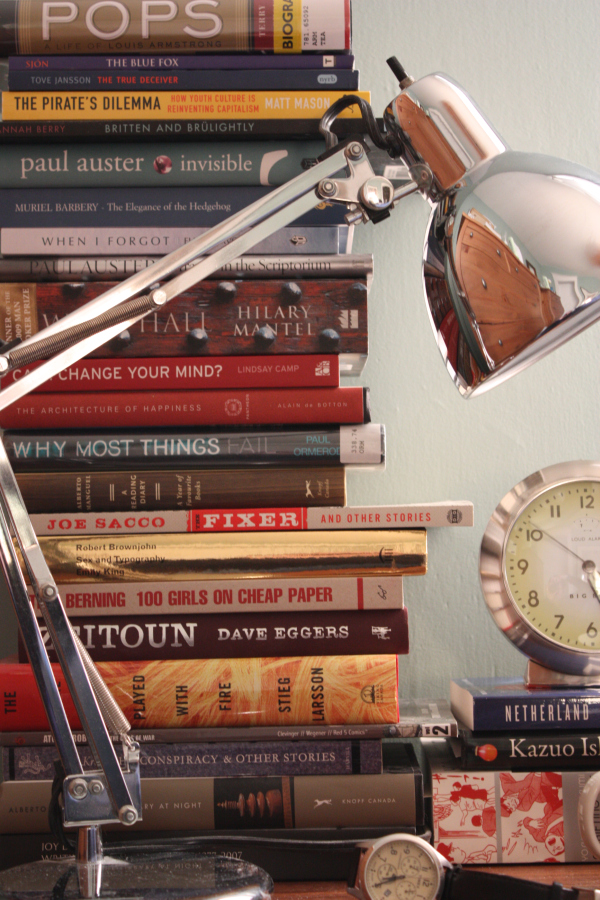
The nice folks at The Silver Liningblog — consistently one of my favourite blogs for vintage design goodness — were kind enough to ask me for a contribution to their ‘Top 5’ feature last month, and so, as of today, the top 5 books beside my bed are online for everyone to see.
I actually just finished reading Pops at the weekend, but there is no guarantee that I will read the rest in that order — the list really is just a happy accident of stacking. You you can read more about each of the selections in the post at The Silver Lining.
Every book alights a path to other books. Follow these paths as far as you can.
Lovely.
Back to Basics — Booktwo.org‘s James Bridle on the Apple tablet (what else?):
I’ve spent several years urging publishers to get on board with new technologies and try new things, but equally I hope there’s space for a lot of publishers to get back to concentrating on what they do best: acquiring, editing, producing and publishing books… [W]e should probably stop scrambling to get on the latest bandwagon (vanilla Books-as-Apps, I’m looking at you), and concentrate on the basics: ebook production, metadata, integrated marketing, quality and consideration. There is a lot to be done, but this or that device will never be the be-all-and-end-all of the future of publishing.
I think James has a point. But honestly, no one I know (and that is an admittedly limited sample) believes “this-or-that device” will magically “save” publishing. Surely it is only bloggers in need of straw men and ‘journalists’ paid to hyperventilate who say that kind of shit?
The War of the Worlds is one of those books that demonstrates our culture’s surprising ability to continue the manufacture of myth. I say surprising, because one would think, with all the technological reproducibility of art now at our disposal — from raw print, to film, to digitisation — that there would be no room left for that hazy instability within which myth thrives.
(Pictured above: The NYRB edition of The War of the Worlds with illustrations by Edward Gorey)
 Little Nemo meets David Lynch — Mark Medley interviews Charles Burns, author of Black Hole and X’ed Out , for The National Post:
 Limits and Boundaries
 Talking About My Generation


 Photographer
  Psycho Cover

 Real Editors Ship