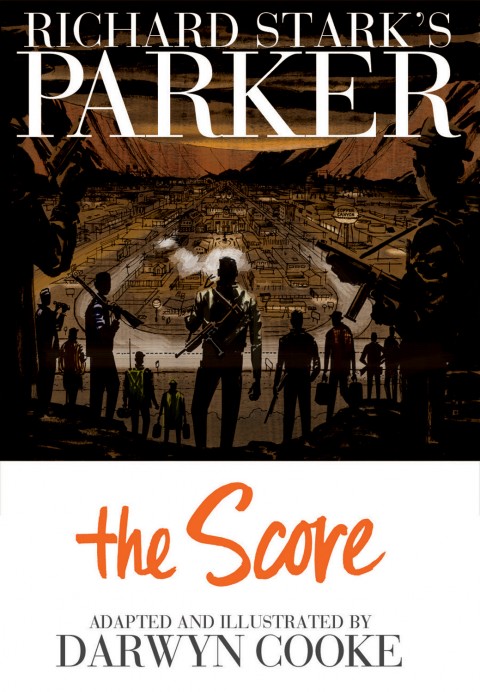
 A long interview with Darwyn Cooke about his latest Donald Westlake/Richard Stark adaptation, The Score (out this week if you’re interested).
Shadows and Fog — Jimmy Stamp on Batman and architecture, for ArchDaily:
Since its inception, Gotham City has been presented as the embodiment of the urban fears that helped give rise to the American suburbs, the safe havens from the city that they are. Gotham City has always been a dark place, full of steam and rats and crime. A city of graveyards and gargoyles; alleys and asylums. Gotham is a nightmare, a distorted metropolis that corrupts the souls of good men. In the excellent book, Woody Allen on Woody Allen, the famously nebbish auteur discusses his moody, Brechtian comedy Shadows and Fog, which takes place over the course of a single night in a vaguely European village. “Once you get out in the night, there is a sense that civilization is gone…You start to realize that the city is just a superimposed man-made convention… All the civilization that protects you and enables you to lie to yourself about life is all man-made and superimposed.”
In other words, civilization ends at night. And in Gotham City, it is always night.
Home of the Free — Mark Lamster on the role of the modern library, for Metropolis magazine:
The pressure to accommodate “other needs” is especially strong at public libraries, which are increasingly taking on civic functions that far exceed the historical mission of serving books to readers. “Libraries are the new cathedrals of our society. They’re very important sanctuaries,” says the architect Bing Thom, whose new public library in Surrey, British Columbia, a suburb of Vancouver, was designed as a space of communal engagement. “People are living in smaller and smaller spaces, so the library becomes the place you escape to for socialization, for solitude, to take a breath. It’s the last space in society that’s free. Even for the homeless. There is a sense of democracy; it is a common space we all share.”
The Worm Eaten Book — Jennifer Schuessler visits the summer Rare Book School at University of Virginia in Charlottesville, for The New York Times:
Rare Book School isn’t just about pondering jaw-dropping masterpieces of printing. What makes the experience unique, students say, is the chance to see — and touch — a huge variety of objects from the school’s own 80,000-item teaching collection, including many that have been folded, stained, waterlogged, written in, worm-eaten or sometimes completely disemboweled.
And finally…
Filthy Lucre — Tim Parks on the complicated relationship between money and writing, for the NYRB:
Writers can deal with a modest income if they feel they are writing toward a body of readers who are aware of their work and buy enough of it to keep the publisher happy. But the nature of contemporary globalization, with its tendency to unify markets for literature, is such that local literary communities are beginning to weaken, while the divide between those selling vast quantities of books worldwide and those selling very few and mainly on home territory is growing all the time.
Like this:
Like Loading...