
Following on from my post yesterday, Joe Sacco talks about his new book The Great War with Michael Silverblatt on Bookworm:
KCRW Bookworm: Joe Sacco The Great War mp3
Comments closedBooks, Design and Culture
Following on from my post yesterday, Joe Sacco talks about his new book The Great War with Michael Silverblatt on Bookworm:
KCRW Bookworm: Joe Sacco The Great War mp3
Comments closedI didn’t know that influential German artist Kurt Schwitters spent the last years of his life in exile in England’s Lake District creating something called the ‘Merz Barn’. Did you?

Schwitters started constructing the original ‘Merzbau’ (pictured above) inside his Hannover studio in the 1920’s and continued to work on it until he fled Nazi Germany in 1937. The Merzbau itself was later destroyed in an Allied bombing raid in World War II.
The uncompleted ‘Merz Barn’ that Schwitters began building near Elterwater in the Lake District is much less well-known. The latest TateShots video visits this only surviving example of Schwitters’ Merz environment:
(I’m not entirely sure how or why radio presenter Tom Ravenscroft (son of the late John Peel) is involved, but if you don’t listen to his weekly music show on BBC, you should probably take a listen… if you like that sort of thing.)
1 Comment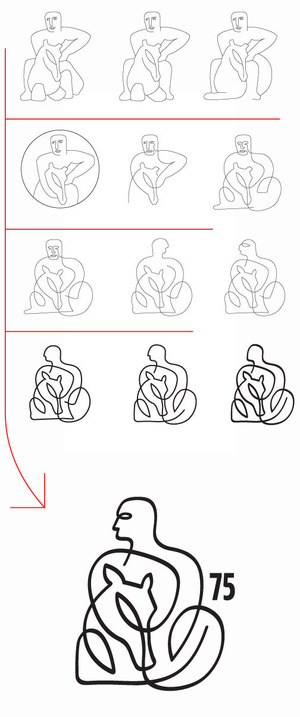
 New Directions celebrates its 75th anniversary in 2011 and to mark the occasion, creative director at large Rodrigo Corral commissioned illustrator Felix Sockwell to redesign their iconic colophon by Heinz Henghes. Sockwell writes about the redesign process (and vomiting!) here (via MobyLives).
Drowned in Sound — You have a few days left to listen to the BBC Radio adaptation of J.G. Ballard’s The Drowned World.
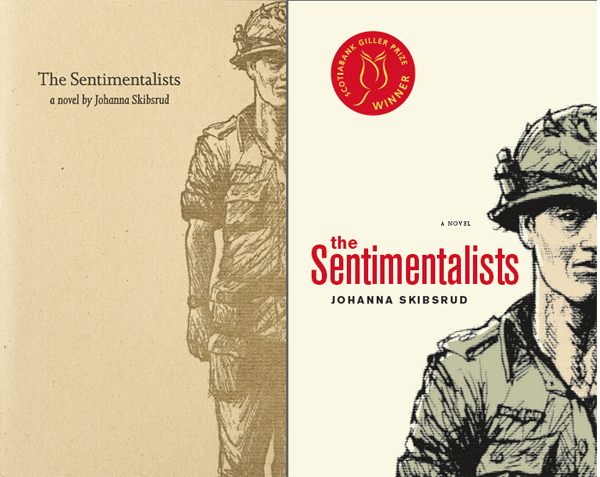
Rewiring — Peter Cocking, art director at Douglas & McIntyre, on designing a new cover for Johanna Skibsrud’s debut novel The Sentimentalists, winner of the Giller Prize and first published by artisan publisher Gaspereau Press:
I felt that the existing cover was to some extent a brand for the book — it appeared in the media quite a bit. It’s different from what we would do in that it’s — and I mean no disrespect to Andrew [Steeves, co-publisher of Gaspereau Press] — but it’s a more literary small-press treatment. It’s very appropriate to the way they publish the book, but it was clear, of course, that we were going to try and push this out into the marketplace in a much wider way. So it seemed to me that the idea was to take what they had, because people might remember this as the cream-yellow book with the solider, and make it a little more contemporary, trade-friendly, a little more aggressive as it were. It wasn’t so much a design from scratch, the way I would normally approach a novel. The way I would describe it is I didn’t build the house, I repainted it, did some new wiring.
And finally…
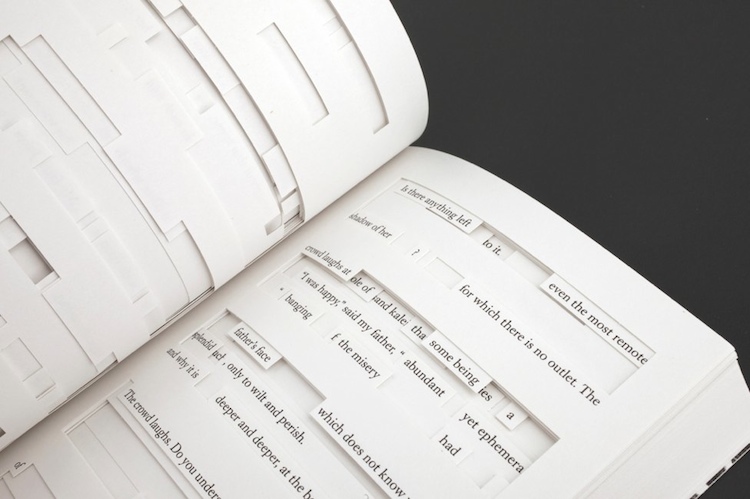

 Bespoke — Richard Weston, AKA Ace Jet 170, on the book designs for the soon-to-be-launched Bespoke Editions:
Bespoke Editions is a one-off edition press; offering beautiful custom-made classic books, printed on demand and hand-finished to order. Personalised and unique, each edition will be made using specially selected cover papers and finishes… The editions will be in a Demy format and the page layouts will be based on the Van de Graaf Canon. After a set of tests, we’ve settled on the beautiful Hoefler Text for the typesetting and each title page will feature a carefully chosen typographic ornament that has some relevance to the particular book.
All Programs Considered — Bill McKibben on the new public radio for The New York Review of Books (via the always astute Edward Nawotka at Publishing Perspectives):
[I]n one sense this is the perfect moment to be a young radiohead. It’s like 1960s and 1970s cinema, with auteurs rewriting the rules. New technology lets you make radio programs cheaply: Pro Tools sound-editing software has now replaced much of the equipment used in big, expensive studios. Listening is even cheaper: the iTunes store has thousands of podcasts… available for free download in a matter of seconds. “It’s a transformative and exciting moment, a huge revolution,” says Sue Schardt, executive director of the Association of Independents in Radio.
But there’s one problem, and that’s the economics of this new world. Radio is now cheap to make, true, but the people who make it still need to live. And it’s very hard to get paid anything at all…
Sounds awfully familiar…

 The beautiful Ligature Loop and Stem poster at For Print Only:
Aside from being a purely creative outlet devoid of typical restrictions… one of the goals for anything produced under the Ligature, Loop & Stem moniker is that it educates as well as inspires. This piece scratched an itch for us in wanting to have a quick reference for letterform characteristics — in essence, so we can all speak the same language when talking about type.
A Pointy Tool — David Carr talks to the founders of The Awl for The New York Times (via Kottke):
“My friends keep talking to me about how they want to start a Web site, but they need to get some backing, and I look at them and ask them what they are waiting for,” Mr. Sicha said. “All it takes is some WordPress and a lot of typing. Sure, I went broke trying to start it, it trashed my life and I work all the time, but other than that, it wasn’t that hard to figure out.”
And finally…
 Tintin Gets Scalped — An annotated page from Charles Burn’s new graphic novel X’ed Out at New York Magazine (via Bookslut):
Comments closedNitnit’s name—and shock of hair—betray his origins. “Golden Books put out six of the Tintin books in English. This was before I could read, but I was looking at them very carefully. The books’ endpapers were filled with images from other Tintin stories that hadn’t been translated. I studied these endlessly. There was a little sentence on the back of each book that said, ‘Look for future titles.’ I kept looking but they never came.”
Latest WYNC RadioLab podcast is all about words, and filmmakers Will Hoffman and Daniel Mercadante have made a beautiful video about wordplay and visual connections to accompany the episode:
2 Comments