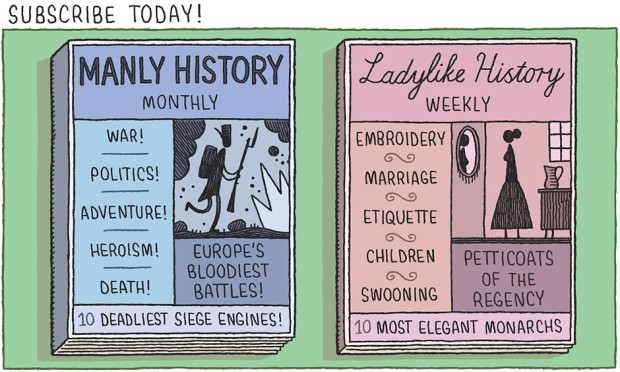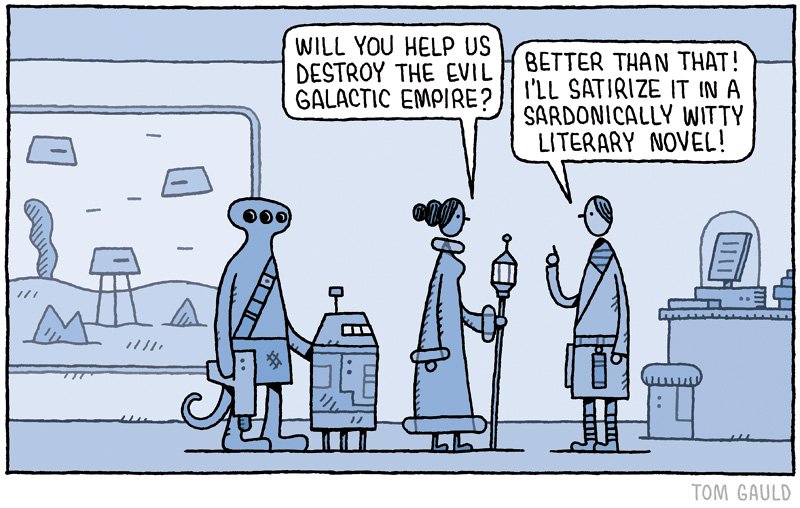
Tom Gauld for The Guardian.
(I’m working on my sardonically witty literary novel as we speak.)
Comments closedBooks, Design and Culture
Tom Gauld for The Guardian.
(I’m working on my sardonically witty literary novel as we speak.)
Comments closed
At the New York Times, Julie Bosman looks at how American bookstores have become hubs of resistance:
Comments closedPolitical organizing is perhaps a natural extension of what bookstores have done for centuries: foster discussion, provide access to history and literature, host writers and intellectuals.
“All bookstores are mission-driven to some degree — their mission is to inspire and inform, and educate if possible,” said Elaine Katzenberger, publisher and executive director of City Lights in San Francisco, a store with a long history of left-wing activism.
“When Trump was elected, everyone was just walking around saying: ‘What do I do. What do we do?’” she added. “One of the places you might find some answers is in books, in histories, in current events, even poetry.”

The dystopia described in George Orwell’s nearly 70-year-old novel “1984” suddenly feels all too familiar. A world in which Big Brother (or maybe the National Security Agency) is always listening in, and high-tech devices can eavesdrop in people’s homes. (Hey, Alexa, what’s up?) A world of endless war, where fear and hate are drummed up against foreigners, and movies show boatloads of refugees dying at sea. A world in which the government insists that reality is not “something objective, external, existing in its own right” — but rather, “whatever the Party holds to be truth is truth.”
“1984” shot to No. 1 on Amazon’s best-seller list this week, after Kellyanne Conway, an adviser to President Trump, described demonstrable falsehoods told by the White House press secretary Sean Spicer — regarding the size of inaugural crowds — as “alternative facts.” It was a phrase chillingly reminiscent, for many readers, of the Ministry of Truth’s efforts in “1984” at “reality control.” To Big Brother and the Party, Orwell wrote, “the very existence of external reality was tacitly denied by their philosophy. The heresy of heresies was common sense.” Regardless of the facts, “Big Brother is omnipotent” and “the Party is infallible.”
Michiko Kakutani, New York Times
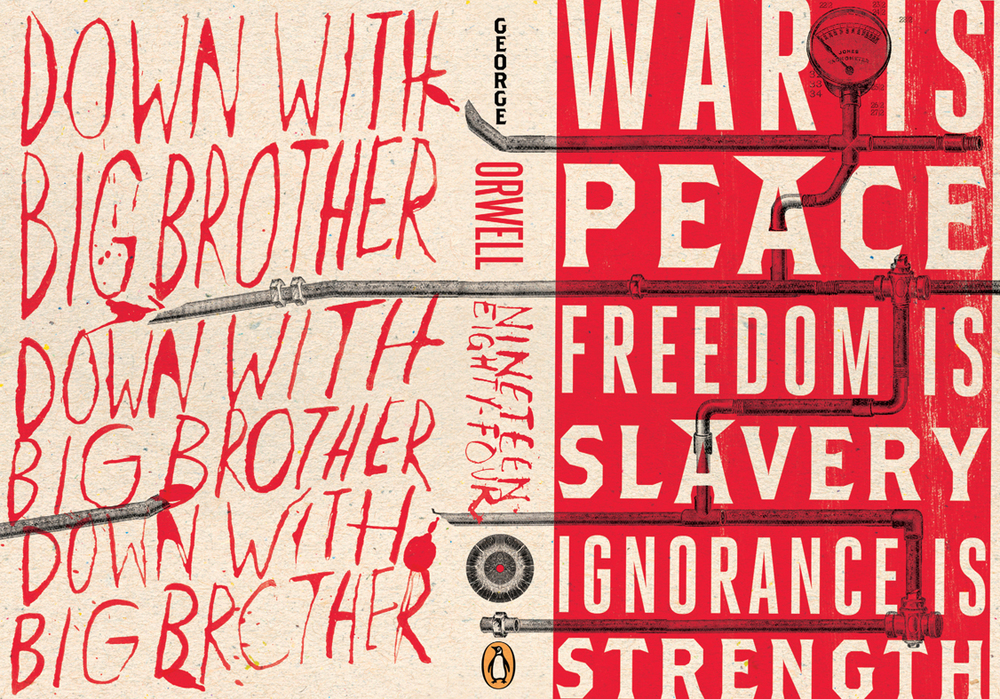
As Nineteen Eighty-Four is suddenly more relevant than ever, I thought I would share a few of the recent covers for Orwell’s classic novel…




2 Comments

I have to confess that I haven’t seen the TV adaptation of Philip K. Dick’s The Man in the High Castle, but I found Aaron Bady’s discussion of the series — and how it differs from the book — at The New Yorker, quite interesting:
In another year, the show’s insistence on humanizing fascists might have seemed like a provocative choice—an effort, like Arendt’s, to understand how normal people can find it in themselves to commit the worst atrocities. In 2017, however—when it is more urgent than ever to distinguish right from wrong, real news from fake, and differences of political opinion from the dangerous undermining of democracy—it feels instead like a pernicious cynicism. At the same time, the series depicts the ideological excesses of the Resistance in the most unforgiving light. More like Al Qaeda than French partisans of the nineteen-forties, they are grim, unsympathetic zealots, who use scattershot terror tactics and have no qualms about causing the suffering of innocent bystanders…
…This nihilism would have been alien to Philip K. Dick… Dick’s “The Man in the High Castle” focussed on how everyday people struggle to carve out lives of integrity in the face of evil, even while knowing—perhaps especially while knowing—that their actions will not ultimately change the course of history. In the novel, Frank Frink’s primary struggle is how to be an artist, not how to overthrow the Reich. In Dick’s view, this, too, was a form of resistance: his major theme as a novelist was the unavoidable complicity of living “normally” under empire; he believed in evil because he saw it everywhere. But if there wasn’t much hope in Dick’s fiction, that was exactly the point of writing it: even in the midst of a triumphant fascist dystopia, the quest for intellectual autonomy lived on in the dissident imaginations of those who could envision a different kind of world. It is telling, too, that the “man in the high castle” was in Dick’s novel not a collector of film reels but a novelist—an eccentric inventor of alt-histories who served as a stand-in for Dick himself. The character was, above all, a tribute to artists who dare to resist power in dark times.
The cover of the Penguin Modern Classic edition (pictured above) was design by Jim Stoddart.
Comments closedThe New York Times has published a transcript of Michiko Kakutani’s recent conversation with US President Barak Obama about books:
Some of the craft of writing a good speech is identical to any other good writing: Is that word necessary? Is it the right word? Is there a rhythm to it that feels good? How does it sound aloud?
I actually think that one of the useful things about speechwriting is reminding yourself that the original words are spoken, and that there is a sound, a feel to words that, even if you’re reading silently, transmits itself.
So in that sense, I think there will be some consistency.
But this is part of why it was important to pick up the occasional novel during the presidency, because most of my reading every day was briefing books and memos and proposals. And so working that very analytical side of the brain all the time sometimes meant you lost track of not just the poetry of fiction, but also the depth of fiction.
Fiction was useful as a reminder of the truths under the surface of what we argue about every day and was a way of seeing and hearing the voices, the multitudes of this country.
You can read the article that resulted from this conversation here.
Surely there are few other politicians — let alone world leaders — who could speak so intelligently and at such length about contemporary literature.

And, on a somewhat related note, I just wanted to mention the Women’s March on Washington on January 21. The official logo for march — reminiscent (in a good way) of Saul Bass’s 1978 logo for the Girl Scouts of America (revamped in 2010 by Original Champions of Design) — was designed by Nicole LaRue. There are sister marches around the world — find your local event here — and you can download typographic posters for occasion from Counter Type.

Resist.
Comments closed
In an excerpt from his new book, Mindless: Why Smarter Machines Are Making Dumber Humans, Simon Head compares the labour practices of Amazon and Walmart:
Amazon equals Walmart in the use of monitoring technologies to track the minute-by-minute movements and performance of employees and in settings that go beyond the assembly line to include their movement between loading and unloading docks, between packing and unpacking stations, and to and from the miles of shelving at what Amazon calls its “fulfillment centers”—gigantic warehouses where goods ordered by Amazon’s online customers are sent by manufacturers and wholesalers, there to be shelved, packaged, and sent out again to the Amazon customer…
…With Walmart’s and Amazon’s business model, the workplace practices that raise employee productivity to very high levels also keep employees off balance and thus ill placed to secure wage increases that match their increased output. The “cult of the customer” preached by both corporations is a scented smoke screen thrown up to hide this fact. Apart from the model’s intensive use of IT, there is not much to distinguish its methods from those of the primitive American and European capitalism of the late nineteenth and early twentieth centuries.
UPDATE: George Packer, continuing his series about Amazon, touches upon a similar topic in a new post for The New Yorker:
Comments closed[T]hese companies are everywhere and nowhere, ubiquitous in our lives but with no physical presence or human face. They are regarded by many users as public resources, not private corporations—there for us—and their own rhetoric furthers this misperception: Facebook’s quest for a “more open and connected world”; Google’s motto, “Don’t be evil,” and its stated mission to “organize the world’s information and make it universally accessible and useful”; Amazon’s ambition to become “Earth’s most customer-centric company.” Because these endeavors seem to involve no human beings, no workers, other than ourselves—the supposed recipients of all the benefits—it takes an effort to realize that the tech economy is man-made, and that, as with the economies that preceded it, human beings have the capacity to shape and reform it for the public good. It would be easier to remember this if every time you clicked “BUY,” searched for an article, or texted a friend your screen flashed the face of a worker who once held a job that made way for your seamless online experience.

Leo Braudy, author of Trying to Be Cool: Growing Up in the 1950s, on the late Pete Seeger and the Coen brothers’ film Inside Llewyn Davis, at the LA Review of Books:
Comments closedLlewyn is the solitary fame seeker, doomed to be disappointed. Perhaps the Coens think he needs a brother to accompany him or be his manager, rather than his critical sister? Always he sings alone… and glares when the audience or even a friend tries to join in. For a story about the folk scene of the 1950s, there is little sense of the unconfined energies of the period, the sense of bonding and belonging that someone like Seeger, Dave Van Ronk, Ramblin’ Jack Elliott, Joan Baez, Phil Ochs, or a host of others could elicit in their audiences. Nor is there anything in Inside Llewyn Davis about the politics that the folk movement wore so explicitly on its sleeve.
Pete Seeger was nothing like Llewyn Davis. He was an emissary from the Popular Front of the 1930s, when leftwing politics was merged with American history and ideals through theater, art, and song. He had a long, rich life, long enough to see changes in American culture unimaginable in the 1950s, and he kept singing. And we, whenever we weren’t too cool to do so, sang along with him.

photo: Leo Williams
Alan Moore discusses his short films, crowd-funding, the Occupy movement, The Prisoner, and zombies (amongst other things) at Salon:
While the revolution will be certainly televised, it strikes me that there is a strong possibility that the revolution will also be crowd-funded. If Kickstarter and other enterprises are giving projects like Occupy Comics a chance, then it does suggest there are imaginative ideas out there with incredible use and application across the board. Not just in the arts, but in the sciences as well. It’s an exciting concept, and I look forward to seeing what emerges from it.

Moore talks more about his Lynchian short film Jimmy’s End — created with Mitch Jenkins — in this short ‘behind-the-scenes’ documentary for Motherboard TV (worth watching just for the interior of the actual Jimmy’s End Working Men’s Club around the 10 minute mark):
He also discusses crowd-funding and ‘The Jimmy’s End Cycle’ of films — the last of which, Heavy Heart, you can still support on Kickstarter — in an interview with Bleeding Cool from earlier this month.
Comments closed
Since I was an infant, I have feared my father’s den. Based on its ancient relics and mass clutter, I have since referred to the location as “Steven Heller’s Cave.”
Steven Heller’s son Nicolas (A.K.A. Ricky Shabazz) has made short video about the apartment where his father stores some of his more controversial design artifacts and ephemera:
Bonkers.
Comments closed
An astonishing short film for what looks to be a very important book:
Ian Cobain’s exposure of Britain’s secret history of torture Cruel Britannia is published by Portobello Books. The starkly brilliant cover (on which the video is based) was designed by FUEL.
Comments closedLess Shit Please — A great article on British political cartoonists by Helen Lewis for The New Statesman:
[Martin] Rowson tells me that his fellow Guardian cartoonist Steve Bell always files as late as possible to make the staff grateful that the picture has arrived at all. “There’s a wonderful story about Georgina Henry, when she was deputy editor, going past the comment desk at about eight o’clock one evening and Steve’s cartoon had just come in,” he says. “It was a wonderful one of [George W] Bush as a monkey, squatting on the side of a broken toilet, wiping his arse with the UN Charter. And there’s all this shit splattered on the wall behind it, and she looks and says, ‘Oh God, no.’ [Alan] Rusbridger had put down this edict saying less shit in the cartoons, please – you know, the editor’s prerogative – and she and Steve had this eyeball-to-eyeball confrontation.” What happened? “He finally caved in. In one of the greatest betrayals of freedom of speech since Galileo, he tippexed out three of the turds.”
Holding On — An interview with Francis Ford Coppola at The Rumpus:
when I wanted to do Apocalypse Now, no one would do it. I couldn’t believe it. I was so disgruntled that I had played by their rules and won, yet they still didn’t want to make it. So I just went on myself, and took all the money and property I had, went to the bank, and made Apocalypse Nowmyself. When it came out it was very dicey. People didn’t know what to make of it; it got bad reviews. My films have always gotten a lot of bad reviews. I was very scared that I was going to be wiped out because the Chase Manhattan Bank had all my stuff. I decided I would make a movie that would be very commercial. Every time I’ve tried to do something commercial it’s always failed. So I made One From The Heart.
And what happened was that Apocalypse Now, little by little, started to be a big success and thought of as a classic, a great movie. But by then I was already making One From The Heart and that was a big flop and I lost everything. So from age forty to age fifty I just had to pay the Chase Manhattan Bank all that money, and I just barely ended up holding onto everything. So ironically, the thing I did to solve the problem ended up causing a problem.
Coming or Going? — Tim Parks on the unevenness of globalization for the NYRB Blog:
To what community does a writer belong today? The whole world, might seem to be the obvious answer in an era of globalization. Alas, it’s not that simple… I am known in England mainly for light, though hopefully thoughtful non-fiction; in Italy for polemical newspaper articles and a controversial book about soccer; in Germany, Holland, and France, for what I consider my “serious” novels Europa, Destiny, Cleaver; in the USA for literary criticism; and in a smattering of other countries, but also in various academic communities, for my translations and writing on translation. Occasionally I receive emails that ask, “But are you also the Tim Parks who…?,” Frequently readers get my nationality wrong. They don’t seem to know where I’m coming from or headed to.
And finally…
A new excerpt from Linotype: The Film, which will finally be released in mid-October apparently…
Comments closed