Hip Flask — An interesting interview with the folks behind 48 Hour Magazineat Gizmodo. There’s some great stuff in the piece, and it’s worth reading from beginning to end, but I particularly liked this insight from Derek Powazek (founder of Fray, co-founder of JPG Magazine, and consultant at MagCloud*):
Print is, at some point, done. However imperfect. It has a rhythm of creation, editing, and publishing. And when it’s done, everyone involved can sit back, look at the thing we made, and feel accomplished.
The web is never done. It’s in a constant state of flux. That’s not good or bad, it just is.
Powazek is also the guy behind Strange Light a print-on-demand magazine that collected photographs of the Australian dust storm that covered New South Wales and Queensland in September last year. He has interesting post about the creation of the magazine on his blog.
No. — A Tumblr that’s apparently devoted to found-type numerals.
The Alcuin Society announced the 2008 Awards for Excellence in Book Design in Canada this week. Utopia/Dystopia by Geoffrey James, designed by George Vaitkunas, published by Douglas & McIntyre, (pictured above) won first prize in the pictorial category. A full list of the winners is available here (PDF).
The Hidden Revolution — Inside Higher Ed discusses an article (sadly not available online) by Sandy Thatcher, director of the Penn State University Press, about digital publishing at university presses:
Thatcher’s argument, in brief, is that the peculiar challenges faced by university presses have given them an incentive to use digital resources in ways that put them somewhat ahead of their peers in the world of trade or mass-market publishing. Given the small market for most scholarly titles, academic publishers were in a unique position to benefit from short-run digital publishing (SRDP) and print-on-demand (POD) technologies.
Charting the evolution of each grid, from the Paleolithic brick of ancient Mesopotamia through the virtual connections of the Internet, Higgins demonstrates that once a grid is invented, it may bend, crumble, or shatter, but its organizing principle never disappears.
The Need for Balance — Novelist Victoria Strauss at Writer Beware on fatuous articles about self-publishing:
For most writers… the path of self-publishing offers substantial downsides and pitfalls… and successes… remain few and far between. These hard facts are way less sexy than the vision of a brave new technological world that makes it possible for (a few) authors to bypass the traditional route to success–but they are no less real. In my opinion, journalists who write about this issue have a responsibility to cover both sides.
Publishers Weekly is reporting that following “one of publishing’s bleakest weeks” in living memory, there’s a reason for us to keep on living in the form of two recent digital announcements from Penguin and Random House.
Penguin have launched Penguin 2.0 which includes more online content, e-books and POD, as well as an app imaginatively called ‘Penguin Mobile’ which makes the features from Penguin’s website available on the iPhone.
In the meantime, Random House have announced a partnership with Stanza “the popular iPhone e-book reader from Lexcycle” that will make e-books by several RH authors available for free on the platform. According to the press release, the books available “will be drawn from each author’s backlist and will include excerpts for any new hardcovers coming in 2009.”
I have to say I was really surprised how much I like e-books on the iPhone. But what does this mean for single-purpose devices like Sony’s e-Reader and Amazon’s Kindle?
“We’re from Kodak, Apple, Google, Yahoo”: The Guardian profiles Blurb — a publishing company with nobody from mainstream publishing — that specialises in high-quality, print-on-demand, photography books. Very, very, cool.
Good news and bad news for online retailers: Statcan found that more Canadians are shopping on the internet, placing almost $12.8 billion worth of orders in 2007, up 61% from 2005. ComScore, on the other hand, have just released their monthly retail e-commerce sales estimates, showing that online spending in October 2008 grew by only 1 percent over October 2007–the lowest monthly growth rate since they began tracking e-commerce in 2001.
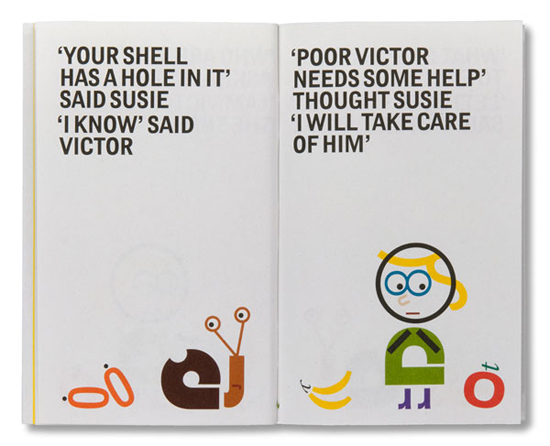
Victor & Susie: A brightly coloured “children’s book for adults” about Susie and Victor the snail, all drawn with letters and punctuation marks, published by Brighten The Corners (pictured). (via drawn)
“A kind of slow-motion suicide”: David Carr’s column for the New York Times looks at why firing their the most talented, experienced employees to cut costs backfired for Circuit City and will do the same for newspapers too:
“Right now, the consumer has all manner of text to choose from on platforms that range from a cellphone to broadsheet. The critical point of difference journalism offers is that it can reduce the signal-to-noise ratio and provide trusted, branded information. That will be a business into the future, perhaps less paper-bound and smaller, but a very real business.”
My take on this for book publishers (as it normally is): Publish less, publish better — quality matters. (via reveries)
Reidy said she hesitated to use the word “crisis” but “there is no question that we are currently dealing with a set of problems that will test us to our limits.” Critical issues facing publishers included: significant decrease in retail traffic, less consumer purchasing, a gloomy economic forecast, declining backlist sales, brand name authors continuing to sell but “everything else is far off normal levels,” and retail partners who demand more favorable terms and concessions “as if we are the answer to their problems,” she said. Other pre-existing problems she enumerated include retailers competing with publishers, low barriers to self-publishing, and the economics of digital publishing that appear to bring in less revenue.”
Tough times indeed, but it is not quite the end of the world apparently. Although publishers must adapt to new realities, and change business practices, the current situation is an opportunity rather than a threat:
“now we have the chance to actually find the reader where they are spending their time—in front of a screen—and cement a relationship with them through e-mail newsletters, viral marketing, mobile delivery and other tools.” Publishing survives, she noted, because readers have a fundamental need for information, inspiration, and entertainment, “and they get that in a book, directly from an author, in an unfiltered way that they cannot get from any other medium.”
Notably, Reidy urges publishers to make entire catalogues available as e-books and to create adopt print-on-demand when a title’s sales begin to slow.
James Bridle of booktwo.org puts his money where his mouth is and launches the entirely print-on-demand, web-based publisher Bookkake: “Bookkake is a project born… of my desire to see publishing move with technology and survive as the guardian and helpmate of literature.”
Faber Books’ on Flickr: “We’re gradually uploading some of our favourite covers, photos and various other ephemera from our archive. Our archivist uncovers new material every day – we hope you enjoy his discoveries as much as we do!”
Five Ways Amazon Can Improve the Kindle from Gadget Lab on Wired.com: “The rumblings in the ground are pointing to an imminent Kindle 2.0, a successor to Amazon’s loved but flawed e-book reader.” Lots and lots of comments. (Is planned obsolescence going to be a problem for the e-book reader in the long-term? Anyone?)
The Muxtape story – or how the music industry is conspiring to alienate fans and kill itself? There’s almost certainly a lesson for the book industry in there somewhere…