Skip to content

Tag: picture books

Slightly Spooky Tale of Fox and Mole by Cecilia Heikkilä

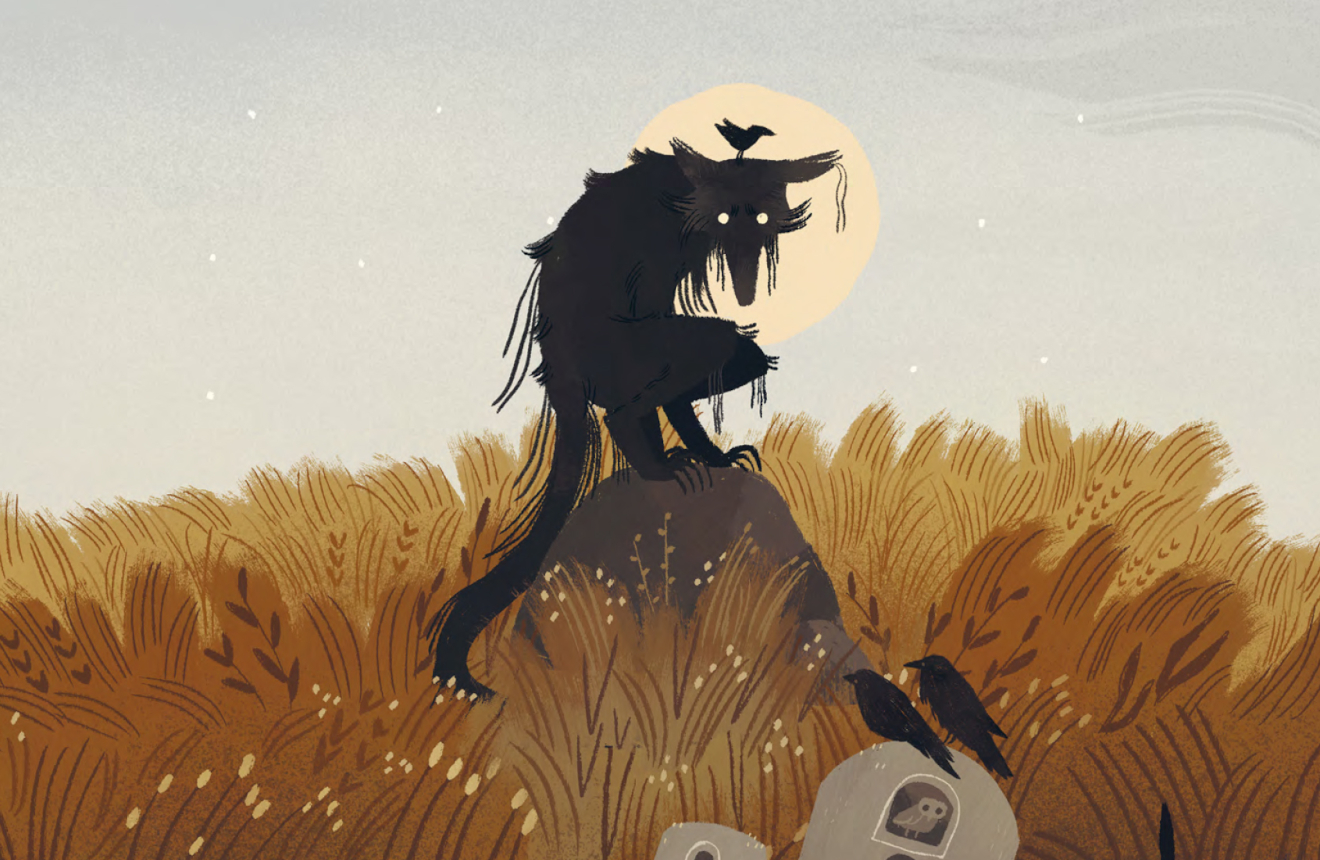
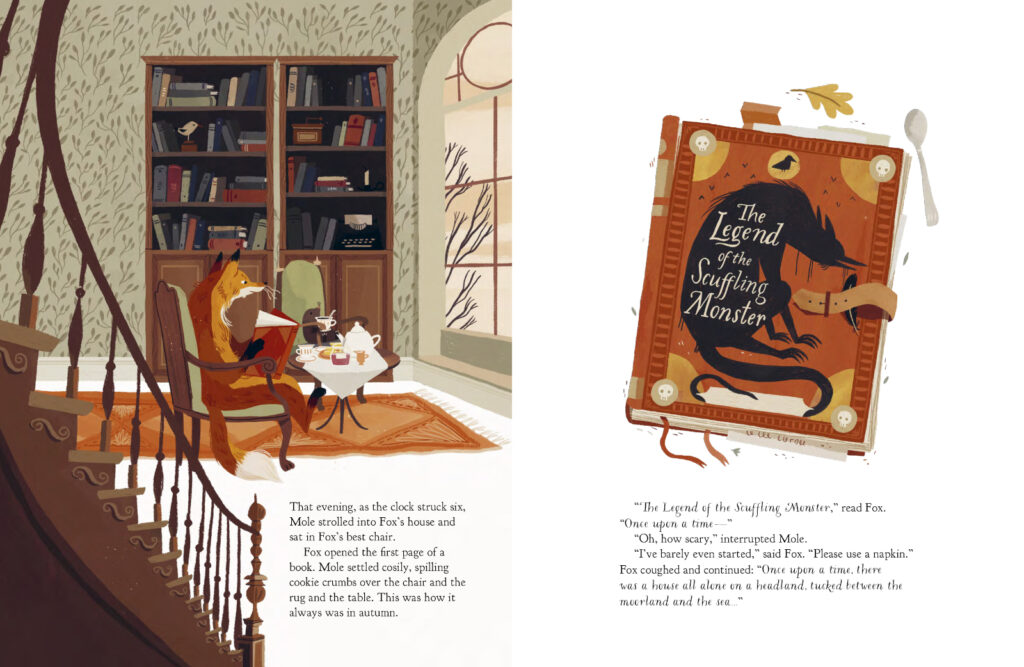
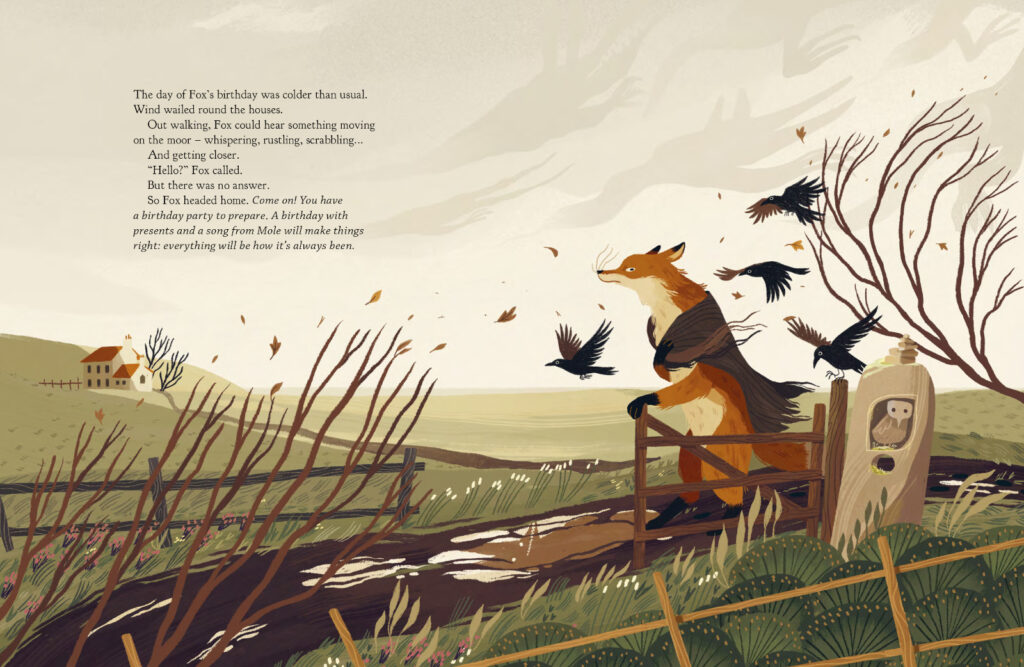
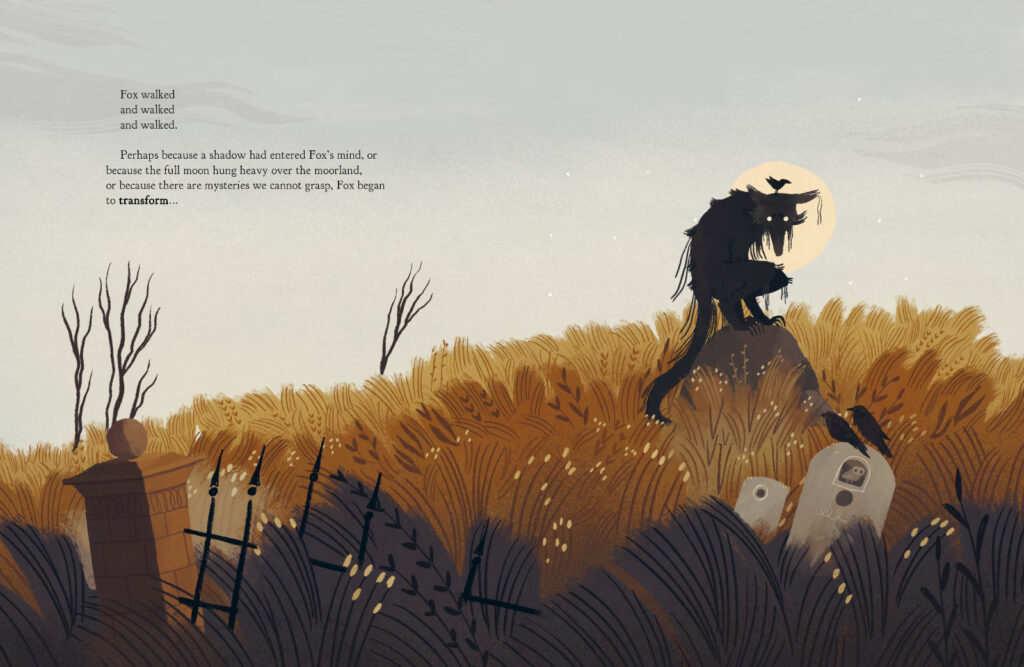
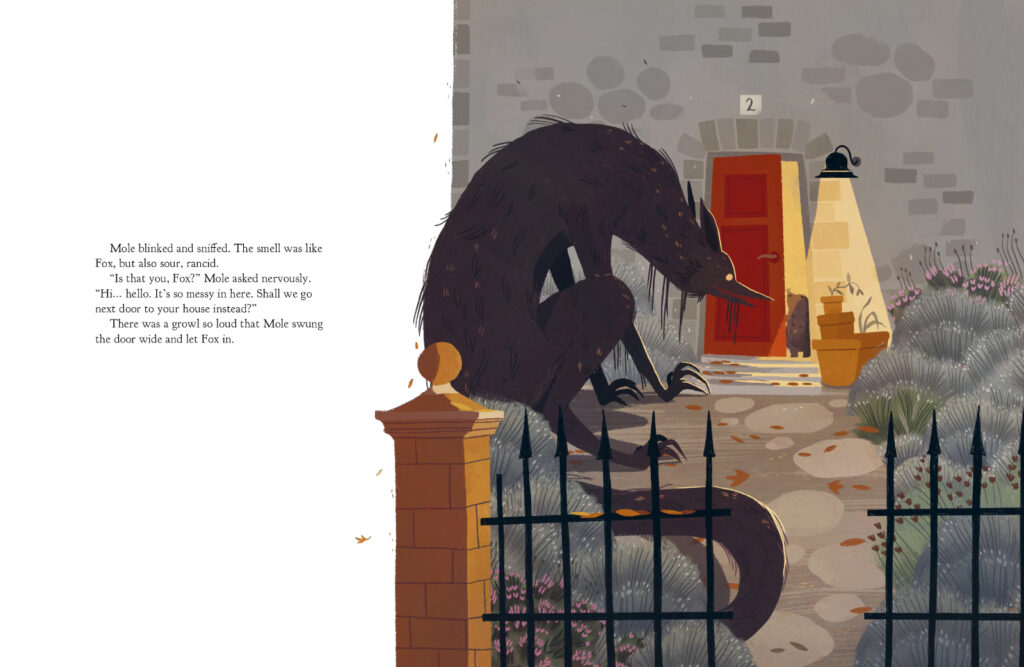
I don’t post a lot of picture books here, but seeing how it’s spooky season, I thought I would mention The Slightly Spooky Tale of Fox and Mole by Swedish illustrator Cecilia Heikkilä, published by Floris Books, which just landed on my desk at work. It’s an appropriately autumnal and windswept story about a dark and scuffling monster that emerges from the moor after Mole takes his friendship with his neighbour Fox for granted. As you can see below, the illustrations are wonderful and although things get a little scary in the middle, it all works out in the end.

Leave a Comment

The Skull by Jon Klassen

Author and illustrator Jon Klassen recently announced that his new book The Skull will be available from Candlewick Press in July, 2023. A whopping 115 pages, and based on a folktale Klassen read in a library before an event in Alaska (a great story in itself!), it tells the tale of a girl who runs away from home and befriends a talking skull she finds alone in a house in the woods. It is as spooky and macabre as it sounds, and totally worth the wait!

Jon Klassen’s latest book with Mac Barnett, The Three Billy Goats Gruff, was published this month.

Comments closed

The Little Wooden Robot and the Log Princess

Tom Gauld’s first picture book for children, The Little Wooden Robot and the Log Princess, is out this month! According to the publisher blurb, the book is inspired by a bedtime story he made up for his daughters:

“I was trying to make a book inspired by three different sets of books: The books that I remember enjoying as a child, the books that I watched my daughters enjoying, and the books I enjoy now as an adult. I wanted the book to have its own quirky feeling but also to function like a classic bedtime story.”

It looks wonderful.

Comments closed

Make Meatballs Sing: The Life and Art of Corita Kent

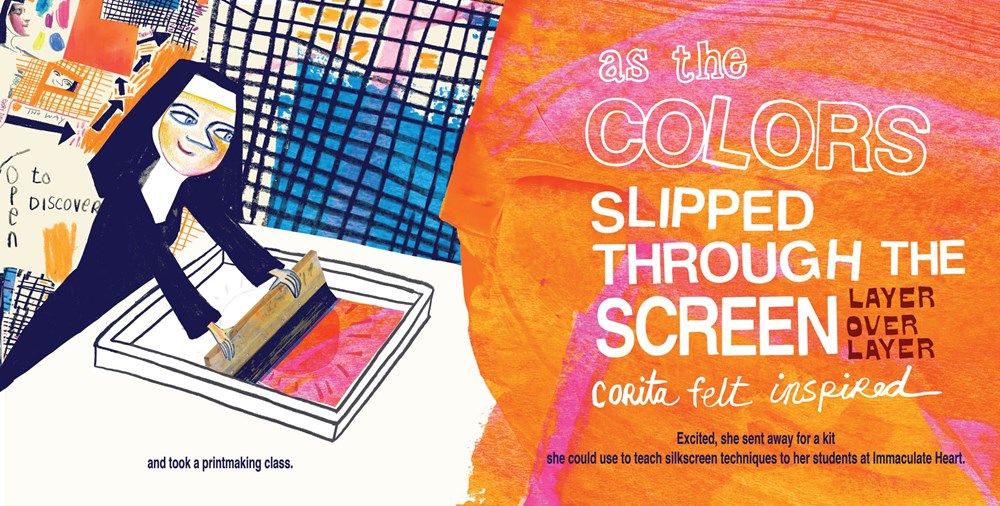
Available this month from Brooklyn-based independent children’s book publisher Enchanted Lion, Make Meatballs Sing by Matthew Burgess and illustrated by Kara Kramer is a new picture book about the life and work of the innovative and unconventional artist, educator and social justice advocate Corita Kent (1918–1986).

Matthew Burgess is the author of Enormous Smallness: A Story of E. E. Cummings, illustrated by Kris Di Giacomo, and last year’s Drawing on Walls: A Story of Keith Haring, illustrated by Josh Cochran, also available from Enchanted Lion.

Comments closed

The Open Book by Bob Staake


A young reader goes on an adventure in this charming wordless comic by Bob Staake for the New York Times.

Publishers Weekly recently posted an interview with Staake about his new book, Bluebird, which is also wordless:

I love writing visually, and wordlessly, because this is was how I read books as a kid. I didn’t really read, but I was a voracious page turner. Nothing would delight me more than pulling out old National Geographics and encyclopedias and looking through the pictures. For years, I have said that this is how children learn how to read. They don’t read, they look. Parents sometimes denigrate the importance of looking in favor of reading the words. It is just as important.

Great stuff.

Comments closed

Midweek Miscellany

Keeping it Simple — Gilbert Hernandez who has two new books out, Julio’s Day and Marble Season, talks about his work at the LA Times Hero Complex blog:

“What I’m really trying to do is streamline my work, to make it an easier read,” he said. “I’ve always admired newspaper comic strips that are very simple and direct, don’t have a lot of dialogue, don’t have a lot of exposition. When I look back at a lot of the comics that are overwritten, like the beloved old Marvel comics, I edit them in my head, to see how modern readers might become more interested in following them. When I look at my old stuff, like ‘Poison River’ and the early ‘Palomar’ stuff, I sometimes think it’s too dense to enjoy. For me, anyway.”

Mechanics — Tom Whipple on algorithms for Intelligent Life:

What has changed is what algorithms are doing. The first algorithm was created in the ninth century by the Arabic scholar Al Khwarizami—from whose name the word is a corruption. Ever since, they have been mechanistic, rational procedures that interact with mechanistic, rational systems. Today, though, they are beginning to interact with humans. The advantage is obvious. Drawing in more data than any human ever could, they spot correlations that no human would… Their strength is that they can take in that information in ways we cannot quickly understand. But the fact that we cannot understand it is also a weakness.

Cardboard Boxes — At The New York Times, Dwight Garner on packing up his family’s favourite picture books:

In the past, when I’ve had to pack my personal library, what I’ve boxed are talismans of intense yet essentially private experience. Picture books aren’t like this. When you’re putting away these square, dog-eared, popcorn-butter-stained things, you’re confronting an entire cosmos of collective memory… They occupy places in our family’s shared consciousness as indelibly as do summer vacations, trips to the hospital or injured birds cared for in cardboard boxes.

And finally (but most importantly)…

A profile of Kim Gordon at Elle Magazine:

Sonic Youth is not just revered within the indie rock world; it’s an indelible part of American pop-cultural history, a sort of byword for tasteful and progressive art that’s also popular. “She was a forerunner, musically,” says Kathleen Hanna, of the riot grrrl band Bikini Kill and later the dance-rock group Le Tigre. “Just knowing a woman was in a band trading lead vocals, playing bass, and being a visual artist at the same time made me feel less alone.” Hanna met Gordon when she came to a Bikini Kill show in the early ’90s. “She invited my band to stay at her and Thurston’s apartment,” Hanna says. “As a radical feminist singer, I wasn’t particularly 
well liked. I was in a punk underground scene dominated by hardcore dudes who yelled mean shit at me every night, and journalists routinely called my voice shrill, unlistenable. Kim made me feel accepted in a way I hadn’t before. Fucking Kim Gordon thought I was on the right track, haters be damned. It made the bullshit easier to take, knowing she was in my corner.”

(Tasteful is not a word I would necessarily use in association with Sonic Youth, but hey… )

3 Comments

Oliver Jeffers: A Quantum of Physics

Gestalten.tv talks to Oliver Jeffers, award-winning author of picture books such as Lost and Found, The Incredible Book Eating Boy, and This Moose Belongs to Me,  about his paintings, collages, installations, and collaborative works, collected in his first monograph Neither Here Nor There:

2 Comments

Babar at 80

Pamela Paul, the New York Times Book Review’s children’s books editor, talks with Laurent de Brunhoff about Babar the elephant, created by his mother and father 80 years ago:

Comments closed

Midweek Miscellany, November 4th, 2009

Fluid — John Gall discusses his brilliant cover design for the Vintage edition of Tom McCarthy’s Remainder, which is still one of my favourite novels of the last few years.

Hamilton Wood Type Catalog No.14 (1899-1900) at Unicorn Graphics’ Wood Type Museum. I quietly obsessed with slab-serifs right now so this is like crack (via Draplin Design Co.).

And The Beat Goes On — Sarah Weinman (much missed at GalleyCat) is writing about publishing for AOL’s money and finance news blog DailyFinance.

Gigantic Robot — Awesome cartoonist and illustrator Tom Gauld has a new website (to accompany his excellent Flickr photostream).

BOOM! — PW talks to Mark Waid, Editor-In-Chief of independent comics publisher BOOM! Studios:

We’re great at getting a focused message out. Because we don’t publish eighty comics a month, our inestimable marketing department does a great job of making every title important in the marketplace and every launch an event. We’re also better than the big guys at taking risks because we don’t have stockholders to answer to, or lenders who would call us crazy… We’re very much a writer-driven, idea-driven company. We start with the story first (with a talented writer) and focus on getting that right.

30 Conversations on Design — Designers, including luminaries such as Massimo Vignelli, Erik Spiekermann, Ellen Lupton and Paula Scher, answer two questions: “What single example of design inspires you most?” and “What problem should design solve next?”

Unheimlich — Sam Leith argues for scary kids books in The Guardian (confession: I’m mostly linking to this story so I could type “unheimlich” which — rather disappointingly — means “unhomely” rather than “the act of undoing the heimlich manoeuver”).

And finally…

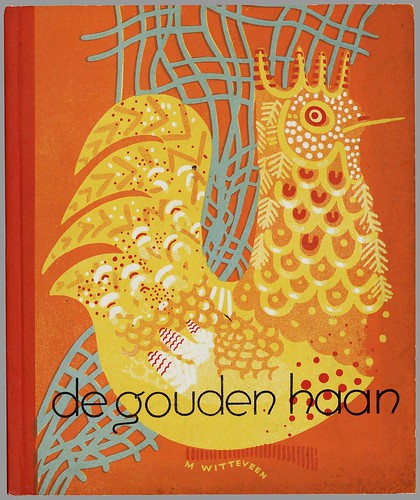
Dutch Picture Books 1810 – 1950 at BibliOdyssey (above: ‘De Gouden Haan’ by Marietje Witteveen, 1940).

‘De Gouden Haan’ by Marietje Witteveen, 1940
Comments closed

Missed Things: Wednesday

Henry Sene Yee, Creative Director of Picador, discusses the elegantly understated cover design for Time by Eva Hoffman, the latest addition to Picador’s BIG IDEAS // small books series.

And I’ve mentioned this before but it bears repeating: Picador are putting their catalogues — and, therefore, their outstanding cover designs — on their Facebook page.

Logicomix by Apostolos Doxiadis and Christos H. Papadimitriou reviewed in The New York TimesThe Guardian, and FT. It sounds kind of awesome. The book also has a nice website with lots of content.

The Inevitable Frontier — Jennifer de Guzman, editor-in-chief at the independent comics publisher SLG Publishing, on digital comics in PW:

Right now, sales from digital comics aren’t going to mean we can pack up print publishing. Not even close. But despite being in the midst of it rather than a wide-eyed observer, I can see that in the near future digital comics are going to be playing a bigger role for all publishers than they do now. And it’s better to be so integrated in the change that you don’t notice that it’s happening than to find yourself left behind and marveling at “the things they can do now.”

“Issues” — A less than warm reception for the Kindle in Australia:

Jeremy Fisher, executive director of the Australian Society of Authors, said he was advising his 3000 members to resist publishing through the Kindle.

“As I understand at this point in time, Amazon asks for a very, very big discount from publishers for their works to be included in Kindle so that the return coming back to the publisher is smaller and the return coming back to the author is smaller,” he said.

“The person making the most money is Amazon.”

Hmm… Yes, well, moving swiftly on…

Jacket Whys — A really nice blog about children’s and YA book covers.

And on the subject of kids books…

Who The Wild Things Are –Artist Roger White looks at the inspiration Maurice Sendak’s Wild Things for the Boston Globe:

The Wild Things looked like nothing ever seen in a children’s book. Rendered in simple ink-hatch over watercolor sketches, they evoked a perfect mixture of proto-adult dread and anarchic, childlike glee – an eternal, platonic form of the kindly monster. From the moment they appeared in 1964, they seemed bracingly and completely original. But in fact Sendak’s monsters had a long series of ancestors and descendants…

But according to Bruce Handy, deputy editor at Vanity Fair, (and his children) kids don’t actually like Where the Wild Things Are… Umm… What?

Comments closed