Skip to content

Tag: penguin random house

Penguin Random House Design Award Winners 2016

ailsa johnson front
Ailsa Johnson (Children’s Prize winner)

ailsa johnson full cover

I’m a little bit late to this, but Penguin Random House UK recently announced the winners of their annual Design Award. The award, which celebrates its 10th anniversary this year, offers art and designs students first-hand experience real book cover design briefs. The winner of each of the three categories — Adult Fiction, Adult Non-fiction and Children’s — receives a work placement at PRH, as well as a £1,000 cash prize. This year’s winners were Ailsa Johnson (Children’s), Zack Crook (Adult Fiction) and Zachary Wieland.


front Zack Crook
Zack Crook (Adult Fiction Prize winner)

Hi Res Full cover design Without Crops Zack Crook

Zachary Wieland FrontCover
Zachary Wieland (Adult Non-Fiction Prize winner)

Zachary Wieland FullCover

Save

Save

Comments closed

Elda Rotor: The Woman Who Runs Penguin Classics

penguin classics elda rotor
Photo by JL Javier

CNN Philippines interviews Elda Rotor, vice president and publisher of Penguin Classics at the Penguin Random House in New York:

The main joy is bringing an audience to a work that would otherwise lead a quiet life, not having the chance to be brought into the light of a modern readership. A greater joy is hearing individual responses of how enlightening or enjoyable a book has been, and connecting that experience with the fact that the edition was a Penguin Classic. The challenges are working very hard to edit, produce, and publish a book and to see its reception to be very modest. So either you realize that the readership was small, or that for some reason we failed to reach a wider audience for a variety of factors… In the 10 years I’ve worked at Penguin Classics, it’s proven to be true that there is nothing that compares to a quality edition of a great work of literature. We are very much in the digital world, providing e-books for much of our list. But there’s something about the physical beauty of a book, finely executed inside and out, that readers find deeply satisfying. We bring much work and thought into the production of our books, from authoritative texts, interior design, to cutting-edge book design, and we have built a strong reputation for this distinction. Developing series such as the Penguin Drop Caps, Penguin Horror, Civic Classics, and soon the Penguin Orange Collection and Penguin Galaxy represents our dedication to our readers and curating special series for their interests that are beautiful objects unto themselves. Overall it reflects the deep respect we have for the reader’s experience and our focus on enriching that experience with a Penguin Classic.

Comments closed

Jason Booher Interviewed at The Perch

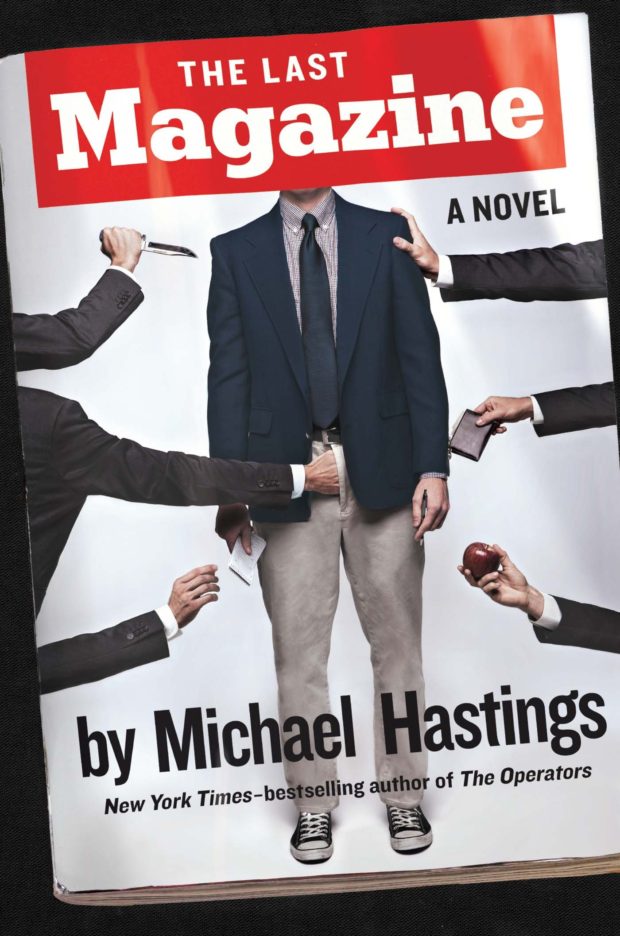
Last Magazine design Jason Booher

Jason Booher, designer and art director of Blue Rider Press and Plume, talks to Penguin Random House blog The Perch about the book cover design process:

A design can be thought of as a set of constraints or parameters. In book design, these consist of things like the conceptual literary content of the book, what makes the book unique in the context of other similar books or all books, how the author is (or is not) known, the expectations of the book from the point of view of the author/editor/sales force/readers, the context of book jacket in the contemporary moment, the context of book jackets in the last 10 (or even 20) years, visual pop culture. Or something that is obvious and not obvious is working with type is very difficult. And it perhaps the most specialized thing that graphic designers bring to that general problem solving into form.

Jason also describes how he approaches a book cover:

There’s a combination of reading the manuscript, and listening to the editor talk about the book. As an art director, I have to dip into almost all the of the books to see what they are like before deciding to whom to give each title. As a designer (if I’m working on that title’s jacket) it’s always different with every book. But as a general process I will read the book, and think and sketch, and sketch, and reread, work though a number of ideas, throw most of them out, stay with others, reread, take a walk (much harder when you are also the art director), try to come up with something new. Those are the first steps.

And how he works with other designers:

When I work with a freelancer (as well as with my in-house designers), I like to see what they come up with without any input from me. Not only are you more likely to get something special and surprising, something you couldn’t have thought of yourself (which is why art directors work with a variety of freelancers in addition to their in-house staff), but you are sending a signal of trust. If a designer knows what “kind” of design they are expected to deliver, they might not push very far or hard. But if they take ownership of being the first arbiters of what the package of the book might be, there is more of a chance for something brilliant. I’m just trying to maximize the talent I have working with me.

With my in house staff, it is similar but there might also be a concept that is floating that we will work with. Or occasionally I’ll work with one designer or my whole team to come up with  ideas together. That’s an exception though, and cover design is generally a sole enterprise in the initial stages. Then it becomes a collaboration when I see comps, and goes from there.

Read the whole interview here.

Comments closed

The Cycling Anthology Jersey Designs by James Paul Jones

The Cycling Anthology_Killed Cover_1

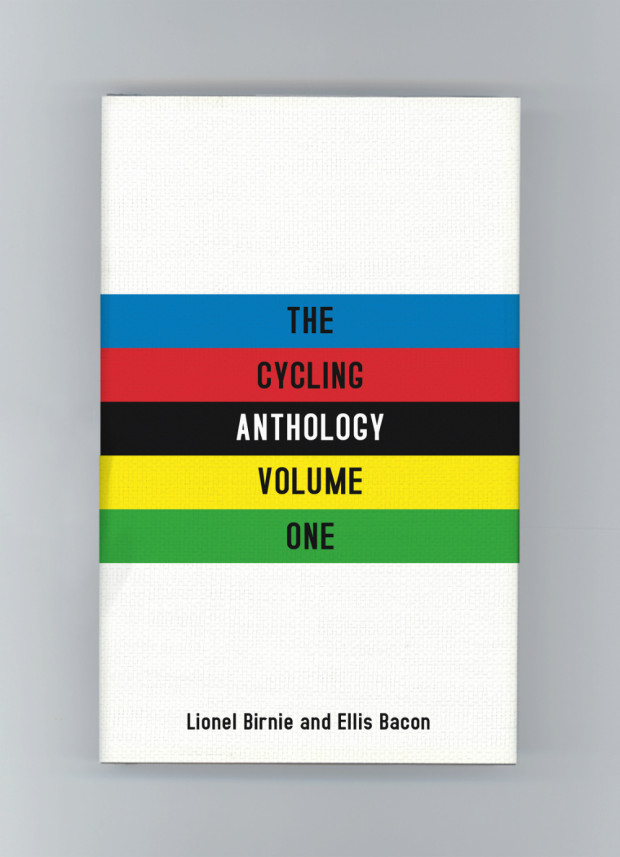
James Paul Jones‘s unused covers for The Cycling Anthology (pictured above) were some of my favourite designs from 2015. Based on famous cycling jerseys, I liked that they were a nod to insiders, but that you that didn’t need to be a cycling fan to appreciate the stylish minimalism of the designs.

When I learnt that they were passed over in favour of a more traditional, illustrative approach, I asked James about his work on cycling books, and why the jersey covers didn’t go to press.

The Cycling Anthology_Killed Cover_2

“I’ve always loved sports but I didn’t count myself a cycling enthusiast until my last year working at Orion Publishing where I was given the job of art directing the photo shoot for David Millar’s book Racing through the Dark,” he told me. “Working with David opened my eyes to the cycling world, and I was lucky enough to work on Sir Bradley Wiggins’ book a couple of years later.”

“Coincidentally David Millar writes beautifully about cycling and has a few essays as part of the Cycling Anthology,” James continued. “I also just finished designing his latest book, The Racer a few months back — all cycling enthusiasts should grab a copy! The contact sheet of ‘tour scars’ is one of my favourite plate sections we’ve ever done, and the back cover features one of the final jerseys he ever wore. Complete with rips, holes and bloody marks from one of his most brutal crashes. As soon as we saw it we knew it had to be featured somewhere, and the photographer captured it brilliantly.”

The Cycling Anthology_Killed Cover_3

The Cycling Anthology presented a different kind of challenge, howeverOriginally self-published, it collects original writing by some of the world’s best writers on the sport, as well as cyclists themselves. Now published by Yellow Jersey Press (an imprint of Penguin Random House), the new volumes of the anthology presented James with an opportunity to repackage the series as a whole, and to experiment with a new look for the covers.

“I wanted to present the editors and authors with two options. A more traditional route, and an option that would hopefully resonate with the cycling community. The jerseys were the latter, and one of the first things I researched. I really wanted to make that connection with the cycling community, and the target market is very design conscious which helps. They are so iconic in the cycling world it just seemed to make perfect sense.”

The Cycling Anthology_Killed Cover_4

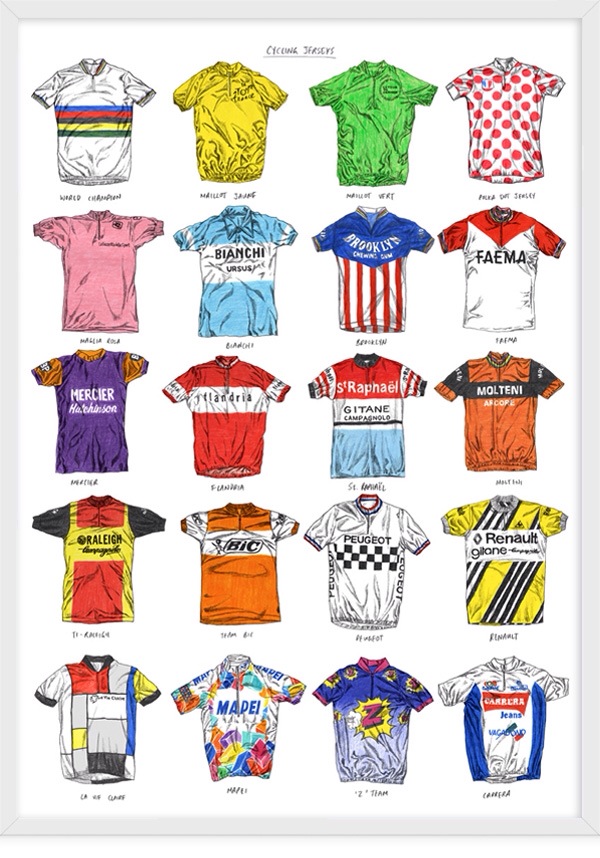
The design of the first volume was inspired by the world champion rainbow jersey. The second by the famous blue and white Bianchi jersey. Volume three was based on the ‘King of the Mountains’ polka dot jersey and the fourth on the Molteni jersey worn by the great Eddy Merckx. The fifth volume was inspired by the chequered shirt of the French cycling team Peugeot. “There were so many jerseys I wanted to include,” said James. “I also recommend David Sparshott’s poster of Cycling Jerseys for anyone wanting to admire the greats in his signature illustration style. Just gorgeous.”
Cycling Jerseys_David Sparshott

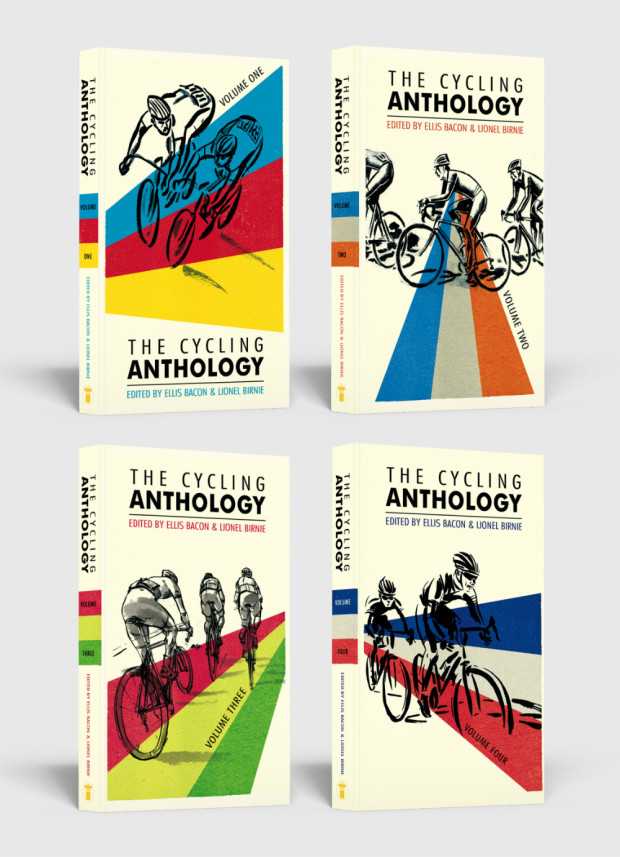
Despite the obvious appeal of these new designs, the publisher decided to stay with a familiar look to the series. “I think the authors wanted to retain some elements from the original designs, which we did on the final covers with the illustrations, and I’m happy with how they turned out,” James told me. “The illustrations are by the talented Simon Scarsbrook. Volumes 1-3 used the original artwork, and we commissioned Simon to come up with two more illustrations for volumes four and five. He was great to work with and they work really well as a series.”
The Cycling Anthology Series

James kept the stripes from the world champion jersey and used them across all the final covers to help unify the series. “The jersey covers will forever by one of my favourite ‘killed covers’ and I really wish they would have taken a chance on them as I’m sure they would have done the job and more.” Agreed.

The Cycling Anthology_Killed Cover_5

Comments closed

There’s no one saying, “You can’t do this in a book for children.”

The New York Times profiles Julie Strauss-Gabel, the publisher of Dutton Children’s Books:

She became publisher of Dutton in 2011, and right away, it was clear this was going to be a different sort of imprint. She whittled down the list from about 50 titles a year for children of all ages, to about 10 books, with a focus on high-quality young adult fiction.

“There was nobody doing just what I do now 20 years ago,” she said. “It would have been unheard-of for a children’s publisher not to do picture books”…

…For such a small list — this year, Dutton will publish a mere eight titles — Ms. Strauss-Gabel’s books are strikingly diverse, covering science fiction and dystopian worlds, psychological suspense and works of social realism. She favors realistic, contemporary fiction, though lately she has been acquiring more memoirs and nonfiction.

“We’re in an era where the definition of a young adult book is completely up for grabs, and people are willing to reinvent it,” she said. “There’s no one saying, ‘You can’t do this in a book for children.’ ”

Comments closed

Hazlitt Interview with Peter Mendelsund

Peter_Mendelsund

Book designer and author Peter Mendelsund discusses his books Cover and What We See When We Read with Christopher Frey for the Hazlitt podcast:

Comments closed

Something for the Weekend

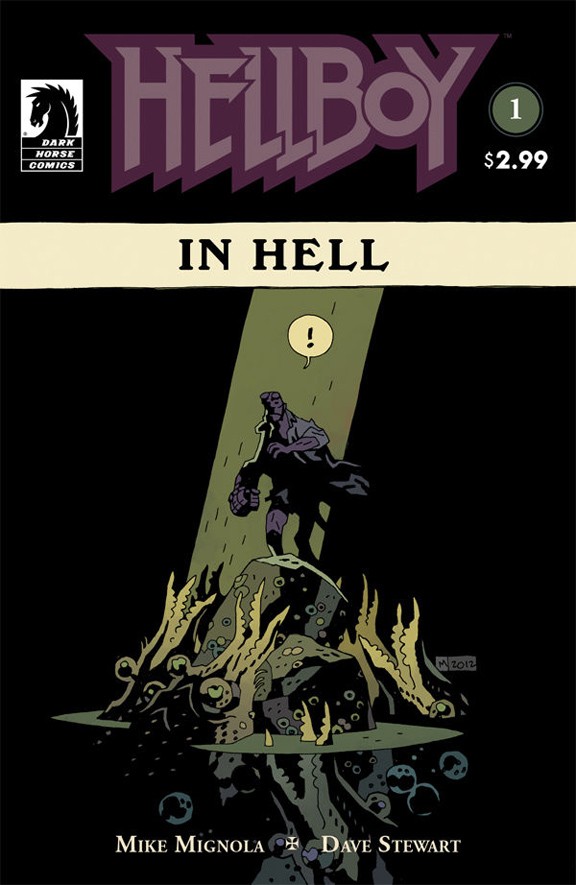
Folklore — Mike Mignola talks about drawing Hellboy again, at ComicsAlliance:

I do have a library. Very little of it is leather-bound. The folklore and mythology library, which is in my studio, is pretty tacky looking since it’s all picked out of used bookstores. I am a book guy but more and more I do use a computer to do certain research things. But there are 30-40, 50, maybe 100 books of folklore in there, most of which haven’t been read. I’ll look at a table of contents and go, “Wow there’s 30 to 40 different Hellboy stories in there.” It’s very comforting to know there’s a million stories to tell that I can pluck off the shelf for those days where it’s like, “Well, I got nothing!”

Suicide Watch — Steve Almond reluctantly reviews Building Stories by Chris Ware for The New Republic:

Ware is essentially a poet of solitude. He uses language and images to capture the private torments of unfulfilled lives. His characters drift in a sea of self-recrimination and unmet desire (not unlike the rest of us). They rarely find love, or resolution.

This bleak approach does yield a curious dividend, though. The occasional moments of grace explode off the page. At one point, we see his heroine cavorting with her daughter on their front lawn. “I remember Lucy landing on top of me, laughing…with the sun shining behind her suddenly life came into perfect focus,” she muses. “This was what it was all about … this very moment … the joyful reality of my daughter.” The girl’s lovely face, nearly life-size, beams at us from the middle of the page.

Of course, this idyll is shattered by the news that one of her friends has committed suicide. If Ware has one flaw, it’s his obvious discomfort with the notion that people—at least his people—might ever find an enduring happiness.

And, while were on the subject of comics…

Hannah Berry, author of the enjoyable Britten & Brülightly, writes about the independent comics scene in the Britain at the New Statesman. Berry’s second graphic novel Adamtine was published earlier this year in the UK by Jonathan Cape.

Also at the New Statesman, Hayley Campbell on the current state of British comics.

Meanwhile, back in the world of big grown-up publishing…

The Telegraph profiles Liz Mohn, “the woman behind media giant Bertelsmann” and, therefore, the monster that is Penguin Random House.

And finally…

Lubricated — Hunter Oatman-Stanford (how’s that for a moniker?) examines the nautical past of popular tattoos at Collectors Weekly:

“Many sailors are extremely superstitious,” says [C.W] Eldridge [founder of the Tattoo Archive], “so they would get specific tattoos to relieve this anxiety over their beliefs. There are stories of guys in the old, wooden-ship days who would get Christ’s head tattooed on their backs so if they got into trouble and had to take lashes, the person wielding the lash would be more sympathetic.”

The variety of designs matched each and every danger aboard a ship. “Sailors would get things like a pig and rooster on their feet to keep them from drowning,” Eldridge says. “They would have ‘Hold Fast’ tattooed on their knuckles so that when they were in the riggings, their hands would stay strong. They would get hinges on their elbows to keep them from having rheumatism and arthritis, and sometimes they would even get a little oil can tattooed above the hinge so that the hinges would stay lubricated.”

Comments closed