Skip to content

Tag: patti smith

Love Among the Ruins

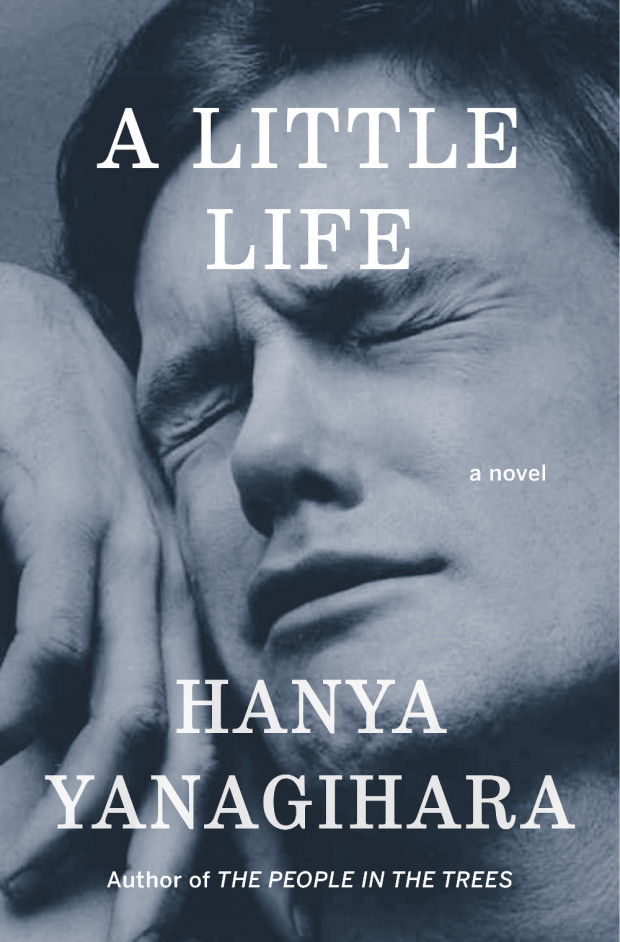
Jacket design by Cardon Webb; jacket photograph Orgasmic Man by Peter Hujar 1987

At the New York Times, Edmund White examines our enduring fascination with the New York of the 1970s:

Recently there’s been, in TV and film and certainly in books, an intense yearning for a specific five-year period in New York City, those years between the blackout in 1977, and 1982, when AIDS was finally named by the Centers for Disease Control. First was Rachel Kushner’s 2013 novel ‘‘The Flamethrowers,’’ whose heroine is a sharp-eyed bystander in the SoHo art scene, and now… ‘‘City on Fire’’ by Garth Risk Hallberg, which also concerns itself with the same time period. There are two television series in development that take place in the late 1970s as well, one directed by Martin Scorsese and co-written with Mick Jagger; the other by Baz Luhrmann. Next year, the Whitney will mount the first retrospective of David Wojnarowicz, the ultimate East Village grunge artist, in over 15 years; the work of his lover, the photographer Peter Hujar — which has recently been used both for an advertising campaign for the men’s wear designer Patrik Ervell and on the cover of… Hanya Yanagihara’s novel ‘‘A Little Life’’ — will be the subject of a forthcoming retrospective at New York’s Morgan Library.

COLLECTIVELY, THESE WORKS express a craving for the city that, while at its worst, was also more democratic: a place and a time in which, rich or poor, you were stuck together in the misery (and the freedom) of the place, where not even money could insulate you. They are a reaction to what feels like a safer, more burnished and efficient (but cornerless and predictable) city. Even those of us who claim not to miss those years don’t quite sound convinced. ‘‘Well, I sure don’t have nostalgia about being mugged,’’ John Waters told me. Though then he continued: ‘‘But I do get a little weary when I realize that if anybody could find one dangerous block left in the city, there’d be a stampede of restaurant owners fighting each other off to open there first. It seems almost impossible to remember that just going out in New York was once dangerous. Do any artistic troublemakers want to feel that their city may be the safest in America? Who’s going to write a book about walking the safe streets of Manhattan? It’s always right before a storm that the air is filled with dangerous possibilities.’’

m train design carol devine carson
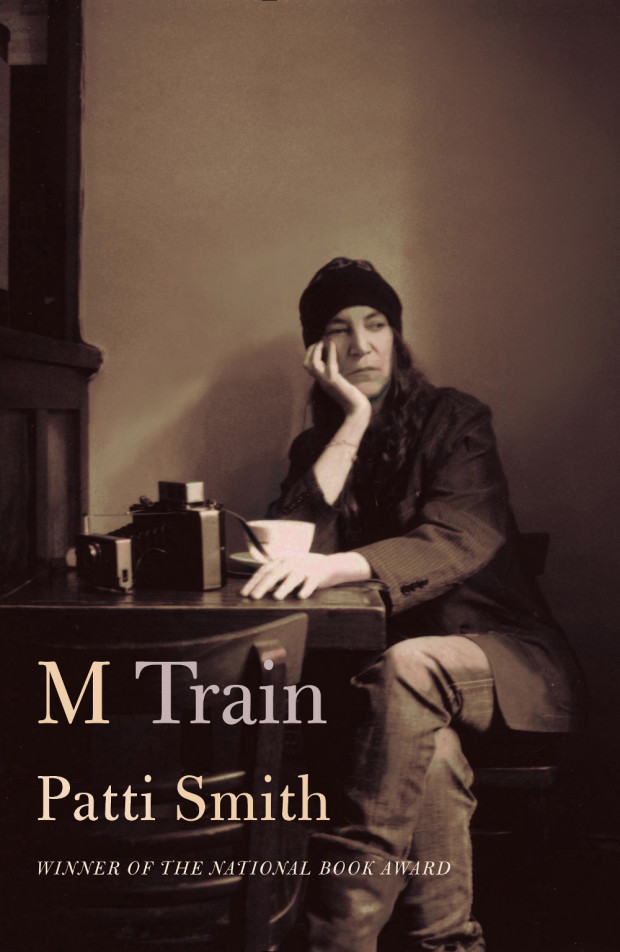
Jacket design by Carol Devine Carson; jacket photograph by Claire Alexandra Hatfield

Similiarly, at the Guardian, Glenn Kenny looks at our obsession with the New York of Lou Reed and Patti Smith:

The New York we aspired to was Lou [Reed]’s, not Liza Minnelli’s, or a little later, Frank Sinatra’s. (The New York we aspired to was also Martin Scorsese’s, too, as it happened, and it’s almost entirely forgotten that it’s in his movie of the same name that the future anthem New York, New York made its first bow.) And these days, “wild side” New York is gazed at in rearview with fervent affection, in works by Edmund White, Patti Smith, Brad Gooch and others. (Not to mention those, like Garth Risk Hallberg or Rachel Kushner, who are too young to have their own memories to work with.) Smith’s books, in particular, seem to have hit a nerve. Her new book M Train is a more impressionistic sequel to her National Book award winning memoir of 2011, Just Kids, which is currently being developed as – weirdly enough, for me and perhaps for her – a Showtime TV miniseries.

The place these books conjure is both very scary, and very exhilarating. Not a place where some kind of arty misfit or wannabe arty necessarily wanted to live, but rather a place where one such creature could live. And hence, a place where one such young creature had to live.

Comments closed

Something for the Weekend

Arresting Charm — Writer and artist Howard Chaykin on the late Carmine Infantino who died April 4th:

My best friend Michael Abramowitz was a huge fan of Carmine’s, and I held and hold his tenure on The Flash from 1956 to 1965 in great affection. Infantino’s Flash was infused with a sleek modernism absent from other work of the period, a look and sensibility utterly different from that of his peers. His work was profoundly two dimensional, apparently uninterested in deep space. He frequently used the lower panel border as his horizon, with figures standing on that line, creating an effect somewhat like a stage apron, with flat shapes serving to represent middle and deep distance. It sounds odd, and it was, but it had an arresting charm. Infantino’s work, viewed today, is far more sophisticated, but also more emotionally detached, than that of his colleagues.

You can see more Carmine Infantino covers at The Golden Age blog.

Accidental Publishing — A feature on Seattle’ comics publisher Fantagraphics in Publishers Weekly:

The Fantagraphics publishing program began “almost by accident” in 1981, according to Groth, and over the last three decades has grown to feature some of the most critically acclaimed comics artists in the U.S. and from around the world. The Fantagraphics list includes the work of the Hernandez brothers (Love and Rockets), Daniel Clowes (EightballGhost World), Chris Ware (The ACME Novelty Library), and Jim Woodring (Frank, Weathercraft) and has grown to include multi-volume archival reprint projects such as R. Crumb’s The Complete Crumb Comics and Charles Schulz’s Peanuts. By championing the comics medium and the creators it has published, Fantagraphics has been instrumental in raising the profile of graphic fiction as an art form that transcends the superheroes and monsters that established the medium so many decades ago.

The Only Kind of Geography — Writer Alan Moore on psychogeography and, in particular, his work with Eddie Campbell on From Hell (via LinkMachineGo):

My approach, in keeping with Theophile Gautier’s elegant definition of Decadent literature as being capable of plundering from the most ancient past or the most recent ‘technical vocabularies’ (which is also a good working definition of postmodernism), would be to see the current model of psychogeography as evolving from and thus essentially containing earlier versions of the practice, making these original techniques available to modern artists as important tools within their repertoire. For example, one need not subscribe to any nebulous New Age conceptions with regard to ‘ley lines’ to appreciate that Brecon visionary Alfred Watkins’s idea of linking geographic points into a web of sightlines could have modern application if regarded as a linkage of ideas, as in both Iain Sinclair’s work and in my own From Hell.

Psychic Garburator — Margaret Atwood on dreams at the NYRB Blog:

Most dreams of writers aren’t about dead people or writing, and—like everyone else’s dreams—they aren’t very memorable. They just seem to be the products of a psychic garburator chewing through the potato peels and coffee grounds of the day and burping them up to you as mush. If you keep a dream journal, your mind will obligingly supply you with more dreams and shapelier ones, but you don’t always want that, nor can you necessarily make any sense of what you may have so vividly dreamt. Why, for instance, did I dream I had surged up through the lawn of Toronto’s Victoria College and clomped into the library, decomposing and covered with mud? The librarian didn’t notice a thing, which, in the dream, I found surprising. Was this an anxiety dream? If so, which anxiety?

See also: Leon Neyfakh on Margaret Atwood at Technology at The New Republic.

And finally…

An interview with Patti Smith at LA Weekly:

I’m much too self-centeredly ambitious to simply be content with the transfer of success from one realm to another. I would rather write or record something great and have it overlooked than do mediocre work and have it be popular. My goals are really work-oriented. I don’t stay in one discipline because it’s more lucrative than another. In fact, the most successful thing I ever did was Just Kids, for which I had absolutely no expectations. I just wanted to do a beautiful little book that would give Robert [Mapplethorpe] to the people. And then it became a global success. It’s so funny, because Robert always cared about me becoming successful, while I never did. It’s almost like he was suddenly saying, “Dammit, Patti, you’re gonna be successful, even if I have to make it happen!” I always laugh when I think that my greatest success came through Robert.

Comments closed

Midweek Miscellany

An interview with award-winning Toronto-based illustrator Gary Taxali at GrainEdit.

How Disappointing — Book designer Peter Mendelsund on what we picture in our minds when we read literary works:

“Call me Ishmael.” What happens when you read this line? You are being addressed, but by whom? Chances are you hear the line (in your mind’s ear) before you picture the speaker. I can hear Ishmael’s words more clearly than I can see his face. (Audition requires different neurological processes than vision, or smell. And I would submit that we hear more when we read than we see). Picturing Ishmael requires a strong resolve.

But if you indeed took the trouble to summon an image of Ishmael what did you come up with? A sea-faring man of some sort? Is this a picture or a category? Do you picture Richard Basehart, the actor in the John Huston adaptation? How disappointing.

(All I can say is that the follow-up essay had better be about comic books, Peter!)

The Secret Detectives — An interview with Patti Smith in The Telegraph:

“When I was young I knew William Burroughs really well. And William’s secret desire, which he never quite did, was to write a straightforward detective novel. How good would that have been! And I used to say, ‘you have to do it William!’ And he’d say” – Smith gives a passable impersonation of the Burroughsian growl – “‘Oh, I don’t know, one of these days.’ William was like the embodiment of a detective, I just loved him so much.”

Our Greatest Creation — Jonathan Glancey, The Guardian‘s former architecture and design correspondent, reviews City: A Guidebook for the Urban Age by P.D. Smith:

The stuff of lofty intentions and grubby backstreet life, the city represents much of our restless and contradictory natures. “In this dynamic, cosmopolitan space,” Smith writes, “lies the wellspring of our creativity as a species. The greatest cities nurture and stimulate ideas in science and the arts that are the very heart of human civilisation. For this reason, sustainable, humane and well-governed cities are our best hope for the future.”

Amen.

Hiding in Plain Sight — Type designer Ramiro Espinoza on ‘Amsterdamse Krulletter’, the curly lettering painted on the windows of traditional pubs in Amsterdam, and his only typographic revival Krul:

The fact that such gorgeous and original letters have largely been ignored in a country with such a rich type- and letter-making tradition reminds me of the plot of Edgar Allan Poe’s famous story “The Purloined Letter”. In the story, an important document cannot be found because it is lying in plain sight. Sometimes things can become invisible to us because of their very familiarity.

Avant Garde — Adrian Shaughnessy on life and work of designer Herb Lubalin at Imprint:

I have a pet theory about why Lubalin is currently popular: In the eyes of many designers, he offers a way of designing—and of communicating—that doesn’t require expensive art direction, over-manicured photography, or grandiose presentation. Lubalin proved that to be effective, all you need is a typeface and a good idea. In other words, he is a designer for the age of austerity.

Unit Editions’ forthcoming limited edition monograph, Herb Lubalin: American Graphic Designer, 1918–81, will be available in August.

And finally (and also at Imprint)…

An interview with designer and collage artist Graham Moore, who incorporates mid-century modern ephemera and fragments from billboard posters into his work.

Comments closed

Something for the Weekend

Sturm und Drang — Author Nick Harkaway (Angelmaker and the forthcoming The Blind Giant: Being Human in a Digital World) on Amazon and the publishing industry for The Guardian:

The most thunderous argument in Amazon’s favour is that the market has spoken, and demands cheaper product. This one I find utterly bizarre. We know very well, in this post-crash age, that the market can be an idiot. The market wanted easy credit extended to all, low taxes and plenty of public spending. The end result was a financial catastrophe that has just plunged us into a double-dip recession and shows no sign of being played out. Sometimes, things cost more than we want. That is a truth we were encouraged to forget in the 90s, but it’s one we’re going to have to remember.

See also: Jason Epstein in the NYRB and Dennis Johnson’s on-going commentary on the Department of Justice’s legal shenanigans at MobyLives (archive).

Literature Needs More Than E-booksJames Bridle for Wired Magazine:

What we are coming to realise is that no one thing can pick up where the book left off; instead it is everything, all of our networks, our services, our devices, the internet plus everything else, which will carry literature forward. Literature is unique among art forms in that it is enacted entirely in the minds of author and reader; a psychic dance. Literature is everything, and thus everything must be employed in its support. And publishers, so long accustomed to doing a couple of things well, are adrift in a world that needs them to do everything — or GTFO.

And finally…

No Sympathy for the Creative Class — A fascinating piece by Scott Timberg for Salon:

Creative types, we suspect, are supposed to struggle. Artists themselves often romanticize their fraught early years: Patti Smith’s memoir “Just Kids” and the various versions of the busker’s tale “Once” show how powerful this can be. But these stories often stop before the reality that follows artistic inspiration begins: Smith was ultimately able to commit her life to music because of a network of clubs, music labels and publishers. And however romantic life on the edge seems when viewed from a distance, “Once’s” Guy can’t keep busking forever.

Yes, the Internet makes it possible to connect artists directly to fans and patrons. There are stories of fans funding the next album by a favorite musician — but those musicians, as well, acquired that audience in part through the now-melted creative-class infrastructure that boosted Smith.

(And on that cheery note, have a good weekend).

Comments closed

Midweek Miscellany


Everyday Epic — Tom Spurgeon interviews Tom Gauld at The Comics Reporter:

I find that when I’m drawing I’m quite happy to come up with larger than life, epic things but when I write things tend to be more down to earth. The contrast between greatness and everyday reality is something which interests me.

You can find my interview with Tom here. His new book Goliath is out in March.

I Am Lousy Copywriter — A list by legendary adman David Ogilvy, author of Confessions of an Advertising Man, at Letter of Note:

If all else fails, I drink half a bottle of rum and play a Handel oratorio on the gramophone. This generally produces an uncontrollable gush of copy.

My Name is Tyranny — Mike Doherty interviews William Gibson about his new book, Distrust That Particular Flavor, for Salon:

I very seldom compose anything in my head which later finds its way into text, except character names sometimes – I’m often very much inspired by things that I misunderstand. Have you ever seen Brian Eno’s deck of Oblique Strategies? One of them is “Honor thy error as a hidden intention.” That’s my favorite. [At a] hotel in New York a couple of days ago, the young woman who checked me in said what sounded to me like, “Thank you, sir; my name is Tyranny. If there’s anything you need …” For the rest of the day, I was thinking of young, benevolent female characters with the first name “Tyranny.”

And finally…

Tiptoeing Through a Sickroom — Luc Sante on Patti Smith for The New York Review of Books:

Her memoir Just Kids (2010), the account of her friendship with the photographer Robert Mapplethorpe, has been justly celebrated. It is delicate and affectionate as it tells of their adventures in a New York City bohemia that now seems a century removed, of the endurance of their relationship despite his realization that he was gay, of their separate pursuits of fame, of his illness and death. It is almost too literary for its own good, since her choices of word and phrase always come down on the genteel side of the ledger: “perhaps” rather than “maybe,” “rise” rather than “stand,” “yet” rather than “but,” “one” rather than “you.” There’s hardly a contraction, outside the dialogue, in the entire book. But despite the fact that this sort of talk is patently not the way she expressed herself at the time, and that it sounds more effortful than natural on the page, it does cover the book with an appropriate hush—it sounds like someone tiptoeing through a sickroom.


Comments closed

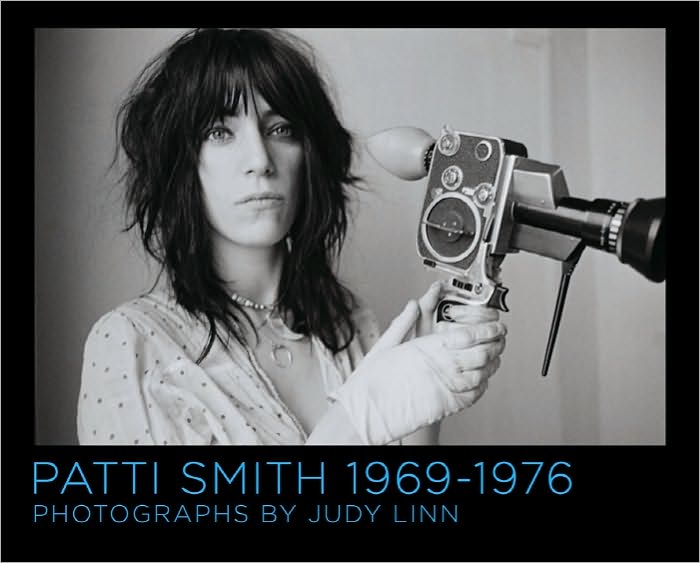
Patti Smith 1969-1976, Photographs by Judy Linn

“I was eager to be Judy’s model and to have the opportunity to work with a true artist. I felt protected in the atmosphere we created together. We had an inner narrative, producing our own unspoken film, with or without a camera.” — Patti Smith

Here’s a short promotional trailer for Patti Smith 1969-1976, Photographs by Judy Linn, mentioned briefly in this morning’s round-up:

(via @theBDR)

Comments closed

Midweek Miscellany

Book Art: Iconic Sculptures and Installations Made from Books by Paul Sloman, a 220-page overview of contemporary art, installation, and design created with and from books , published Gestalten.

La Mémoire Retrouvée — Edmund de Waal, author of The Hare with the Amber Eyes, on his family’s connection to Proust, for The Daily Telegraph:

Proust played with the interpenetration of the real and the invented; his novels have a panoply of historical figures who appear as themselves mingling with characters reimagined from recognisable people. Elstir, the great painter who leaves his infatuation with Japonisme to become an Impressionist, has elements of both Whistler and Renoir, but has another dynamic force. And Proust’s characters stand in front of actual pictures. The visual texture of the novels is suffused not just with references to Giotto and Botticelli, Dürer and Vermeer, Moreau, Monet and Renoir, but by the act of looking at paintings, by the act of collecting them, remembering what it was to see something, the memory of the moment of apprehension.

Doomed — Jonathan Coe, author most recently of The Terrible Privacy of Maxwell Sim, on film adaptations of books for The Guardian:

In the course of their famous book-length interview, François Truffaut once asked Alfred Hitchcock about his approach to literary adaptation, and Hitch’s response was as magisterial, worldly and mischievous as one would expect: “What I do is to read a story only once, and if I like the basic idea, I just forget all about the book and start to create cinema. Today I would be unable to tell you the story of Daphne du Maurier’s The Birds. I read it only once, and very quickly at that.”


Circumventing the Male Gaze The New Yorker‘s Hilton Als on photographer Judy Linn and a new book collecting her photographs of Patti Smith:

I wonder what Patti and Judy saw in one another—I mean, beyond the description Judy provides in her little essay at the back of the book. What is the energy that one being picks up on, and how does it complement the other’s? Judy and Patti went to Detroit one summer and worked for a local paper and Crawdaddy, respectively; Patti wrote rock criticism and Judy took pictures. Lester Bangs was their friend. The world got bigger. Collaboration can be vexing, but there’s not a note of complaint in their work together. The pictures are documents of girls doing things together, sometimes in their summer dresses. And when there’s a third person present—Mapplethorpe, some other boy—they make a little room for him, but he’s rarely center frame; the pictures are rare in that they circumvent the male gaze and thus approval; instead, they document how each woman’s vision is equal to the other’s.

And finally…

Designer Data — The New York Times on data visualization:

Visual analytics play off the idea that the brain is more attracted to and able to process dynamic images than long lists of numbers. But the goal of information visualization is not simply to represent millions of bits of data as illustrations. It is to prompt visceral comprehension, moments of insight that make viewers want to learn more.

And on a related note: The Infographic Inforgraphic by Ivan Cash.

Comments closed

Monday Miscellany

These are mostly links I was going to post on Friday, but with a long post on Mendelsund and a last minute WordPress fail (to add to all the usual pressures of part-time blogging) I thought I might as well hold them over until today. Think of it less as a bad end to last week, and a great start to this one (or something like that)…

Designer Eric Skillman on Adrian Tomine’s illustrations for the Criterion boxed set of Yasujiro Ozu’s The Only Son/There Was a Father.

And on the subject of Adrian Tomine, David L. Ulin reviews his new book Scenes From an Impending Marriage for The LA Times:

Tomine has always been a master of the small gesture, as anyone familiar with his work knows. Such encounters motivate the deceptively informal stories in his series “Optic Nerve,” as well as his graphic novel “Shortcomings,” which explores the limits of identity and intimacy. With “Scenes from an Impending Marriage,” though, he seems almost willfully understated, tracing, in a series of offhand comics, the peculiar rigors of the wedding dance, from guest lists to seating charts to invitations and beyond.

(For the record: several of Adrian’s books, including the new one, are distributed in Canada by my employer, Raincoast Books).

The Impulse to Write — Patti Smith talks about her writing and music in The Guardian:

“More than anything that’s been the thread through my life – the desire to write, the impulse to write. I mean, it’s taken me other places, but it was the impulse to write that led me to singing. I’m not a musician. I never thought of performing in a rock’n’roll band. I was just drawn in. It was like being called to duty – I was called to duty, and I did my duty as best as I could.”

And finally…

London Intrusion — China Miéville, author most recently of The City and The City and Kraken, is posting a webcomic on Tumblr (via Robot 6).

(And speaking of Tumblr… Posts from here and The Accidental Optimist are now also available on Tumblr if that’s your thing.)

Comments closed

Patti Smith on PBS NewsHour

I began, of course, as a poet, but the power of rock ‘n’ roll — rock ‘n’ roll was really the canopy of our cultural voice, and especially in the ’60s, late ’60s and early ’70s, that — and our rock stars, the people who were building that voice, whether it was John Lennon or Neil Young or Bob Dylan, or whoever it was, they were infusing politics and — and political ideology, social justice, sexual energy, poetics, all within the canopy of rock ‘n’ roll, and striving to make this a universal language. It was a real mission. And I — I wanted to add to that. Writing poetry is beautiful, but, when I was young, I wanted to be part of this important cultural voice.

Patti Smith talks about her memoir Just Kids on PBS NewsHour:

(via The BDR)

Comments closed

Favourite New Books of 2010

Ducking in just under the wire, here is my list of favourite of new books of the year. It’s not meant to represent the “best” of 2010. Rather, it’s a completely unscientific, very subjective list of books (arranged in alphabetical order) that I enjoyed. As I mentioned in my previous post, I found compiling the list a bit of a challenge and yet, for all that, there’s an air of withering predictability about the selections. There are no surprises. But even if this wasn’t a particular stellar year for reading, there were still lots of books I was excited about and that can only be a good thing.

I should also mention, for the sake of disclosure and all that, the top 10 includes one book distributed by Raincoast Books in Canada, and the list of honourable mentions refers to a couple of other titles I have helped promote in some minor capacity. They’re included here because I actually like them, not for any nefarious marketing reasons, but I guess you’ll just have to take my word for that. In any case, all these titles are identified with an asterisk…

And with that out of the way, on to the list!

Born Modern: The Life and Work of Alvin Lustig*
Elaine Cohen Lustig & Steven Heller

Chronicle Books
ISBN 9780811861274
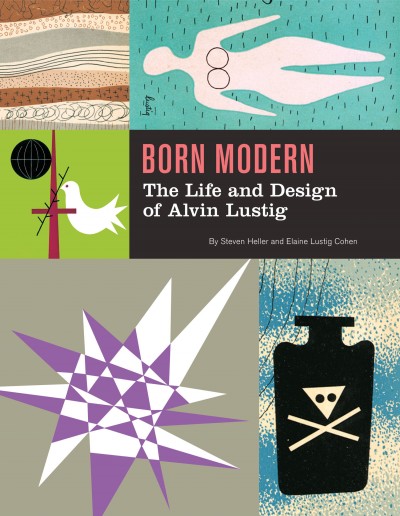
I am a little embarrassed to start this list with a title distributed by Raincoast, but it comes first alphabetically and, I can honestly say tat Born Modern was the book I was most looking forward to this year. And I was not the only person excited about the book. When I tweeted about it from the Raincoast sales conference, the response was immediate. Almost every North American book designer I’ve ever spoken to cites Lustig — who designed covers for New Directions Press in the 1950’s — as an influence. The book designer’s book designer, then… A must-have.

C
Tom McCarthy
Knopf
ISBN 9
780307593337

Tom McCarthy’s C was, as mentioned previously, one of the defining books of the year for me, standing — perhaps unfairly — opposite the ubiquitous Freedom. If I am honest though, I liked it less than McCarthy’s previous novel, the starkly compact Remainder (one of my favourite books of the last 10 years). At times, the sprawling, crawling C felt like it was held together with the sticky-tape of McCarthy’s singular intellect (a thought reaffirmed by seeing him in conversation with Douglas Coupland in Toronto). But somehow, in the end,  it still works in some sort of baffling, gorgeous way.

The book was also perfect excuse to finally talk to Knopf cover designer Peter Mendelsund for the blog. The Q & A with Peter and Tom about C is here.


The City and the City
China Miéville
Del Rey
ISBN 9780345497529

I am cheating a little by including The City and the City because it was first published in 2009. It was, however, published in paperback in 2010, and as that’s how a lot of us still buy our fiction, I’m bending the rules to include it.

The novel itself is essentially a detective story, but what lifts out of the ordinary is the imaginary space in which it takes place. Architecture, geography and maps are clearly important to Miéville, but where, for example, Perdido Street Station creates a fantastically baroque city of ghettos and towering alien architecture, The City and the City is only slightly off-kilter — familiar but unsettling — and the book is even better for it.

Joy Division
Kevin Cummins
Rizzoli

ISBN 9780847834815

This was my Christmas present (thank you Mrs C.O.!) and it is — pretty obviously I would think — for fans only. Still, I’m guessing there’s quite a few out there. In any case, the book is a collection of beautiful black and white photographs of Joy Division and the late Ian Curtis by Manchester-born photographer Kevin Cummins. It includes Cummins’ iconic pictures for the NME of the band standing on a snowy bridge in Hulme, Manchester, as well as photographs of live performances and the band back stage. The book was stylishly designed — with more than a whiff of Peter Saville — by London design agency Farrow.

Just Kids
Patti Smith
Ecco
ISBN 9
780060936228

Other than owing a copy of Horses,  I can’t say that I’m particularly familiar with the work of Patti Smith, or Robert Mapplethorpe for that matter (other than the sort of stuff must people know about his art, and that he was connected to Sam Wagstaff, no relation). But, it doesn’t really matter. Smith’s memoir about her relationship with Mapplethorpe is a touching and self-deprecating look at their early years together in New York and their adventures in the art/music scene of the late 1960’s and early 1970’s.

Memories of the Future
Sigizmund Krzhizhanovsky, translated by Joanne Turnbull
NYRB
ISBN 9781590173190

I am definitely cheating by including this in the list as it was published in 2009. That said, it was published late in 2009, I missed it, and it’s too good not to be in this year’s top 10.

The book itself  is a collection of seven short stories written between 1922 and Krzhizhanovsky’s death in 1950,  all of which were suppressed by Soviet censors. The stories are reminiscent of Gogol’s short fiction and Bulgakov’s novellas, and suffice to say, they’re all bonkers. But in a good way. I loved the story Quadraturin about the man who gets lost in his black, ever-expanding apartment, and the strange time travel title story which concludes the book.

Penguin 75: Designers, Authors, Commentary (the Good, the Bad…)
Paul Buckley

Penguin
ISBN 9780143117629

Seeing as I spend so much time talking about cover design, I would be remiss if I didn’t include Penguin 75 in my top 10. Released to celebrate Penguin’s 75th anniversary, it’s a surprisingly diverse and candid look at the recent cover designs from Penguin’s US outpost in New York.  I talked about Penguin 75 with art director Paul Buckley and book designer Christopher Brand here.

Parker: The Outfit
Darwyn Cooke

IDW
ISBN 9781600107627

The previous book in Darwyn Cooke’s Richard Stark adaptations, The Hunter, was on last year’s list, so perhaps it is hardly surprising that the sequel, which I think is better,  is in this year’s top 10 as well. In new book, the formidable Parker — now with a new face — turns the tables on ‘the Outfit’, who quickly wish that they’d let sleeping dogs lie. Cooke seems in more confident form with this adaptation and the result is a stylish and fast-paced noir that looks incredibly cool. My pithier Advent Book Blog pitch for The Outfit is here.

The Shallows
Nicholas Carr
W.W. Norton & Co.
ISBN 9780393072228

I had a frisson of recognition reading Carr’s description of internet affected attention spans and I doubt I was the only one who thought “oh god, that’s happening to me” while reading The Shallows. The book is too long — a shorter book would’ve been even more effective — but it is still compelling. Carr doesn’t say technology is wrong, but reminds us that for all its benefits, we should be mindful of the consequences and what we might be losing.

Werewolves of Montpelier
Jason
Fantagraphics

ISBN
9781606993590

I wrote about my love for Jason’s comics when Werewolves of Montpellier was about to be released earlier this year, and the book itself didn’t disappoint. Ostensibly the book is about a thief called Sven who disguises himself as werewolf to rob people’s apartments and incurs the wrath of the town’s actual werewolves. It is, however, as much about friendship, identity, loneliness, and, ultimately, Sven’s unrequited love for his neighbour Audrey. In a lovely one-page scene, Audrey stands behind Sven, hugging his shoulders.  “Do women come from another planet?” she asks. “Yes, women come from another planet,” Sven replies. The whole book is achingly brief, but Werewolves of Montpellier is possibly my favourite Jason book to date.

Honourable Mentions

American Trademarks edited by Eric Baker and Tyler Blick*
Footnotes In Gaza by Joe Sacco (December 2009)
I.O.U.: Why Everyone Owes Everyone and No One Can Pay by John Lanchester (published in the UK as Whoops!)
KENK by Richard Poplak and Nick Marinkovich*
Large Scale: Fabricating Sculpture in the 1960’s and 1970’s by Jonathan Lippincott*
The Lost Rolling Stones Photographs: The Bob Bonis Archive, 1964-1966 by Larry Marrion
The Rocketeer: The Complete Collection by Dave Stevens (December 2009)
Shirley Craven and Hull Traders: Revolutionary Fabrics and Furniture 1957-1980 by Lesley Jackson (October 2009)

So there you go. If  this hasn’t met your requirements, Largehearted Boy is aggregating every online “best of 2010” book list he can find, and Fimoculous is aggregating all of the lists related to 2010 in categories ranging from ‘Advertising’ through to ‘Words’. That should keep you busy…

Happy New Year!

aggregates all of the lists related to 2010aggregated all of the lists related to 2010)
Comments closed

Patti Smith and Jonathan Lethem in Conversation

Artist Patti Smith, author of Just Kids, in conversation with Jonathan Lethem, author of Chronic City, earlier this year:

(via MobyLives)

Comments closed

Midweek Miscellany

An excerpt from Jay McInerney’s introduction to Joy Division (published by Rizzoli), accompanied by a slideshow of Kevin Cummins’ photographs of the band, in Vanity Fair.

Sandwiches with Ginsberg — Patti Smith reads from Just Kids, the story of her friendship with Robert Mapplethorpe, at National Book Awards in New York.

“It’s not all pristine snow and leather goggles”The Guardian reviews I.N.J. Culbard’s adaptation of At the Mountains of Madness by H.P. Lovecraft. Culbard talks about illustrating and adapting Lovecraft at the SelfMadeHero blog.

Also at The Guardian: A 26 letter slideshow from David Sacks’ new book, Alphabets: A Miscellany of Letters (pictured below: illustration by Jonathan Lander, 2009):

Slow Down — An interview with Pushcart Prize editor Bill Henderson at Kirkus Reviews:

My friends in commercial publishing tell me that indeed times are terrifying. Nobody knows where the commercial world is headed as it tries to make a profit. The villains are those who attempt to corner the e-book market and announce that they have hundreds of thousands of titles available instantly… Why is this speed of any interest to anybody? Serious readers take their time in savoring a book. But suddenly we’ve all turned into speed freaks. Those who will suffer most from this, interestingly, are the big-box superstores that can only stock a mere 100,000 titles in their walls… The independent bookstores may, on the other hand, do very well because they can treat customers as human beings.

And finally…

Interviews with typographer Erik Spiekermann and book maven Sarah Weinman at From the Desks Of

Comments closed