Skip to content

Tag: nick harkaway

Midweek Miscellany

Krazy Kriticism — Sarah Boxer on George Herriman’s long-running newspaper comic strip Krazy Kat, at the LA Review of Books:

[E]ven 95 years ago the truth was as loud and clear as a pair of clapping mitten rocks rising up out of the mesa encantada: Krazy Kat is perfect and Herriman is a genius — linguistically, graphically, poetically, onomatopoetically, every which way. Confronted with such perfection, most of Herriman’s critics, once they finish reciting plot, affecting accents, and making comparisons to classics, have always thrown up their hands and said, “Behold!” But does it have to be that way? The genius label, after all, has never kept Shakespeare or Picasso scholars from finding something to say.

A Natural End — An interview with Tom Gauld at The Comics Journal:

I never draw things big. Even if something needs to be big, I’d still draw it small and scale it up. I like to draw small (my drawings are not much bigger than the finished, printed comics) as it reigns in perfectionism, and I get a bit of natural wobble and error into the drawings. One problem with digital is that you can zoom in and in forever: but with a pen, the width of the line gives a natural end.

Canaries — Nick Harkaway, author of The Blind Giant, talks about books on the digital age at The Browser:

Our environment seems to be constantly filled with moral panics. When you open the newspaper, there’s always a piece about how the digital environment is making us stupid or paranoid, but so little of it has any basis. There was a piece in The Guardian the other day about how behaviour on Facebook was linked to socially aggressive narcissism. You had to go six paragraphs into the story to find out that the link wasn’t causal. It was just as possible that Facebook was the canary in our coal mine, telling us that our society was aggressively narcissistic in general – which I don’t find terribly difficult to believe.

And finally…

Little Glories —  Sam Taylor, who translated HHhH by Laurent Binet, on the art (and perils) of translation, at the Financial Times:

There is… something else slightly troubling about the relationship between authors and translators. It can, I suppose, be reduced almost to a hierarchical relationship: the author is primary, the translator secondary. We notice when a translation is bad, but when it is good we forget that what we are reading is a trans­lation at all. However, while there is little glory in translation, and although I began doing it only for financial reasons, I wouldn’t want to give it up now – even were I able to make a living from writing novels.

Comments closed

Midweek Miscellany

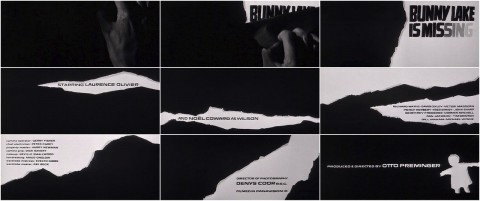
The excellent Art of the Title looks at the opening sequences to Anatomy of a Murder and Bunny Lake is Missing by Saul Bass.

Just Getting Started — Bill Moran on the Hamilton Wood Type and Printing Museum in Two Rivers, Wisconsin, for Design Observer:

When you hold a piece of wood type in your hands this deceptively simple piece of mass communication rewards you with its grace but also surprises with its weight. End grain maple is cut from the cross section of a tree yielding a harder and heavier piece of wood. Using the end grain of the wood improves durability with most wood type that was made in the nineteenth century still fully functional a century after its date of manufacture.

Leading the Blind — Nick Harkaway, author of The Blind Giant: Being Human in a Digital World, on book publishers and technology at The Guardian:

There’s a willingness to think: we’ll let everyone else figure out how the market should work, and then we’ll just supply books in the same way that we did to bookshops to electronic sellers like Amazon, Apple and Google. But booksellers are tied to publishing – they need conventional publishing models to continue – but for those companies that’s not the case. Amazon is an infrastructure company; Apple sells hardware; Google is really an advertising company. You can’t afford as a publisher to have those companies control your route to market.

Creative Paralysis — Michelle Dean on the future of ‘serious’ publishing at The Rumpus:

I don’t think there is anyone out there who has recently looked at the state of book publishing, I mean really looked, and not tightened her grip on her wineglass… I don’t work inside or report on publishing, but what limited exposure I do have suggests that there is indeed a crisis on the horizon. Anyone who’s ever wanted to see their name in print on the cover of a book — biography or novel, chapbook or memoir — ought to be thinking about that, about how to sustain the world of books. But the focus on the internet as the death of culture, which drones on in tired refrain on certain book sites, strikes me as bizarre, and overstated, not to mention creatively paralyzing.

And finally…

Eleanor Wachtel interviews composer Philip Glass for CBC Radio:

CBC Radio Ideas: Wachtel on the Arts with Philip Glass mp3

Comments closed

Something for the Weekend

Sturm und Drang — Author Nick Harkaway (Angelmaker and the forthcoming The Blind Giant: Being Human in a Digital World) on Amazon and the publishing industry for The Guardian:

The most thunderous argument in Amazon’s favour is that the market has spoken, and demands cheaper product. This one I find utterly bizarre. We know very well, in this post-crash age, that the market can be an idiot. The market wanted easy credit extended to all, low taxes and plenty of public spending. The end result was a financial catastrophe that has just plunged us into a double-dip recession and shows no sign of being played out. Sometimes, things cost more than we want. That is a truth we were encouraged to forget in the 90s, but it’s one we’re going to have to remember.

See also: Jason Epstein in the NYRB and Dennis Johnson’s on-going commentary on the Department of Justice’s legal shenanigans at MobyLives (archive).

Literature Needs More Than E-booksJames Bridle for Wired Magazine:

What we are coming to realise is that no one thing can pick up where the book left off; instead it is everything, all of our networks, our services, our devices, the internet plus everything else, which will carry literature forward. Literature is unique among art forms in that it is enacted entirely in the minds of author and reader; a psychic dance. Literature is everything, and thus everything must be employed in its support. And publishers, so long accustomed to doing a couple of things well, are adrift in a world that needs them to do everything — or GTFO.

And finally…

No Sympathy for the Creative Class — A fascinating piece by Scott Timberg for Salon:

Creative types, we suspect, are supposed to struggle. Artists themselves often romanticize their fraught early years: Patti Smith’s memoir “Just Kids” and the various versions of the busker’s tale “Once” show how powerful this can be. But these stories often stop before the reality that follows artistic inspiration begins: Smith was ultimately able to commit her life to music because of a network of clubs, music labels and publishers. And however romantic life on the edge seems when viewed from a distance, “Once’s” Guy can’t keep busking forever.

Yes, the Internet makes it possible to connect artists directly to fans and patrons. There are stories of fans funding the next album by a favorite musician — but those musicians, as well, acquired that audience in part through the now-melted creative-class infrastructure that boosted Smith.

(And on that cheery note, have a good weekend).

Comments closed