Skip to content

Tag: modernism

Something for the Weekend

Imprint talks to John Bertram about his Recovering Lolita project:

For obvious reasons, of course, [Lolita] remains as controversial a novel as it was a half century ago, if not more so. And, probably helped along by Kubrick’s breezy film, and many very terrible covers, the term “Lolita” has come to popularly mean something quite the opposite of the novel’s namesake, so a designer has that to contend with as well. On the one hand, then, designers face the very real challenge of communicating some of that complexity in a cover, which can easily become overwhelming… On the other hand, I think there are also important ethical considerations that require careful negotiation since, whatever people may think, we are talking about a novel which has child rape at its core.

There is more about  the project here (pictured above: Lolita designed by Rachel Berger).

The Bare Specificities — A really lovely profile of Portland-based book-scout Wayne Pernu at The New Yorker:

On the job, Pernu keeps a few principles in mind—first and foremost, the importance of condition. For example, with its original dust jacket, the value of a first-edition “The Great Gatsby” can multiply from two thousand five hundred dollars to more than two hundred thousand. “That little piece of paper on the book is often worth thousands and thousands of dollars, much more than the book itself,” Pernu says. “Specificity is really crucial as well. A book called ‘World History’ isn’t going to do well, but a book called ‘Peruvian Shovel Makers in the Seventeenth Century,’ that’s going to be worth a lot of money to someone. You always get excited when you see something that specific, no matter what it is.”

Also really nice: An interview with English letter carver Fergus Wessel for I Love Typography:

Eric Gill is my hero! His lettering, in my opinion, remains unsurpassed, partly because of its honesty. We are all striving for perfection, but there really is no such thing of course. If we try to control it and attempt to be too artistic, we are in danger of losing that honesty. One has to let the letters flow a little.

There are certainly strict rules of good layout and lettering, but rules are there to be broken. But in order to bend the rules, one has to know them in the first place, and attain that initial discipline. This requires years of experience and practice; it is something that evolves and it is during this evolution that you develop your own individual style and form.

And finally…

Alexandra Harris, author of Romantic Moderns, on Modernism at The Browser:

To an extent, yes. But take [Nikolaus] Pevsner for example, who was one of the great exponents of the Bauhaus version of modernism in England. Because there’s such a strong German tradition of minimal, pared down, internationalist architecture, for him it was a kind of nostalgia. It wasn’t our English tradition but a German tradition, so it seemed to us very brutal and modernist. But to him it was laden with associations and emotions, as it was for the other émigré artists like [Laszlo] Maholy-Nagy and Naum Gabo.

Again, what seems very new is actually attached to a tradition, and is so much more interesting that an absolute break with the past. A lot of these buildings that seem very modern are deeply entangled with a tradition of classical architecture using the same classical symmetries and the sense of elegance and refinement that comes straight down from Greece and Rome, and it doesn’t get more traditional than that. So there’s always a traditionalism in the modern.

Comments closed

Midweek Miscellany

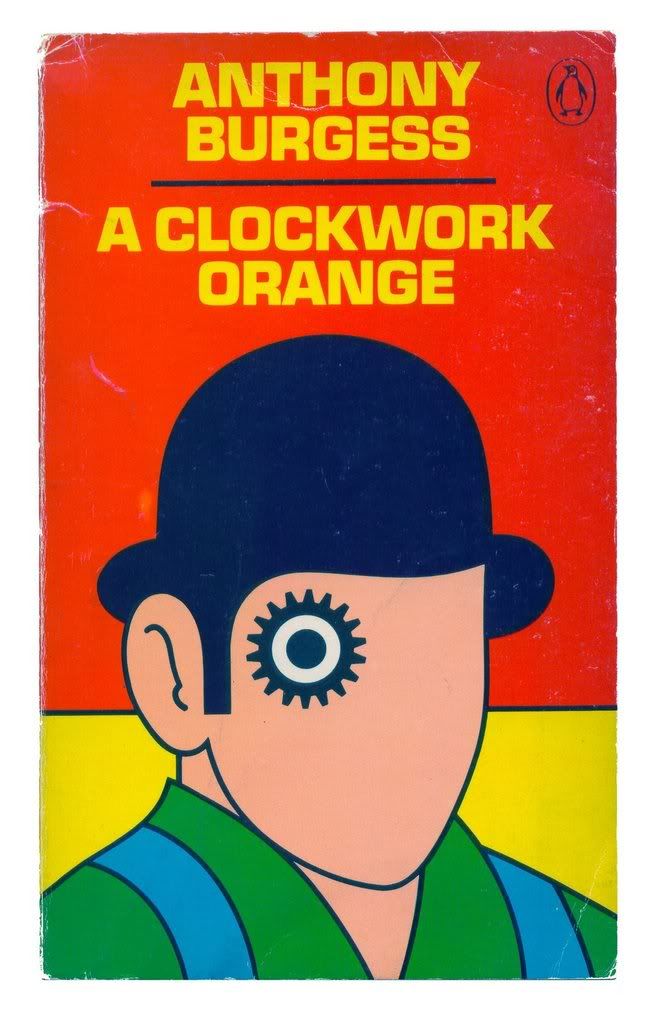
A little late on this, but 50 Watts has posted the winners of  Polish Book Cover contest. Will Schofield’s co-judges were Aleksandra and Daniel Mizieliński, editors of 1000 Polish Book Covers, and Peter Mendelsund. All the amazing entries are here. Pictured above: A Clockwork Orange by Chris Taylor.

Fragments of Experience The Guardian reviews Modernist America by Richard Pells:

Film editing, he tells us, owes debts to cubism, futurism and surrealism. Cutting from one shot to another enables the cinema to “create a feeling of movement as well as a sometimes fractured sense of time and reality. The fragments of experience, captured in a single shot and then juxtaposed with other shots to produce a multiplicity of perspectives, are the cornerstones of the cinema, and they are also central to the modernist view of the world.”

Music from Nowhere — Rob Young, author of Electric Eden, interviewed in the LA Times:

[P]art of my argument is that the British folk revival did actually begin much earlier than… the 1950s — you have to look back at the late 19th century and the Victorian folk collectors… [William] Morris is important because what you find in the 1880s and ’90s is a surge of conservation and preservation projects starting up, mainly by people who were horrified at the destructive effects of industrial progress on the landscape, the environment and the labor conditions of the working class. Morris was at the forefront of this, and his time-travel novel “News from Nowhere” sets out the utopian conditions of a better world in which the future is actually like a medieval golden age.

Gestalt-Ingenieur — Dieter Rams on design, Jonathan Ives and Apple for The Daily Telegraph:

I am troubled by the devaluing of the word ‘design’. I find myself now being somewhat embarrassed to be called a designer. In fact I prefer the German term, Gestalt-Ingenieur. Apple and Vitsoe are relatively lone voices treating the discipline of design seriously in all corners of their businesses. They understand that design is not simply an adjective to place in front of a product’s name to somehow artificially enhance its value. Ever fewer people appear to understand that design is a serious profession; and for our future welfare we need more companies to take that profession seriously.

And finally…

Music for Dieter Rams — a mini-album by Jon Brooks (via The Donut Project):

“Every sound on this record, from the melodic sounds to the percussion, the atmospheric effects to the bass lines originates from the Braun AB-30 alarm clock.”

Awesome.

Comments closed

Midweek Miscellany

Canadian illustrator and typographer Darren Booth at From The Desks Of

There’s on more on Darren’s cover for An Object of Beauty on his blog.

Misery — Editor and author Diana Athill profiled at The Telegraph (via PD Smith):

‘I have always been a watcher,’ she says. ‘Of myself in particular. Even at times of acute unhappiness I’ve watched myself being unhappy. I also think I’m one of those people who has never been wholly involved in an emotion, but then I think a lot of writers are like that.’

Is Modernism Boring? — Rhys Tranter at The Spectator Book Blog:

If modernism means anything in Woolf or Joyce, it is the struggle for what it means to be modern. Both present us with an array of fascinatingly complex characters, seeking to question their identity and their place in the modern age. Language becomes a character, too, an all-pervading texture that sets the mood of each story, and playfully subverts the ABC plots of yesteryear. Amid a proliferation of new technologies, of political upheaval and social change, Joyce, Woolf and the literary modernists actively interrogate the way we perceive the world around us, in ways still relevant today. In this way, modernism is not something we leave on our shelves and neglect to pick up. Modernism is that which speaks to modern life.

What’s the Worst that can Happen? — Gary Shteyngart, author of the dystopian Super Sad True Love Story, interviewed at the new and great looking book blog Full Stop:

Most people don’t care anymore because they’re beyond caring. The endless cult of self-expression that makes people stream or write about themselves day in and day out without any kind of filter. If you write a novel, you’re often writing about yourself as well, but you’re clearly filtering it through a bunch of things, not least of which is technique. So it’s not an entirely plausible future, but in some ways it could be. What if all the worst things happen politically, socially, and in terms of our literacy?

Top 10 fonts of 2010 lists from You Work For Them and Fontwerk (Google Translate version here).

And finally…

The 50 best comic book covers of 2010 as chosen by Robot 6

4 Comments

Midweek Miscellany

Killing Her Softly — Joseph O’Neil reviews Martin Stannard’s biography of Muriel Spark for The Atlantic (thx Ben):

In one of her memoirs, [Doris] Lessing suggests: “Writers, and particularly female writers, have to fight for the conditions they need to work.” This sounds like an understatement, particularly in relation to the last pre-feminist generation, to which she belonged. Dipping into it, we see that Penelope Fitzgerald, a mother of three, did not publish until the age of 58, that Iris Murdoch and Flannery O’Connor and Patricia Highsmith were childless. Spark may not have been alone in associating motherhood with artistic and personal annihilation. (Other patterns emerge. Highsmith, Lessing, and Spark all loved cats, and in fact Spark received a cat from Highsmith, with whom she also shared itinerancy and a gleefully vicious imagination. If you took scoops of the temperaments of Doris Lessing and Patricia Highsmith and added a dollop of Flannery O’Connor—for the cold Catholicism—the resulting gelato would taste a lot like Muriel Spark.)

Sensory Deprivation — The ubiquitous Jonathan Franzen, author of Freedom,  interviewed at the A.V. Club:

Where does this stuff come from? It comes from sensory deprivation. It comes from turning down all the volume knobs to the one setting—or somewhere between zero and one—on everything, so I can actually hear myself think and I can actually poke around inside myself. We’re all so used to cultural noise being played at full volume. It can come as a surprise, even to myself, how much you can know about what’s going on by listening to almost nothing. It’s important, because if you have it up at full volume, you can’t hear yourself think, and all you want to do is chase after the stuff that’s going on.

And if you think Mr Franzen might have got a little too big for his boots, then following Emperor Franzen on Twitter might be for you (“I was on the cover of TIME. That’s TIME magazine, bitches…”).

Fighting the Last War — John Le Carré talks to the BBC Radio 4 Today Programme about his new novel Our Kind of Traitor (released next month):

“I was laughed at, in a way, when the Cold War ended and the wall came down… ‘Poor old Le Carre, what will become of him? Nobody’s spying anymore.’ The reality is, the budgets have never been bigger, the recruitment has never been more wholesale.”

Boredom — Lee Rourke, author of The Canal, interviewed for 100th issue Bookslut:

We’re in constant thrall, either waiting to be used by technology or desperately trying to catch up with it. Boredom is the realization of an acute emptiness caused by this widening void… There’s nowhere for us to go now. We are stranded. We have been marooned. My novel, The Canal, is a summation of this sense of dread: this slow realization that things, everything, is speeding up and moving away from us. We have been left with the inability to deal with what this distance creates within us…

And finally…

Living in Conservative Times — Tom McCarthy reviews What Ever Happened to Modernism? by Gabriel Josipovici for The Guardian:

In cultural terms, we live in deeply conservative times… We shouldn’t imagine, though, that things were that different in the golden age of modernism. Ulysses was printed, in 1922, on a small, private press in Paris, in a run of 1,000; Kafka’s Metamorphosis, on its small-press publication in 1915, sold 11 copies – of which 10 were bought by Kafka. Yet can anyone, now, name the successful middlebrow writers of 1922 or 1915? Of course not.

(And, as this is a blog for people who like to live under rocks, Tom’s novel C was shortlisted for the 2010 Man Booker Prize yesterday.)

3 Comments

Q & A with Peter Mendelsund and Tom McCarthy

In the early days of The Casual Optimist I scribbled out a short list of book designers I wanted to interview. More designers have been added since then, but a few of the original list remain un-interviewed. At the top of the list has been the name I actually wrote down first: Peter Mendelsund.

As Senior Designer at Knopf, Mendelsund’s designs feature here regularly. Much as I love his covers, however, Peter has been interviewed extensively elsewhere. I just haven’t known how to approach his work in a way that he would find interesting.

That was until I saw the shockingly subversive jacket design for Tom McCarthy‘s new novel “C”. The pairing of Mendelsund, the designer who is a musician, and McCarthy, the author who is an artist, was — it seemed to me — inspired.

A perfect opportunity…

What follows is primarily an interview with Peter about that design for “C”. But over the course of a few emails, Peter and I both decided to bring Tom into the conversation. I had met Tom shortly after the release of his debut novel Remainder and Peter had, it transpired, met Tom in New York after Knopf had signed “C”. It made sense to both of us.

It is a long, but absolutely fascinating exchange. Peter kindly answered my questions more fully than I had any right to expect and Tom, who was contributing from Stockholm, was more than gracious in less than ideal circumstances. I’m grateful to them both.

7 Comments

10 Websites for Vintage Books, Covers and Inspiration

1. A Journey Round My Skull — “Unhealthy book fetishism from a reader, collector, and amateur historian of forgotten literature.”

2. The Art of Penguin Science FictionA comprehensive collection of Penguin sci-fi covers from 1935 onwards.

3. BibliOdyssey“Books… Illustrations… Science… History… Visual Materia Obscura… Eclectic Bookart.”

4. Book (Design) Stories — Felix Wiedler’s incredible collection of modernist design and typography books from Germany and Switzerland 1925–1965.

5. Book Worship — “graphically interesting, but otherwise uncollectible, books that entered and exited bookstores quietly in the 50s, 60s, and 70s”.

6. I Was A Bronze Age BoyComic books, crime fiction and pulp magazines curated by Mark Justice. Awesome name. Awesome blog.

7. Killer Covers of the Week — Pulpy goodness and vintage crime fiction covers expertly curated The Rap Sheet‘s J. Kingston Pierce.

8. The Pelican ProjectThings Magazine‘s collection of Pelican paperbacks organized by decade.

9. Pop Sensation — Rex Parker appraises, critiques and generally ridicules his vintage paperback collection.

10. Spanish Book CoversSpanish pulp: detectives, masked gangsters, pin-ups, skeletons, and zombies! (French language)

AND BONUS! 11. French Book Covers — But not entirely safe for work… It’s French. You have been warned.

Let me know if I’ve missed any other great vintage book cover sites. AND  I’m working on a list of book cover related photostreams and groups on Flickr so please pass on your recommendations! Cheers.

modernist book design in germany and switzerland 1925–1965 (and beyond)

17 Comments

Naïve: Modernism and Folklore in Contemporary Graphic Design

Published this month by Gestalten (thanks Siobhan!):

A minimalist design vocabulary is currently being reinvented by a troop of young graphic designers who are rediscovering the stylistic elements reminiscent of classic graphic design such as silkscreen printing, classical typography, hand lettering, woodcutting and folk art and integrating them into their work. Naïve documents this extraordinary renaissance of Classic Modernism, from the 1940s to 1960s, in contemporary graphic design.

1 Comment

From New Typography to Swiss Style

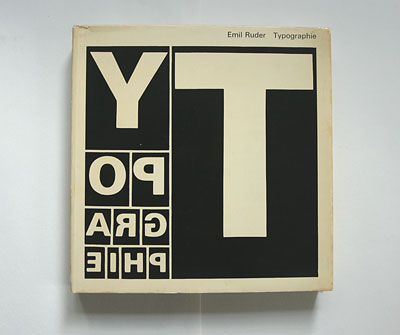
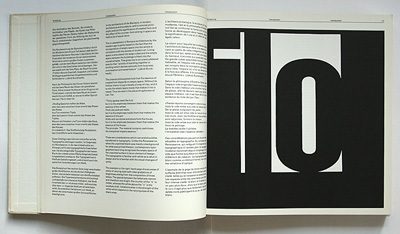
As the cover of Emil Ruder’s Typographie (pictured above) suggests, Felix Weidler’s vast collection of modernist book design in Germany and Switzerland 1925-1965+ is a remarkable archive. It not only includes covers, but interior photos, and notes. Brilliant. (via davidthedesigner).

Comments closed