Skip to content

Tag: massimo vignelli

The Great Discontent: Michael Bierut

michael-bierut-hero-jake-chessum

The Great Discontent has a really interesting (and long) interview with Michael Bierut about his career in graphic design:

The reason I love graphic design is because it’s a way to get paid to learn new things. For example, let’s say someone asks if you’d like to design a book. It’s not about being interested in pagination, covers, binding, typography, or paper. Those are all important, but what really makes designing a book fun is being interested in whatever the book is about. Sometimes it’s a great and exciting book that you’re really into: that’s like someone asking, “Would you like to sit and eat ice cream with me?” But sometimes it’s a book whose subject you don’t know about at all, so you get to talk to people who may be the world’s foremost experts on that subject. Even better!

When I brief interns about a project, I don’t say, “It’s this big and it has x amount of words and pictures.” I say, “These people are trying to do this, they’re trying to get this message across, and their big challenge is that.” Those pieces of information put the project into a larger context. That’s how I learned when I was starting out. I was a pretty good designer in college, and I’m not sure I’m a better craftsperson as I was then. However, I’m a much better designer now because I made people pay me to go from dumb to smart over and over and over again.

Comments closed

NYCTA Graphics Standards Manual Reissue

standards-manual

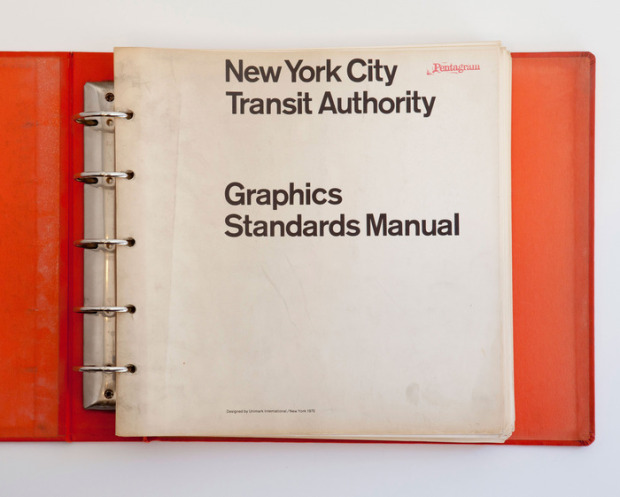
If you’ve been on Twitter for past couple of days you’ll have no doubt noticed that the design community (or the sizeable type-obsessed segment of it) is very excited that designers Jesse Reed and Hamish Smyth, founders of thestandardsmanual.com, have started a Kickstarter project to reissue the 1970 NYC Transit Authority Graphics Standards Manual by Unimark’s Massimo Vignelli and Bob Noorda as a full-size, limited edition book:

Every single day, millions of New Yorkers rely on the subway to get around the city, and you can’t use the subway without encountering the signage designed by Unimark. Over the years many changes have taken place (such as the switch from Standard Medium to Helvetica), but it is a testament to the quality of the work that, 44 years later, the signage holds up.

And perhaps on a deeper level, the signage has given the subway a voice. When a lot of people think of New York City, these signs pop into their head. We feel a tremendous responsibility to publish not only an important piece of design history, but an important part of New York City’s history.

Even if you can’t afford the book itself — it starts at $133USD if you live in Canada, more if you are in the EU —  you can back the project for as little as $3, and the project’s video featuring Pentagram‘s Michael Bierut on the graphic standards manual is well worth watching:

You can also see scans from a copy of the manual discovered the basement of design firm Pentagram in 2012 on thestandardsmanual.com.

Comments closed

Michael Bierut — The Creative Influence

creative-influence

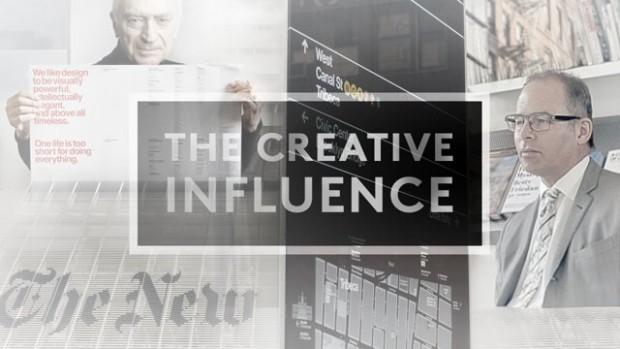
In this new short film for The Creative Influence documentary series, designer Michael Bierut talks about his mentor Massimo Vignelli, what makes an enduring logo, and how the internet has changed the way we work:

Comments closed

Designed by: Lella Vignelli

Designed_by_Lella

Designer Massimo Vignelli has created a book dedicated to the work of his lifelong collaborative partner and wife Lella:

Designed_by_Lella_3 Designed_by_Lella-2

The book can be downloaded for free as a PDF.

Comments closed

Design Is One: Lella & Massimo Vignelli


Design is One, the new documentary film by Kathy Brew and Roberto Guerra about designers Lella and Massimo Vignelli, opened at the IFC in New York yesterday:

Comments closed

Massimo Vignelli Makes Books

Massimo Vignelli discusses his approach to book design:

[vimeo http://vimeo.com/64811872 w=500]

The video was produced by Pentagram’s Michael Bierut and Aron Fay for Mohawk’s “What Will You Make Today?” campaign, and is accompanied by a limited edition journal that reproduces Vignelli’s grid from the film.

Comments closed

Midweek Miscellany

The Analytical Eye — Rick Poyner’s second essay for Design Observer on the visual interpretation of J.G. Ballard examines the work of French artist Peter Klasen:

What both Ballard and Klasen share… is a cold, appraising, analytical eye. It’s impossible to tell how they feel about what they show, or to know what they want us to feel, if anything at all. Their findings are disturbing and perhaps even repellent from a humanist perspective, yet the new aesthetic forms they use to embody them are, even today, exciting, provocative and tantalizingly difficult to resolve.

Any Colour — So Long As It Is Black — The WSJ profiles Massimo Vignelli:

“The greatest design has to provide a little pleasure,” he explained, producing the straightforward black bag he carries; Mr. Vignelli wears nothing but black. Proudly reporting that he’d bought the bag from a local street vendor, he pulled out a black Leica camera…, a pair of black Ray Bans and a tape measure—alas, bright yellow, not black.

“This is my dictionary,” Mr. Vignelli said of the tape measure. He explained that even as a child he had such fascination with the dimensions of things that he would challenge his friends to guess their size. He believes that subtleties of shape conjure emotion. “Is that three centimeters or four centimeters?”

All Forest, No Trees — David L. Ulin reviews The Information by James Gleick for The LA Times:

Over the course of human culture, there have been a number of significant transformations, beginning with the alphabet, which Gleick calls “a founding technology of information. The telephone, the fax machine, the calculator, and, ultimately, the computer are only the latest innovations devised for saving, manipulating, and communicating knowledge.” It is his idea that all these technologies exist as part of a continuum, with each developing from the last.

The key to such an argument is perspective, which is often in short supply when it comes to the information culture, with its tendency to inspire either paeans or jeremiads. Gleick, however, is too smart for that; he’s all about the forest, not the trees.

And finally…

Breaking Machines — Richard Conniff, author of The Species Seekers, on what the Luddites really fought against:

Despite their modern reputation, the original Luddites were neither opposed to technology nor inept at using it. Many were highly skilled machine operators in the textile industry. Nor was the technology they attacked particularly new. Moreover, the idea of smashing machines as a form of industrial protest did not begin or end with them. In truth, the secret of their enduring reputation depends less on what they did than on the name under which they did it. You could say they were good at branding.

Comments closed

Midweek Miscellany

Designers & Books — A beautiful new site compiling lists of books that designers identify as “personally important, meaningful, and formative.” Nice.

Rules Are What Make You — Michael Bierut at Designer Observer on his modernist upbringing at Vignelli Associates:

The rules weren’t written down anywhere or even explicitly communicated. They were more like unspoken taboos. Using Cooper Black, like human cannibalism or having sex with your sister, simply wasn’t done. For many young designers in the studio, the rules were too much. They resisted (futilely), grew restless (eventually), and left. By staying, I learned to go beyond the easy-to-imitate style of Helvetica-on-a-grid. I learned the virtues of modernism.

Thoughts on Design — The legendary George Lois at 10 Answers

When I was 14, aspiring to be a designer, 26 year-old Paul Rand published his iconic book, THOUGHTS ON DESIGN. My copy of it, bought, dime by dime with tip money delivering flowers all over the five boroughs for my fathers florist shop, remains the most important book in my library of over 10,000 art books. It’s thread-bare condition is witness to my reading, and memorizing, his revolutionary approach to the creation of communicative design.

Autodestruct — Author Ursula K. Le Guin reviews Monsieur Pain by Roberto Bolaño for The Guardian:

Surrealist narrative is a literary form at war with itself; disconnection is a primary tactic of surrealism, and story is a process of making connections, however unexpected. Readers open to the autodestructive element of modern art may find the surrealist devices in Monsieur Pain more deeply engaging than coherent narrative. I find them curiously old-fashioned, overly cinematic, and all too close to self-parody. But this early Bolaño novel has a moral and political urgency that obliges me to accept its noir banalities. Its tortuous method of approaching the unspeakable reveals the face of evil without glamorising it, as popular literature and film so often do. By indirection it avoids collusion.

And finally…

A stop motion digital magazine cover by Adam Voorhes and Will Bryant for Bluetooth’s publication Signature:

(via DesignWorkLife)

Comments closed

Smith and Vignelli

As is no doubt clear from recent blog posts, I have a huge amount of respect for the work of designer Massimo Vignelli and so I really enjoyed this recent interview with Debbie Millman for the new series of Design Matters.

Vignelli, however, does not want for ego, and so I was struck how humble British designer and cycling enthusiast Paul Smith is in this fascinating and inspiring conversation with designer Mike Dempsey by comparison:

Paul Smith Interview

Egos aside, it interesting that the lives and careers Smith and Vignelli seem share some unlikely common threads — from their early apprenticeships and life-long partners, to their sense of design, tradition, and detail.

Comments closed

Massimo Vignelli — A Short Documentary

It is turning into something of a mini Massimo Vignelli week at The Casual Optimist. Here is John Madere’s short documentary about the designer, mentioned briefly on Wednesday:

3 Comments

The Desk

The Desk is a fascinating mini-documentary about our complex relationships with our workspace. It features commentary from experts Alice Twemlow, Eric Abrahamson, Massimo Vignelli, David Miller, Kurt Andersen, Søren Kjær, Alfred Stadler, Jennifer Lai, and Ben Bajorek:

Created by Imaginary Forces for L Studio, The Desk first episode in a series called ‘Lines’  that looks at the design of everyday objects and they affect us. Other episodes include The High Heel, The Lens, The Elevator,  and The Parking Structure.

(via Brandon Schaefer)

Comments closed

Midweek Miscellany

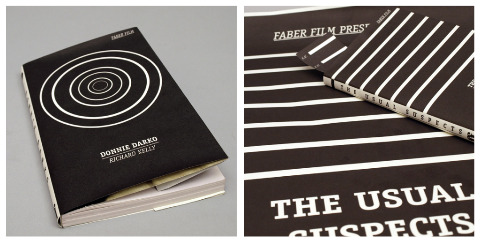
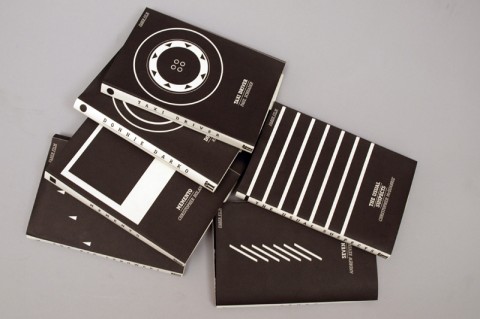
Another great set of designs for the 2009 D&AD student award brief for typography sponsored by Faber and Faber, this time by Rinse Design (via Cosa Visuales). See also: Ed Cornish’s designs for the brief.

Phaidon have relaunched their website and it is really rather nice (via FormFiftyFive).

The Imaginary PresentMike Doherty interviews William Gibson about his new novel Zero History for The National Post:

In his earlier books, Gibson says, he aimed to devise “futures that felt as though they were filled with designed artifacts, as indeed they would be. I can’t think of too many science fiction writers who’d bother trying to do that.” In the [new] series, his devotion to design has gone into overdrive, reflecting the idea that “everything is ‘designer,’ ” even though “with most things, you’ll never know the name of a designer.”

PopMatters also spoke to the author about the new book.

Code — Jennifer Egan, author of A Visit From the Goon Squad, reviews Tom McCarthy’s C for The New York Times:

[McCarthy] aligns disparate things into larger patterns full of recurring images: analogies between the human body and earth, and machinery; hums and whirs; film screens; bowels and tunnels; electric circuits; cauls and other silken membranes. These repetitions come to feel like the articulation of a larger code — as if, were readers to plot their exact positions throughout the novel, they would discover a hidden message.

What Ever Happened to Reading Properly? — ReadySteadyBlog’s Mark Thwaite on critics misreading of  Gabriel Josipovici’s What Ever Happened to Modernism?:

It’s interesting that Josipovici’s book which, in many ways, is both a call to read more carefully and an enquiry into why reading carefully is beyond so many cultural gatekeepers, has been read so sloppily by so many of its critics… Josipovici doesn’t invoke marginal or avant-garde writers, nor praise typographical or narrative playfulness over stale traditionalism, but rather brings us back to canonical writers (a good part of his essay is taken up with Wordsworth) and allows us to see what was at stake for those artists in their work, and what is at stake for us as readers.

And finally… It’s Vignelli week at Design Observer:
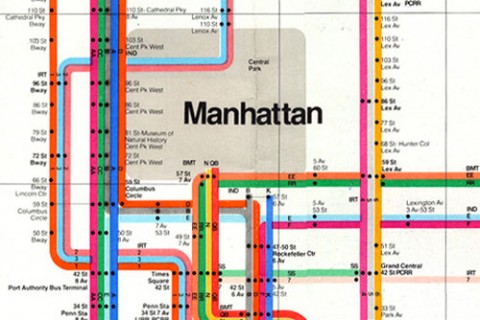
Debbie Millman’s 2007 interview with Massimo Vignelli (excerpted from her book How To Think Like a Graphic Designer):

I’m interested in “essence” — my major aim is really to get to the essence of the problem. And just throw away everything that’s not pertinent to it. At the end of a project, my work should be the projection of that experience, the essence of effect. It’s a habit that you get into… The essence is what is left when there’s nothing else that you can throw away.

Michel Bierut profiles Lella Vignelli:

Massimo has often defined their working relationship like this: “I’m the engine, and Lella is the brakes.” The first time I heard this as a young designer, it was clear to me which was more important. If you were a designer, wouldn’t you want to be the engine, powerful, propulsive, driving forward? It was only years later that I remembered something my high school driving instructor once said: “You don’t get killed in a car accident because the car won’t start. You get killed because the breaks fail.”

And, there is an interesting, beautifully shot, video interview with Massimo Vignelli by photographer John Madere here.

There will surely be more good stuff as the week progresses…

Comments closed