Skip to content

Tag: Marketing

Marketing Plan

A little too on the nose, Tom. 

(Tom Gauld for The Guardian)

Comments closed

One Book, Two Titles

Writing for the Globe and Mail, Claire Cameron, author of The Last Neanderthal, takes a look why at Elisabeth de Mariaffi’s new novel is being packaged differently in Britain and Canada

A novel is like a question – what happens when…? [UK publisher] Titan Books is focusing on what happen when a child goes missing. “There is nothing more terrifying than the loss of a child!” publisher Miranda Jewess says. Meanwhile, HarperCollins Canada publisher Iris Tupholme says, “Our focus in positioning the book is less on the missing child, though that is a key part of the story, and more on the tension and mystery for [the mother] Heike.”

The book was originally titled ‘I Remember You’ when it was sold to the publishers. But when de Mariaffi brought forward ‘Hysteria’ as an alternative, Tupholme loved it because it “suggests the book’s complexity … the story’s focus on women.” Jewess also considered the new title, but thought ‘Hysteria’ “sounded like a more gritty action thriller.”

Both covers do tap into deep-seated fear. But the different focus of those fears may speak more to a transatlantic literary divide, says Kate Pullinger, a Canadian novelist in Britain and professor of creative writing and digital media at Bath Spa University. She sees the two covers as responding to each market for fiction.

“In Canada, the popular writer can remain literary,” but in Britain, though there are exceptions, Pullinger says “literary fiction is increasingly devalued and invisible in the marketplace.” In her view, the British cover is trying to connect to the commercial market; it ties into the tabloid newspaper culture that screams for attention. “Scary Sad Crime Happened Here!”

I seem to spend a lot of time in my professional life trying to explain why titles and covers for Canada (and the US) sometimes need to be different from their counterparts in the UK. I even put together some examples for recent trip to London. So I don’t know that this is a ‘rare’ as Cameron supposes. But, in any case, enough people have expressed interest in this that I am trying to expand that original deck into a more coherent presentation for a few other clients. If I ever get it finished I will share a version of it here. 

Comments closed

The Shiny Surface of Jonathan Ive

My ‘longreads’ to-read list is as bad, if not worse, than the pile of books I have to read right now, so it’s taken me until today to get to that very, very long New Yorker profile of Jonathan Ive, the senior vice-president of design at Apple.

Unfortunately, the whole thing is a bit disappointing and, I thought, even a little sad. By the end, Ive remains an enigma. What lingers is his famous friends, love of bland luxury brands, and just how remarkably wealthy he is (writer Ian Parker reminds you several times that Ive owns a private jet).

It seems Ive is either depressingly shallow or, more likely, these superficial things are all that he is willing to reveal about himself, which is depressing too in its own way. Ive is, no doubt, just politely protecting his privacy, but he comes across as peevish and sadly unlikeable, which is a shame. Or maybe I’m just not interested enough in industrial design and luxury brands, or Apple if it comes to that.

The article does, however, give me an excuse to post this blistering 15 minute video of NYU Stern marketing professor Scott Galloway talking a mile-a-minute about Apple, Amazon, Facebook and Google. I’m sure he’s wrong about a lot of things, but not only does he talk about Apple’s transition from tech company to luxury brand, he also offers some of the most cogent insights into the current problems facing Amazon I’ve heard in a while:


Interestingly, Ian Parker says in his New Yorker article that watch manufacturers are not worried about Apple stepping into the market. Galloway says they should be. I guess we’ll see who is right.

Comments closed

Jonathan Franzen Says No

So good, Tom… So, so good.

4 Comments

Hitchcock and the History of Movie Trailers

If you are still stewing over last night’s lacklustre Oscars (or even if your not), take a listen to Terry O’Reilly’s entertaining history of movie trailers for The Age of Persuasion. He kicks it off with this genius trailer for Alfred Hitchcock’s The Birds:

And, for it’s worth, movie trailers were originally created to get people OUT of theatres, not into them. Brilliant.

Listen to The Age of Persuasion podcast:

CBC RADIO: AOP GOES TO THE MOVIES

Comments closed

Incidental Media

I’m not exactly sure how the ideas in these videos by Dentsu London and BERG relate to books and print, but I’m pretty sure they do in some tangential way.

There’s a lovely sense of how new media can connect and adapt old media in interesting, unobtrusive ways, and it seems much more human-shaped than the rather linear idea that a new technologies must replace or destroy existing ones:

(via Russell Davies)

Comments closed

Something for the Weekend

Salu, Bonjour! — The Caustic Cover Critic features the awesome work of designer Michael Salu. The typography is great.

And speaking of typography…

KnockoutThe New York Times profile type jedis Hoefler & Frere-Jones:

Sitting in their New York studio in the charmingly ramshackle Cable Building, designed in 1892 by the flamboyant Beaux-Arts architect Stanford White, Mr. Hoefler and Mr. Frere-Jones are engaging advocates for their craft. They met in 1989, when they were working independently and found themselves hunting for the same antique typography books. “We’ve given up now because the prices have gone crazy,” said Mr. Frere-Jones. “Between us we own so many that if there’s something we don’t have, it’s either an uninteresting variation or there’s only one in the world and it costs $20,000.”

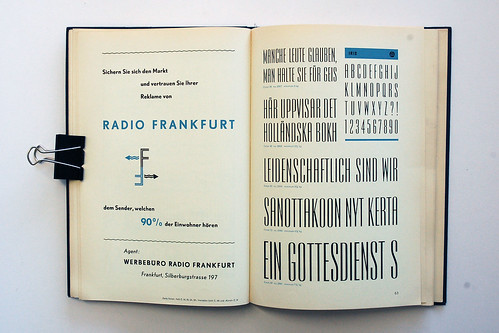
Schriftenkatalog — Beautiful pages from a 1960’s Dutch type catalogue on Flickr (via Inspire Me)

And… The history of the ampersand at the Webdesigner Depot (thanks Nic).

A Guide to Online Publicity (For Dummies) — Freelance writer, editor and blogger Lindsay Robertson’s common sense — but on the money — “do’s and don’ts” for flacks like me approaching bloggers like er… me (via Kottke).

And finally…

Two lovely posts at The Silver Lining featuring the work of Elaine Lustig Cohen: Part 1 and Part 2. There are more Elaine Lustig Cohen book covers at ephemera assemblyman and there is an amazing Flickr pool devoted to the design work of Alvin and Elaine Lustig here.

1 Comment

Something for the Weekend, July 3rd, 2009

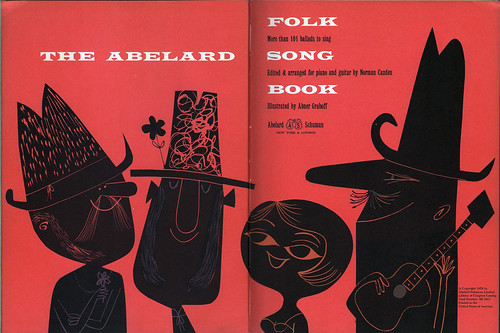
Who Was Abner Graboff? —  Frustrated with the lack information available online about artist, designer and illustrator Abner Graboff, Ward “Ward-O-Matic” Jenkins decided to do some digging himself. His research — now available in a three part series —  includes a host of great images of Graboff’s children’s books and book cover designs, as well as a nice interview with Graboff’s son Jon:

Throughout my father’s career, he did hundreds of book jacket designs and I once asked him, in a slightly condescending way, if he enjoyed that kind of work? He said he loved it because he had to nail the vibe of the book in a single illustration and when he got it right, that it was very satisfying. There was a long period of time when I could walk into a bookstore, look around, pick up a book and look at the jacket design credit… and more often than not, find his name. Later on, I started to get fooled. Other designers were either copying or being heavily influenced by his style.

Calling Bullshit on Social Media — Scott Berkun, O’Reilly author of The Myths of Innovation and Making Things Happen (via — irony alert — Mark Bertils on Twitter):

TV forced radio to change and in some ways improve. The web forced TV, newspapers and magazines to change, and they will likely survive forever in some form, focusing on things the web can not do well.  Its unusual for new thing to completely replace the old ones and when they do it takes years. Anyone who claims social media will eliminate standard PR or mass media is engaging in hype, as odds are better those things will change and learn, but never die. It’s wise to ask what each kind of media / marketing is good and bad for and work from there.

Berkun’s definitely onto something here and it probably deserves a whole post (maybe later!)… Certainly, he’s right to point out (earlier in the essay) that there have always been social networks. But he doesn’t note that for many city dwellers traditional social and familial networks have been breaking down in the post-war period, which I suspect is part of the seductive appeal of connecting online for us slightly older urban types whose use Twitter and Facebook a lot… Anyway, it’s interesting that some of Berkun’s points about technology probably also apply to e-books.

Berkun’s essay also reminded me of an article I read in Fast Company earlier in the week, Our Kids Aren’t Web-Addicted… Are We?:

It’s only we adults that are at PC workstations all day, looking for ways to avoid doing work or trolling the boundaries of our IT-installed browser filters. And we’re the only ones who have social networks big enough to require a tool like Twitter. Imagine how absurd Twitter seems when you only have 10 or 12 friends, not a network of 300+ coworkers, college buddies and colleagues?

And finally…

Krazy — Bill Watterson, creator of Calvin & Hobbes, on George Herriman’s seminal comic strip Krazy Kat, reproduced at This Recording (via Bookslut):

Krazy Kat gains its momentum less from the personalities of its characters than from their obsessions. Ignatz Mouse demonstrates his contempt for Krazy by throwing bricks at her; Krazy reinterprets the bricks as signs of love; and Offissa Pupp is obliged by duty (and regard for Krazy) to thwart and punish Ignatz’s “sin,” thereby interefering with a process that’s satisfying to everyone for all the wrong reasons. Some 30 years of strips were wrung out of that amalgam of cross-purposes. The action can be read as a metaphor for love or politics, or just enjoyed for its lunatic inner logic and physical comedy.

Comments closed

Why Not? Or How We Live-Tweeted Fall 09

Why Not?

One the things that really stuck with me from Michael Tamblyn’s 6 Projects That Could Change Publishing For Ever presentation at the BookNet Tech Forum in March was the idea that publishers have to “place lots of little bets quickly.”

It tied into another idea that’s been kicking around recently about reframing ‘Why?’ questions into ‘Why Not?’ questions. That is to say, whenever we — publishers, book distributors et al — ask “why would we do this?” we should flip the question on it head and ask “why wouldn’t we?”.

This doesn’t mean we should pursue every idea that someone puts forward. Sometimes there will be good reasons not to try something — “it costs too much” and “it’s illegal and/or evil” are perfectly valid reasons that spring to mind to nix something (and no doubt there are  plenty more). But, in my experience, reframing the ‘why?’ question encourages people (me included) to think creatively and be more positive about ideas/projects we might otherwise dismiss out of hand.

#rainfall09

This is all a roundabout way of explaining how I ended up twittering from the  Raincoast Books Fall 09 Sales Conference last week.

Before we got under way on the first morning, a few of the early birds were laughing about using Raincoast’s Twitter account to micro-blog the presentations as they happened. Although it started as a joke, the near-inevitable “why would we?” and “who cares?” questions came up, and that raised the stakes. I turned the questions around and couldn’t actually think of any good reasons why we shouldn’t ‘live tweet’ the conference. I had my laptop, wireless access and a power source, so it seemed easy enough to do. And I figured people would tell me pretty quickly if they were bored and I should stop.

Decision made.

We quickly adopted #rainfall09 (an identifying reference tag for twitter posts or ‘tweets’ which was accidentally shortened to #rainfall on more than one occasion) and,  with some help from my colleague Siobhan, I covered all 3 days of the conference in a series of posts of 140 characters or less.

To people who live their lives online and are accustomed to social media rather than the slightly conservative book publishing world, the response to all this is probably a very sarcastic “big whup”. But sales conferences are not usually open and inclusive, and, needless to say, there was a degree of skepticism and resistance to overcome. Certainly it was experiment for us, if not, admittedly, a very large one. And  we were, as far as I’m aware (and someone please correct me if I am wrong), the first publisher/book distributor to Twitter their entire conference.

20/20

With the benefit of hindsight, the drawbacks were predictable. It was very intensive and time-consuming and I found it was difficult — at least initially —  to interact with the people actually in the room and tweet. I’m sure I missed a lot of nuance and I passed on more than few book samples with the barest of glances. We probably over-tweeted and lost a few followers as a consequence.

That all said, the positive outcomes vastly outweighed the problems. The feedback was overwhelmingly positive. We learnt as we went along — becoming better organized and tweeting less — and we gained far, far more followers than we lost over the 3-day period. Our posts were re-tweeted. Followers asked questions and made requests. We raised awareness of Raincoast, the publishers we work with, and the books we distribute. And we were able to connect with reviewers and bloggers we weren’t previously aware of.

I would do some things differently next time for sure. But, ultimately, it was definitely worth doing.

If you are thinking about live-tweeting your conference, here are my 5 Tips:

  1. Be Prepared — Whilst Twitter is great for spontaneity,  making sure you can set-up  your laptop with internet access, and a power source is essential (our conference days were 10 hours straight). And knowing the books (at least a little) in advance, definitely helps — I was often scrambling to find additional information on particular titles and bookmarking a few pages in my browser in advance would have been a plus.
  2. Be selective — Raincoast Books is primarily a distributor. We have something like a thousand titles a season from a variety of publishers. It is impossible to tweet about all of them, and it became quickly apparent it isn’t desirable to try. Our followers just wanted the highlights.
  3. Link — Readers also wanted links to more details if a title caught their eye. I had publisher websites and google open in separate tabs at all times. Even so, linking wasn’t always possible. Put your marketing materials online early and encourage your authors to update their sites (and join Twitter!).
  4. Be creative — If you can’t get your marketing material for your key titles online before conference, or something comes out of left-field, use the resources you do have to find an interesting work-around. When we had some very immediate reader interest in a book called The Quotable Douchebag and there was no information available online, the publisher Quirk Books quickly threw up a blog post with details.
  5. Tool-Up — Twitter management tools like TweetDeck and HootSuite are always useful for professional Twittering, but being able to quickly monitor replies, retweets, and references, not to mention conveniently shorten URLs was essential during conference.

Did you follow @RaincoastBooks or #rainfall09 last week? If so, how did you think it went? What could we do better next time? Leave a comment below or email me.

Note: This is my personal blog, and this post is my personal opinion. Neither reflect the opinion or official policy of Raincoast Books.

Illustrations from the Inspired Magazine Social Bird Icon Set (From the top: Chimero’s Birdie by Frank Chimero, Burdy by Tad Carpenter, and Jacque by Jessica Gonacha).

2 Comments

Midweek Miscellany Feb 18th, 2009


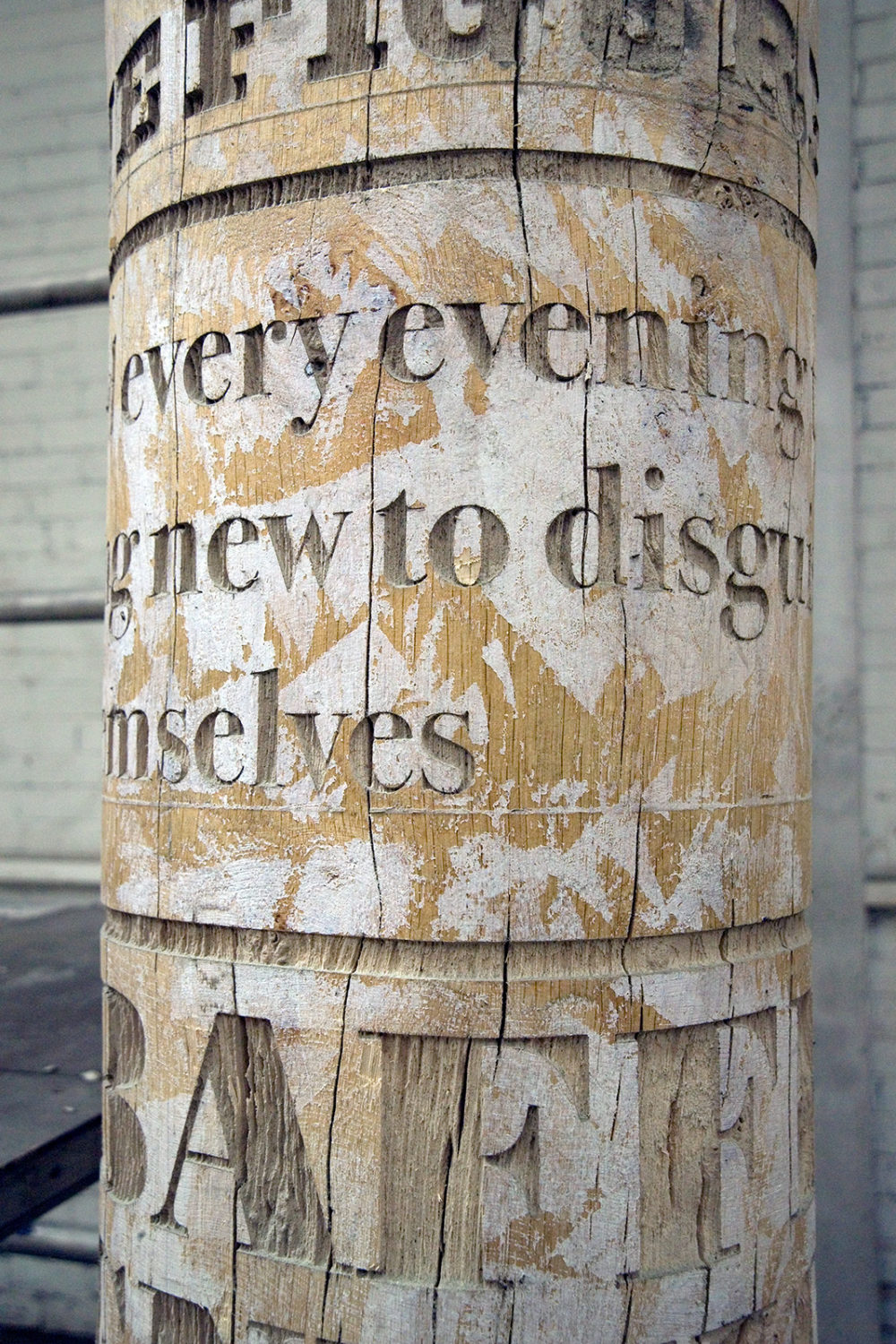
Typographic Trees — I saw pictures of the latest collaboration between artist Gordon Young and design studio why not associates a while back, but a mention in the latest issue of Creative Review is the perfect excuse to post a couple of images of these lovely sculptures for Crawley Library in West Sussex. It’s probably worth mentioning that (unsurprisingly) why not also do a nice line book design.

An interview with Allan Kornblum, publisher at nonprofit literary publisher Coffee House Press, is the latest installment in Scott Esposito’s How to Publish in a Recession series  at Conversational Reading:

Now with Borders on the brink, and former readers becoming would-be writers and self-publishing books instead of reading books, a major shake-up was inevitable… The recession isn’t the only factor driving changes in writing and publishing. Writers on the one hand, and book and magazine publishers on the other, are both trying to figure out what the changes in information technology will mean. Will books get shorter, so they can be read on a cell phone? Will nonfiction migrate to ebooks, while literature stays on the printed page? Will backlist titles become downloadable PDFs? Will future desktop printers include binding equipment?

Funeral in Berlin — Possibly the most badass cover ever (pictured above) and part of the amazing collection in the Penguin Paperback Spotters’ Guild Flickr pool (first seen at FFFFound). And funnily enough it is apparently Len Deighton’s 80th Birthday.

30 Novels Worth Buying for the Cover Alone — “A book must stand out on the bookstore bookshelf yet cover designers rarely receive the recognition that authors do.” And  in “appreciation of these unsung artists”, Beth Carswell chooses her 30 favourite fiction covers for AbeBooks.

MinuteMen — a retro-Nintendo-style-arcade-kung-fu-kick-punch-jump-game promoting the new Watchmen movie. Smartass viral marketing if you like that kind of thing. And if you listen closely, that sound you hear is Alan Moore’s teeth grinding away in Northampton. Buy the book.  (via GalleyCat).

How do you define good design? Gary Hustwit, director of Helvetica, interviewed about his new film Objectified at the Dwell Magazine blog:

If it didn’t exist, would anyone really miss it? Would it leave a hole in anyone’s life?

If we asked ourselves this question in publishing more often, how many books would actually get published? And would publishers be in the mess they’re in now? Answers on a postcard please.

And finally, Spy Vibe — a blog dedicated to 1960’s spy style! This is so cool I can’t even be bothered to find a tenuous link to books or publishing (although there surely is one)…

2 Comments

Monday Miscellany

“I have always enjoyed photographing loners” — A lovely BBC audio slideshow of “Writers’ Rooms” narrated by award winning photographer Eamonn McCabe. The project, appearing weekly in The Guardian and currently on show Madison Contemporary Art in London, captures the working environments of novelists, biographers and poets.

Book Industry Enters Shaky Chapter: NPR’s Lynn Neary looks at last week’s horrorshow.

The 10 Best Books of 2008 according to The New York Times Book Review. Interesting that they’ve also created a mini-site which has promotional material for the top 10 books, including shelf talkers, bookmarks, and posters for bookstores to download . There are also web banners and a video with author Toni Morrison. This is has to be a good idea.

“The news is still big. It’s the newspapers that got small”: A spectacular Roger Ebert rant about the death of criticism :

The celebrity culture is infantilizing us. We are being trained not to think. It is not about the disappearance of film critics. We are the canaries. It is about the death of an intelligent and curious, readership, interested in significant things and able to think critically. It is about the failure of our educational system. It is not about dumbing-down. It is about snuffing out.

Spot. On.  I actually met Roger Ebert a few years back in Pages bookstore. The Toronto International Film Festival must have been on. I had no idea who he was at the time (a colleague told me later), but he was very nice about it.

“The Most Dangerous Man in Publishing”:  A profile of publisher Barney Rosset in Newsweek:

Before Rosset challenged federal and state obscenity laws, censorship (and self-censorship) was an accepted feature of publishing. His victories in high courts helped to change that. Rosset believed that it was impossible to represent life in the streets and in the dark recesses of the heart and mind honestly without using language that in the mid-20th century was considered “obscene”—and therefore illegal to sell or mail. To a significant extent, the books he published convinced others that this was true.

The Well-Tended Bookshelf— Laura Miller on culling one’s book collection:

There are two general schools of thought on which books to keep, as I learned once I began swapping stories with friends and acquaintances. The first views the bookshelf as a self-portrait, a reflection of the owner’s intellect, imagination, taste and accomplishments… The other approach views a book collection less as a testimony to the past than as a repository for the future; it’s where you put the books you intend to read.

Which leads me rather nicely to…

Books At Home: A blog about bookshelves. It is possible that this just too nerdy. Even for me.

Relevance: Brian at daxle.net interviews author Tim Manners , editor and publisher of The Hub and Reveries.com. It’s a fascinating discussion that covers innovation, brands, and the consequences of overabundant advertising (amongst other things).

3 Comments

This Is Where We Live

This Is Where We Live is a wonderfully rich stop-animation video celebrating the 25th anniversary of HarperCollins imprint 4th Estate. The entire video is made from books–or parts of books–published by 4th Estate:


This Is Where We Live from 4th Estate on Vimeo.

A high-definition version of the film (recommended), production stills, and other behind the scenes footage, can be found at the special ’25th Estate’ website. Apt Studio’s Times Emit blog also has details about their involvement in the project.

Link

Comments closed