Skip to content

Tag: magazines

The Greatest

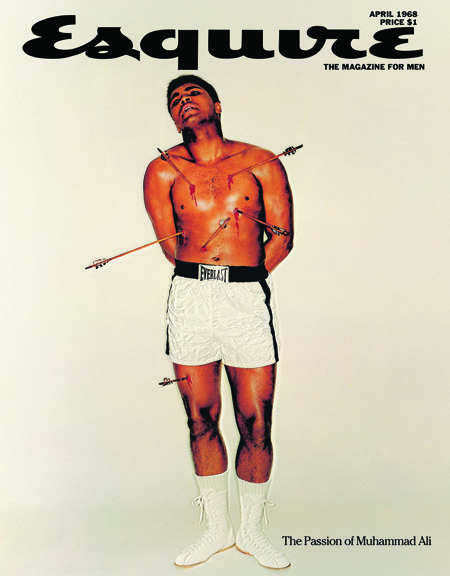
Like Dieter Rams, George Lois seems to be a recurrent theme here and I was wondering why that was. Sure, he has a new book out (published by Assouline), but why is he still relevant? Thinking about this, I kept coming back to his April 1968 Muhammad Ali cover for Esquire.
George Lois Esquire: Ali as St SebastianIn 1964 Muhammad Ali, the heavyweight champion of the world, had controversially joined The Nation of Islam and changed his name from Cassius Clay. Three years later he refused to be drafted into the U.S. army because of his religious beliefs and opposition to the Vietnam War. He was stripped of his world title and had his professional boxing license suspended.

At a time of racial tension in the US (there were race riots and civil rights protests across the country in 1967 as well as protests against the Vietnam war) Ali was a successful, outspoken, controversial and self-confident black man refusing to fight for his country. He was reviled and, one suspects, feared by white conservative America.

By 1968, Ali was on bail awaiting his appeal to the Supreme Court. He was still unable to fight and the magazine was planning a story on his exile from the ring.

Putting the boxer on the cover was certainly controversial. But Lois did not make the fighter ‘respectable’ (one doubts the thought even entered his head). Instead, in a photograph taken by Carl Fischer, he presented Ali bare-chested and pierced with arrows.

It is a striking, bloody, and shocking image — especially given the context.

Yet it is also witty, irreverent and surprising: a complex “big idea” rendered with beautiful simplicity.

Lois posed Ali as Saint Sebastian, a 3rd Century Christian soldier and martyr who was bound to a post and shot full of arrows for his beliefs (the arrows, incidentally, didn’t kill him — a subsequent beating took care of that).

The reference was a postcard of a 15th Century painting by attributed to Castagno in the Metropolitan Museum in New York (the Met have since re-attributed the painting to Francesco Botticini).

Like so many of Lois’ other covers for Esquire — this is unquestionably an attack on the establishment. But ‘Ali as St. Sebastian’ is also just about the most elegant and incisive “fuck you” imaginable. It is not the shocking irreverence that makes it resonate — it’s the lacerating wit.

From race to sex to Vietnam — this stuff mattered to Lois. And that never, ever gets old.

Links:
George Lois

George Lois AIGA Medalist
The Passion of George Lois, Design Observer
George Lois 12 Favourite Classic Esquire Covers, New York Magazine
George Lois, Wikipedia

Trailer for the documentary Art & Copy featuring a movie-stealing George Lois (just guess which one he is):

1 Comment

Midweek Miscellany

Well, oh shit. Go fuck yourself — The pugnacious George Lois in BlackBook magazine:

The design was the idea. I don’t design, if you know what I mean. If you want Andy Warhol being devoured by his own fame in a can of Cambell’s soup, you just put the can there and you have him drowning in it. Case closed.

You’re knocked down by the idea, and the fact that it’s got complete clarity visually. Don’t complicate it with busy work.

That’s the way I do everything. If I was a doing a magazine, it’s not a question of if I’d be having more white space. It’s a question of every third or fourth spread I’d make a spread that would take your breath away — or piss you off. Or something.

“Yoda” — An interview with Dieter Rams at More Intelligent Life (Thanks Ben S.):

We have enough products. If you look at the market you have ten or 20 coffee makers that basically look all the same, doing all the same thing: they are making coffee. We don’t need 20 of these things, we need one good one.

Less, But Better… Less, But Better… [REPEAT].

The View From TorontoNational Post book critic Philip Marchand (formerly of the Toronto Star) talks to Conversations in the Book Trade:

I’m not sure how much “trouble” literature is in. The age of Tennyson was the last period in literature when “serious” literature found a mass market. Ever since, we’ve had a very small minority of readers for “serious” stuff, and a fairly large audience for thrillers, romance novels, detective novels, and so on. Then there’s the Da Vinci Code phenomenon in which everybody, from your dentist to your car mechanic, is reading a certain book – in order to be able to join in discussions about the book on social occasions, if for no other reason.

Frontmatters — Alex Camlin, Creative Director at Da Capo (interviewed here), has started a blog! Yay Alex!

This is Display! — Another site (along with the Alvin Lustig archive) that probably should have been on yesterday’s list of inspiring websites, Display is a “curated collection of 59 (and growing) important graphic design books, periodicals and ephemera.”

Comments closed

Monday Miscellany, February 9th, 2009

“Books exist because we want and need them” — A slide show of pages from Robert Bringhurst’s new book The Surface of Meaning: Books And Book Design In Canada (pictured) published by CCSP Press in The Globe and Mail. (Disclosure: The Surface of Meaning is distributed by Raincoast in Canada).

A bookshop is a dynamite-shed — Bookride have posted a splendid John Cowper Powys rant about second-hand bookshops:

[A] bookshop — especially a second-hand bookshop — is an arsenal of explosives, an armoury of revolutions, an opium den of reactions. And just because books are the repository of all the redemptions and damnations, all the sanities and insanities, of the divine anarchy of the soul, they are still, as they have always been, an object of suspicion to every kind of ruling authority.

Pessimism Porn — Hugo Lindgren explains his addiction to nightmarish economic news  in New York Magazine:

“[E]cono-porn… feeds a powerful sense of intellectual vanity. You walk the streets feeling superior to all these heedless knaves who have no clue what’s coming down the pike. By making yourself miserable about the frightful hell that awaits us, you feel better. Pessimism can be bliss too.”

Publishing certainly has its fair share of addicts…

Visionary locations — Toby Litt on J.G. Ballard in the Guardian:

“Plenty of other writers now fictionally venture into multistorey carparks, airport hospital wards, decaying hotels, but they do so in the knowledge that they’re trespassing on Ballard’s territory. He was here first; he was the pioneer – back when these places were seen as totally unliterary. What could possibly happen on a motorway embankment that was of interest?”

Finding alternative best sellers — Toronto bookshop This Is Ain’t The Rosedale Library profiled by Brian Joseph Davis in the Globe and Mail.

Is CondéNet Dead? — Slate’s The Big Money examine how “a publishing giant failed to get the Web”. Lessons (if more were needed) for book publishers (via @jafurtado):

“To say that we’re just a magazine company in this day and age is like saying that we’re a buggy company.”

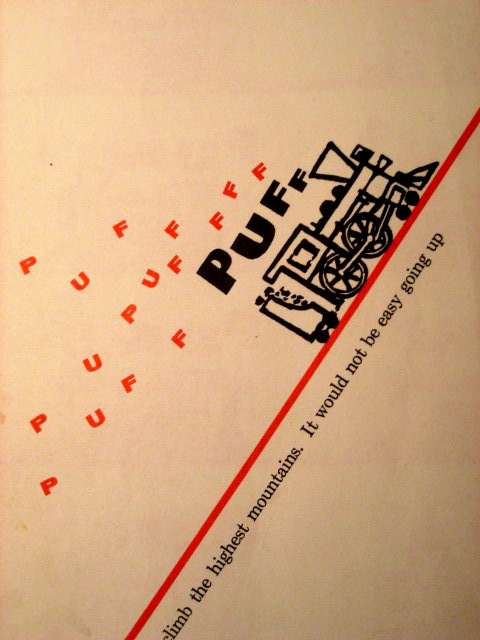
PUFF — lovely pictures of PUFF by William Wondriska (published in 1960 by Pantheon Books Inc.) at the wonderful Grain Edit (pictured above).

Image Spark— A neat image bookmarking tool. V. excited about this as you can probably imagine… (via @michaelSurtees/DesignNotes) .

1 Comment

Print Isn’t Quite Dead Yet Apparently

Even though the internet played an unprecedented part in the US presidential election campaign (at least according to Adrianna Huffington), Barak Obama’s historic victory sparked a run on the old-fashioned newspaper the following day. Papers increased their print-runs, but newsstands still sold out, and copies of the New York Times sold on sale ebay at inflated prices. Sam Martin at Design Mind has an facinating take at what this means for print:

“If print is dead – a rumor that has been going around for quite a few years now – why are so many people still interested in it?

It would be folly to say print is relevant because of a single day of big sales. To me it’s more of a testament to the quality, longevity, and emotion that’s still attached to print… True, you can keep a PDF on your computer or bookmark an article to remember later. But nothing compares to the long term impact of something you can hold in your hands.”

Link (via DesignNotes)

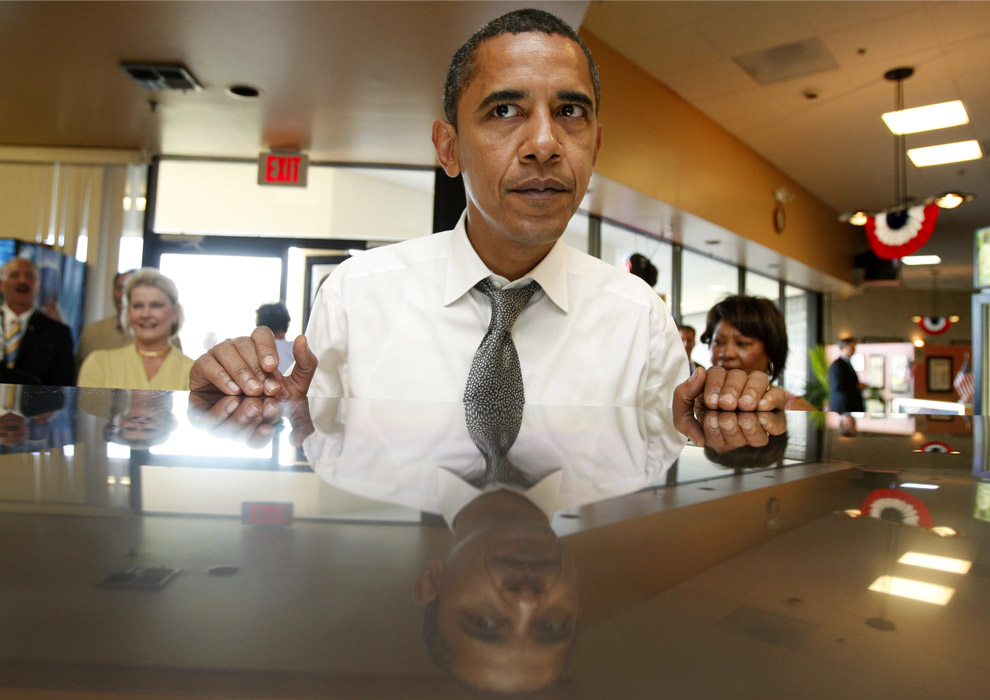
(Photograph of Barak Obama seen at The Big Picture)

1 Comment