Skip to content

Tag: krazy kat

Chris Ware on George Herriman and Krazy Kat

The New York Review of Books has an essay by cartoonist Chris Ware on George Herriman the creator Krazy Kat, one of the most beautiful, poetic and inventive comic strips ever created:    

Krazy Kat has been described as a parable of love, a metaphor for democracy, a “surrealistic” poem, unfolding over years and years. It is all of these, but so much more: it is a portrait of America, a self-portrait of Herriman, and, I believe, the first attempt to paint the full range  of human consciousness in the language of the comic strip. Like the America it portrays, Herriman’s identity has been poised for a revision for many decades now. Michael Tisserand’s new biography Krazy does just that, clearing the shifting sands and shadows of Herriman’s ancestry, the discovery in the early 1970s of a birth certificate which described Herriman as “colored” sending up a flag among comics researchers and aficionados. Tisserand confirms what for years was hiding in plain sight in the tangled brush of Coconino County, Arizona, where Krazy Kat is supposedly set: Herriman, of mixed African-American ancestry, spent his entire adult life passing as white. He had been born in the African-American neighborhood of racially mixed, culturally polyglot 1880s New Orleans, but within a decade Herriman’s parents moved George and his three siblings to the small but growing town of Los Angeles to escape the increasing bigotry and racial animosity of postbellum Louisiana. The Herrimans melted into California life, and it was there that George, with brief professional spates in New York, would remain for the rest of his life.

But imagine knowing something about yourself that’s considered so damning, so dire, so disgusting, that you must, at all cost, never tell anyone. Imagine leaving behind a life to which you cannot claim allegiance or affection. Imagine suddenly gaining advantages and opportunity while you see others like you, who have not followed in the footsteps of your deception, suffering. Herriman, once he was considered white, didn’t even have a way of voicing this identity. Until he started drawing Krazy Kat.

Krazy, the new biography of Herriman by Michael Tisserand that Chris Ware mentions, was also recently reviewed for New York Times Book Review by Nelson George: 

Though Herriman’s “Krazy Kat” comic strip was admired in his lifetime, it wasn’t until years after his death in 1944 that his vast influence received widespread critical respect. Herriman’s depiction of the tangled relationships among the black cat Krazy, his white mouse tormentor and sometime love interest Ignatz and the bulldog Officer Pupp, set against a desert backdrop in fictional Coconino County (taken from a real area of Arizona), inspired several generations of cartoonists. Charles M. Schulz’s “Peanuts,” Ralph Bakshi’s “Fritz the Cat” and Art Spiegelman’s “Maus” all owe a debt to Herriman’s draftsmanship and poetic sense.

Schulz got turned on to “Krazy Kat” right after World War II, he said, and it “did much to inspire me to create a feature that went beyond the mere actions of ordinary children.” Theodor Geisel (Dr. Seuss), whose animal characters strongly resemble Herriman’s, told a biographer, “At its best, the comic strip is an art form of such terrific wumpf! that I’d much rather spend any evening of any week rereading the beautifully insane sanities of George Herriman’s Krazy Kat than to sit myself down in some opera house to hear some smiling Irish tenor murdering Pagliacci.” The iconoclastic Robert Crumb called Herriman the “Leonardo da Vinci of comics,” while the ambitious Spiegelman argued that “Krazy Kat” “crossed all kinds of boundaries, between high and low, between vulgar and genteel.” All this alone would have made Herriman worth serious study.

But then in the early 1970s, a quarter-century after his death, a birth certificate was found stating that Herriman was born “colored” to Creole parents in that 19th-century hotbed of miscegenation, New Orleans. Clearly his work had to be re-examined. Not to question its genius, but to see how much of it dealt with hiding a huge part of himself in plain sight.

If you haven’t read any Krazy Kat, seek it out. The strange language, the small, inky art, and the repetitiousness of the strips — collected together into numerous, beautifully designed, paperbacks by Fantagraphics — can seem a little intimidating at first, but it really pays off if you stick with it. 

From “Krazy Kat,” April 16, 1922.
Comments closed

Midweek Miscellany

Krazy Kriticism — Sarah Boxer on George Herriman’s long-running newspaper comic strip Krazy Kat, at the LA Review of Books:

[E]ven 95 years ago the truth was as loud and clear as a pair of clapping mitten rocks rising up out of the mesa encantada: Krazy Kat is perfect and Herriman is a genius — linguistically, graphically, poetically, onomatopoetically, every which way. Confronted with such perfection, most of Herriman’s critics, once they finish reciting plot, affecting accents, and making comparisons to classics, have always thrown up their hands and said, “Behold!” But does it have to be that way? The genius label, after all, has never kept Shakespeare or Picasso scholars from finding something to say.

A Natural End — An interview with Tom Gauld at The Comics Journal:

I never draw things big. Even if something needs to be big, I’d still draw it small and scale it up. I like to draw small (my drawings are not much bigger than the finished, printed comics) as it reigns in perfectionism, and I get a bit of natural wobble and error into the drawings. One problem with digital is that you can zoom in and in forever: but with a pen, the width of the line gives a natural end.

Canaries — Nick Harkaway, author of The Blind Giant, talks about books on the digital age at The Browser:

Our environment seems to be constantly filled with moral panics. When you open the newspaper, there’s always a piece about how the digital environment is making us stupid or paranoid, but so little of it has any basis. There was a piece in The Guardian the other day about how behaviour on Facebook was linked to socially aggressive narcissism. You had to go six paragraphs into the story to find out that the link wasn’t causal. It was just as possible that Facebook was the canary in our coal mine, telling us that our society was aggressively narcissistic in general – which I don’t find terribly difficult to believe.

And finally…

Little Glories —  Sam Taylor, who translated HHhH by Laurent Binet, on the art (and perils) of translation, at the Financial Times:

There is… something else slightly troubling about the relationship between authors and translators. It can, I suppose, be reduced almost to a hierarchical relationship: the author is primary, the translator secondary. We notice when a translation is bad, but when it is good we forget that what we are reading is a trans­lation at all. However, while there is little glory in translation, and although I began doing it only for financial reasons, I wouldn’t want to give it up now – even were I able to make a living from writing novels.

Comments closed

Something for the Weekend

Sweet Nuttin’ — A primer on George Herriman’s classic and wonderfully idiosyncratic comic strip Krazy Kat at Robot 6:

Krazy Kat is far from a chore… Indeed, it is rarely anything less than a delight to read, although it can be a bit challenging for newcomers. The early strips are dense with wordplay, while the later strips take on the quality of near-abstract paintings at times. Then there’s Krazy’s off-kilter dialogue (“If only I could be star or a moom or a komi or ivin a solo eeklip. But me, I’m nuttin”). Thus, whichever book you decide to dive into first, I’d recommend taking your time. Read (and reread) the strips slowly and don’t feel the need to rush through.

Unhappy Endings — Jason Zinoman, author of Shock Value: How a Few Eccentric Outsiders Gave Us Nightmares, Conquered Hollywood and Invented Modern Horror, talks to Terry Gross for NPR’s Fresh Air:

I think that as you look at this period from ’68 to the end of the ’70s, generally, first of all, you see a lot more unhappy endings. There isn’t this kind of catharsis at the end that you see in a lot of movies before that.

The central kind of monsters are no longer werewolves and vampires and the supernatural. The central monsters are – or I guess I would say the central monsters become serial killers and zombies… And I think the other thing that marks it is there’s a certain kind of moral ambiguity about these movies and just generally a sort sense of confusion and disorientation that marks most of these films.

Meanwhile, over on KCRW filmmaker and author John Sayles talks about his hefty new book A Moment in the Sun with Michael Silverblatt for Bookworm.

And finally…

Rick Poynor on the dictionary as art concept for Designer Observer:

With book design, we should value appropriateness to subject, vivid animation of content, and the dexterity and panache with which the designers interpret every purposeful, cherishable convention of the book. The notion of continual reinvention as a worthwhile or attainable goal is particularly misplaced here…

Comments closed

Something for the Weekend, July 3rd, 2009

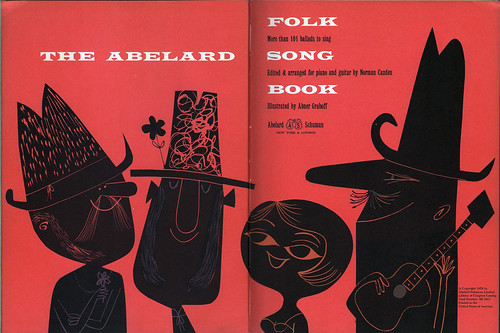
Who Was Abner Graboff? —  Frustrated with the lack information available online about artist, designer and illustrator Abner Graboff, Ward “Ward-O-Matic” Jenkins decided to do some digging himself. His research — now available in a three part series —  includes a host of great images of Graboff’s children’s books and book cover designs, as well as a nice interview with Graboff’s son Jon:

Throughout my father’s career, he did hundreds of book jacket designs and I once asked him, in a slightly condescending way, if he enjoyed that kind of work? He said he loved it because he had to nail the vibe of the book in a single illustration and when he got it right, that it was very satisfying. There was a long period of time when I could walk into a bookstore, look around, pick up a book and look at the jacket design credit… and more often than not, find his name. Later on, I started to get fooled. Other designers were either copying or being heavily influenced by his style.

Calling Bullshit on Social Media — Scott Berkun, O’Reilly author of The Myths of Innovation and Making Things Happen (via — irony alert — Mark Bertils on Twitter):

TV forced radio to change and in some ways improve. The web forced TV, newspapers and magazines to change, and they will likely survive forever in some form, focusing on things the web can not do well.  Its unusual for new thing to completely replace the old ones and when they do it takes years. Anyone who claims social media will eliminate standard PR or mass media is engaging in hype, as odds are better those things will change and learn, but never die. It’s wise to ask what each kind of media / marketing is good and bad for and work from there.

Berkun’s definitely onto something here and it probably deserves a whole post (maybe later!)… Certainly, he’s right to point out (earlier in the essay) that there have always been social networks. But he doesn’t note that for many city dwellers traditional social and familial networks have been breaking down in the post-war period, which I suspect is part of the seductive appeal of connecting online for us slightly older urban types whose use Twitter and Facebook a lot… Anyway, it’s interesting that some of Berkun’s points about technology probably also apply to e-books.

Berkun’s essay also reminded me of an article I read in Fast Company earlier in the week, Our Kids Aren’t Web-Addicted… Are We?:

It’s only we adults that are at PC workstations all day, looking for ways to avoid doing work or trolling the boundaries of our IT-installed browser filters. And we’re the only ones who have social networks big enough to require a tool like Twitter. Imagine how absurd Twitter seems when you only have 10 or 12 friends, not a network of 300+ coworkers, college buddies and colleagues?

And finally…

Krazy — Bill Watterson, creator of Calvin & Hobbes, on George Herriman’s seminal comic strip Krazy Kat, reproduced at This Recording (via Bookslut):

Krazy Kat gains its momentum less from the personalities of its characters than from their obsessions. Ignatz Mouse demonstrates his contempt for Krazy by throwing bricks at her; Krazy reinterprets the bricks as signs of love; and Offissa Pupp is obliged by duty (and regard for Krazy) to thwart and punish Ignatz’s “sin,” thereby interefering with a process that’s satisfying to everyone for all the wrong reasons. Some 30 years of strips were wrung out of that amalgam of cross-purposes. The action can be read as a metaphor for love or politics, or just enjoyed for its lunatic inner logic and physical comedy.

Comments closed