Skip to content

Tag: Kids Books

Something for the Weekend

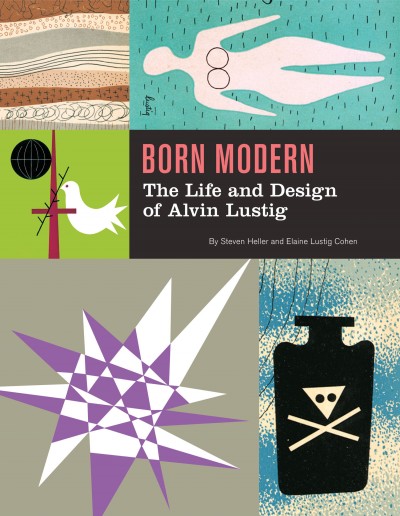
There are two new books about designer Alvin Lustig available this month — Born Modern: The Life and Design of Alvin Lustig by Steven Heller and Elaine Lustig Cohen (Chronicle Books*) and Purity of Aim: The Book Jacket Designs of Alvin Lustig by Ned Drew and Paul Sternberger (RIT Cary Graphic Arts Press).

The Death of the Book has Been Greatly Exaggerated — Tech columnist Christopher Mims on the “irrational exuberance” around e-books (via MobyLives):

Tech pundits recently moved up the date for the death of the book, to sometime around 2015, inspired largely by the rapid adoption of the iPad and the success of Amazon’s Kindle e-reader. But in their rush to christen a new era of media consumption, have the pundits overreached?

I’m calling the peak of inflated expectations now. Get ready for the next phase of the hype cycle – the trough of disillusionment.

The Secret Life of Shepperton — A photo essay on Shepperton, the suburban town south west of London where author J. G. Ballard spent most of his adult life. The photographs are accompanied by text from Ballard’s own novels, autobiography, interviews as well as observations about the town and its history (via 3:AM).

And finally…

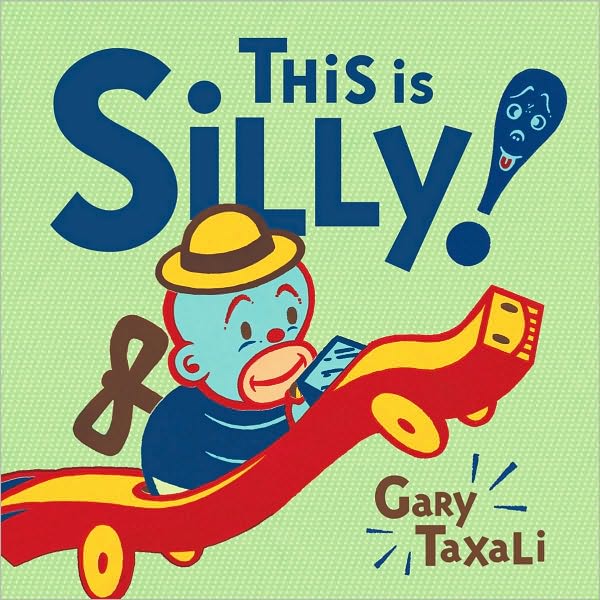
The Wonderful 36 Pages features This is Silly! by Toronto-based artist/illustrator Gary Taxali:

* Chronicle Books is distributed in Canada by my employer Raincoast Books.

Comments closed

Something for the Weekend

Sadly I missed the book launch earlier this week, but Toronto-based artist and illustrator Gary Taxali talked to the Torontoist and The National Post about his new kids book This is Silly!. You can see more of Taxali’s amazing book covers here.

ArtifactsMaximus Clarke has a fascinating conversation with William Gibson about his new novel Zero History :

I reach instinctively for something without knowing why, and place it in the narrative, and if it strikes a resonant chord with me, I’ll leave it there… But I myself have wondered why I do that — why I depict a universe of man-made objects, with people walking among them (laughs). My best answer is that it’s the way I perceive things. And I also suspect that the narratives of objects are more available to us when the objects themselves have become slightly decrepit. So I think my interest in old things, and worn things, isn’t about nostalgia in any conventional sense; it’s about the revelation of the narrative of how that object came to be in the world, and what it once might have meant to someone.

And on a somewhat related note, an interview with J.G. Ballard from the Winter 1984(!) issue of The Paris Review:

I would say that I quite consciously rely on my obsessions in all my work, that I deliberately set up an obsessional frame of mind. In a paradoxical way, this leaves one free of the subject of the obsession. It’s like picking up an ashtray and staring so hard at it that one becomes obsessed by its contours, angles, texture, et cetera, and forgets that it is an ashtray—a glass dish for stubbing out cigarettes.

The Black Arts — Book cover designers discuss their devious techniques for winning a clients approval with Peter Mendelsund and Peter Terzian:

Yes, a good design should speak for itself—but what if the client isn’t listening? Well, that’s when designers employ methods that are not taught in design school. Psychological methods. Machiavellian methods. Used-car-dealer methods. Manipulation. Intimidation. Seduction.

The PDF is here.

And Peter T has clearly been busy. The editor of Heavy Rotation: Twenty Writers on the Albums That Changed Their Lives has an article on books about album cover art at BookForum.

And finally (and on the subject of music)…

Finding Our WayRadiohead bassist Colin Greenwood reflects on the digital “pay what you think it’s worth” release of their album In Rainbows in 2007  and the band’s distribution options for their new songs:

I buy hardly any CDs now and get my music from many different sources: Spotify, iTunes, blog playlists, podcasts, online streaming – reviewing this makes me realise that my appetite for music now is just as strong as when I was 13, and how dependent I am upon digital delivery. At the same time, I find a lot of the technology very frustrating and counter-intuitive. I spend a lot of time using music production software, but iTunes feels clunky. I wish it was as simple and elegant as Apple’s hardware. I understand that we have become our own broadcasters and distributors, but I miss the editorialisation of music, the curatorial influences of people like John Peel or a good record label. I liked being on a record label that had us on it, along with Blur, the Beastie Boys and the Beatles.

(via Subtraction)

Comments closed

Once Upon a Time

An amazing book trailer for an amazing pop-up book by illustrator Benjamin Lacombe:

(via Daily Design Discoveries)

3 Comments

Something for the Weekend

Hornby Cover Versions — Some rather beautiful student work by Barcelona-based graphic designer Lucía Castro (although my inner-bookseller gets very twitchy at the thought of those soft off-white covers!). (via Cosa Visuales)

Full of Refusals — Tom McCarthy interviewed for More Intelligent Life:

[C]ontemporary literature has to deal with the challenges laid down by modernism. The most exhilarating and unsettling upheavals took place in the early 20th century, and to ignore them and go back to writing some kitsch version of the 19th-century novel is ostrich-like… I’m suspicious of the term ‘avant-garde’. I think it should be restricted to its strict historical designation: Futurists, Dadaists, Surrealists etc. “Tristram Shandy” and “Motherless Brooklyn” aren’t avant-garde novels; they’re novels.

C by Tom McCarthy will finally available in the US and Canada on September 7th.

A stunningly simple Malevich-like book cover design by Jason Booher and Helen Yentus for the paperback edition Inside the Stalin Archives by Jonathan Brent. First seen at the Book Cover Archive who have just posted a slew of Jason’s covers.

On the subject of the BCA, co-curator Ben Pieratt has recently updated his own design portfolio.

Agile Content — Marny Smith interviews Brian O’Leary of publishing consultants Magellan Media Partners:

[P]ublishers are competing against both established players and new entrants at the same time.  The newer players often have much lower costs than we’re used to, making them potentially tough competitors… I’ve been thinking lately that publishers need to work more aggressively on creating agile content that can be discovered and easily reused or recombined.  Creating content that is sold in one format just won’t be cost-effective in the future.

And finally…

The cute book trailer for OH NO! Or How My Science Project Destroyed the World written by Mac Barnett illustrated by Dan Santat:

You can find more of Dan’s awesome illustrations on his Flickr:

(via The Ward-O-Matic)

Comments closed

Midweek Miscellany


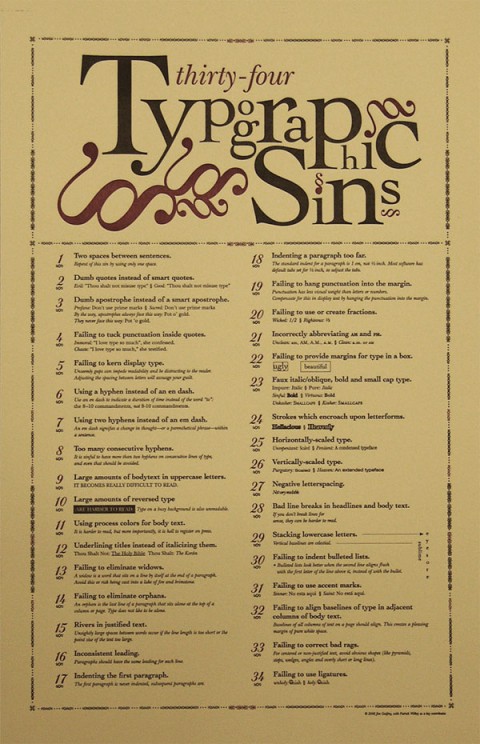
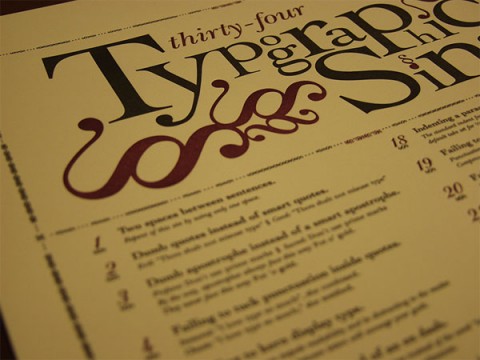
Typographic Sins Poster designed by Jim Godfrey (seen at For Print Only).

And on the subject of graphic design crimes…

Angry Paul Rand on Twitter (via @thebookdesigner):

My advice for designers & design students: fuck the rules, if your work is good enough to get away with it.

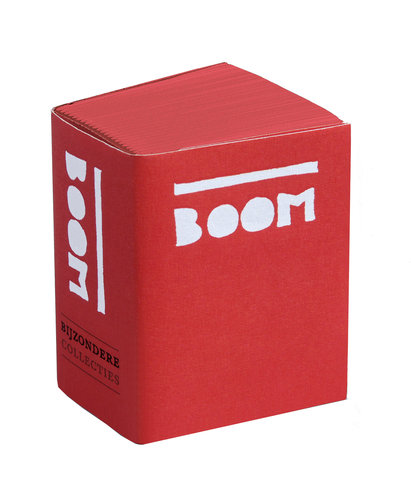
Boom — Alice Rawsthorn profiles Dutch book designer Irma Boom for the New York Times:

Ms. Boom, 49, has designed most of her books just as she has wanted. Typically, a book designer works with the text and images selected by the editor and art director, but Ms. Boom prefers to combine all three roles by deciding on the book’s structure and choosing the themes and visual material herself. She then obsesses over every element — not just how the book will look, but how it will feel and smell — and invents ingenious ways of achieving the desired effects.

One of her books was printed on coffee filter paper. Another was scented to smell of soup. A monograph of the work of the Dutch artist Steven Aalders was made in the exact dimensions of one of his paintings. The page edges of a book on the American textile designer Sheila Hicks were hacked with a circular saw to evoke the fraying edges of her work. The title on the white linen cover of a history of the Dutch company SHV only becomes visible after frequent use. There are 2,136 pages in that book, but no page numbers, to encourage readers to dip in and out.

An exhibition of Boom’s work, ‘Irma Boom: Biography in Books’ runs until Oct. 3 at the University of Amsterdam Library. The book accompanying the exhibition, designed by Boom and pictured above, is only 2 inches high, 1.5 inches wide and 1 inch thick.

And finally…

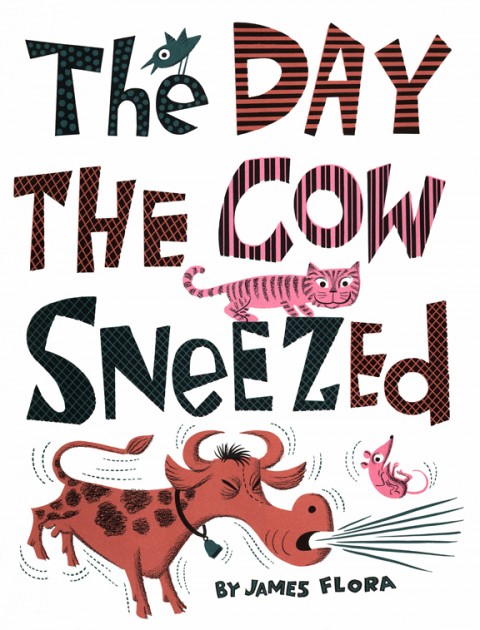
Enchanted Lion are reprinting Jim Flora’s kids books starting with The Day The Cow Sneezed in Fall 2010. Flora was best known his incredible jazz and classical album covers for Columbia Records and RCA Victor, and is officially awesome.

Comments closed

Something for the Weekend

A fittingly Alvin Lustig-like cover for New Directions by Rodrigo Corral, seen at Book Covers Anonymous.

An Open Book-Publishing Platform — Book Oven’s Hugh McGuire on WordPress as a book publishing platform. It’s an intriguing idea even if don’t accept Hugh’s belief that books and the web will be indistinguishable in a matter of years. And, to judge by the comments, it something a lot of people have been working on.

Afterlife — With the US publication of The Girl Who Kicked The Hornet’s Nest, Charles McGrath looks at Steig Larsson, the late author of the Millennium series, and his unhappy legacy in the New York Times. Sarah Weinman has more on Larsson and the new book (of course)…

Enticement and Exegesis — Knopf designer Peter Mendelsund (who, incidentally, designed the covers for US editions of the Millennium books) on author David Foster Wallace, Infinite Jest, and book cover design:

Book jacket design should concern itself with, in my estimation, equal parts enticement (“Come buy this book”) and exegesis (“This is what this book is about, more or less.”) A good cover doesn’t let one category trump the other. A good cover should not resort to cliché in order to accomplish either. But the real key here, in both categories (enticement and exegesis) is the designer’s ability to work the sweet-spot between giving-away-the-farm, and deliberate obfuscation.

Book jackets that tell you too much, suck. Book jackets that try to change the subject also suck, and are furthermore, too easy.

My interview with Peter about Tom McCarthy’s book “C” is here.

And finally…

It’s a Book, Jackass! — a cute video featuring a tech-loving donkey and a book loving ape for It’s a Book! by Lane Smith, published by Macmillan  (via Chronicle Books):

Comments closed

Midweek Miscellany

How To Live Safely in a Science Fictional Universe

A new cover from John Gall, seen at Peter Mendelsund’s JACKET MECHANICAL. Am I the only one who wants to hear these two in conversation? Dear NPR, could you get on that please?

Soft in the Middle — James Surowiecki looks at how midrange companies are being pressured by both high-end products at one end and ‘just good enough’ products at the other in the New Yorker (via Kottke):

The products made by midrange companies are neither exceptional enough to justify premium prices nor cheap enough to win over value-conscious consumers. Furthermore, the squeeze is getting tighter every day… This doesn’t mean that companies are going to abandon the idea of being all things to all people. If you’re already in the middle of the market, it’s hard to shift focus—as G.M. has discovered. And the allure of a big market share is often hard to resist, even if it doesn’t translate into profits.

I think we going to see this more in publishing with the midlist losing out to quick, cheap and ‘just good enough’ e-books and expensive, beautifully packaged hardcovers.

Somewhere Between Skeptic and Proselytizer — John Williams founder of The Second Pass interviewed at The Virginia Quarterly Review blog:

I think the way books are written about has been opened up in healthy ways. I like that there are more amateur (and semi-pro and pro) voices on the Internet, in the sense that it’s not just the unimaginative circle wherein writers of a certain kind of book review another example of that kind of book written by someone else. I’m not the first (or even the hundredth) to think that can lead to a lot of back-scratching or dry summation rather than forcefully argued opinion. It’s also true that the Internet has been great for, say, literature in translation, where entire sites (like Three Percent) can be devoted to a subject that gets less attention than it should in mainstream outlets. But as for how literary careers are made, I don’t think that’s changed as much as the tech apostles would like to believe.

The Incredible Book-Making Boy — Super talented author and illustrator Oliver Jeffers, whose new book The Heart and the Bottle was published earlier this month, interviewed at Seven Impossible Things Before Breakfast:

I begin with a single idea… and then tease that out in my sketchbook with hundreds of other drawings and pieces of writing that explore how the narrative can grow and extend into something that is satisfying. Once I’ve got a basic plot, I work with my editor in streamlining everything down to fit the thirty-two-page format…  Getting the story to flow between those thirty-two pages is probably the most difficult part. It’s like directing a film, where the pace needs to be set and decisions made of what goes where. It’s at this point that many of the compositions get cut. There is a careful balance between what the pictures are showing and what the words are saying, and if something is shown, it often doesn’t need to be said.

And finally…

Contemporaries, He Yanming

Chinese Book Covers seen at the excellent Ephemera Assemblyman.

5 Comments

10+ Flickr Groups for Book Design and Inspiration

10 Websites for Vintage Books, Covers and Inspiration” is one of the most popular posts on The Casual Optimist, and here, at long last, is the promised follow-up: “10 Flickr Groups for Book Design and Inspiration.”

There are a lot of amazing photostreams with book sets — Covers etc, insect54, Kyle Katz, mjkghk, Montague, Paula Wirth, and Scott Lindberg to name just a few that I’ve come across — but I’ve decided to focus this post on my favourite group pools because they collate the best of these individual streams together.

I’ve also decided to highlight groups that are about specific subjects, genres, publishers, or designers, because I think these are more useful than the more general (but still interesting) book pools such as A+ Book Covers, Book Cover Club, and My Books

ABC Verlag Graphic Design books

1. ABC Verlag, Zurich — A collection of scans and images from Zurich-based ABC Verlag who specialized in graphic design and fine art books between 1962 to 1989.

1627

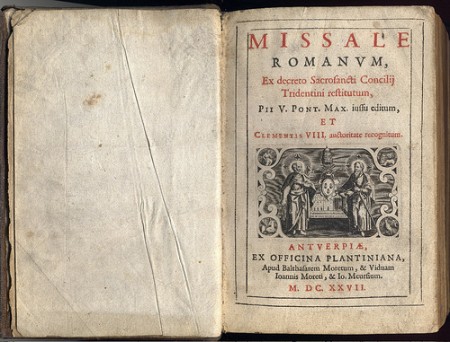
2. Antique Books — images of books, covers and illustrations that are a hundred years old or more.

Design and Paper: Number 13: Spread

3. Designers’ Books — “what’s on the shelves of designers and other smart creatives.” Not to be confused with the also excellent designers-books.com pool or Book Design pool.

Literature in America

4. Alvin & Elaine Lustig Design — celebrates the work of Alvin and Elaine Lustig, both renowned for their incredible book cover designs.

They Shoot Horses Don't They

5. The Penguin Paperback Spotters’ Guild — An astonishing collection of vintage Penguins, Pelicans, Peregrines, and Puffins. Also of interest: The Great Pan! Illustrated Pan Book Covers and Vintage Fontana Books.

Playback by Raymond Chandler Cover art by William Rose

6. Pulp Fiction — As you would expect: detective novels, crime fiction, adventure comics, trashy romance, weird science, blaxploitation and more. See also: The Old-Timey Paperback Book Covers and The Crime & Mystery Book Covers.

Thoughts on Design by Paul Rand

7. The Paul Rand Modern Graphic Design Fan Club — Like the Lustig Design group, this is not just a book pool, but it does, however, include many of Paul Rand’s iconic book designs, making it essential to this list in my opinion.

I Know an Old Lady, by Rose Bonne. Pictures by Abner Graboff.
8. The Retro Kid A collection of cool illustrated children’s books from the mid-1940’s through the mid-1960’s, curated by The Ward-O-Matic illustrator Ward Jenkins.

metropolis thea v marbou

9. The SciFi Books Pool Vintage science fiction covers from the 1940s, 50s, 60s and 70s.

computers

10. Vintage Paperbacks — The place for amazing paperbacks that aren’t Penguins. Curated by graphic designer and art director Gregory Boerum, the focus is on quality stuff with design interest from the 1960’s and 70’s.

So there we have it: 10 of my favourites. What are yours?

10 Comments

Midweek Miscellany, November 11th 2009

The Nabokov Collection — Art Director John Gall on the Vintage Nabokov redesign at Design Observer:

Nabokov was a passionate butterfly collector, a theme that has cropped up on some of his past covers. My idea was also a play on this concept. Each cover consists of a photograph of a specimen box, the kind used by collectors like Nabokov to display insects. Each box would be filled with paper, ephemera, and insect pins, selected to somehow evoke the book’s content. And to make it more interesting… I thought it would be fun to ask a group of talented designers to help create the boxes.

John’s short essay is accompanied by a great slide show of the specimen boxes (above: The Luzhin Defense by Paul Sahre; below Speak, Memory by Michael Bierut).

And Joseph at The BDR has a nice follow up post, with a couple of nice vintage Nabokov covers.

So, do the specimen boxes (lovely as they are) work as covers? You tell me…

Amazon releases a Kindle app for PCs. But who cares? Hmm… I don’t know if I ‘care’ as such, but I do think it’s significant. Is it one more nail in the plastic coffin of single use devices? There’s more on the app at the Washington Post

And while we’re on the subject of e-books…

The Internet Isn’t Killing Anything — From Russell Davies:

Something That’s Growing Is Not The Same As Something That’s Big.

Something That’s Declining Is Not The Same As Something That’s Small.

…Worth remembering I think.

Best Illustrated Children’s Books of 2009 — The New York Times choose their favourites (accompanied with a lovely slide show). The New Yorker‘s Adam Gopnik talks about the selection process with Sam Tanenhaus on the Book Review Podcast (pictured above: Tales From Outer Surburbia written and illustrated by the awesome Shaun Tan).

And finally…

A sneak peak at the new Krazy & Ignatz cover by Chris Ware for Fantagraphics.

1 Comment

Midweek Miscellany, November 4th, 2009

Fluid — John Gall discusses his brilliant cover design for the Vintage edition of Tom McCarthy’s Remainder, which is still one of my favourite novels of the last few years.

Hamilton Wood Type Catalog No.14 (1899-1900) at Unicorn Graphics’ Wood Type Museum. I quietly obsessed with slab-serifs right now so this is like crack (via Draplin Design Co.).

And The Beat Goes On — Sarah Weinman (much missed at GalleyCat) is writing about publishing for AOL’s money and finance news blog DailyFinance.

Gigantic Robot — Awesome cartoonist and illustrator Tom Gauld has a new website (to accompany his excellent Flickr photostream).

BOOM! — PW talks to Mark Waid, Editor-In-Chief of independent comics publisher BOOM! Studios:

We’re great at getting a focused message out. Because we don’t publish eighty comics a month, our inestimable marketing department does a great job of making every title important in the marketplace and every launch an event. We’re also better than the big guys at taking risks because we don’t have stockholders to answer to, or lenders who would call us crazy… We’re very much a writer-driven, idea-driven company. We start with the story first (with a talented writer) and focus on getting that right.

30 Conversations on Design — Designers, including luminaries such as Massimo Vignelli, Erik Spiekermann, Ellen Lupton and Paula Scher, answer two questions: “What single example of design inspires you most?” and “What problem should design solve next?”

Unheimlich — Sam Leith argues for scary kids books in The Guardian (confession: I’m mostly linking to this story so I could type “unheimlich” which — rather disappointingly — means “unhomely” rather than “the act of undoing the heimlich manoeuver”).

And finally…

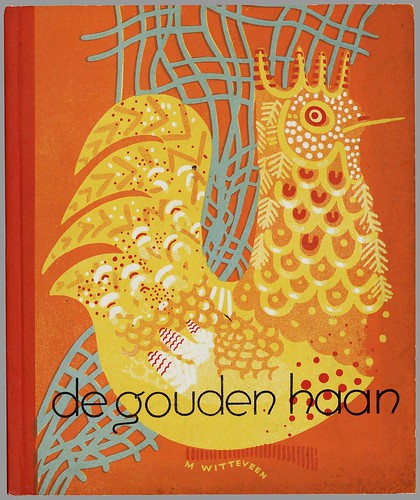
Dutch Picture Books 1810 – 1950 at BibliOdyssey (above: ‘De Gouden Haan’ by Marietje Witteveen, 1940).

‘De Gouden Haan’ by Marietje Witteveen, 1940
Comments closed

Missed Things: Wednesday

Henry Sene Yee, Creative Director of Picador, discusses the elegantly understated cover design for Time by Eva Hoffman, the latest addition to Picador’s BIG IDEAS // small books series.

And I’ve mentioned this before but it bears repeating: Picador are putting their catalogues — and, therefore, their outstanding cover designs — on their Facebook page.

Logicomix by Apostolos Doxiadis and Christos H. Papadimitriou reviewed in The New York TimesThe Guardian, and FT. It sounds kind of awesome. The book also has a nice website with lots of content.

The Inevitable Frontier — Jennifer de Guzman, editor-in-chief at the independent comics publisher SLG Publishing, on digital comics in PW:

Right now, sales from digital comics aren’t going to mean we can pack up print publishing. Not even close. But despite being in the midst of it rather than a wide-eyed observer, I can see that in the near future digital comics are going to be playing a bigger role for all publishers than they do now. And it’s better to be so integrated in the change that you don’t notice that it’s happening than to find yourself left behind and marveling at “the things they can do now.”

“Issues” — A less than warm reception for the Kindle in Australia:

Jeremy Fisher, executive director of the Australian Society of Authors, said he was advising his 3000 members to resist publishing through the Kindle.

“As I understand at this point in time, Amazon asks for a very, very big discount from publishers for their works to be included in Kindle so that the return coming back to the publisher is smaller and the return coming back to the author is smaller,” he said.

“The person making the most money is Amazon.”

Hmm… Yes, well, moving swiftly on…

Jacket Whys — A really nice blog about children’s and YA book covers.

And on the subject of kids books…

Who The Wild Things Are –Artist Roger White looks at the inspiration Maurice Sendak’s Wild Things for the Boston Globe:

The Wild Things looked like nothing ever seen in a children’s book. Rendered in simple ink-hatch over watercolor sketches, they evoked a perfect mixture of proto-adult dread and anarchic, childlike glee – an eternal, platonic form of the kindly monster. From the moment they appeared in 1964, they seemed bracingly and completely original. But in fact Sendak’s monsters had a long series of ancestors and descendants…

But according to Bruce Handy, deputy editor at Vanity Fair, (and his children) kids don’t actually like Where the Wild Things Are… Umm… What?

Comments closed

Q & A with Lincoln Agnew, Harry and Horsie

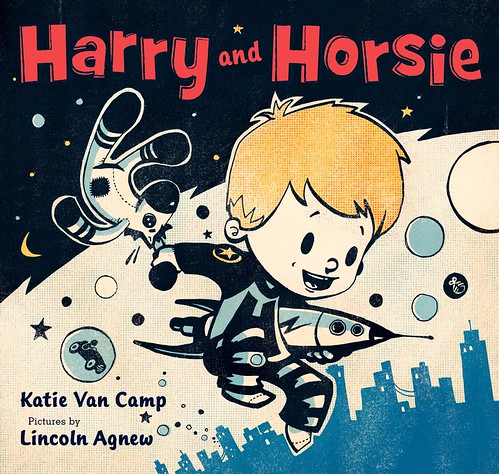
Children’s picture book Harry and Horsie by Katie Van Camp has mostly been in the news because the eponymous Harry happens to be the very real son of TV host and comedian David Letterman (who also provides the foreword to the book).

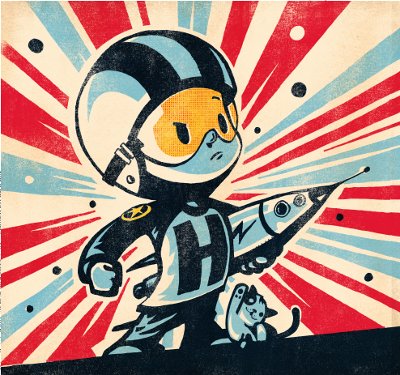
But what caught my eye were the illustrations by Calgary artist Lincoln Agnew. The illustrations, which bring to mind 1950’s advertising, cereal boxes, comics, vintage toys, pop art, and Bill Watterson’s Calvin & Hobbes, give the book a distinctive retro look.

I managed to catch up with Lincoln by email and ask him a few questions about his work.

Briefly, could you tell me a little about yourself?

No.

Hahahahaha…. I kid….. apparently I think I’m funny.

I’m just an artist trying to find my way with as little compromise as possible.  I go to sleep when I am tired, get up when I’m awake and work on any project i deem “fun” during the hours in between.  I’ve gone into debt trying to maintain my “artistic integrity” and on the days that I become too hungry to care i give in to my belly and use a steel scrub brush to bathe off the guilt…. after i finish my steak dinner.

Is Harry and Horsie the first children’s book you’ve illustrated?

Yes, the first of many i hope…. i really enjoyed the process.  I had no idea what i was doing but was inspired by the challenge.

How did you become involved in the book?

A great friend of mine, Alan Rosales introduced me to Katie at a New Years party in Montreal long before she decided to write a book.  We spoke for about ten minutes before she grew tired of my jibber jabber and moved on.  Years later he heard that she was looking for an  illustrator and recommended me for the job.  Katie and I then started tossing ideas around over email for the next few years but we didn’t reunite face to face until we both arrived in New York to celebrate with our publishers.  She was taller than I remembered.

How did you create the images? Could you describe your process?

My process is clumsy at best, I fumble around with rough outlines, scanners, photocopiers, pencil crayons, ink pens, sandpaper and computers. It’s a struggle, nothing really comes easy and there’s only a small window of time before the love turns to hate.

The illustrations have a wonderful retro feel. Where did you look for inspiration?

It all started with the toys, while I was doing up some rough sketches for the story I figured the rocket ship should look like a vintage tin toy from the 50’s.  That initial research inspired the look of everything to follow.

Where else can we see your work?

It’s around. I do freelance design, illustration and photography for magazines, studios, bands and clothing companies.  I vary my medium and style to fit the project…. so very little of it looks like the book.

Can we expect more children’s book illustrations from you in future?

Absolutely! Katie and I learned a lot during the initial process so we are eager to apply our new found knowledge to create something bigger and better than the first!  We are currently working on a second Harry and Horsie adventure with the lovely people over at Balzer and Bray/Harper Collins.

Thanks Lincoln!

And special thanks to Melissa Zilberberg, Marketing and Publicity Coordinator at HarperCollins Canada, for helping arrange the interview.

All illustrations copyright (c) 2009 by Lincoln Agnew

3 Comments