Skip to content

Tag: journalism

How The New York Times Works

gallery_1423676945-front_page_markup

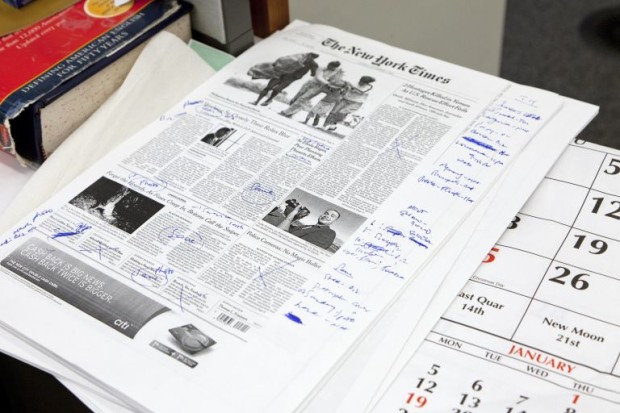
In a fascinating piece for Popular Mechanics, Reeves Wiedeman looks at how the New York Times gets made in 2015. It’s interesting how their graphics department has evolved in the past few years:

The Times employs approximately 1,300 journalists, a classification that now includes much more than writers, editors, and photographers. There are videographers and developer–journalists and graphic designers, who insist that you not call them graphic designers. Every section of the paper has been affected by the Internet, but the graphics department is hardly recognizable from the days not long ago when, to accompany a story about Borneo, for example, it would simply produce a small black-and-white map of Borneo. [Graphics editor] Duenes’s desk still produces traditional newspaper graphics, but it also now employs thirty-five people who have expertise in statistics, programming, cartography, 3D modeling, motion graphics, audio production, or video editing. At the department’s two long desks, designer Haeyoun Park combs through data on the racial breakdown of police forces—a story the graphics team reported without any instigation from print reporters—while nearby Matt Bloch is updating the paper’s digital hurricane tracker… A breaking-news event might require eight members of Duenes’s team, who are otherwise free to focus on the kind of in-depth reporting for which the Times‘ print reporters are generally known. Last August a graphics editor who had been tracking police data for four years discovered that the New York Police Department had more or less ended its controversial stop-and-frisk policy, which some critics had described as racial profiling. This was news to the reporters on the Metro desk, and the editor there assigned a story to go along with the graphics department’s analysis.

The story, and the graphic, ran on the front page.

I also particularly liked the stuff about their R & D Lab:

The R&D Lab opened nine years ago with the goal of looking three to five years into the future. (TheTimes declined to say how much it cost to build.) Marc Frons, the company’s CIO says he has no idea how people will interact with theTimes in ten years, “whether it’s on your wrist, or your forehead, or you take a pill, or it’s a holographic contact lens, or a head-up display in your vehicle—or on your mirror in your bathroom.” The lab explored E Ink before the Kindle even existed, was responsible for delivering the earliest versions of the paper’s mobile news alerts, and helped the Times become the first publisher with an application on Google Glass. One of the lab’s researchers recently designed a brooch programmed to light up whenever a topic is mentioned that matches something the wearer read about online that day. What good would that do, exactly? Boggie answers with enthusiasm, “We don’t know yet!”
1 Comment

Joe Sacco: Putting the Reader in the Picture

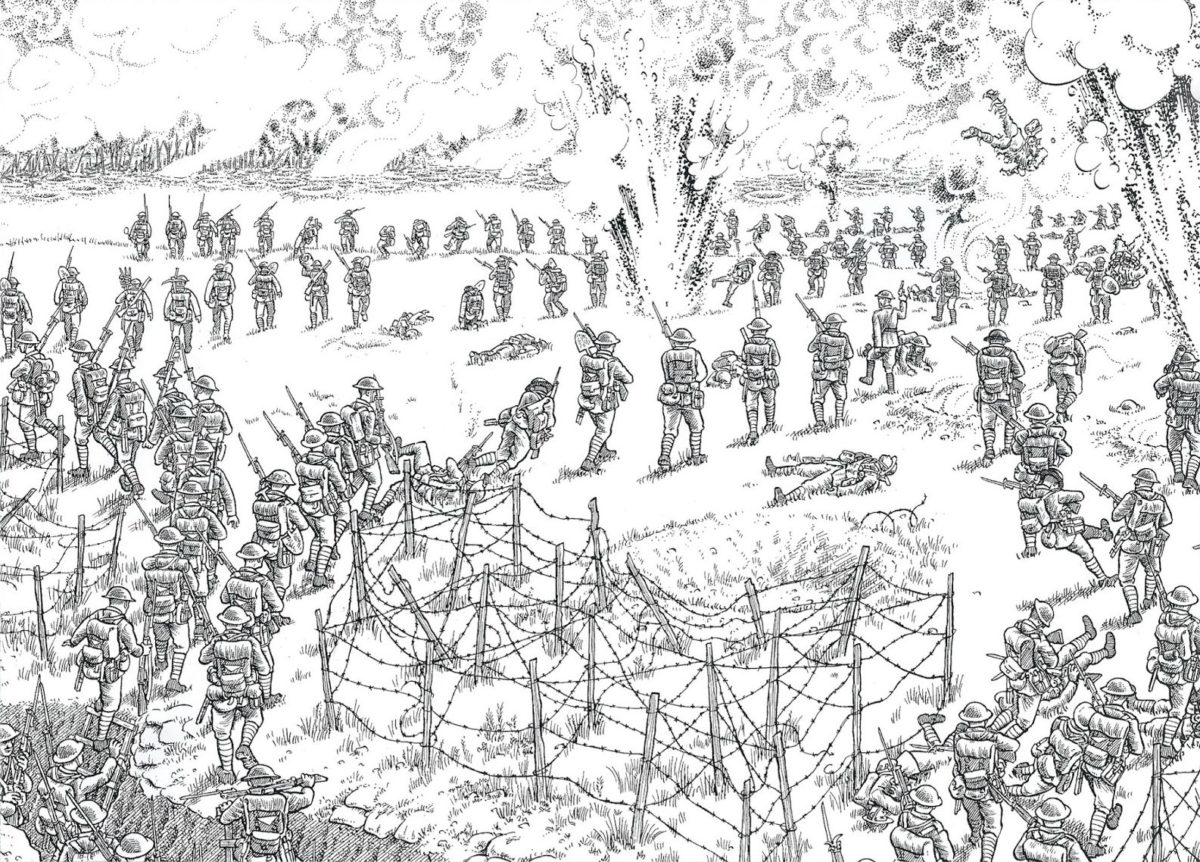
Cartoonist Joe Sacco discusses his new illustration/book The Great War in an interview at Salon:

I think every medium has its strengths. But I think illustrated work puts the reader directly into a picture. You open up, let’s say, a comic book, and I’ve drawn a Palestinian refugee camp — you’re inside it, and with the multiple images, you’ll hopefully get an idea of the atmosphere. As a cartoonist, you’re concentrating on giving visual information — especially in the background — that can be conveyed by multiple images. And things follow the reader around. You know, the architecture will follow the reader from one panel to another, so it becomes part of the atmosphere that the reader is imbibing. With the written word, you can describe the architecture, but you’re not going to keep mentioning it as a figure is walking down the street, you’re not going to keep mentioning what the background is. With comics you can do that.

Comments closed

Janet Malcolm: The Devil in the Detail


Gaby Wood interviews journalist Janet Malcolm for The Telegraph:

How Malcolm goes about her journalistic business is clear from her person. Her gaze is remarkably unflinching; unnervous, but not stern. She concentrates on looking at all times. She is difficult to interview, but for reasons much more prosaic than the dramatic ones I had conjured. She simply finds herself uninteresting, and so gives away little. You feel there is much more to know, and that the failure must lie in your ability to ask about it. Because when you listen back to the recording you find that she has not been especially evasive, merely – politely – private. ‘Have a macaroon,’ she says.

Malcolm’s most recent collection of essays, Forty-One False Starts, has just been published in the UK by Granta.  The US edition is available from FSG, (and is, for sake of disclosure etc., distributed in Canada by my employer Raincoast Books).

Comments closed

Midweek Miscellany

Survival Training — Colson Whitehead, author of Zone One, on watching horror flicks and b-movies, in science fiction edition of The New Yorker:

It was survival training. “A Clockwork Orange,” which I saw several times on HBO before I was ten, taught me more about not opening my door to strangers than a hundred school-assembly lectures. I never talked much in educational settings, so it is unlikely that I asked my mother, “What are they doing to that woman?” during my introduction to Stanley Kubrick, but, had I inquired, I’m sure she would have said, “It’s a comment on society, son.”

See also: Laura Miller on the first fictional space aliens, William Gibson on science fiction and Tomorrow, and cover illustration by Daniel Clowes (pictured above).

And on a related note: Nobel Prize-winning economist Paul Krugman talks science fiction at Wired.com:

I read Foundation back when I was in high school, when I was a teenager, and thought about the psychohistorians, who save galactic civilization through their understanding of the laws of society, and said “I want to be one of those guys.” And economics was as close as I could get. Those are pretty unique novels — they really are structured nothing like even the great bulk of science fiction, because they are about how social science can be used to save humanity.

Terrifying French children’s books.

And finally… An interesting interview with The New York Times media columnist David Carr (and star of the documentary Page One) at Talking Points Memo:

The tools of production are at hand for everyone. I used to hire a lot of young people when I was the editor of Washington City Paper, and you used to have them show you the clips and see where else you worked. Show me what you’ve made with your own bare little hands. That, I think, is super important. People say, “You should’ve been here for the good old days.” I think that’s crazy. Yeah, it’s a little harder, but you have so many more tools at your disposal to story-tell. It’s cool to be in a business where you still learn. You don’t have to be able to code yourself, but you have to know what coding is. You should be able to work in Final Cut Pro. WordPress should be second-nature. I think, in generational terms, being able to produce and consume content at the same time.

Comments closed

Midweek Miscellany

Lumps of Language — John Sutherland reviews The Words of Others: From Quotations to Culture by Gary Saul Morson for Literary Review:

We think of our use of language as ‘fluency’. There are, however, congealed lumps floating in it and, if we look beneath the surface, often more lumps than liquidity. Put another way, most language is pre-owned. The previous owners are, as Gary Morson instructs us, often worth knowing about.

Hard — Cartoonist James Sturm finds out just how hard it is to get a cartoon in The New Yorker:

I don’t normally draw gag cartoons; I’m what’s now called a “graphic novelist.” I’m not really considering a career change, but I was dealing with the mid-career blahs and wanted to try something new. It takes me several years to write and draw a book. The book’s subject determines and limits what I can and can’t draw. I enjoy the process, but it’s a slog. I wanted more spontaneity in my creative life. So in March I decided to fill a sketchbook, 90 pages, with New Yorker-style cartoons—one cartoon a day for three months. No excuses.

Much linked to elsewhere: A sad (and slightly bonkers) interview with Grant Morrison about his book Supergods in Rolling Stone.

Dan Nadel at The Comics Journal responds.

And finally… While were on the subject of comics…

Here’s an neat primer on comics journalism, in the form of comics journalism, by Dan Archer (via The Ephemerist).

Comments closed

Don McCullin

Photojournalist Don McCullin is internationally renowned for his images of conflict. But a new exhibition of his photographs at Tate Britain focuses on three other aspects of his work: his first foreign assignment in divided Berlin in 1961; documentary work on homelessness in East London in the late 60s, and landscape works, both urban, and rural from the 1970s to the present day.

In this short interview, McCullin talks about the exhibition and his sadness a being known only as a war photographer:


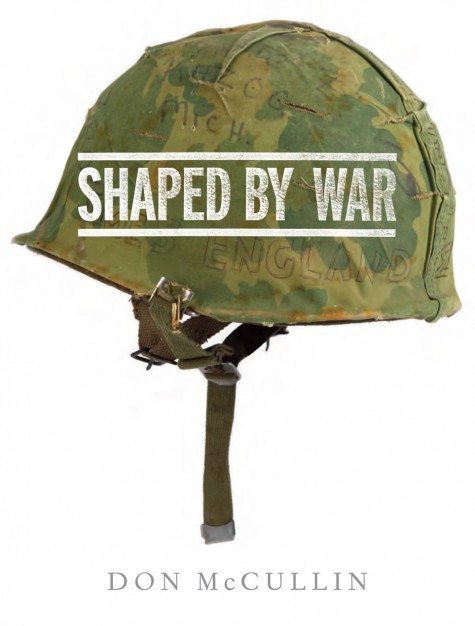
If (like me) you are not able to visit the exhibition, a retrospective of McCullin’s work is available from Jonathan Cape, while his photographs of social deprivation are collected in the 2007 book In England. A selection of his war photographs, shown at The Imperial War Museum last year, can be seen in the exhibition catalogue Shaped by War.

(via Simon Armstrong)

Comments closed

Midweek Miscellany

An interview with the talented Allison Colpoys, book designer at Penguin Books Australia, at The Design Files.

Particular Beasts — A brief interview with art director John Gall about teaching book design:

Each book is its own particular beast that has to be designed from the ground up. Every designer has their own way of looking at the problem and coming up with a solution. It can’t help but be personal on some level.

A Twist, Flourish or Quirk — Louise Fili and Steven Heller, authors of Scripts: Elegant Lettering from Design’s Golden Age, on script typefaces at Design Observer:

During the letterpress era [script typefaces] were in such great demand that many people “invented” them, and many others copied them. In some commercial printing shops, composing cases filled with scripts were stacked floor to ceiling to the exclusion of other type. Printers routinely amassed multiple styles of the heavy metal type fonts, each possessing a distinct twist, flourish or quirk, used to inject the hint of personality or dash of character to quotidian printed pieces… Scripts signaled propriety, suggested authority yet also exuded status and a bourgeois aesthetic. The wealthy classes couldn’t get enough fashionable scripts in their diet.

The Pilot Fish and The Whale — David Carr, media columnist at the New York Times, talks about the documentary Page One: Inside The New York Times with screenwriter Aaron Sorkin  for Interview Magazine:

I think one of the things that Page One does an amazing job of demonstrating is the importance of editors. You can see our editor, Bruce Headlam, shaping, arguing, pushing back. Of course, that’s what you don’t have a lot of in the blogosphere. There is nobody pushing people to support what they’re saying, nobody arguing against the assumptions that are brought to the table…

Slow Journalism — An interview with cartoonist and journalist Joe Sacco (Footnotes in Gaza) for the A.V. Club:

[I]t’s one of the slowest art forms or media there is. You know, there’s fast food and there’s the slow food movement; I guess this is slow journalism. It just forces you into it. It’s difficult for me because I love being in the field, so to speak. I love that day-to-day thrill of being in places, and the great privilege of meeting people and going into their homes and seeing what their lives are like. I love that. But when you compare how much time is spent reporting to how much time is spent at a desk just writing and drawing, the reporting is a fraction. That’s just the way it is.

And finally…

Sing Out — Dorian Lynskey, author of 33 Revolutions per Minute, recommends five books about protest songs. The cover of 33 Revolutions per Minute was designed by Jacob Covey.

http://www.bookdepository.com/Footnotes-Gaza-Joe-Sacco/9780805092776/?a_aid=optimist
Comments closed

Learning to Love the (Shallow, Divisive, Unreliable) New Media

James Fallows, veteran journalist and author of Breaking the News, has a lengthy article in The Atlantic on Gawker and the effect of digital media on journalism:

One by one, the buffers between what people want and what the media can afford to deliver have been stripped away. Broadcast TV was deregulated, and cable and satellite TV arose in a wholly post-regulation era. As newspapers fell during the rise of the Internet, and fell faster because of the 2008 recession, the regional papers fell hardest. The survivors, from The New York Times to the National Enquirer, will be what British newspapers have long been: nationwide in distribution, and differentiated by politics and class. The destruction of the “bundled” business model for newspapers, which allowed ads in the Auto section to underwrite a bureau in Baghdad; the rise of increasingly targeted and niche-ified information sources and advertising vehicles; and the consequent pressure on almost any mass offering except for sports—all of these are steps toward a perfected market for information of all sorts, including news. With each passing month, people can get more of what they want and less of what someone else thinks they should have.

Every news organization recognizes this shift… The Atlantic is now profitable in part because traffic on our Web site is so strong. Everyone involved in the site understands the tricks and trade-offs that can increase clicks and raise the chances of a breakout “viral” Web success. Kittens, slide shows, videos, Sarah Palin—these are a few. For us and for other publications, they are complications. For Gawker, they’re all that is.

According to Fallows, however, the disruption is also creating new, positive opportunities:

Economic history is working against “legacy” news organizations like the BBC, The New York Times, NPR, and most magazines you could name. But historical forces don’t play out on a set schedule, and can be delayed for a very long time. Economic history is also working against museums, small private colleges, and the farm-dappled French countryside, but none of them has to disappear next week. Even as it necessarily evolves, our news system will be better the longer it includes institutions whose culture and ambitions reach back to the pre-Gawker era, and it would be harder and costlier to try to re-create them after they have failed than to keep them on life support until their owners find a way to fit their values and standards into the imperatives of the new systems.

But the new culture also creates positive opportunities—as, it’s worth saying again, every previous disruption has… At no stage in the evolution of our press could anyone be sure which approaches would support life, and which would flicker out. Through my own career I have seen enough publications and programs start—and succeed, and fail—to know how hard it is to foresee their course in advance. Therefore I am biased in favor of almost any new project, since it might prove to be the next New York Review of Books, Rolling Stone, NPR, or Wired that helps us understand our world.

If you are interested in journalism and news media, the whole article is definitely worth your time.

Comments closed

The Bends

The Guardian has posted an transcript of this year’s Andrew Olle Lecture given by their editor Alan Rusbridger. The subject of his talk was “The Splintering of the Fourth Estate”, and even in its edited form, it is a long and fascinating read that covers movable type, the BBC,  Rupert Murdoch, social media, pay walls, collaborative journalism and more. It’s essential reading…

It’s developing so fast, we forget how new it all is. It’s totally understandable that those of us with at least one leg in traditional media should be impatient to understand the business model that will enable us magically to transform ourselves into digital businesses and continue to earn the revenues we enjoyed before the invention of the web, never mind the bewildering disruption of web 2.0.

But first we have to understand what we’re up against. It is constantly surprising to me how people in positions of influence in the media find it difficult to look outside the frame of their own medium and look at what this animal called social, or open, media does. How it currently behaves, what it is capable of doing in the future.

On one level there is no great mystery about web 2.0. It’s about the fact that other people like doing what we journalists do. We like creating things – words, pictures, films, graphics – and publishing them. So, it turns out, does everyone else.

For 500 years since Gutenberg they couldn’t; now they can. In fact, they can do much more than we ever could.

(via Jay Rosen)

Comments closed

Something for the Weekend

Thanks for the CBC Books blog for including The Casual Optimist in their list of 10 ‘Book Blogs We Appreciate’ earlier this week. It is always nice to be appreciated — I only hope I can live up to the billing… :-)

The Story of Eames Furniture — Written and designed by Marilyn Neuhart together with her husband John, who both worked with the Eames Office from the 1950’s until 1978, the year Charles Eames’s died. Published later this month by Gestalten, the book comes in two full-colour volumes with a slipcase.

The Future of the Future — William Gibson interviewed in The Atlantic:

I think that our future has lost that capital F we used to spell it with. The science fiction future of my childhood has had a capital F—it was assumed to be an American Future because America was the future. The Future was assumed to be inherently heroic, and a lot of other things, as well… I’m not going all Sex Pistols, shouting No Future!—I’m suggesting that we’re becoming more like Europeans, who have always retrofitted their ruins, who’ve always known that everyone lives in someone else’s future and someone else’s past.

Respect for the UsersJay Rosen‘s inaugural lecture to incoming students at Sciences Po école du journalisme in Paris earlier this month:

The Web effortlessly records what people do with it. Therefore it is easy to measure user behavior: what people are interested in, what they are searching for, clicking on, turning to… right now. What should a smart journalists do with this “live” information?… [Y]ou should listen to demand, but also give people what they have no way to demand because they don’t know about it yet. In fact, there is a relationship between these things.  The better you are at listening to demand, the more likely it is that the users will listen to you when you say to them: you may not think this is important or interesting, but trust me… it matters. Or: “this is good.” Ignoring what the users want is dumb in one way; editing by click rate is dumb in a different way. Respect for the users lies in between these two.

And finally…

Graphic designer James Patrick Gibson talks to Babelgum about his photoblog New Type York , an archive of images of typographic artifacts — signs, directions and building inscriptions — around New York City (via DesignRelated):

Comments closed

Jay Rosen on the Media

The Economist’s Democracy in America blog has an interesting Q & A with Jay Rosen, professor of journalism at NYU and author of What Are Journalists For?, about the American news media. The focus is largely on politics (Democracy in America is a blog about American politics after all), but Rosen’s insights into the future of the news media in general are also pertinent to the book industry:

The cost of changing settled routines seems too high, but the cost of not changing is, in the long term, even higher. A good example is the predicament of the newspaper press: the print edition provides most of the revenues, but it cannot provide a future. I know of no evidence to show that young people are picking up the print habit. So if the cost of abandoning print is too high, the cost of sticking with it may be even higher, though slower to reveal itself. That’s a problem…

…[T]he alternative to chasing clicks is building trust and an editorial brand. “What people want” arguments don’t impress me. I think anyone with a half a brain knows that you have to listen to demand and give people what they have no way to demand. You have to listen to them, and assert your authority from time to time, because listening well is what gives you the authority to recommend what is not immediately in demand.

Link

Comments closed