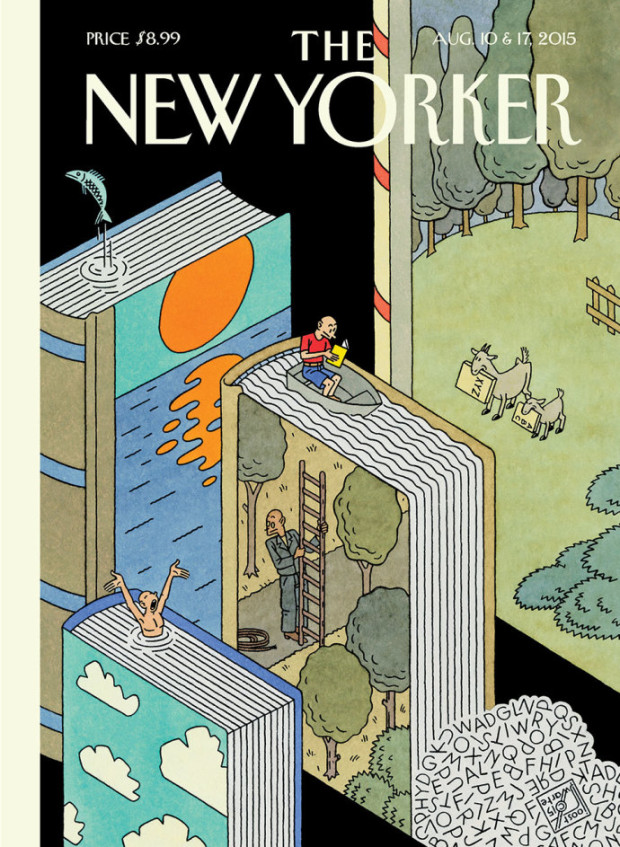
“Cartooning has an edge on all other media. You don’t need anything else such as canvas and paint, or camera and actors: the road to expression is only a sheet of paper and a pencil away.”
A new Joost Swarte cover for The New Yorker.
Comments closedBooks, Design and Culture
“Cartooning has an edge on all other media. You don’t need anything else such as canvas and paint, or camera and actors: the road to expression is only a sheet of paper and a pencil away.”
A new Joost Swarte cover for The New Yorker.
Comments closed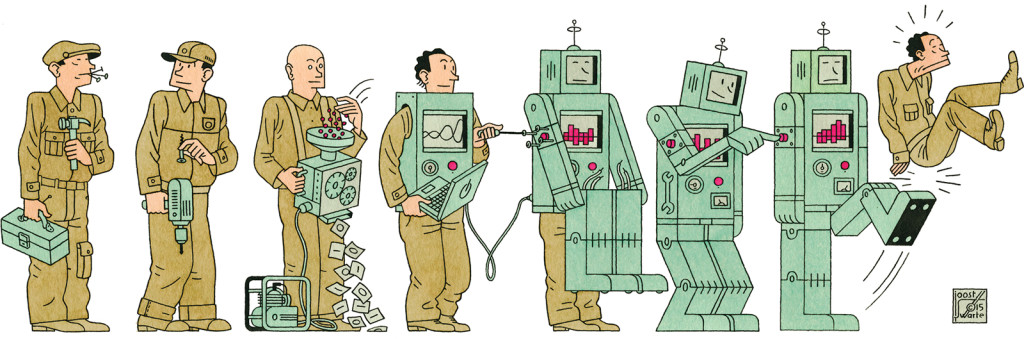
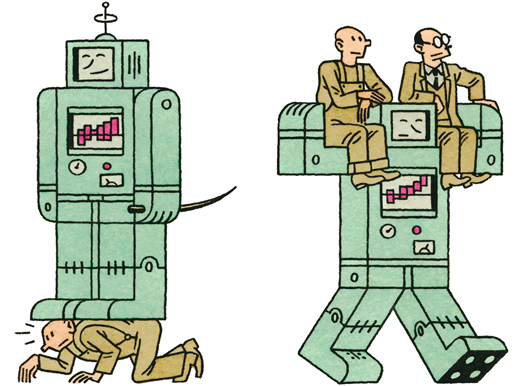
Writing at the MIT Technology Review, David Rotman looks at the impact of automation and digital technology on jobs with reference to a number of recent books related to the subject including Rise of the Robots: Technology and the Threat of a Jobless Future by Martin Ford, The Great Divide by Joseph Stiglitz, and The Second Machine Age by Erik Brynjolfsson and Andrew McAfee. But if you find that all too depressing to contemplate — and who doesn’t? — you can at least enjoy the wonderful Joost Swarte illustrations that accompany article …


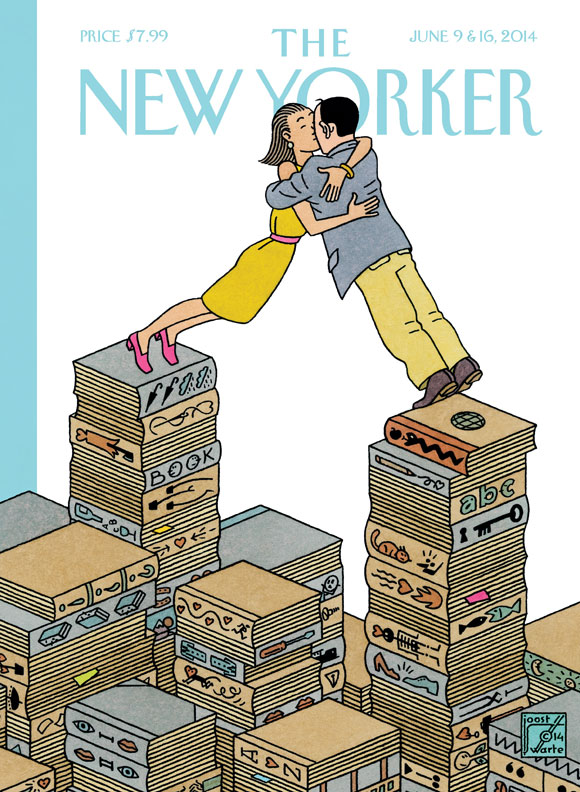
Dutch cartoonist and designer Joost Swarte has drawn the cover for The New Yorker‘s new Summer Fiction issue.
1 Comment
This wonderful illustration by Dutch cartoonist Joost Swarte accompanied a discussion on traditional bookstores in the digital marketplace in last Sunday’s New York Times.

Comics Without Borders — a long interview with cartoonist Joost Swarte at The Comics Journal:
In the graphic field of comics I was inspired by Will Eisner’s Spirit. If I see these title pages, the constructions in his title pages, and what he does with the lettering, that was very interesting. And then another thing is, I love the older comics like Little Nemo and Lyonel Feininger. And I was interested also, because I studied industrial design… about the Dada people in Holland and Germany, and Bauhaus architecture and design world, in which there are almost no borders. I mean, people do whatever they like. Then you have the older artists like Tatlin. They designed their own clothes, they do architecture, they do flying machines, they do painting, they do everything. I mean, it was always nice to know that if you want to do different things, that you’re not standing alone. That somebody else did it, and they survived.
Losing Their Grip — Peter Aspen reviews three new books on cinema — The Big Screen by David Thomson, Do the Movies Have a Future? by David Denby, and Film After Film by J Hoberman — for the FT:
It is one of the most famous one-liners in the history of cinema, which also turned out to be an inadvertent prophecy. “I am big,” says the slighted Norma Desmond in Sunset Boulevard (1950). “It’s the pictures that got small.”
She had no idea. The past half-century has seen the pictures get smaller and smaller, to the point that we wonder if they can ever be big again. From television screen, to laptop, to smartphone, the ever-shrinking movies reach a greater part of the world than ever before. But what have we lost along the way?
Holberman’s book is given more in-depth consideration at the LA Review of Books.
And finally…
In the shit — book shopping with Michael Dirda at The Paris Review:
So this is how a man acquires 10,000-odd books, more than he could ever display or read. It’s a combination of maniacal persistence and utter nostalgic whimsy. You have to be willing to search high and low for a potential beauty, but most of the time you’ll take a Book Club hardcover of a book you don’t like if it reminds you of something from your past.
As if to illustrate the point, Dirda found a mass-market paperback of Black Alice, by Thomas Disch and John Sladek. Dirda was a friend of Disch until the sci-fi author killed himself in 2008. “He was a wonderfully cynical man,” Dirda said. “I have a first edition of this but I’ll get it anyway.”
Comments closed