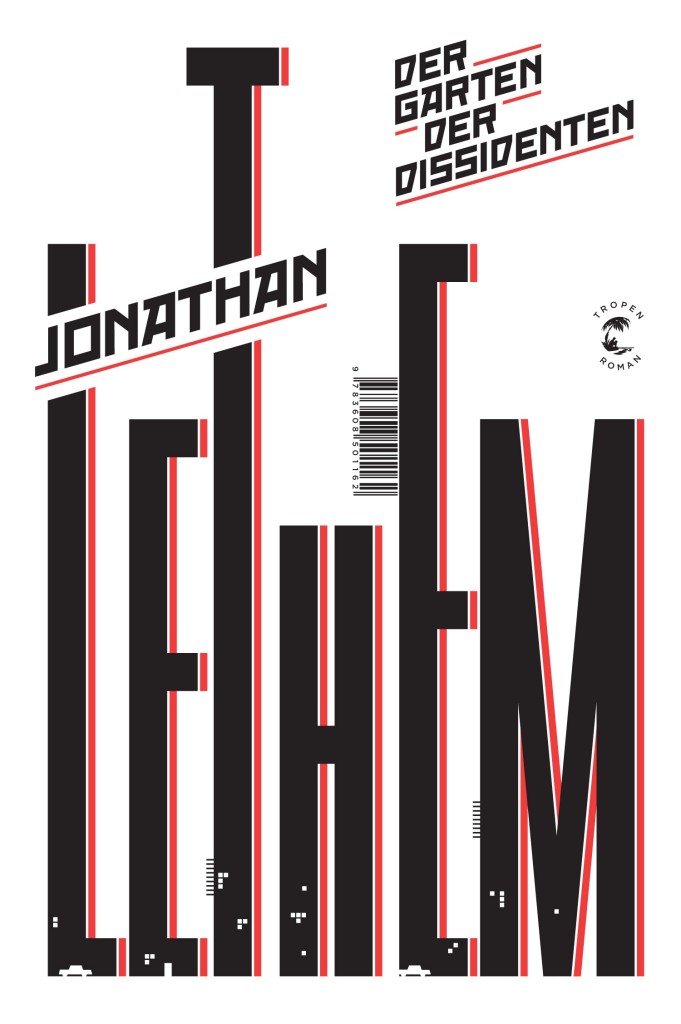
I just came across the book covers of Munich-based Stephanie and Tom Ising, also known as Books We Made. There’s some lovely work in their portfolio:





You can also find Books We Made on Facebook.
(via Coudal / The Fox is Black)
Comments closedBooks, Design and Culture
I just came across the book covers of Munich-based Stephanie and Tom Ising, also known as Books We Made. There’s some lovely work in their portfolio:
You can also find Books We Made on Facebook.
(via Coudal / The Fox is Black)
Comments closed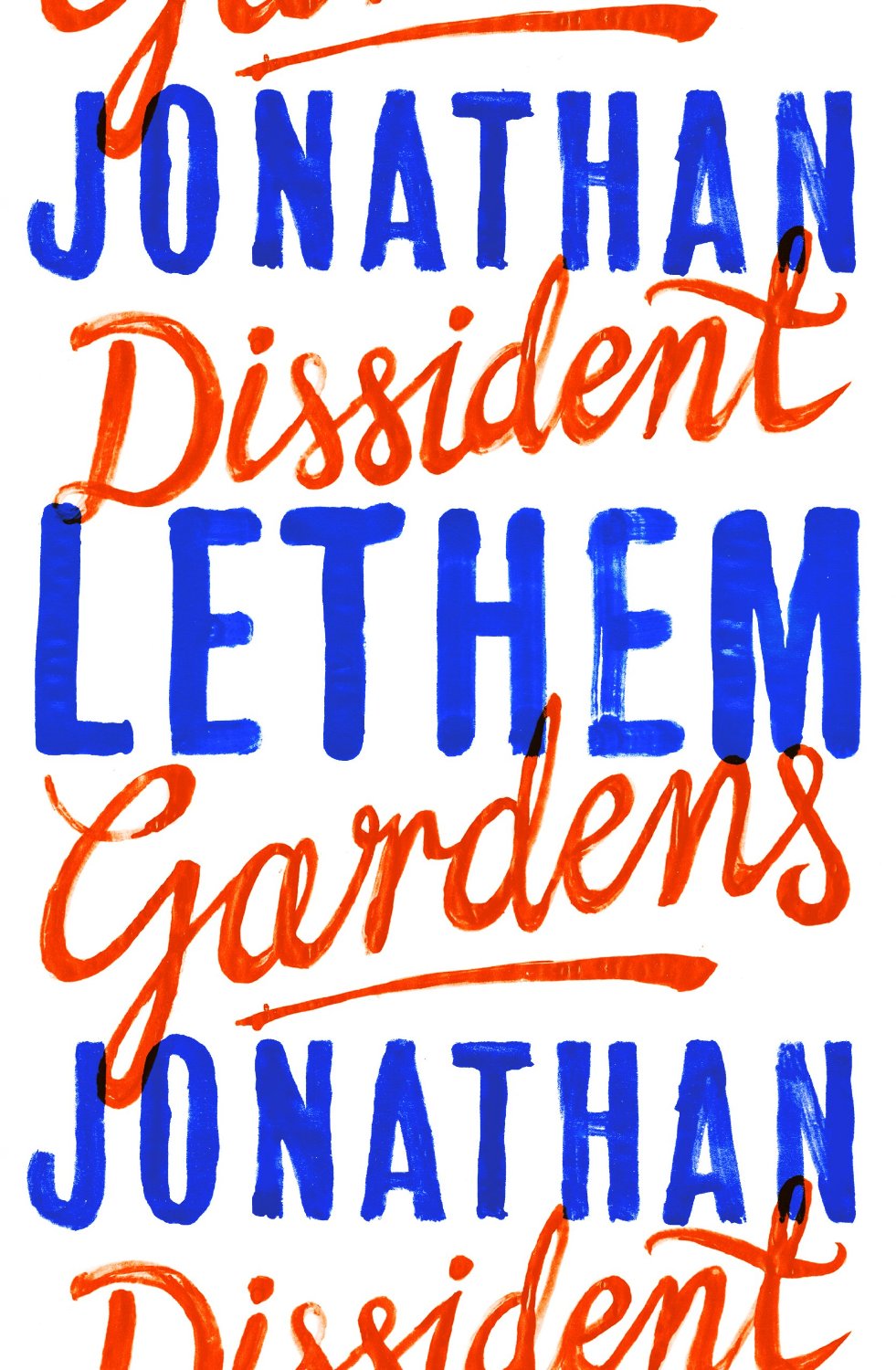
Jonathan Lethem discusses science fiction, comics and his new novel Dissident Gardens with Jesse Hicks at The Verge:
Comments closedI like that Philip K. Dick and the science fiction writers that I fell in love with were intrinsically in this termite role, nibbling around the edges of the culture. I know it was uncomfortable for them, and it certainly didn’t pay as well as they might have liked, but it meant that their work had a relevance and vitality and disreputable energy that, for me as a younger reader, hands-down won over the official literary product of the same time period.
Though one of the things that’s wrong with marginal identities is that you tend to act as though the big hegemonic center is all one thing itself. “The mainstream” doesn’t agree with itself or make any kind of sense or have a coherent position, except in the very small matter of believing itself to be the only action. That’s the only thing it agrees about. [laughter] The rest of it, if you really pay any attention and care, and I started to care about all kinds of novels and all kinds of literary ventures, and possibilities — different kinds of lives that writers led — the rest of the mainstream is pretty much at one another’s throats over various matters of style and politics, minor grudges and so forth. But it looks like one big thing if you’re in exile from it.

Jonathan Lethem talks about writing his new novel, Dissident Gardens, with Brian Gresko at the Los Angeles Review of Books:
Of course, in the writing, Dissident Gardens couldn’t bear much of what I’d learned. Novels don’t want to be crammed with factual stuff. I mostly left it aside, including some astonishing truths, which when you first come across them, you think, holy shit, I’ve learned this crazy thing and now I’ll blow people away by revealing this knowledge in the book! But at the juncture where you’d insert such a thing, you flinch, seeing the cost is too high. The facts will intrude — either on the reader’s experience, or my own relationship to the page, to the dream. You’ve heard of killing your darlings? You’ve got to kill plenty of the world’s darling’s too
Dissident Gardens is out this week in the US & Canada (I believe you have a bit longer to wait in the UK). The book was reviewed in Sunday’s New York Times Book Review.
Comments closed
Risky Business — Cartoonist Adrian Tomine talks about his new book Scenes From An Impending Marriage, which originally started life as a mini-comic for his wedding guests, with More Intelligent Life:
I probably first started thinking about publishing it when a copy appeared on eBay. I assumed that since it was only given to close friends and family, that would never happen, but I was wrong. And like I said, since I was slowly adding pages to the book, I eventually found myself with 50 or 60 pages worth of material, and I just proposed the idea to my publisher. If he had declined, I would’ve happily filed it away…
AND Adrian and his wife Sarah Brennan talk about the new book with NPR’s All Things Considered.
(For the record, Scenes From An Impending Marriage is distributed in Canada by my employer Raincoast Books).
Sunny-Side — Jonathan Lethem talks to Carolyn Kellogg at The LA Times about decamping from Brooklyn to Southern California. There is more of their conversation at Times’ Jacket Copy blog:
I’ve only probably reviewed seven or eight novels. It’s really problematic. I’m gregarious with writers; I like novelists. I don’t want my sympathies to cause me to write a review that’s in any kind of bad faith, nor do I want to destroy some pleasant, even if it’s slight, collegial feeling. I try to review the dead guy — Bolaño — or the biography of the dead guy, because I like being in the conversation. Sometimes I look at what Updike did at the New Yorker. I don’t know if many people have the temperament, let alone the incredible set of skills he brought to that, the versatility, the endless curiosity, to identify with so many different kinds of novelists who were not doing what he does.
The Price of Zero — David Carr on media companies and unpaid contributors for The New York Times:
For those of us who make a living typing, it’s all very scary, of course. It’s less about the diminution of authority and expertise, although there is that, and more about the growing perception that content is a commodity, and one that can be had for the price of zero… For the media, this is a Tom Sawyer moment. “Does a boy get a chance to whitewash a fence every day?” he says to his friends, and sure enough, they are soon lined up for the privilege of doing his chores. That’s a bit like how social networks get built. (Just imagine if Tom had also schooled them in the networking opportunities of the user-generated endeavor: “You’re not just painting a fence. You’re building an audience around your personal brand.”)
And finally…
In the Age of Screens — A serialized essay about contemporary book discovery and reading by Chad W. Post, publisher of Open Letter Books, editor of the Three Percent blog:
[W]e’ve stripped away all the institutions that supported the ways in which most outsiders found their literature, leaving texts to float untethered in the ether, there to be found… There is no serendipity… And yet, for the long-term benefit of society, we need people to have—and be exposed to— ideas from the out-of-nowhere.
The complete essay is available as a PDF.

Artist Patti Smith, author of Just Kids, in conversation with Jonathan Lethem, author of Chronic City, earlier this year:
(via MobyLives)
Comments closed
90 Covers — David McCandless talks about the protracted cover design process for his new book Information is Beautiful (via This Isn’t Happiness):

Engage — Online literary magazine and short fiction hub Joyland — founded by authors Brian Joseph Davis and Emily Schultz — is launching an e-book imprint.
Graphic Novels for Booksellers — A core list compiled by Graphic Novel Reporter.
And if that’s not nerdcore enough for you, take a look at The Periodic Table Of Super-Powers. “Orphan” is atomic number 1.
Absurdity and Tragedy — Author Jonathan Lethem on Philip K. Dick and his own novel Chronic City at 21C Magazine (via Maud Newton):
I’ve always agreed with the view that – with science fiction – its predictive powers were the least important or least relevant aspect of its public profile. I always loved stuff like Orwell’s 1984, where he explicitly said “It’s 1948, reversed.” I liked writers that were doing allegorical, satirical, fantastical versions of everyday life.
That suggests that Dick’s work is dated to the ’60s and ’70s. And I thought of him very much in this framework, and not as an extrapolative writer… But I think that Dick saw the makings of the contemporary reality we experience so profoundly.
As I’ve mentioned previously, I wanted to like Chronic City more than I did. Dan Green has a comprehensive critique of the book (and Lethem’s post-modernism) at his blog The Reading Experience. Dan is, perhaps, less forgiving than I would be, but definitely smarter…
[W]hile Lethem’s work is consistent with much postmodern fiction in that it is essentially comic, the comedy of a novel like Chronic City is indeed much too gentle, too shy of the more corrosive humor of much postmodern comedy. It isn’t so much that the novel is short on “satiric bite” as that ultimately it is merely satire, a relatively mild critique of post-9/11 New York under Bloomberg, which has become inhospitable to its misfits and nonconformists.
Lethem reads from Chronic City and discusses the book in this video interview with The Guardian.
2 Comments
Pub Psychology — Archie Ferguson, formerly of Knopf and now art director at HarperCollins, interviewed at the CoveredUp blog:
Publishing has always seemed a lot more glamorous than it is. And if it ever was glamorous, those days are long, long gone. These days I spend a lot of time answering emails – not phone calls – from far and wide, running up and down the stairs… doing damage-control, and feeling more like I’m a psychologist as much as anything else.

Virtual City — Jonathan Lethem, author of Chronic City, interviewed in The New Statesman:
Manhattan, the great secular-commercial metropolis, the world’s first and greatest city founded on concepts other than religious or national identity – and therefore a kind of science-fiction city, a conceptual project, a place unnaturally subject to the distorting forces of capital, ideology, projection, wish-fulfilment and so on – has become…a place both persistently real and unreal. Or, an unreal place where real people are living out their existence… What’s gone wrong and right in this place has a special amount to tell us.
The difference between Time Roman and Times New Roman — Because I know you’re curious.
The Form of a Book — Another lovely, insightful post from A Working Library:
2 CommentsOn the page, the rhythm of the text emerges from both the macro design—the pleasing shape of the page, the proper amount of thumb space—and the micro—the right amount of leading, the evenness of the word spacing, the correct break of a line. On the screen, the rhythm of a text encompasses all of these things and more—the placement of a link, the shift from text to video and back again, the movement from one text to another. The rhythm becomes more complex as the orchestra gets larger, but the desire for rhythm does not subside.
In order to create this rhythm, the book must be designed and composed for the screen. A beautiful digital text can no more be arrived at by “converting” from a print design than a beautiful print book can be created by converting a Word file. The digital book will never come into its own so long as it is treated as a byproduct, unworthy of attention.

A Wall in Palestine — more quiet mastery from Henry Sene Yee who excels in projects that require maximum discretion and minimal commentary. Like his cover design for Columbine, A Wall in Palestine is notable for what it leaves out. An early contender for cover the year. You heard it here first.
Making the World Fun to Look At — The Cleveland Plain Dealer has (what is believed to be) the first interview with Bill Watterson, creator of Calvin and Hobbes, since 1989:
I think some of the reason “Calvin and Hobbes” still finds an audience today is because I chose not to run the wheels off it.
I’ve never regretted stopping when I did.
Amen.
Seven Things Publishers Need to Remember — A nice post by Kobo Books exec (and compulsive list maker) Michael Tamblyn on e-books and pricing:
A reader should never have to worry about “leaving books behind” or “losing their library”. If you can’t download it and move it somewhere else, it’s worth less. Seriously. They’re books, not Atari 2600 video game cartridges.
(But I’m waiting for the “7 Things E-tailers Need to Remember” post Michael. When’s that coming? You can post here if you want)
The Lost 1970 Man Booker Prize — Commemorating novels missed out because of rule changes in 1971. Bonkers. But kind of great.

Problem Solver — Ian Shimkoviak of The Book Designers interviews the legendary Carin Goldberg for their new blog CoveredUp:
I’m not a sentimentalist. The e-book is inevitable. And they make sense. The publishing industry can’t sustain the old/current model for making/selling books. It’s wasteful and unsustainable. They have to embrace change. Good content will continue to be created whether it’s represented on paper or on a screen. And there will always be a market, albeit small, for beautiful picture books. The role of the graphic designer is shrinking but it’s in our court to get involved in the next wave of imagery and ideas.
And finally…
Jonathan Lethem, author of Chronic City (which I liked, but wanted to like more), interviewed on KCRW’s Bookworm (via the incroyable Largehearted Boy):
2 Comments

Illustrator Jay Ryan has a new book, Animals and Objects In and Out of Water (published by Akashic Books), coming in December. Literary types might remember Jay’s cover and illustrations for Michael Chabon’s novella The Final Solution.
Jay is also touring the US in November and December with Paul Hornschemeier whose new book All and Sundry (published by Fantagraphics) is now available (via Jacob Covey).

(Un)selling — Independent sales rep John Mesjak on building trust with bookstores and readers in the Huffington Post:
I’m able to act as a guide for my bookstore buyers because they trust me. That trust comes both from recommending great books that have ended up being staff favorites and, maybe more importantly, sometimes telling a buyer, “You don’t need this book.”…Good booksellers earn trust with their own customers the same way — by providing honest suggestions and reliable advice… Booksellers shouldn’t be afraid to say, ‘I didn’t like the book.’
Small Acts of Defiance — Novelist Jonathan Lethem, interviewed in Time about his new book Chronic City, on owning a small used-book store in Maine (via Shelf Awareness):
I don’t really own the building. I guess I sort of own the books until someone comes along and buys them. I’m like the junior partner in a very funky clubhouse of a used-book store. It’s something that makes me very happy… it never crossed my mind that it was an expression of defiance. If it’s taken as that, that’s great. I did it for the pleasure. It didn’t have to do anything with my career or the Internet or the publishing world. It was just to be handling the books. I worked in used-book stores for 15 years on and off. That was the only work I ever had before becoming a full-time writer. I have a lot of osmotic book knowledge just from handling books I didn’t ever read. Turning them over in my hands, trying to figure out where they came from and why they exist and whether they should be priced at $4 or $6.
Plus ça change — Literary agent and prolific blogger Nathan Bransford summarizes (with the requisite amount hyperbole) a week that saw another wave of e-readers and an ugly price war in the US:
This was, quite simply, a massively huge week in the publishing industry. All of the various pressures on the industry seemingly came to a head: the steady rise of e-books, downward pressure on book prices… the rising clout of e-tailers, an increasingly difficult landscape for independent bookstores, and the industry’s creeping dependence on a small handful of mega-bestselling authors.
AND speaking of the pricing wars, the American Booksellers Association has asked the Department of Justice to investigate the practices of Amazon.com, Wal-Mart, and Target.
And finally…
Co-existence — Steven Fry on on why books and the web go together in an interesting piece for the BBC earlier this year:
Very often people oddly put books against the internet… You don’t throw away your books when you buy a computer. You keep both. The beauty of living in the present day is you don’t abandon the past. The past co-exists.

Rejected Covers by Klas Ernflo — Typography to make you weep (with either joy or envy). (via ISO50)
Poet of Desolate Landscapes — Author Jonathan Lethem on J.G. Ballard in the New York Times:
[V]ery few writers I’ve encountered, even those I’ve devoted myself to, have burrowed so deeply in my outlook, and in my work, where I find myself recapitulating Ballardian patterns not for their beauty (though they are beautiful) but for their tremendous aptness in attempting to confront the dying world before me, and inside me.
Ira Glass on the Internet and Public Radio — The host of NPR’s This American Life talks to Jesse Brown for a TVO Search Engine podcast (is it just me, or is there something gently life affirming about the fact Ira Glass doesn’t know who Chris Anderson is?)
“Well, it’s still more fun than a lot of other jobs” — Over at The Barnes & Noble Review, Daniel Menaker, author and former Executive Editor-in-Chief of Random House and fiction editor of The New Yorker, discusses — with bracing candour I might add — publishing and the role of book editors (don’t read if you are even slightly depressed):
[T]he tectonically opposing demands on publishing — that it simultaneously make money and serve the tradition of literature — and its highly unpredictable outcomes and its prominence in the attention of the media have made it a kind of poster adult for capitalism and the arts in crisis.
All awfully close to bone, and yet somehow Menaker also misses something vital about publishing and the opportunities that are arising…

Slovakian Book Covers — More amazing stuff from the genius A Journey Round My Skull (above: Binding illustration for Moji přátelé milionáři by Bernt Engelmann, 1968)
No-Man’s Land — A little late to the party, but over at The Atlantic, technology journalist Kevin Maney looks at why the future might not be so bright for the Kindle (and he doesn’t even mention the iPhone):
Life, it turns out, is a series of tradeoffs between great experience and high convenience... Most successful products and services aim for one or the other, but not both. Products and services that offer neither tend to fail.
That’s why, despite all the great press it’s gotten, Amazon.com’s Kindle may be in trouble: in aiming to provide both a great experience and supreme convenience, it has achieved neither.
And lastly…

Words on Film — Designer Ed Cornish discusses his fantastic, but unused, cover designs for the 2009 D&AD student award brief for typography (sponsored by Faber and Faber) at FaceOut Books (because I haven’t linked to FaceOut for about 5 minutes right?).