Skip to content

Tag: JG Ballard

Something for the Weekend

The Many Lives of Donald Westlake — Michael Weinrab on the work of Donald Westlake, for Grantland:

The Outfit is 213 pages, which is actually somewhat long by the standards of the early Parker novels. There are 24 Parker titles in all, and most of the early ones are tight little symphonies of spare and rigid prose, split into four distinct movements; they somehow manage to adhere to a rough formula and still blow your hair back every time. Their tone is brutal and unsentimental, and their themes are Nietzschean to the extreme: People act, without adverbial accompaniment, and the whys and wherefores are utterly beside the point. The protagonist is a career criminal, a sociopathic utilitarian who despises small talk. When someone asks him if he had a good flight to his destination, he thinks, This wasn’t a sensible question. He is concerned entirely with the successful execution of crimes and with his own self-preservation amid this process. One memorable chapter ends with the line, “He buried him in the cellar in the hole the kid had dug himself.”

The Parker novels, written by Westlake under pseudonym Richard Stark, have been republished by the University of Chicago Press, with covers designed by David Drummond.

Simulations  — Tim Maughan on Extreme Metaphors, a new collection of interviews with J.G. Ballard, at Tor.com:

You can perhaps argue that Ballard missed the big change that was to come just years after his death—the apparent crisis of global capitalism, the shift of industrial and financial production towards the east, and the tightening pressure on the suburban middle classes that this would result in. But the kicking back against these pressures, in the form of the online rebellion and well mannered protest of Anonymous and the Occupy movement, seem to fit perfectly into this description. Both are, in many ways, more of a simulation of a protest than an actual protest themselves—one involves doing little more than clicking a mouse, the other seemingly owing more to music festivals and camping than to hard-fought political resistance.

Let It Bleed — An interview with cartoonist Yoshihiro Tatsumi at Hazlitt:

The parents were really up in arms about these bad books. Manga at that time was different than it is now. It was friendly manga, so little kids could read it too… On the page you have the same number of panels, the people move from left to right and they’re all the same size and it all looks the same on the page… There was no movement or anything like that. We took inspiration from movies, doing zoom shots or close-ups. Using the camera. We wanted to use these techniques in manga, really violent movement. We were trying to move the panels in a realistic kind of way, to make work without lies, true work.

Tatsumi, Eric Khoo’s 2011 film based on Tatsumi’s memoir A Drifting Life, is currently showing at the Lightbox in Toronto.

And finally…

The Names Change But… The conclusion to Mark Medley’s fascinating series on House of Anansi, ‘A Publisher’s Year’, at the National Post:

“The truth about publishing is that publishing houses change their names and identities all the time. It’s the nature of this perilous trade. When I started in the business there was a Collins, and there was a Harper & Row. I can’t even remember when it became HarperCollins. There was Doubleday Canada, and all of its imprints, and there was a Random House, and all of its imprints…”

Publishers fail and new publishers emerge to take their place.

Comments closed

Midweek Miscellany

Steven Heller shares a few pages from Effective Type-use for Advertising, self-published by Benjamin Sherbow in 1922, at Imprint.

Lost in the Shuffle — Brian Appleyard profiles the writer and critic Clive James:

James’s television work, brilliant as it was, has tended to blur his identity as one of the most influential writers of his time. At one level every newspaper is still packed with James wannabes, his prose tricks and tropes are imitated everywhere; at another level, the whole 1980s wave of new British fiction, especially Martin Amis, showed signs of having learnt from James. Most important was his invention of a way of writing seriously about popular culture.

Listed — Phil Patton on the age of the list, for the New York Times:

We’re living in the era of the list, maybe even its golden age. The Web click has led to the wholesale repackaging of information into lists, which can be complex and wonderful pieces of information architecture. Our technology has imperceptibly infected us with “list thinking.”

Lists are the simplest way to organize information. They are also a symptom of our short attention spans.

And finally…

Swallowing Up the Past — John Gray on J. G. Ballard and memory, for BBC Magazine:

Through a kind of inner alchemy, the Shanghai of his childhood became the London of his first major novel The Drowned World, also published in 1962.

Irreversibly altered by climate change so that it has become a region of tropical lagoons and advancing jungle, the city is almost unrecognisable, though the weed-choked streets remain intact in the depths of the lagoons and the upper floors of a few crumbling hotels continue to be habitable.

Like many of Ballard’s characters, the novel’s central protagonist – a biologist who shares many of Ballard’s own preoccupations with time and memory – doesn’t regret the passing of the old world. At the end of the novel he finds fulfilment in the sun-filled wilderness that is swallowing up the past.

Comments closed

Something for the Weekend

Isolation — Martin Amis on J.G. Ballard’s novel The Drowned Worldat The Guardian:

Ballard gives The Drowned World the trappings of a conventional novel (hero, heroine, authority figure, villain), and equips it with a plot (jeopardy, climax, resolution, coda); but all this feels dutiful and perfunctory, as if conventionality simply bores him. Thus the novel’s backdrop is boldly futuristic while its mechanics seem antique (with something of the boys’-own innocence we find in John Buchan and CS Forester). In addition, Ballard’s strikingly “square” dialogue remains a serious lacuna. Here as elsewhere, his dramatis personae – supposedly so gaunt and ghostly – talk like a troupe of British schoolteachers hoisted out of the 1930s: “Damn’ shame about old Bodkin”, “Capital!”, “Touché, Alan”. (Cf DeLillo, whose dialogue is always fluidly otherworldly.) We conclude that Ballard is quite unstimulated by human interaction – unless it takes the form of something inherently weird, like mob atavism or mass hysteria. What excites him is human isolation.

(The jacket for the 50th anniversary edition, pictured above, was designed by Darren Haggar)

Avatars of Reaction — New York Times film critics A. O. Scott and Manohla Dargis discuss comic book movies:

A critic who voices skepticism about a comic book movie — or any other expensive, large-scale, boy-targeted entertainment — is likely to be called out for snobbery or priggishness, to be accused of clinging to snobbish, irrelevant standards and trying to spoil everyone else’s fun.

What the defensive fans fail or refuse to grasp is that they have won the argument. Far from being an underdog genre defended by a scrappy band of cultural renegades, the superhero spectacle represents a staggering concentration of commercial, corporate power. The ideology supporting this power is a familiar kind of disingenuous populism. The studios are just giving the people what they want! Foolproof evidence can be found in the box office returns: a billion dollars! Who can argue with that? Nobody really does.

Hmm… Isolation and misery… Really must try harder with this blogging lark…. Have a good weekend.

Comments closed

Something for the Weekend

It Looks Pretty Cool” — Chip Kidd on his design for Haruki Murakami’s new novel 1Q84:

logistically the title is a book designer’s dream, because its unique four characters so easily adapt it to a very strong, iconic treatment.

F**ked — Author Dale Peck on founding  Mischief + Mayhem, a new publishing collective, in The Financial Times:

“The whole point of writing literature was that in exchange for not getting paid a lot of money, you could say whatever you wanted; now, you don’t get a lot of money and you don’t get to say what you want. All of which segues to why writing is f***ed.”

The Last of the Old-Style Hollywood Actresses — A Ballardian Primer to Elizabeth Taylor:

What did Taylor represent to Ballard? Less a sex symbol and more an emblem of the parallel landscape that celebrity culture in the 1960s and 70s inhabited, a virtual reality colonising the private lives of ‘ordinary’ people exposed, through mass communications and on a hitherto unprecedented scale, to a world as strange as an alien planet yet paradoxically erotic and near – a synthetic substitute for reality itself.

(images: cropped photograph of Elizabeth Taylor by Bert Stern via Dan Shepelavy (top). Cover of Crash by J.G. Ballard designed by David Wardle).

Too Much InformationThe New York Times of the meaning and the use of the word “information”:

The use of the word “information” itself… seems to have exploded since its earliest recorded appearance in 1387. (“Fyve bookes com doun from heven for informacioun of mankynde.”) As Michael Proffitt, the managing editor of the Oxford English Dictionary, notes in an essay written for the recent relaunch of the O.E.D.’s digital edition, “information” is the 486th most frequently occurring word in Project Gutenberg’s searchable corpus of mostly pre-1900 literature. A 1967 survey of contemporary American English ranked it 346th. And the rise of digital technology seems only to have speeded its ascent. One recent survey of online usage lists “information” as the 22nd most common word.

And finally… It seems unlikely that you haven’t seen these already, but still…

New Vintage paperback designs for James M. Cain “conceived by Megan Wilson, executed by Evan Gaffney.” Stunning stuff.

Comments closed

Midweek Miscellany

Pharmaceutical Sincerity — Michael Bourne on Fear and Loathing in Las Vegas 40 years on for The Millions:

I can still remember sitting in the basement of my parents’ house in Northern California, practically whizzing myself with delight at that dizzying list of pharmaceuticals. I was fourteen and I’d read Catcher in the Rye and A Separate Peace and all the other books about and for nice, well-heeled boys whose lives have gone a little off the rails, but Fear and Loathing in Las Vegas was different. It wasn’t just the mind-blowing drug use or the lusty middle finger Thompson seemed to be giving straight America; no, what was so startling, so riveting to my fourteen-year-old’s mind was how sincere the whole thing seemed.

Base Camp — Levi Stahl compares J.G. Ballard to Joseph Conrad (via The Second Pass):

Ballard’s scientists, marooned on far-flung outposts throughout the galaxy, are merely Conrad’s company agents and traders thrown into the future.

Like Conrad’s characters, Ballard’s have been nominally put in charge of places that are only barely understood back home–and whose history, culture, traditions, and dangers are almost entirely a secret. Their knowledge is limited where it isn’t totally useless; their true dominion extends no farther than the walls of their base camp; and the culture they represent is utterly unwanted, even insignificant when set against against the inescapable age of the universe around them.

Disrupting Molecules — Apple designer Jonathan Ive profiled in the Daily Mail (of all places):

Ive is not like other product designers, who too often trade in slick superficialities and press releases. Ive prefers to be engrossed in fundamentals and has very little interest in personal publicity. To him, the way a thing is made is fundamental to its character: his mind occupies a workshop, not an artist’s atelier.

With an Ive product, it is impossible to say where the engineering ends and the ‘design’ begins. It’s a continuum. He thinks and thinks about what a product should be and then worries it into existence. It’s what Ive calls ‘effort and care beyond the usual’. He has very few distractions…

…With the MacBook Air, he told me it’s, metallurgically speaking, about as far as you can actually go with aluminium before you start disrupting molecules. A calm and engaging personal manner becomes almost excitable when he describes the outer limits of transforming stainless steel. This Zen-like obsession with materials, with getting to what he calls the ‘local maximum’, is what gives Apple products their extreme appearance.

Semantic Slippage — The Information by James Gleick reviewed in The New York Times:

[In] its ordinary usage, “information” is a hard word to get a handle on (even after a recent revision, the Oxford English Dictionary still makes a hash of its history). It’s one of those words, like “objectivity” and “literacy,” that enable us to slip from one meaning to the next without letting on, even to ourselves, that we’ve changed the subject.

That elusiveness is epitomized in the phrase “information age,” which caught on in the 1970s, about the same time we started to refer to computers and the like as “information technology.” Computers clearly are that, if you think of information in terms of bits and bandwidth. But the phrases give us license to assume that the stuff sitting on our hard drives is the same as the stuff that we feel overwhelmed by, that everybody ought to have access to, and that wants to be free.

Kick Out the Jams — Wired Magazine profiles everyone’s favourite funding platform Kickstarter (via Waxy):

While plenty of people are willing to extol Kickstarter’s earth-shattering potential, its founders are not among them. “We never had change-the-world aspirations,” says cofounder Yancey Strickler, who insists he just wanted to help artists get stuff made. (Strickler’s team approves every project before it’s posted, and Strickler has personally funded 340 of them, making him the site’s greatest patron.) But the world may have other plans for the site. The Kickstarter guys may have kick-started something bigger than they ever intended…[J]ust as Twitter outgrew its beginnings as a humble messaging system, Kickstarter may not be able to maintain its low profile much longer. “The most interesting companies demonstrate emergent behavior,” says Fred Wilson, a venture capitalist at Union Square Ventures, which invested in Kickstarter. “People’s use of the service is never what the creators intended.”

And finally… Just in case you’ve been in a dark room with the lights off for the last 24 hours (and who could blame you?),  a US federal judge has rejected Google’s legal settlement with authors and publishers reached in 2008. Read about at The Guardian, The New York Times, or the media outlet of your choice.  MobyLives stops just short of dancing on it’s grave, and Jacket Copy looks at what might come next.

Comments closed

Midweek Miscellany

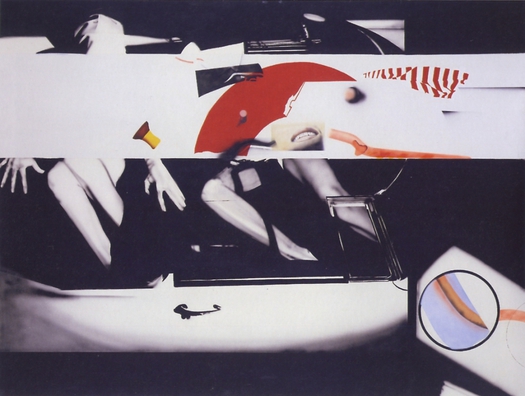
The Analytical Eye — Rick Poyner’s second essay for Design Observer on the visual interpretation of J.G. Ballard examines the work of French artist Peter Klasen:

What both Ballard and Klasen share… is a cold, appraising, analytical eye. It’s impossible to tell how they feel about what they show, or to know what they want us to feel, if anything at all. Their findings are disturbing and perhaps even repellent from a humanist perspective, yet the new aesthetic forms they use to embody them are, even today, exciting, provocative and tantalizingly difficult to resolve.

Any Colour — So Long As It Is Black — The WSJ profiles Massimo Vignelli:

“The greatest design has to provide a little pleasure,” he explained, producing the straightforward black bag he carries; Mr. Vignelli wears nothing but black. Proudly reporting that he’d bought the bag from a local street vendor, he pulled out a black Leica camera…, a pair of black Ray Bans and a tape measure—alas, bright yellow, not black.

“This is my dictionary,” Mr. Vignelli said of the tape measure. He explained that even as a child he had such fascination with the dimensions of things that he would challenge his friends to guess their size. He believes that subtleties of shape conjure emotion. “Is that three centimeters or four centimeters?”

All Forest, No Trees — David L. Ulin reviews The Information by James Gleick for The LA Times:

Over the course of human culture, there have been a number of significant transformations, beginning with the alphabet, which Gleick calls “a founding technology of information. The telephone, the fax machine, the calculator, and, ultimately, the computer are only the latest innovations devised for saving, manipulating, and communicating knowledge.” It is his idea that all these technologies exist as part of a continuum, with each developing from the last.

The key to such an argument is perspective, which is often in short supply when it comes to the information culture, with its tendency to inspire either paeans or jeremiads. Gleick, however, is too smart for that; he’s all about the forest, not the trees.

And finally…

Breaking Machines — Richard Conniff, author of The Species Seekers, on what the Luddites really fought against:

Despite their modern reputation, the original Luddites were neither opposed to technology nor inept at using it. Many were highly skilled machine operators in the textile industry. Nor was the technology they attacked particularly new. Moreover, the idea of smashing machines as a form of industrial protest did not begin or end with them. In truth, the secret of their enduring reputation depends less on what they did than on the name under which they did it. You could say they were good at branding.

Comments closed

Midweek Miscellany

Atrocity Exhibition — Rick Poynor on the book covers  and other visual interpretations of J.G. Ballard at Design Observer:

The repeated failure of editors, designers and illustrators to engage intellectually with The Atrocity Exhibition is all the more remarkable because the book offers a litany of Ballardian images: bunkers, concrete causeways, jutting balconies, crashed bombers, a drained sculpture fountain, a deserted beach resort, rubber mannequins and plastic dummies, as well as more ambiguous images such as a “conceptual auto disaster” or a “spinal landscape” — quite apart from its erotic content.

See also: James Pardey’s essay on David Pelham’s Ballard covers for Penguin.

Cock of the Walk — Publisher Benedikt Taschen profiled in The Wall Street Journal:

Mr. Taschen admits he puts too much love and attention into his creations to ever go into the orbit of mass publishing, adding that he wants to make collectibles, not disposables. “Most books look so s— and dispassionately done; they are disposable from the beginning,” says the publisher. “Their books are not designed to become significant objects, so most books have no identity, no soul. I’m not saying all, but the vast majority [of publishing houses], with a few exceptions, have lost their profile and personality. It doesn’t look like they have spent a lot of care and love.”

(Says the publisher of The Big Butt Book book…)

A wonderful gallery of book trade labels.

See also: Book trade labels in the collection of Crossett Library Bennington College (via @shelfappeal).

The Lure of Lists — Literature professor Jeremy Dauber on the attraction of literary lists for More Intelligent Life:

Looking at the books double-stacked on shelves in my office, I can check off their provenance one by one: New York Times 10 Best Books of 2010; 500 Essential Graphic Novels; Harold Bloom’s guide at the end of The Western Canon; the awards list at the Locus Index to Science Fiction Awards; and the National Yiddish Book Centre’s 100 Greatest Works of Modern Jewish Literature. The stacks include the occasional recommendation of a friend or an impulse buy, but those are the exceptions to the list-derived rule.

And finally…

…On the list of all things awesome, BLDGBLOG interviewing Hellboy creator Mike Mignola ranks pretty highly (thanks @derekmurr):

I have never done a story in a shopping mall because, even if I’m not drawing it myself, I don’t want to see somebody draw a shopping mall. In the Hellboy world, and in other things I’ve done, those places almost don’t exist. When I do Eastern Europe—and I’ve been to Eastern Europe, and I’ve seen the shopping malls and the god-awful housing projects and things, and there are horror stories that take place in there, I have no doubt—but I gravitate toward the classic, clichéd, spooky places, whether they truly exist in this world or not.

See also: Hellboy: The Whittier Legacy in USA Today.

Comments closed

Something for the Weekend

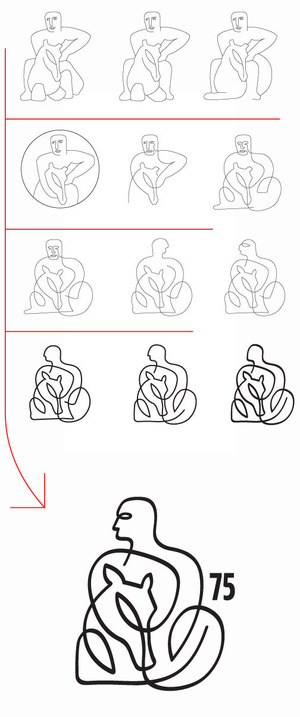
New Directions celebrates its 75th anniversary in 2011 and to mark the occasion, creative director at large Rodrigo Corral commissioned illustrator Felix Sockwell to redesign their iconic colophon by Heinz Henghes.  Sockwell writes about the redesign process (and vomiting!) here (via MobyLives).

Drowned in Sound — You have a few days left to listen to the BBC Radio adaptation of J.G. Ballard’s The Drowned World.

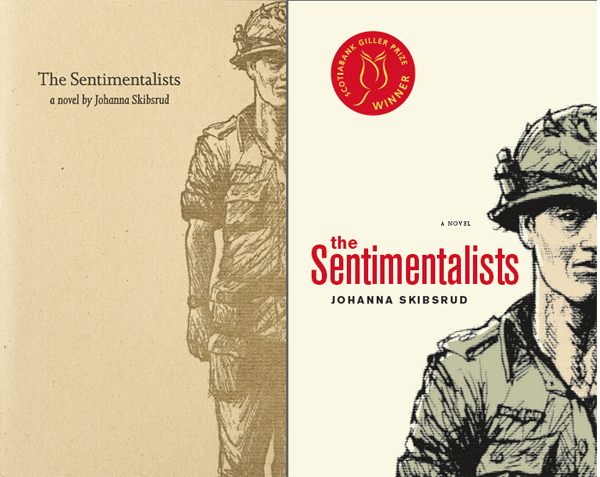
Rewiring — Peter Cocking, art director at Douglas & McIntyre, on designing a new cover for Johanna Skibsrud’s debut novel The Sentimentalists, winner of the Giller Prize and first published by artisan publisher Gaspereau Press:

I felt that the existing cover was to some extent a brand for the book — it appeared in the media quite a bit. It’s different from what we would do in that it’s — and I mean no disrespect to Andrew [Steeves, co-publisher of Gaspereau Press] — but it’s a more literary small-press treatment. It’s very appropriate to the way they publish the book, but it was clear, of course, that we were going to try and push this out into the marketplace in a much wider way. So it seemed to me that the idea was to take what they had, because people might remember this as the cream-yellow book with the solider, and make it a little more contemporary, trade-friendly, a little more aggressive as it were. It wasn’t so much a design from scratch, the way I would normally approach a novel. The way I would describe it is I didn’t build the house, I repainted it, did some new wiring.

And finally…

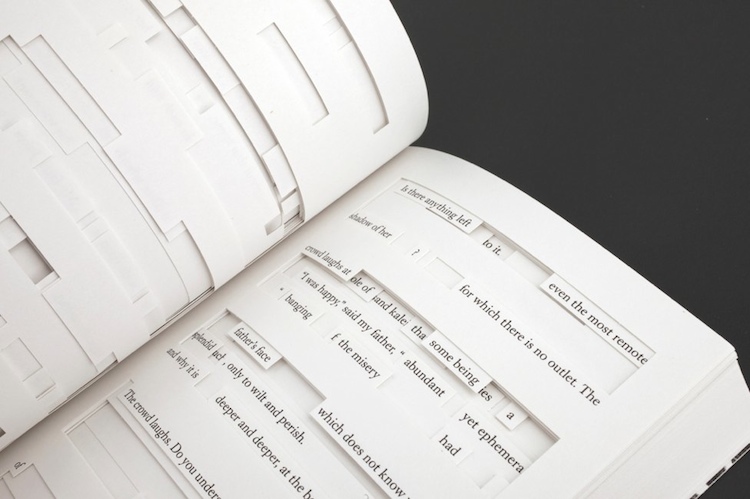
Jonathan Safran Foer’s “unmakeable” book Tree of Codes published by Visual Editions and printed by Belgian publisher and printer Die Keure, seen at Fast Company.
Comments closed

Something for the Weekend

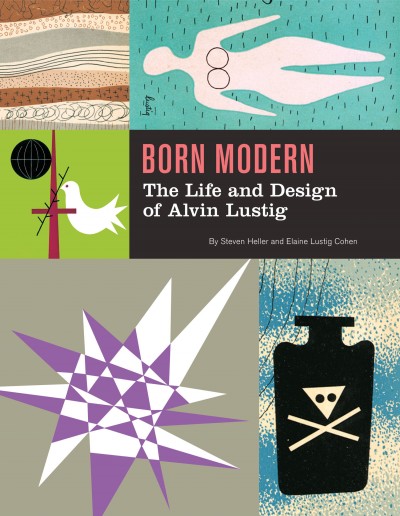
There are two new books about designer Alvin Lustig available this month — Born Modern: The Life and Design of Alvin Lustig by Steven Heller and Elaine Lustig Cohen (Chronicle Books*) and Purity of Aim: The Book Jacket Designs of Alvin Lustig by Ned Drew and Paul Sternberger (RIT Cary Graphic Arts Press).

The Death of the Book has Been Greatly Exaggerated — Tech columnist Christopher Mims on the “irrational exuberance” around e-books (via MobyLives):

Tech pundits recently moved up the date for the death of the book, to sometime around 2015, inspired largely by the rapid adoption of the iPad and the success of Amazon’s Kindle e-reader. But in their rush to christen a new era of media consumption, have the pundits overreached?

I’m calling the peak of inflated expectations now. Get ready for the next phase of the hype cycle – the trough of disillusionment.

The Secret Life of Shepperton — A photo essay on Shepperton, the suburban town south west of London where author J. G. Ballard spent most of his adult life. The photographs are accompanied by text from Ballard’s own novels, autobiography, interviews as well as observations about the town and its history (via 3:AM).

And finally…

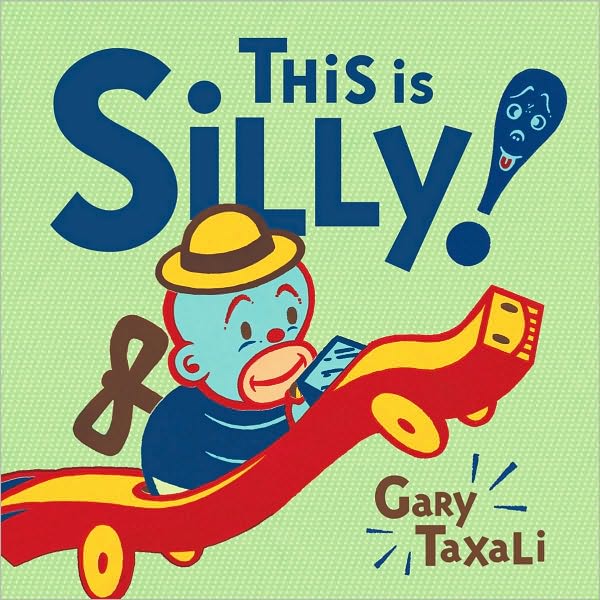
The Wonderful 36 Pages features This is Silly! by Toronto-based artist/illustrator Gary Taxali:

* Chronicle Books is distributed in Canada by my employer Raincoast Books.

Comments closed

Something for the Weekend

Sadly I missed the book launch earlier this week, but Toronto-based artist and illustrator Gary Taxali talked to the Torontoist and The National Post about his new kids book This is Silly!. You can see more of Taxali’s amazing book covers here.

ArtifactsMaximus Clarke has a fascinating conversation with William Gibson about his new novel Zero History :

I reach instinctively for something without knowing why, and place it in the narrative, and if it strikes a resonant chord with me, I’ll leave it there… But I myself have wondered why I do that — why I depict a universe of man-made objects, with people walking among them (laughs). My best answer is that it’s the way I perceive things. And I also suspect that the narratives of objects are more available to us when the objects themselves have become slightly decrepit. So I think my interest in old things, and worn things, isn’t about nostalgia in any conventional sense; it’s about the revelation of the narrative of how that object came to be in the world, and what it once might have meant to someone.

And on a somewhat related note, an interview with J.G. Ballard from the Winter 1984(!) issue of The Paris Review:

I would say that I quite consciously rely on my obsessions in all my work, that I deliberately set up an obsessional frame of mind. In a paradoxical way, this leaves one free of the subject of the obsession. It’s like picking up an ashtray and staring so hard at it that one becomes obsessed by its contours, angles, texture, et cetera, and forgets that it is an ashtray—a glass dish for stubbing out cigarettes.

The Black Arts — Book cover designers discuss their devious techniques for winning a clients approval with Peter Mendelsund and Peter Terzian:

Yes, a good design should speak for itself—but what if the client isn’t listening? Well, that’s when designers employ methods that are not taught in design school. Psychological methods. Machiavellian methods. Used-car-dealer methods. Manipulation. Intimidation. Seduction.

The PDF is here.

And Peter T has clearly been busy. The editor of Heavy Rotation: Twenty Writers on the Albums That Changed Their Lives has an article on books about album cover art at BookForum.

And finally (and on the subject of music)…

Finding Our WayRadiohead bassist Colin Greenwood reflects on the digital “pay what you think it’s worth” release of their album In Rainbows in 2007  and the band’s distribution options for their new songs:

I buy hardly any CDs now and get my music from many different sources: Spotify, iTunes, blog playlists, podcasts, online streaming – reviewing this makes me realise that my appetite for music now is just as strong as when I was 13, and how dependent I am upon digital delivery. At the same time, I find a lot of the technology very frustrating and counter-intuitive. I spend a lot of time using music production software, but iTunes feels clunky. I wish it was as simple and elegant as Apple’s hardware. I understand that we have become our own broadcasters and distributors, but I miss the editorialisation of music, the curatorial influences of people like John Peel or a good record label. I liked being on a record label that had us on it, along with Blur, the Beastie Boys and the Beatles.

(via Subtraction)

Comments closed

Midweek Miscellany

Jimmy Corrigan Japanese Edition Poster from PRESSPOP (via Flog!).

Zingers — Film critic and blogger Roger Ebert, who has lost the ability to speak unaided, on Twitter:

Twitter for me performs the function of a running conversation. For someone who cannot speak, it allows a way to unload my zingers and one-liners… This has become addictive. I tweet too often. I actually go looking for stuff to tweet. I have good friends who suggest things… I was doing this daily, but have scaled back because it was keeping me up too late.

I’ve made a change recently. After writing my blog, “The quest for frisson” and reading two recent articles about internet addiction, I have looked hard at my own behavior. For some days now I have physically left the room with the computer in it, and settled down somewhere to read. All the old joy came back, and I realized the internet was stealing the reading of books away from me. Reading is calming, absorbing, and refreshing for the mind after hectic surfing… I like the internet, but I don’t want to become its love slave.

Landscapes from a Dream — James Pardey (The Art of Penguin Science Fiction) on JG Ballard’s early novels and the Penguin cover art of David Pelham at The Ballardian:

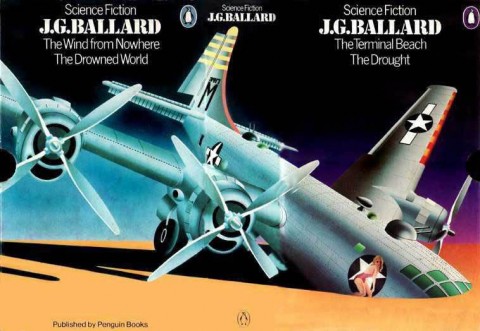
Pelham’s covers featured a crepuscular sky above a barren expanse of water, sand or sunbaked earth as the backdrop for an artefact of twentieth-century industrial or military technology. According to the September 1974 issue of Science Fiction Monthly, these machines depict ‘the debris of our society’. Pelham, the article explained, ‘finds romance in seeing the future as if it were already the past – in visualizing ruins created from the artifacts we are manufacturing now’. But the paradox of Pelham’s artifacts is that they are not in ruins. His are pristine machines at odds with their apocalyptic settings. Half buried or submerged, they stand as tombstones to ostentation and brutality. They are icons, but only of man’s arrogance.

JG Ballard’s archive was recently acquired by the British Library. The Guardian has an fascinating slide show of the archive, including pictures of Ballard’s annotated manuscript pages.

And finally…

4CP | Four Color Process — A blog of comic panels enlarged Lichtenstein-like to reveal the CMYK halftone dots.

2 Comments

Midweek Miscellany

EndGrain — A “directory and aggregator for wood type and letterpress works and information on the web.” Lovely.

Crash — Iain Sinclair (author, most recently, of Hackney, That Rose-Red Empire — just out in paperback by the way) on JG Ballard’s artistic legacy:

A late moralist, he practised undeceived reportage, not prophecy: closer to Orwell than HG Wells. Closer to Orson Welles than to either. Closer to Hitchcock. Take out the moving ­figures on staircases that go nowhere and stick with hollow architecture that co-authors subversive drama

Picture Book Report — 15 artists create illustrations inspired by their favourite books. Pictured below: Kali Ciesemier‘s take on Sabriel by Garth Nix. I’m also looking forward to Robot Johnny‘s take on The Hitchhiker’s Guide to the Galaxy (via The Art Department).

Indigo 2.0Canadian Business magazine on Indigo and their digital book division Kobo:

“Kobo has been across the smartphone space from the beginning,” says Lisa Charters, senior vice-president and director of digital for Random House Canada. “And that unique offering is really important to us as publishers, because we want consumers to have all options to read e-books, and not necessarily have to purchase a $300 device.”

What’s more, says New York publishing consultant Mike Shatzkin, “they beat Google into the cloud.” Kobo’s library system is based in cloud computing. When you buy a Kobo book, it resides on Kobo’s servers and you access it via your device of choice. So when you squeeze in 20 pages of The Lost Symbol on your laptop in the morning, and later that day open the Kobo application on your BlackBerry, Kobo automatically plops you down on page 21.

Interesting stuff, although I do wish journalists could stay away from the Gutenberg clichés (and Dan Brown. Barf).

And finally…

Reserve Window Design — “We hired our good friend John Downer, who is a professional sign painter & typographer, to fly to LA to do gold leaf lettering on our store window & transom. Glass gilding is becoming a lost art that only a few dozen people in the United States still know how perform” (via We Love Typography):

4 Comments