An interview with Richard Ford, recorded onstage at a special PEN benefit at the International Festival of Authors in Toronto, on CBC Radio’s Writers & Company:
CBC Radio Writer’s & Co. Richard Ford Mp3
Comments closedBooks, Design and Culture
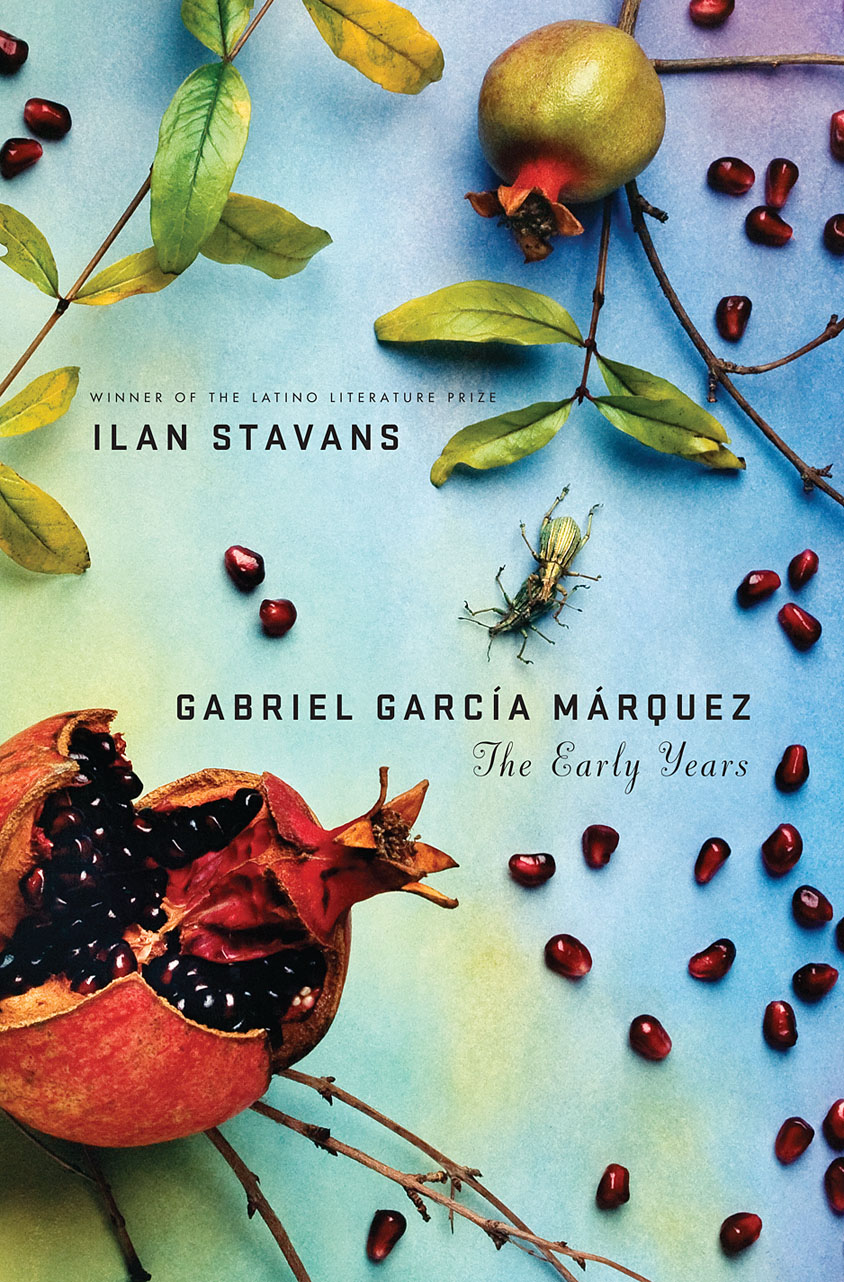
I recently mentioned to a friend that I was going to interview book cover designer Jason Ramirez. “Jason’s the best,” he said. “Any time I’m stuck on type, I try to imagine what Jason would do and work from there.”
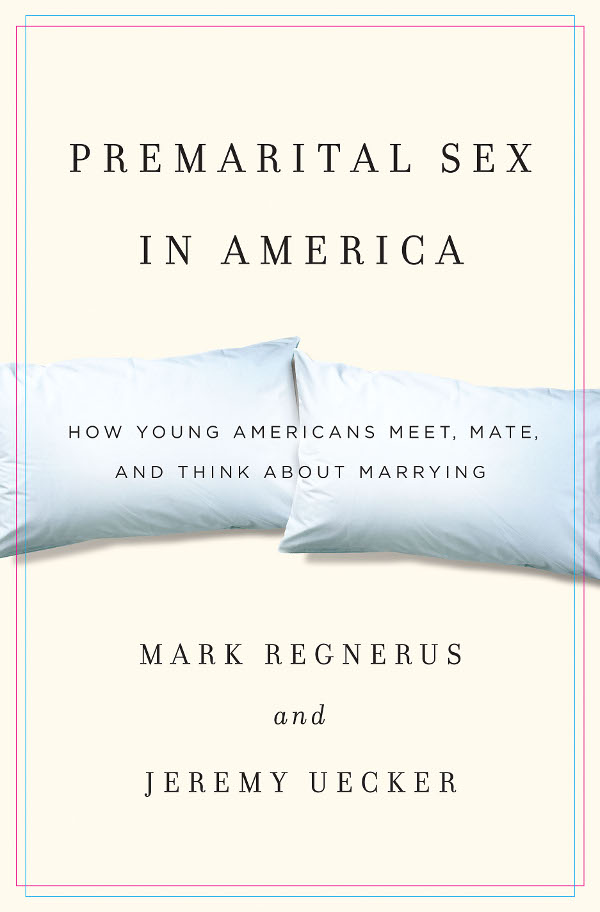
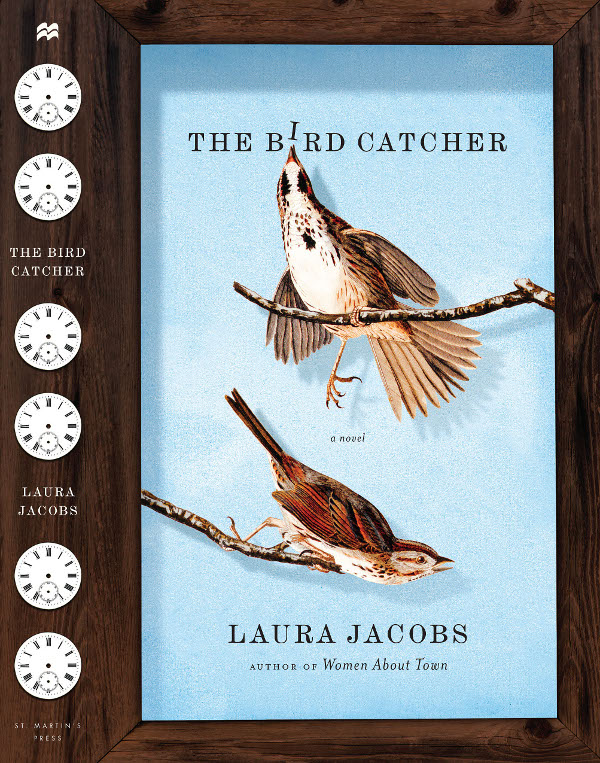
And when you look at Jason’s book covers you know what he means. A designer at New York’s St. Martin’s Press his typography is always beautiful. Each elegant letter is given room breath and perfectly compliments the design as a whole.
There is, in fact, an irresistible incisiveness and precision to Jason’s work that lend all his book covers an airy beauty. They feel spacious and uncluttered; direct without ever being blunt. I’m sure it won’t be too long before more designers ask, “what would Jason do?”
Jason and I corresponded by Twitter and email, and you can see more his portfolio on the Behance Network.

How did you get into book design?
I pretty much took a roundabout way into book design. I first went to college in upstate New York with the intention to eventually study medicine. Four years later, after a near-fatal rendezvous with organic chemistry, I graduated with a degree in comparative religious studies. I spent the next few years in San Francisco working for a real estate investment company, first in human resources and then in marketing and branding. It was during my stint in marketing and branding, which introduced me to the design world of San Francisco, that I began to daydream about a move to the city of New York to study design. Eventually I worked up the courage to make the move and was accepted to Parsons School of Design. During my last year at Parsons I had the good fortune of taking a book cover design course instructed by Gabriele Wilson. Pretty much from the onset of the class I was hooked. Shortly after graduating again, I began working with Rodrigo Corral and continued for a bit over a year before landing at St. Martin’s Press.
How long have you been at St Martin’s?
I’ve been with St. Martin’s Press since November 2007.
Approximately how many titles do you work on a season at St Martin’s?
I work on anywhere from ten to fifteen new titles each season, across four different imprints: St. Martin’s Press (trade hardcover), St. Martin’s Griffin (trade paperback), Minotaur (mystery) and Palgrave-Macmillan (which is actually an academic and trade publishing company; a close cousin to St. Martin’s).
Is there a house style?
No. One of the terrific things about working at St. Martin’s is the variety of titles published each season. Working across genres provides an opportunity to bring a fresh perspective to each project.
Do you also work freelance?
I’ve had the opportunity to work with a few publishers including, Atlas & Co., HarperCollins, Oxford University Press, The Countryman Press, W.W. Norton, and Vintage. I’ve also dabbled in a bit of interior book design with the talented design and publishing duo of Scott & Nix (Charles Nix and George Scott).
Could you describe your design process?
My process may vary depending on the project, but I always begin by reading. I try to read as much as possible of whatever materials are available, be it a manuscript, proposal, or synopsis. Depending on the subject matter, additional research might be needed. Not to mention that a bit of scouting for related imagery and typography can often inform and inspire. I tend to rely heavily on a sketchbook to record notes relating to the content and meaning of a book; ideas about imagery, typefaces and colors; and thumbnail sketches. And from this hopefully a clear, clever and attractive idea will prevail.

What are your favourite books to work on?
I appreciate the opportunity and challenge to work on various genres. Though I often tend to be drawn to non-fiction titles such as academic and business-oriented subjects. The conceptual challenge to visually simplify complex and comprehensive subject matter that might not be immediately accessible to a reader resonates with me.
What are the most challenging?
Any project has the potential to be challenging. Sometimes a project that I expect to be relatively easy to nail will prove to be the most time-consuming, requiring multiple rounds of revision. The challenge in this situation can be sustaining a fresh approach throughout multiple iterations, as well as mitigating your ideas with the opinions of others involved.
Do you have any recent favourites?
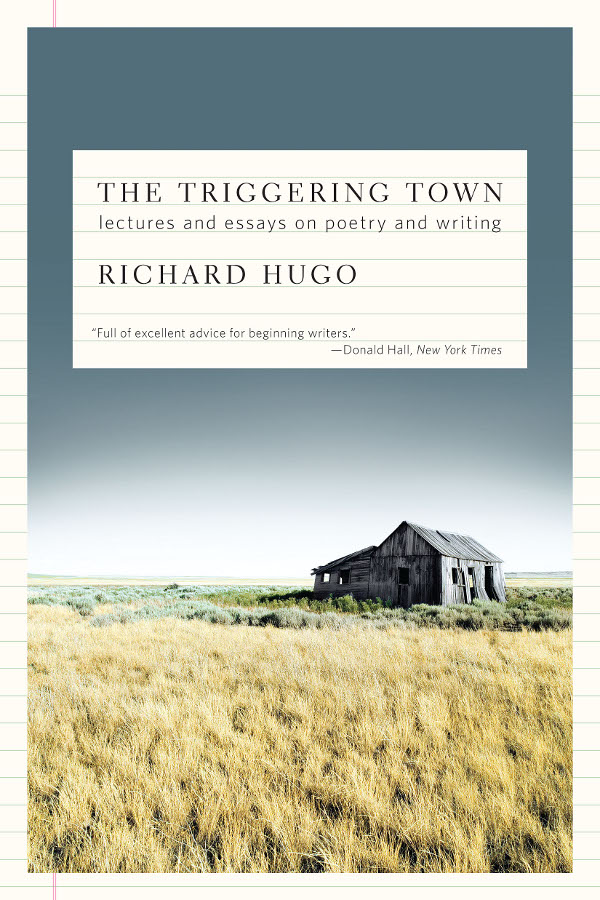
Two recent favorites include, Gabriel García Márquez: The Early Years, a biography that charts Márquez’s life leading up to the publication of his classic, One Hundred Years of Solitude; and Glimmerglass, my foray into the burgeoning young adult paranormal genre. I’m also quite fond of two relatively recent freelance projects: Power, a business management book about leadership and management success; and The Triggering Town, a collection of witty and inspirational essays on writing and poetry.
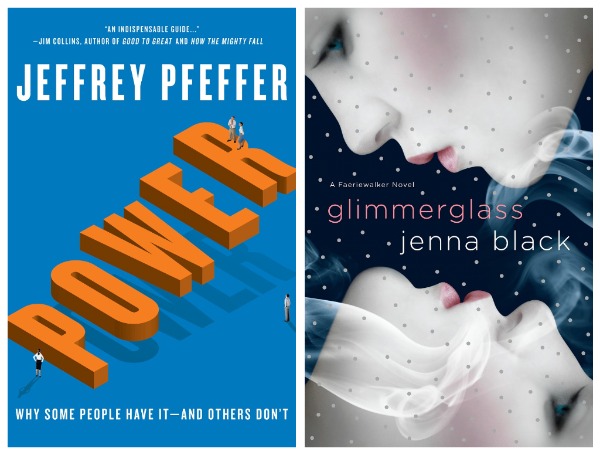
Where do you look for inspiration, and who are some of your design heroes?
I will take cues from popular culture, be it the daily headlines, magazines, music, television, movies, and the internet. On any given day, I might find inspiration in a post in my Twitter feed, from a thought-provoking illustration within the New York Times, by thumbing through a design or art book, or simply from a conversation had with a friend or colleague. And I’m almost always inspired when inside a book store.
I admire the work of Paul Rand, Alvin Lustig, Vaughan Oliver, Stefan Sagmeister, and Michael Bierut, to name a few. But the reality is that there so many visually creative people, both inside and outside of publishing, whose work I admire and find inspirational.
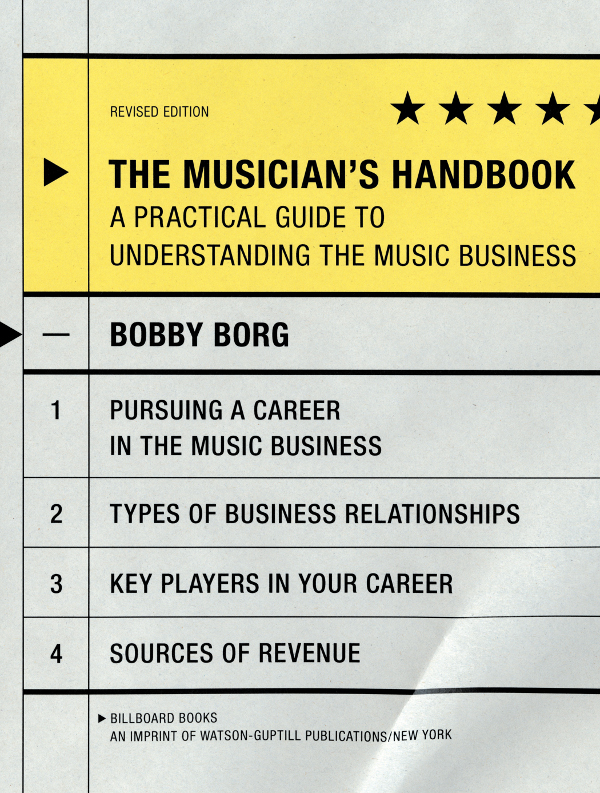
Who else do you think is doing interesting work right now?
There are many smart and talented designers working in publishing today who are consistently creating great jacket design such as Rodrigo Corral, Evan Gaffney, John Gall, Jamie Keenan, Peter Mendelsund, and Gabriele Wilson.
What are you reading currently?
Admittedly, at times I can be a bit lazy. So aside from finishing the lingering manuscript, scrolling through my Twitter feed, or browsing my Netflix queue, it’s not surprising that I’m reading an outdated issue of New York Magazine, inching closer to finishing The Glass Castle which I began last summer, and randomly reading excerpts from the Autobiography of Mark Twain.
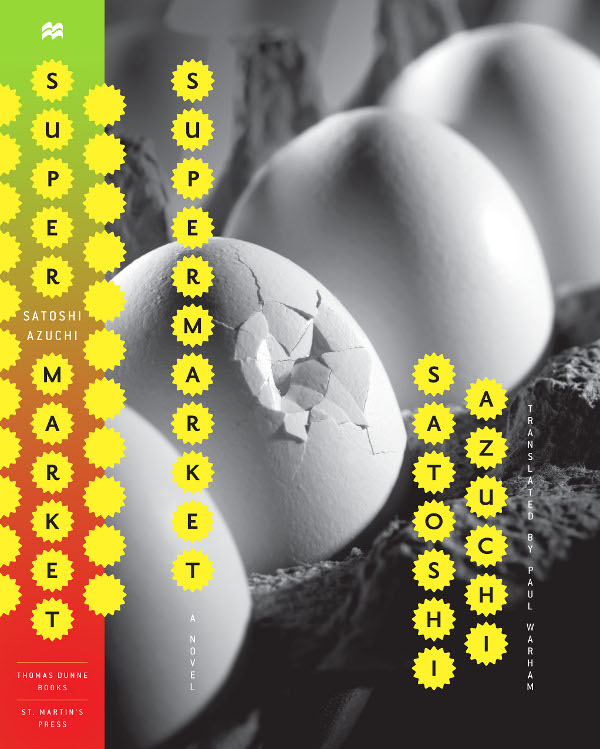
What does the future hold for book cover design?
This is the great unknown. I prefer to believe that the physical book will survive alongside the electronic book. That said, as technology evolves, additional possibilities may be created for book cover design in a digital form. In the long-term perhaps the digital book, both the content and the artwork used to package and identify it, will become multi-dimensional and interactive so that a reader might have the ability to navigate through multiple layers of storytelling. Or maybe I’ve seen one too many Harry Potter movies … I guess we’ll have to wait and see.
Thanks Jason!
1 Comment
Simon Garfield, author of Just My Type: A Book About Fonts, talks to Ramona Koval for The Book Show on ABC Radio National:
RN Book Show — Simon Garfield: Just My Type Mp3
Comments closedBen Fullerton, Director of User Experience at Method Design in San Francisco, talks to Nora Young about design that supports solitude and mindfulness for CBC Radio’s Spark:
CBC Spark: Ben Fullerton Designing for Solitude Mp3
(I love this idea).
Comments closed
An interesting interview with John B. Thompson, author of Merchants of Culture: The Publishing Business in the Twenty-First Century, at Beyond the Book:
[R]eaders are going to be faced with a growing proliferation of possibilities in terms of the ways that they read and consume the written word, and people will make different choices about that. I think what we will see is some readers will migrate effortlessly into an electronic environment and will welcome the emergence of a variety of different ways to read texts online or in dedicated e-book readers or on iPads or other forms of device that will enable them to read in different ways and different contexts… Others will find it less attractive and will continue to value some aspects of the printed book that are important to them, because for many readers, books are not just reading devices. Books are cultural artifacts. They are social objects. They are indeed forms of art, which they like to own and possess and to put on a shelf and display and to share with others and to return to time and again and read on various occasions in the future. And they will continue to cherish that physical objective character of the printed book. And so, some will not choose to read in an online or an electronic form, because for them, the book matters as an object.
Beyond the Book John B. Thompson Mp3
(via MobyLives)
2 Comments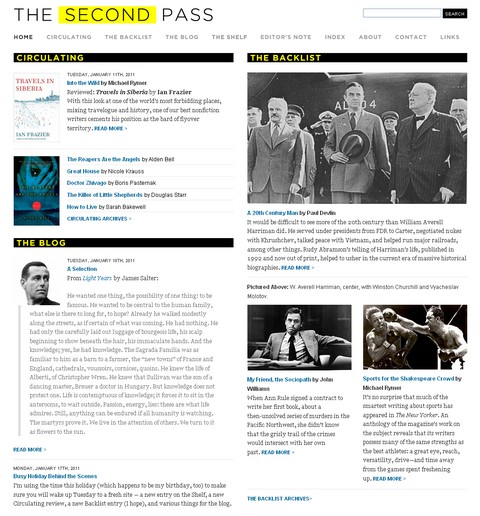
I feel a special admiration for The Second Pass. Launched almost two years ago — shortly after first tentative posts at The Casual Optimist — and with a list of whip-smart contributors, it seemed to signify a second wave online literary journals that built on the success of groundbreaking sites like Bookslut and ReadySteadyBlog. Well-designed and appropriately eclectic, it had wider horizons than ailing newspaper review pages, and yet Brooklyn-based founder John Williams — who previously worked in publishing — seemed less prone to the snark so commonplace among some of the more established online literary set.
 I was, needless to say, surprised when I first received an email from John. The idea that he had even heard of the less-than whip-smart The Casual Optimist seemed so… unlikely. And yet, John and I have remained in touch on and off for the past year and half, and I have even contributed to The Second Pass, so I thought it was high time I talked to him about the site and its recent book party in Brooklyn.
We corresponded by email…
For those people unfamiliar with the site, could you describe The Second Pass?
The site is an online magazine devoted to books new and old. It features reviews of new books, essays about older and more obscure books, and a blog about books of all stripes. That’s the basics. It’s a place where serious readers of all kinds can enjoy themselves and, from time to time, maybe learn about a book or author they might not otherwise learn about.
What makes The Second Pass unique?
Unique is a strong word. There are other sites and publications that pay attention to obscure books, but I think the site’s regular devotion to it — including out-of-print books — is rare, if not entirely unique. I also like to think the writing is generally at a level that separates it from many other online-only enterprises.
What lessons have you learned in the first 20 months of editing the site?
Plan ahead. And have contingency plans. I’ve learned those lessons, though I’m still learning to act on them.
Appearance and readability often seem to be an afterthought for websites about books, but that doesn’t seem to be the case with The Second Pass. Did a lot of planning go into the design of the site?
Yes, my friend Strath Shepard spent time coming up with several visual ideas for the site, and I chose from among them — any one of which I would have been thrilled with. I wanted to make sure the site looked good, because I think design is as important online as anywhere else. It should be strong and inviting without being an obstruction or a distraction, in my opinion.
Is it easier or more difficult for independent online literary journals to find an audience today?
Easier than it was in the past online? I’m not sure about that. My unscientific sense is that many more people are spending time online, but that the idea of a big audience for niche blogs or journals is more or less a dead dream. Reaching a certain core number of readers is easy enough online, if you’re patient and steady in your production, but I think the audience for serious books coverage is inherently limited in a way that can be hard to admit. I would rather try to reach the maximum of that particular audience (and I have no idea what that number would be; my site’s traffic is surely a tiny sliver of it) than start throwing too many things at the wall to try to reach a more general audience. I think the pressing need for lots of traffic is reflected at a place like The Huffington Post, where the books coverage is a hodgepodge of too-frequently-published pieces that don’t feel unified in any satisfying way. But those people who work for places where increasing traffic is paramount — to paraphrase David Letterman, I wouldn’t give their troubles to a monkey on a rock. I’m happy there’s no one above me worrying about traffic.
What other book sites do you read regularly?
Maud Newton, The Book Bench, Paris Review Daily, Bookslut, The Millions, John Self, Levi Stahl’s I’ve Been Reading Lately, the Barnes & Noble Review, Mark Athitakis, Novel Readings, and yours. Those might be the ones I check most regularly, off the top of my head, but I drop in on many more, most or all of them on the links page at The Second Pass.
Where does the name of your blog, A Special Way of Being Afraid, come from?
It comes from a Philip Larkin poem called “Aubade,” which is a terrifying and beautiful confrontation of the fear of death. It begins: “I work all day, and get half-drunk at night. / Waking at four to soundless dark, I stare.” And a bit later: “This is a special way of being afraid / No trick dispels. Religion used to try…” It’s always been one of my favorite poems, and I thought that phrase would make a good blog name, back in 2005, when I started it. I still like the name.
How has the experience as founder and editor of The Second Pass been different from blogging?
I started the older blog while working for a big publishing house, partly as a way to maintain the habit of writing and to develop my own voice while in a job that made it difficult to find time for those things. Especially in the beginning, I felt it was important to keep the blog regularly updated, for the exercise of it and for building readership, however modest. I feel that pressure more keenly with The Second Pass, since I have more ambitions for it. Ideally, I would update it far more often than I do. I also work with other people on The Second Pass. I wear all the hats, but I rely on reviews and essays from other writers, a social part of the experience that I really enjoy but that makes it different from the more dictatorial nature of the blog.
The blog is also more wide-ranging. I’m probably a reader first and foremost, but I’m also a longtime fan of music, movies, and sports, among other things. Not to mention the more personal things I might ruminate about over there. I still consider the blog a useful outlet for those things, though I’ve been terribly neglecting it for the past several months, if not longer.
The Second Pass held its first event in November. What made you decide to throw a party?
I had been meaning to have a party ever since last March, when the site celebrated its one-year anniversary, but was stymied by various obstacles that wouldn’t have stymied someone with more resolve. I thought it would be fun to have a party, and figured it couldn’t hurt the site’s visibility. Plus, I wanted to showcase some of the fantastic people who have written for the site.
Who read at the event?
Carlene Bauer, Will Blythe, and Maud Newton read from works of fiction in progress. Jason Zinoman read from his book about horror movies in the 1960s and ’70s, which is being published here next summer. And Lauren Kaminsky read an excerpt from a terrifically weird book called Listen, Little Man by Wilhelm Reich, a screed written by an Austrian psychoanalyst who worked with Freud and later seemed to have cracked up pretty good. I’m hoping Lauren will write about the book (and him) for the site at some point.
Do you think the evening was a success? And will you be organizing more events in future?
I thought it was a big success. I’m biased, of course, but the readers couldn’t have done a better job, there was plenty of wine and food, and everyone seemed to have a good time. Melville House, an independent publisher and bookstore in Brooklyn, was a gracious host. And yes, I’m certainly hoping to do it again, perhaps in Manhattan next time, when the site turns two (which happens March 10) or soon after.
Do you think interest in live book events will see the same kind of revival that live music events have in recent years?
I think live book events, at least in New York, have been thriving in recent years. My dirty little secret is that I find many traditional readings dull. Not all, but many. Lots of good writers just aren’t good readers, which is no knock on them. It’s not their job, and they’re very different skills. Only a few lucky people have both. I think it’s also asking a lot of a text to keep people interested for a long stretch of time while it’s read aloud. (I’m not a big fan of audio books for that reason, though this is probably saying much more about my aural attention span than about the worth of audio books.)
Who are some of your other favourite authors?
William Trevor, Richard Russo (especially pre-Pulitzer), Marilynne Robinson, David James Duncan, Dostoevsky, Lorrie Moore, Wilfrid Sheed, Nabokov, William James, Martin Amis (back when), Iris Murdoch, Richard Ford (the Bascombe books, particularly), to name a few.
What were your favourite books of 2010?
I recently finished The Killer of Little Shepherds by Douglas Starr, a nonfiction story set in late-19th-century France, which tells the parallel stories of a serial killer on the loose and a criminologist who was doing a lot to introduce the set of forensic techniques that we now, thanks to TV, simply refer to as “CSI.” It’s a gripping story, smartly told. I also enjoyed Brady Udall’s The Lonely Polygamist. He’s an old-fashioned storyteller, sweeping and just the right amount of sentimental, and this novel is about a Mormon with four wives and 28 children.
What books are you looking forward to reading in 2011?
I’m glad you asked this, because it reminded me that I’m behind in figuring out what the site will cover this year. I’m a fan of Jonathan Coe’s work, and his new novel, The Terrible Privacy of Maxwell Sim, is coming in March. Just today, I received a galley of House of Exile by Evelyn Juers, a biography of Heinrich Mann, his wife Nelly, and their circle of famous friends. I’ve been looking forward to its U.S. publication since I read a terrific review in the TLS. And of course, there’s David Foster Wallace’s novel in April. Though I’m skeptical of posthumous releases, including this one, I’m as curious as every other fan of his.
Thanks John!
Photo credit: Justin Lane

John Gall is Vice President and Art Director for Vintage/Anchor Books, an instructor at the School of Visual Arts, and the author Sayonara Home Run! The Art of the Japanese Baseball Card.
Previously Art Director at Grove/Atlantic, Gall has been interviewed about his work by Step Inside Design, Design Bureau, and Barnes & Noble (video). He garnered even wider attention in 2009 when he commissioned a roster of high-profile designers — including Rodrigo Corral, Carin Goldberg, Chip Kidd, Paul Sahre, Megan Wilson and Duncan Hannah — to redesign twenty-one Vladimir Nabokov book covers within the confines of specimen boxes (read more about the designs at Print Magazine).

I have wanted to interview John for a long time, but as he talked about book design extensively elsewhere and regular readers are more than likely familiar with his work already, I was waiting for the right subject. It was his colleague Peter Mendelsund, who suggested that rather than discuss his book covers, I should ask John about his collages. John Gall makes collages? Yes, indeed he does. And, needless to say, they are very good.
I met John in Toronto in December last year, and we corresponded by email.

When did you first start making collages?
It’s something that I’ve been doing sporadically since forever. And when I say sporadic I mean, years or decades between doing anything.
Do you create them digitally or by hand?
All hand done. One of the reasons I do this is to get away from the computer, drop the design think and work with the hands. Its kind of liberating to not have the ability to resize things on the fly. I sometimes use a digital camera to keep track of the permutations since my brain no longer can.

Can you give me a sense of their size?
8 x 10 on up to 18 x 24
How do you chose your titles?
The titles come from things I may be thinking about, or reading, or songs I may be listening to at the time I am making them. Then I make an anagram. It now takes me a lot of time to decipher the original source and many times I cannot. Strangely, when I posted “Hot Elves,” I got a ton of hits, which made me briefly consider naming everything after comic-nerd fetishes.
Who are your artistic influences and where do you look for inspiration?
I like the same old dead people as everyone else: Kurt Schwitters, Marianne Brandt, Georges Hugnet, Rauschenberg, John Chamberlain (not dead yet!), etc. People working today who make me incredibly jealous: Fred Free, Mark Lazenby, John Stezaker, James Gallagher, Lou Beach and family, Wangechi Mutu, Clara Mata, Robert Pollard, Nicole Natri, Paul Butler, Charles Wilkin and a bunch of people I’ve met on Flickr who’s real names I do not know.
Not sure how influential any of these folks are but they do inspire me to get off my ass and get to work.

Is creating a collage a similar process to designing a cover?
Yes and no. In both cases you are moving things around on a page until they look “right”. For me, when I am doing the collage work I am eliminating the concept (and most of the time the typography) so it is reduced to forms on a page.
Graphic design is a total left brain/right brain thing. A combination of logical carefully considered thinking and intuitive personal expression. For the collage work I try to put the logical aside and exercise the intuitive muscle.

Has making collages informed your designs?
When I am stuck, I sometimes find myself thinking “What can’t I do on a book cover”? Its chance to make the wrong path and see where that leads. Force myself to make the wrong decisions. Trying to leave thoughts of what looks “good” out of the equation. Nearly impossible, but that is the goal. The hope was that these notebooks could fuel design ideas. Not so sure if that is still the case. They’ve become a thing unto their own.
Have you ever used one of your pieces in a cover?
I used them on a poster once. Attempted to use them on a skateboard design. A couple of people have tried to use them on book covers, to no avail.


Was creating a series of collages from recombined book covers cathartic?
Not really. More like, “hmmm…its 12:30 AM, I’ve spent all day working on book covers and now I’m tearing apart old covers to make new covers. Lo-ser”.
That said I’ve since started up this series again and will be posting them shortly. But I can only do these when I am away from work for a spell. Generally its like, “enough with the book covers already, is Food Jammers on yet?”.
Where do you gather your source materials from?
Most of what I work with comes in the daily mail: catalogs, magazines, etc. I intentionally try not to work with anything that is too vintage or too inherently beautiful—though I do break this rule all the time. My thinking is that all the great collage artists of the past used source material that was lying around in the trash or purchased at the local five and dime. Today we look at a Cornell piece or a Schwitters piece and marvel at the incredible printed material they had to work with. They were working with the Foodtown circulars and Bass Pro Shop catalogs of their day except, well, OK, more beautiful.
Do you still collect Japanese baseball cards?
The collecting has tapered of quite a bit since the book was published. I’m much more selective now. but if I see something particularly beautiful up for auction I’ll probably go for it. I’m not a super smart collector though. I tend to buy what I like and not what will be valuable.

Do you collect anything else?
I’m trying not to acquire to much stuff anymore and am getting ready to purge. I collect old snapshots, the occasional flashlight and I’ve recently acquired a hankering for old high school yearbooks. I’ve also been trading and collecting collage work.
Your collages are included in the recently released Graphic: Inside the Sketchbooks of the World’s Great Graphic Designers. How did that come about?
The author Steven Heller, asked me if I had anything that I’d want to contribute. I told him I keep two kinds of notebooks, one that is basically a to do list and idea book. The others are the collage notebooks. They were much more interested in those. By the way, its a beautiful book.

Untitled, James Gall (2008); Untitled, Owen Gall (2008)
You’ve collaborated with your kids on some collages. Can you tell me about ‘Dad’s Drawing Class’?
Kids are the best. The great thing about collage is that anybody can do it, but its hard to do well. Kids are naturals. They have no preconceived notions as to what looks good, just do what they like. So they are free to do whatever they want—that is, until they get old enough to become self conscious..
Dad’s Drawing Class is something I like to do with my kids while we are hanging out on vacation without cellphones and video games. We’ve done collage, some drawing exercises. I even had them drawing typographic forms one morning. My wife is also very creative and influential in this regard. She teaches a nature drawing program for children.

Where can we see your work next?
I had a couple pieces in a group show last year and some of my work will be in a book coming out next spring called “Cutters”. Showing this work is not something that I am actively pursuing. I’m not so convinced of its worthiness. I have a flickr stream, a typepad blog and if you find yourself wandering around in my attic any time soon, you will probably see some work.
Thanks John!
Images:
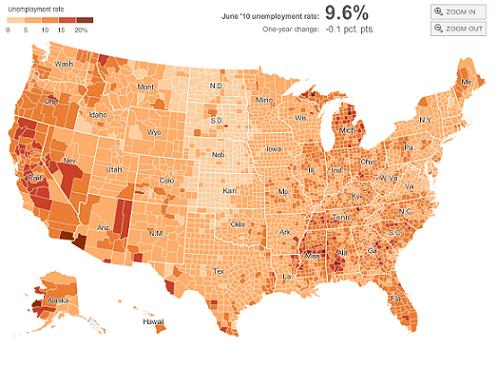
Amanda Cox, graphics editor at The New York Times, discusses data visualization with Nora Young for CBC Radio’s Spark:
This week’s Q & A with The Heads of State is my last interview of 2010. There are more Q & A’s with book designers and other book folk planned for 2011, but in the meantime, here’s a round-up of this past year’s interviews:

Jason Kernevich (left) and Dustin Summers (right), known together as award-winning design shop The Heads of State, met in the design program at Tyler School of Art, Philadelphia. Shortly after graduating, the duo began producing screen-print posters for the local independent music scene. The simple, bold graphic style of their work quickly garnered international attention and acclaim, and their clients now include the likes of R.E.M., Wilco, The National, The New York Times and The Guardian, as well as publishers Penguin, HarperCollins, and Random House.

If that wasn’t enough, the duo recently released a new letterpress print inspired by F. Scott Fitzgerald’s novel The Great Gatsby . The 4-colour, limited edition print (on 140 lb. French Poptone Sweet Tooth paper) shows the business cards and personal stationery of the Jazz Age VIPs that attend Gatsby’s parties in the summer of 1922. Complete with lovely touches such vintage typography and the characters’ professions and street addresses, the print is a beautiful tribute to a 2oth Century classic.

Jason, Dustin and I corresponded by Twitter and email about the Gatsby print and their unique design collaboration.
How did this project come about?
We’d been kicking around the idea of doing something with the novel for a long time. Chapter Four breaks from the plot for a moment and the narrator begins reminiscing about the folks who came to the parties that summer. The names by themselves are just incredible. There is some detail given about the characters’ background but not much. We had to make a lot of it up. But there were hints at a profession or an address here and there and that led to the idea to do business cards.


What’s the enduring appeal of The Great Gatsby for you?
Like most people, we first came across this book in high school and hated it. Rediscovering it later in life has been a joy. The time period holds endless allure. It was between the wars. The reputation of the roaring twenties and its decadence and flamboyance allows the reader to imagine so much more than what’s on the page. And there’s plenty on the page! It’s all the more poignant because of the crash that followed.

Do you think the story has particular contemporary relevance?
The lead-up to the Great Depression holds a contemporary economic relevance for sure. But it’s also a hell of a break-up story in a way with it’s jealousy, conspiracy, and doomed aspirations. That is certainly a side of the novel not fully grasped in the 9th grade.
 Your work often seems inspired by New Deal era WPA illustration and mid-century modern design. Are you also inspired by the Jazz Age?
We hadn’t really looked to it for much inspiration in the past, but through our research we found that a lot of the documents of that era were much more practical and less decorative than we anticipated, which connected more with our aesthetic.

How did you recreate the vintage type?
A lot of it came from books that we scanned as well as classic typefaces that predate the era or modern decorative faces that reference it. There was also some hand lettering done.

Did you research 1920’s typefaces? Were you trying to be totally accurate?
We weren’t trying to be 100% accurate. Capturing the spirit was the most important thing. We had a few historical references for inspiration. The credits and titles for the original King Kong conveyed a sense of glamour and of old New York that was appropriate for some cards despite the film being from 1933. We found a few business cards from the early twenties for doctors, furriers, jewelers, etc. They were surprisingly modest and utilitarian. Which makes sense due to printing and lettering limitations. So we aimed for somewhere in the middle.

Do you have a favourite ‘card’ on the poster?
It changes. The “Films Par Excellence” card is a favorite. But Jordan Baker’s gets our pick. She is the only main character we did a card for and we wanted to sneak it in as a payoff to fans of the book. We like to say that her card was inspired not just by her profession (golf champion) but by her eyelashes.
What’s the appeal of manual printing processes like letterpress and silkscreen?
It a tactile, sensual thing that you feel connected to as a viewer. It’s great to be able to interact with a piece of design in that way. It also added a disguise of authenticity and age to this project. Oh, the irony.
 Could you describe your creative process? How does your collaboration work?
Over the years we’ve developed quite a shorthand with one another. Our process is sometimes as simple as a conversation while sketching. We’ve hit on some of our best ideas in a matter of few minutes by just talking through the problem at hand. Sometimes it’s more labored over. In those instances we hit the books, research, sketch, and let the best and most clear idea win. We are both always in pursuit of the best idea and that helps move things along.

Who are your design heroes?
We have so many. Plenty of usual suspects from the 1950’s and 1960’s and from our early days of making silkscreen posters. We love the travel posters of David Klein. Book designers like John Gall and Paul Sahre. Leanne Shapton is a personal favorite. A lot of our artist friends never cease to amaze us with the work they churn out. Jessica Hische. Tim Gough. Matt Curtius and Gina Triplett. Martha Rich. Josh Cochran and Chris Neal and everybody else at the Pencil Factory in Brooklyn.
 What’s next for The Heads of State? Will we be seeing more book covers from you soon?
We’ve got some book covers in the works. We’re also working on more self-initiated projects and products as well as a few branding projects we’ll be unveiling in the next few months that we’re pretty psyched about.
Thanks!
How did this project come about?
We’d been kicking around the idea of doing something with the novel for a long time. Chapter Four breaks from the plot for a moment and the narrator begins reminiscing about the folks who came to the parties that summer. The names by themselves are just incredible. There is some detail given about the characters background but not much. We had to make a lot of it up. But there were hints at a profession or an address here and there and that led to the idea to do business cards.
What’s the enduring appeal of The Great Gatsby for you?
Like most people, we first came across this book in high school and hated it. Rediscovering it later in life has been a joy. The time period holds endless allure. It was between the wars. The reputation of the roaring twenties and its decadence and flamboyance allows the reader to imagine so much more than what’s on the page. And there’s plenty on the page! It’s all the more poignant because of the crash that followed.
Do you think the story has particular contemporary relevance?
The lead-up to the Great Depression holds a contemporary economic relevance for sure. But it’s also a hell of a break-up story in a way with it’s jealousy, conspiracy, and doomed aspirations. That is certainly a side of the novel not fully grasped in the 9th grade.
Your work often seems inspired by New Deal era WPA illustration and mid-century modern design. Are you also inspired by the Jazz Age?
We hadn’t really looked to it for much inspiration in the past, but through our research we found that a lot of the documents of that era were much more practical and less decorative than we anticipated, which connected more with our aesthetic.
How did you recreate the vintage type?
A lot of it came from books that we scanned as well as classic typefaces that predate the era or modern decorative faces that reference it. There was also some hand lettering done.
Did you research 1920’s typefaces? Were you trying to be totally accurate?
We weren’t trying to be 100% accurate. Capturing the spirit was the most important thing. We had a few historical references for inspiration. The credits and titles for the original King Kong conveyed a sense of glamour and of old New York that was appropriate for some cards despite the film being from 1933. We found a few business cards from the early twenties for doctors, furriers, jewelers, etc. They were surprisingly modest and utilitarian. Which makes sense due to printing and lettering limitations. So we aimed for somewhere in the middle.
Do you have a favourite ‘card’ on the poster?
It changes. The Films Par Excellence card is a favorite. But Jordan Baker’s gets our pick. She is the only main character we did a card for and we wanted to sneak it in as a payoff to fans of the book. We like to say that her card was inspired not just by her profession (golf champion) but by her eyelashes.
What’s the appeal of manual printing processes like letterpress and silkscreen?
It a tactile, sensual thing that you feel connected to as a viewer. It’s great to be able to interact with a piece of design in that way. It also added a disguise of authenticity and age to this project. Oh, the irony.
Could you describe your creative process? 10. How does your collaboration work?
Over the years we’ve developed quite a shorthand with one another. Our process is sometimes as simple as a conversation while sketching. We’ve hit on some of our best ideas in a matter of few minutes by just talking through the problem at hand. Sometimes it’s more labored over. In those instances we hit the books, research, sketch, and let the best and most clear idea win. We are both always in pursuit of the best idea and that helps move things along.
Who are your design heroes?
We have so many. Plenty of usual suspects from the 1950’s and 1960’s and from our early days of making silkscreen posters. We love the travel posters of David Klein. Book designers like John Gall and Paul Sahre. Leanne Shapton is a personal favorite. A lot of our artist friends never cease to amaze us with the work they churn out. Jessica Hische. Tim Gough. Matt Curtius and Gina Triplett. Martha Rich. Josh Cochran and Chris Neal and everybody else at the Pencil Factory in Brooklyn.
What’s next for The Heads of State? Will be seeing more book covers from you soon?
We’ve got some book covers in the works. We’re also working on more self-initiated projects and products as well as a few branding projects we’ll be unveiling in the next few months that we’re pretty psyched about.
Thanks! Dan