Skip to content

Tag: innovation

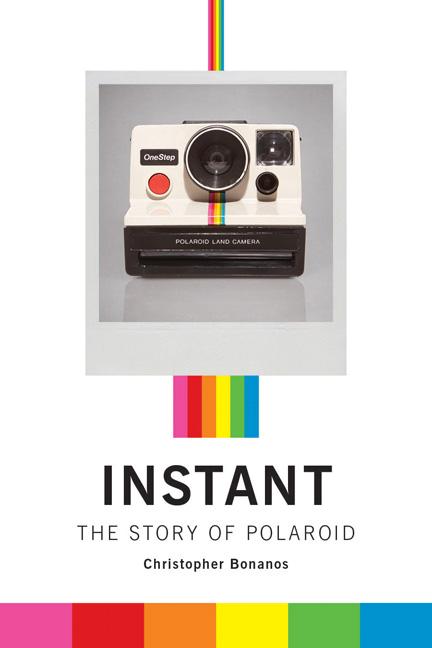
Instant: The Story of Polaroid

Led by the visionary Edwin Land, Polaroid grew from a 1937 garage start-up into a billion-dollar pop-culture phenomenon. Instant by New York magazine editor Christopher Bonanos tells the story of Land’s unique invention, Polaroid’s first instant camera, its meteoric rise in popularity and adoption by artists such as Andy Warhol, and the company’s eventual decline into bankruptcy and its unlikely resurrection in the digital age:

(I should, of course, make clear that as much as I am fascinated by Polaroid cameras, Instant is published by Princeton Architectural Press, who are also distributed in Canada by my employer Raincoast Books. But while I am on the shill, I might as well mention Balthazar Korab: Architect of Photography another P A Press titlewhich was published this earlier month. Korab was Eero Saarinen’s on-staff photographer. Fast Company has a slideshow of some of the stunning images from the book. You should take a look).

Comments closed

Something for the Weekend

Innovation Starvation— SF author Neal Stephenson at World Policy Journal on why the big stuff doesn’t get done:

SF has changed… from the 1950s (the era of the development of nuclear power, jet airplanes, the space race, and the computer) to now. Speaking broadly, the techno-optimism of the Golden Age of SF has given way to fiction written in a generally darker, more skeptical and ambiguous tone. I myself have tended to write a lot about hackers—trickster archetypes who exploit the arcane capabilities of complex systems devised by faceless others.

Believing we have all the technology we’ll ever need, we seek to draw attention to its destructive side effects. This seems foolish now that we find ourselves saddled with technologies like Japan’s ramshackle 1960’s-vintage reactors at Fukushima when we have the possibility of clean nuclear fusion on the horizon. The imperative to develop new technologies and implement them on a heroic scale no longer seems like the childish preoccupation of a few nerds with slide rules. It’s the only way for the human race to escape from its current predicaments. Too bad we’ve forgotten how to do it.

See also:  Stephenson’s new book REAMDE reviewed by The A.V. Club and the NY Times.

Stealing from Dr. Strange — Lev Grossman, author of The Magicians and The Magician King, talks to Graphic Novel Reporter about comics:

Watchmen (and, just as much, Miracleman) changed everything for me. [Alan] Moore attacked and undermined everything that was sacred about the superhero story, and in the process he wrote the greatest superhero story that had ever been written. I never forgot that. A lot of those lessons show up in The Magicians: When you question the basic assumptions of a genre, you make that genre stronger, not weaker.

Also, I steal a lot from Dr. Strange.

And on the subject of comics… Ruth Franklin reviews MetaMaus by Art Spiegelman for The New Republic:

This writer is not Elie Wiesel or Primo Levi, though his work, like theirs, is based in testimony. He is not Piotr Rawicz or H.G. Adler, though he shares their interest in viewing real events through a filter of surrealism. He is not Thomas Keneally, though his work has a quality of the “nonfiction novel” about it; nor is he W.G. Sebald, though his books, like Sebald’s, have been described as a mix of fiction, documentary, and memoir. He is Art Spiegelman, and he has done more than any other writer of the last few decades to change our understanding of the way stories about the Holocaust can be written.

Edges — Nicholas Carr, author of The Shallows, on what remains of books:

One of the essential characteristics of the printed book, as of the scribal codex that preceded it, is its edges. Those edges, as John Updike pointed out not long before he died, manifest themselves in the physical form of bound books – “some are rough-cut, some are smooth-cut, and a few, at least at my extravagant publishing house, are even top-stained” — but they are also there aesthetically and even metaphysically, giving each book integrity as a work in itself. That doesn’t mean that a book exists in isolation — its words, as written and as read, form rich connections with other books as well as with the worlds of nature and of men — but rather that a book offers a self-contained experience. The sense of self-containment is what makes a good book so satisfying to its readers, and the requirement of self-containment is what spurs the writer to the highest levels of literary achievement. The book must feel complete between its edges.

And finally…

In The Wall Street JournalLee Marshall looks for Fellini’s Rome:

Sometimes Fellini’s Rome and Felliniesque Rome live in close proximity. The apartment that Federico and Giulietta shared (Via Margutta, 110) is on a small, charming street where Truman Capote once lived and Puccini composed. There’s not much to see except a plaque on the building with caricatures of the pair and a commemorative poem in Roman dialect. But notice the number on the door of the palazzo: above the 110, it says “Già 113″—formerly 113—a very Felliniesque address.

Comments closed

Something for the Weekend

EquationsLauren Panepinto’s stunning op-art covers for a new trilogy of novels by Simon Morden, published by Orbit. From the Orbit blog:

These online cover images truly don’t do the packages justice — each book has a single bright colour and in the printed version that will actually be a fluorescent ink. Spot gloss lamination and subtle embossing will heighten the effect of the illusions and make them very nice objects to pick up and stare at — they really draw you in when you see them in person. Here they are separately, and larger, to really start to mess with your eyes…

I immediately thought of Bridget Riley when I saw these…

In Praise of Big Cities — Typographer Erik Spiekermann, author of Stop Stealing Sheep, on cities for blueprint Magazine:

I hardly ever go out; I love to eat at home and can think of nothing worse than a weekend house in the country somewhere. All I would ever need to take my mind off things is right outside. It’s actually a long time since I’ve been to a theatre or the opera, but I wouldn’t want to live in a place that has neither. The thought of all this activity happening outside my front door makes living here attractive. There are lots of cafes, and they always seem to be busy, full of people who seem to neither have a home nor an office to go to. Coffee shops have been described as the perfect place to be out in public while on your own and a good reason to leave your house while avoiding fresh air. I don’t need to go there, but the thought that I could at anytime is enough to avoid feeling lonely.

Iambik — Hugh McGuire walks the talk and launches a new audiobook company with an eclectic collection of literary fiction from independent presses.

And finally…

Good Ideas — Nora Young interviews Steven Johnson, author of Where Good Ideas Come From, for CBC Radio’s Spark:

CBC Radio Spark: Steven Johnson

1 Comment

Chance Favours the Connected Mind

A clever book trailer for Steven Johnson’s new book Where Good Ideas Come From :

(via Kottke)

2 Comments

IDEO’s Future of the Book

Design consultancy IDEO present three visions for the “future of the book” (none of which include print of course):

Any thoughts?

7 Comments

What’s Next For Publishers?

An unforeseen consequence of the “New Think for Old Publishers” debacle at SXSW in earlier this year is that I will be a participant in a session on the role of the publishers in the digital age at Book Camp Toronto on June 6th.

140 Character Assassination

The now infamous SXSW panel was supposed to discuss “what’s going right and what’s going wrong in publishing, assess success of recent forays into marketing digitally, digital publishing, and what books and blogs have to gain from one another.”

As has been well documented elsewhere, things did not go according to plan.

Despite the presence of heavyweight panelists (including the venerable Clay Shirky), new ideas were in short supply. Audience frustration overflowed on to Twitter and an array of 140 character bullets (identified by a #sxswbp hashtag) ripped into the panel, with what was perhaps the kill-shot fired by a writer in the audience:

“If, as an author, I can design it myself, write it myself, publish it myself, why would I bother going to a publisher at all? What purpose do you serve?”*

Existential Crisis

The old answer to this question was that publishers offered technical expertise and mass distribution.

But, nowadays, digital technology has made it easy for writers to publish, distribute and market their own books independently. And whilst professional editing, design, production, distribution, and marketing may still be valuable and sought-after services, it’s become very apparent that the perceived gap between self-publishing and traditional publishing is narrowing.

The battering that the SXSW panel took inadvertently revealed what we have long-suspected — publishers need to change the way they think about themselves, the decisions they make, and the services they offer, or cease to exist.

Fine Filtering

One idea that gained some currency in the aftermath of SXSW was that publishers are — or could be — ‘cultural curators’, a role made only more important by the explosion of content created and distributed by digital technology.

In a world where it is impossible to read everything that is emailed, texted, tweeted, posted, uploaded, or printed, there is an opportunity for publishers to become trusted advisers who sift through the vast digital slush-pile and present only the best, most interesting work. Or so the argument goes.

Unfortunately, the truth of the matter is that publishers haven’t proved to be very effective at curating in the past, and it’s precisely this kind of pretension that gets them in trouble at events like SXSW.

A rap sheet of opportunistic publishing, self-indulgence, costly blunders, and generally too much poor product means that publishers (not to mention the mainstream media) have squandered any cultural authority they may once have had, and have been superseded by an informal network of curators connected online.

Furthermore, curation doesn’t really explain what publishers actually do for authors. If it’s just filtering (by set a of cultural criteria I may or may not agree with), why bother going to a publisher at all?

Strengthening the Signal

Not long after after SXSW I sat down in Toronto with Book Camp TO organizer Hugh McGuire to discuss these crumbling cultural hierarchies and the implications for publishers.

Expressing my dissatisfaction with the idea of publishers as curators  — and trying to take into account Hugh’s reader-centric approach — I suggested that perhaps we’d stand ourselves in better stead if we thought of ourselves more as ‘advocates’.

More proactive than curation, advocacy takes into account that publishers do more than find completed works of art and present them to the public. And it goes at least part way towards explaining what publishers do for authors, whilst offering a model for how they can interact meaningfully (and honestly) with readers.

Perhaps, just as crucially, it also means being able to effectively publish and promote books that we believe in, without making any of the claims of cultural authority or superiority that are attached to curating — the framework of advocacy works whether you are publishing literary fiction or genre, poetry or humour.

Admittedly, there are probably minimal and maximal versions of what ‘publisher as advocate’ means. On the minimal side, publishers promote (and defend if necessary) their books in the public forum. A more maximal version — which is probably where my thinking lies — would not simply limit advocacy to marketing a finished product. It would begin with the commissioning editor championing the work in-house, and continue through the production of the book to the publicist who is pitching it to reviewers, and beyond. It would also mean publishing less and publishing better.

So…

These ideas are not definitive. In fact they’re a rather hurried formation (at the prompting of Sean Cranbury) of a jumble of ideas that I’ve had kicking around my head that need more time, but also more air and more discussion.

The Book Camp Toronto session about the role of publishers is on Saturday June 6th at the University of Toronto’s iSchool. Please come along and share your ideas. If you can’t make it, please feel free to leave your feedback, ideas, and links in the comments section or send me an email or a DM.

Over and Out.

* For the record, this quotation is from panelist Peter Miller‘s account of #sxswbp

1 Comment