Skip to content

Tag: information

James Gleick on What Libraries Can (Still) Do

James Gleick (The Information, Faster) on libraries, and James Palfrey’s book BiblioTech: Why Libraries Matter More Than Ever in the Age of Google, at the NYRB Blog:

In the midst of an information explosion, librarians are still the most versatile information specialists we have. And the purest. In his new book, BiblioTech, a wise and passionate manifesto, John Palfrey reminds us that the library is the last free space for the gathering and sharing of knowledge: “Our attention cannot be bought and sold in a library.” As a tradition barely a century and a half old in the United States, it gives physical form to the principle that public access to knowledge is the foundation of democracy.

The problem of libraries now—and it is a problem—involves some paradoxes, which need to be sorted out. For one thing, as Palfrey says, librarians will need to cherish their special talent as “stewards” while letting go of the instinct to be “collectors.” Knowledge in physical form needs to be handled carefully, preserved, and curated. But with digital information pouring into iPhones and Kindles in petabytes—via Twitter and Instagram and YouTube, not to mention Amazon’s self-publishing factories—libraries need to rethink old habits. They cannot collect everything, or even a small fraction of everything. “That model is already too hard to keep up,” Palfrey says. “A network of stewards can accomplish vastly more than a disconnected (even sometimes competitive) group of collectors ever can.”

Comments closed

RSA Animate: The Power of Networks

In this new RSA Animate, Manuel Lima, senior UX design lead at Microsoft Bing and author of Visual Complexity, talks about networks and the challenges of mapping a complex world:

Comments closed

Something for the Weekend

A busy week for John Gall, Art Director at Anchor/Vintage: he unveiled a beautiful new website, and his design for the paperback boxed set of 1Q84 by Haruki Murakami (pictured above). My Q & A with John is here.

Los Angeles Review of Books also has a swanky new website.

Let’s Not Get Carried Away — Harvard professor Ann Blair, author of Too Much To Know, on the history of information at The Browser:

“Reading” covers a wide range of practices. Medieval scholasticism, for example, favoured a ponderous kind of reading of difficult Latin texts done by a few qualified scholars with pen in hand to comment on them. This kind of reading typically took place in a library or study with access to many other learned books. Novel reading was very different when it developed, especially in the 18th century – novels were viewed as engrossing and escapist entertainment, which was typically enjoyed in a nice comfy chair. Interestingly, this kind of reading, which we try to encourage in our children today, worried people in the 18th century. Wouldn’t girls especially get carried away by flights of fancy? People thought it important to control reading. For instance, it was considered better to have girls read in a circulating library since a public setting imposed limits on how far they could get carried away. So some of the fears parents have today about kids playing video games used to apply to reading.

And finally…

Howard Jacobson on Wisden’s Cricketer’s Almanack for the Independent:

What a wonderful thing is Wisden, that lovely, lozengy, yellow-jacketed, Bible-shaped and Bible-weighted cricketers’ almanack, 1,500 pages deep, in which the averages of batsmen and bowlers and wicketkeepers, English and not-English, male and female, living and dead, are collated with a mystic punctiliousness that proves beyond argument the existence of God. You want to see the Divine Watchmaker at work on the mathematics of life? Then read Wisden.

Comments closed

Midweek Miscellany

Pharmaceutical Sincerity — Michael Bourne on Fear and Loathing in Las Vegas 40 years on for The Millions:

I can still remember sitting in the basement of my parents’ house in Northern California, practically whizzing myself with delight at that dizzying list of pharmaceuticals. I was fourteen and I’d read Catcher in the Rye and A Separate Peace and all the other books about and for nice, well-heeled boys whose lives have gone a little off the rails, but Fear and Loathing in Las Vegas was different. It wasn’t just the mind-blowing drug use or the lusty middle finger Thompson seemed to be giving straight America; no, what was so startling, so riveting to my fourteen-year-old’s mind was how sincere the whole thing seemed.

Base Camp — Levi Stahl compares J.G. Ballard to Joseph Conrad (via The Second Pass):

Ballard’s scientists, marooned on far-flung outposts throughout the galaxy, are merely Conrad’s company agents and traders thrown into the future.

Like Conrad’s characters, Ballard’s have been nominally put in charge of places that are only barely understood back home–and whose history, culture, traditions, and dangers are almost entirely a secret. Their knowledge is limited where it isn’t totally useless; their true dominion extends no farther than the walls of their base camp; and the culture they represent is utterly unwanted, even insignificant when set against against the inescapable age of the universe around them.

Disrupting Molecules — Apple designer Jonathan Ive profiled in the Daily Mail (of all places):

Ive is not like other product designers, who too often trade in slick superficialities and press releases. Ive prefers to be engrossed in fundamentals and has very little interest in personal publicity. To him, the way a thing is made is fundamental to its character: his mind occupies a workshop, not an artist’s atelier.

With an Ive product, it is impossible to say where the engineering ends and the ‘design’ begins. It’s a continuum. He thinks and thinks about what a product should be and then worries it into existence. It’s what Ive calls ‘effort and care beyond the usual’. He has very few distractions…

…With the MacBook Air, he told me it’s, metallurgically speaking, about as far as you can actually go with aluminium before you start disrupting molecules. A calm and engaging personal manner becomes almost excitable when he describes the outer limits of transforming stainless steel. This Zen-like obsession with materials, with getting to what he calls the ‘local maximum’, is what gives Apple products their extreme appearance.

Semantic Slippage — The Information by James Gleick reviewed in The New York Times:

[In] its ordinary usage, “information” is a hard word to get a handle on (even after a recent revision, the Oxford English Dictionary still makes a hash of its history). It’s one of those words, like “objectivity” and “literacy,” that enable us to slip from one meaning to the next without letting on, even to ourselves, that we’ve changed the subject.

That elusiveness is epitomized in the phrase “information age,” which caught on in the 1970s, about the same time we started to refer to computers and the like as “information technology.” Computers clearly are that, if you think of information in terms of bits and bandwidth. But the phrases give us license to assume that the stuff sitting on our hard drives is the same as the stuff that we feel overwhelmed by, that everybody ought to have access to, and that wants to be free.

Kick Out the Jams — Wired Magazine profiles everyone’s favourite funding platform Kickstarter (via Waxy):

While plenty of people are willing to extol Kickstarter’s earth-shattering potential, its founders are not among them. “We never had change-the-world aspirations,” says cofounder Yancey Strickler, who insists he just wanted to help artists get stuff made. (Strickler’s team approves every project before it’s posted, and Strickler has personally funded 340 of them, making him the site’s greatest patron.) But the world may have other plans for the site. The Kickstarter guys may have kick-started something bigger than they ever intended…[J]ust as Twitter outgrew its beginnings as a humble messaging system, Kickstarter may not be able to maintain its low profile much longer. “The most interesting companies demonstrate emergent behavior,” says Fred Wilson, a venture capitalist at Union Square Ventures, which invested in Kickstarter. “People’s use of the service is never what the creators intended.”

And finally… Just in case you’ve been in a dark room with the lights off for the last 24 hours (and who could blame you?),  a US federal judge has rejected Google’s legal settlement with authors and publishers reached in 2008. Read about at The Guardian, The New York Times, or the media outlet of your choice.  MobyLives stops just short of dancing on it’s grave, and Jacket Copy looks at what might come next.

Comments closed

Something for the Weekend

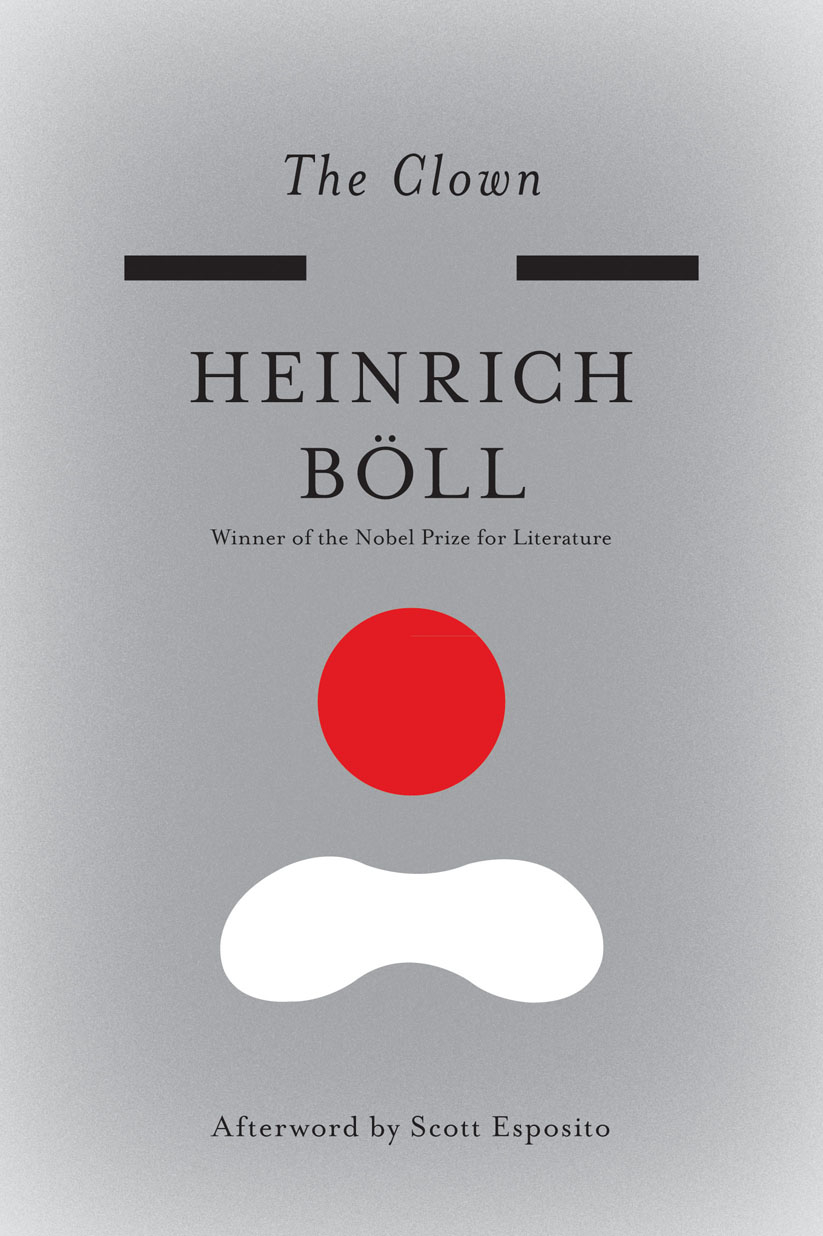
The Book Bench interviews designer Kelly Blair about her work and her Heinrich Böll redesigns for Melville House:

There are so many amazing and striking book covers out there, yet I am most often drawn to the simplest thing on the shelf. Perhaps it’s because I am so immersed in book design day-to-day, but sometimes going into the bookstore can feel visually overwhelming, like the cereal aisle at the grocery store. To that end, David Knopka’s series design for the Melville House novellas still stands as one of my favorites. For the same reason, walking into the Persephone book shop in London feels like a breath of fresh air.

And on the subject of book covers, I’ve been loving designer Andrew Henderson‘s Lovely Book Covers Tumblr.

You can find The Casual Optimist Tumblr here.

Cabaret — Author Hanif Kureishi on the art of writing for The Independent:

There’s no connection between being able to write and being able to explain your work in a rain-swept tent to an audience staring at you like hungry animals contemplating a suspect steak. Listening and reading are different experiences. Reading, writing for a reader, and being read, are intimate acts, and there’s something about trying to articulate what you’ve done that can flatten and reduce it, horrifyingly so.

Some writers choose the written word because they find it difficult to speak directly; many writers are in love with solitude. Whichever it is, good writing should resist interpretation, summary and the need for applause.

The Information — Michael Dirda reviews Too Much To Know: Managing Scholarly Information Before the Modern Age by Ann M. Blair for The Washington Post:

Just how to present information for easy use was a constant vexation. In late antiquity, one might simply find a list of authorities cited. Gradually, though, compilers began to employ categorical headings or to arrange entries alphabetically or according to elaborate branching diagrams of knowledge. “One historian has counted nineteen different systematic orders present in early modern encyclopedic works, including the order of creation, of the Decalogue, of the biblical narrative,” and various “chronological and geographical orders,” as well as others that follow “the chain of being.”

While people during the Middle Ages and later drew much of their learning from dictionaries and digests, the more ambitious also took extensive notes from whatever classics came their way. By the Renaissance one could even purchase the equivalent of “Reading for Dummies”: Francesco Sacchini’s 1614 “De ratione libros cum profectu legendi libellus,” i.e.,”A Little Book on How to Read With Profit.”

The Science of Making Decisions — Sharon Begley on how too much information impairs our ability to make decisions:

The problem has been creeping up on us for a long time. In the 17th century Leibniz bemoaned the “horrible mass of books which keeps on growing,” and in 1729 Alexander Pope warned of “a deluge of authors cover[ing] the land,” as James Gleick describes in his new book, The Information. But the consequences were thought to be emotional and psychological, chiefly anxiety about being unable to absorb even a small fraction of what’s out there. Indeed, the Oxford English Dictionary added “information fatigue” in 2009. But as information finds more ways to reach us, more often, more insistently than ever before, another consequence is becoming alarmingly clear: trying to drink from a firehose of information has harmful cognitive effects. And nowhere are those effects clearer, and more worrying, than in our ability to make smart, creative, successful decisions.

And related… Jonah Lehrer, contributing editor at Wired and the author of How We Decide and Proust Was a Neuroscientist, on why easy decisions seem so hard:

The problem, of course, is that the modern marketplace is a conspiracy to confuse, to trick the mind into believing that our most banal choices are actually extremely significant. Companies spend a fortune trying to convince us that only their toothpaste will clean our teeth, or that only their detergent will remove the stains from our clothes, or that every other cereal tastes like cardboard. And then there is the surreal abundance of the store shelf… While all these products are designed to cater to particular consumer niches, they end up duping the brain into believing that picking a floss is a high-stakes game, since it’s so damn hard. And so we get mired in decision-making quicksand.

Comments closed

Journalism in the Age of Data

A fascinating 54-minute documentary about news and data visualization by Geoff McGhee:

(via Information Aesthetics)

Comments closed