Skip to content

Tag: graphic novels

New Stamps Celebrate Canadian Graphic Novelists

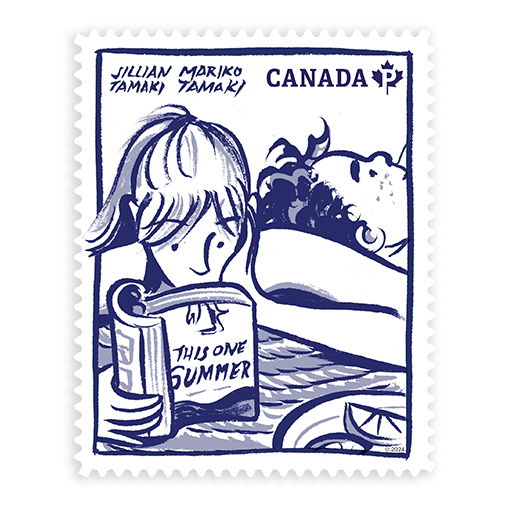
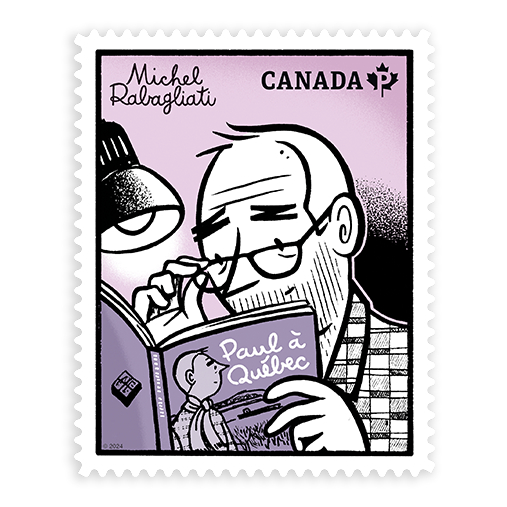
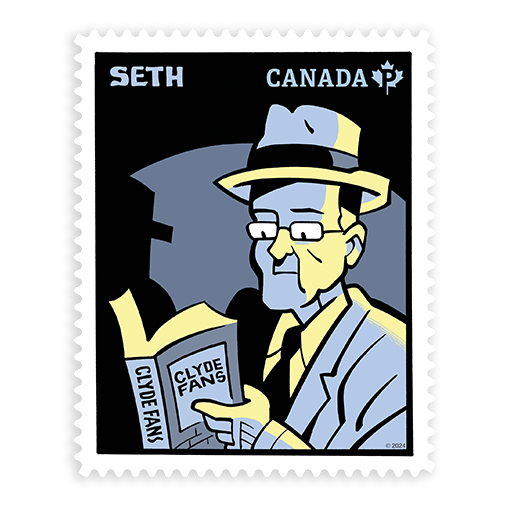
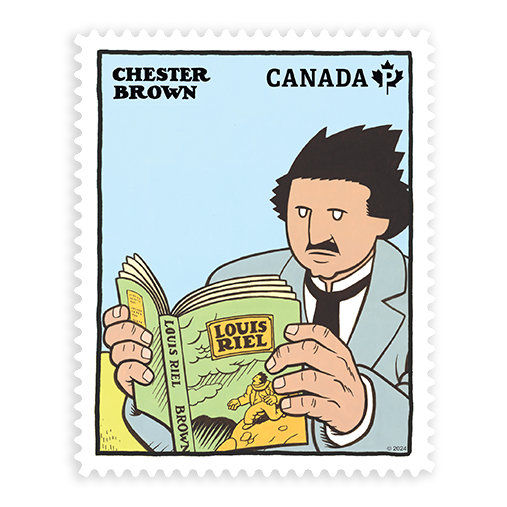
Canada Post is celebrating Canadian graphic novels with a set of stamps created by Chester Brown, Michel Rabagliati, Seth, and Jillian Tamaki and Mariko Tamaki.

While Canada Post has previously issued stamps featuring superheroes, it hasn’t specifically showcased the work of contemporary Canadian cartoonists before. These new stamps feature original drawings by each of the artists depicting their best known characters reading the books they’re in.

As a side note, I don’t know how well known Michel Rabagliati is outside of Canada (I’m actually not sure how well known he is in Anglo-Canada either come to that!), but his gentle semi-autobiographical graphic novels are all lovely. They’re beautiful drawn. Paul Moves Out, the first one I read, is a charming look at studying illustration and graphic design in Montreal the 1970s. It was published in English by Drawn & Quarterly back in the day, but it looks like it might be out of print, which would be a shame. Anyway, worth trying to find a copy if you can.

Comments closed

Gene Luen Yang: The In-Between World of the Graphic Novelist

The New Yorker‘s book blog Page-Turner have posted a wonderful interview with cartoonist Gene Yang:

I grew up reading comics, and I just have this deep attachment to the medium. I think a lot of the things in my life that I become most passionate about, and most excited about, are all from comics…  In traditional Asian arts, the word and the picture always sit next to each other. I have an aunt, a Chinese brush painter, who told me that when you do a Chinese brush painting, you have to pair the image up with some poetry. A complete work is not masterful unless both of those elements are masterful. So maybe there’s some sort of attachment there—the idea of words and pictures working together is part of my family history.

You can read my interview with Gene, posted yesterday, here.

1 Comment

Q & A with Gene Luen Yang

I wouldn’t be surprised if you were feeling a little disillusioned with comics right now — frictionless superhero movies that deliver ever-diminishing emotional returns; ham-fisted editorial decisions; disputes over rights, compensation and artwork; violence; stupidity; institutional misogyny and racism; and generic blandness will do that.

Beyond the multiplexes and controversies, however, it is actually a quite an exciting time to be reading comics.

There are signs — Brian K. Vaughan and Fiona Staples‘ space opera Saga, Hawkeye by Matt Fraction, David Aja and Javier Pulido, and Scott Snyder and Greg Capullo‘s horror-driven Batman spring to mind — that genre comics may still have some life in them.

Classic series and newspaper strips are being properly curated and are more available than before. Under-appreciated artists are being rediscovered.

Alternative cartoonists such as Peter Bagge, Alison Bechdel, Chester Brown, Jaime and Gilbert Hernandez, Rutu Modan, and Chris Ware are producing some of the best work of their careers. The art of Daniel Clowes and Art Spiegelman is being recognised with gallery exhibitions.

And sitting somewhere between in the alt. auteurs and the superheroes, cartoonists like Emily Carroll, Becky Cloonan, Tom Gauld, Faith Erin Hicks, Hope Larson, Bryan Lee O’Malley, Luke Pearson, Noelle Stevenson — artists who have absorbed a diverse range of influences — are carving out niches for themselves, often combining and subverting genres and styles to produce uniquely personal visions.

It’s in this last, loose group of cartoonists1 — the one between the experimental and the mainstream — that I’d put artist and writer Gene Luen Yang.

Best known for his work on the Avatar: The Last Airbender graphic novels, and the critically acclaimed American Born Chinese, Gene’s most recent work is Boxers & Saints, an ambitious two-volume historical graphical novel telling parallel stories of two young on the opposite sides of the Boxer Rebellion. Already shortlisted for the National Book Award for Young People’s Literature and listed amongst Publishers Weekly‘s best books of the year — it is a remarkably mature, compassionate, and accomplished work that is at times funny, at times tragic, but always very human.

I recently met Gene while he was in Toronto to promote Boxers & Saints. I was impressed by his thoughts on being a cartoonist and on the medium itself, and we spent a good couple of hours talking books, comics, and movies. We have since corresponded by email for this Q & A.

American Born Chinese and Boxers & Saints are distributed in Canada by my employer Raincoast Books, and parts of this interview have appeared previously on the Raincoast blog.

  1. These are, admittedly, all very arbitrary, untidy and personal lists and categorizations — nobody who’s interesting fits exactly.
2 Comments

Jeet Heer: In Love With Art and The Superhero Reader


At the Comics Reporter, Jeet Heer discusses his two recent books on comics, The Superhero Reader edited with Charles Hatfield and Kent Worcester, and In Love With Art: Françoise Mouly’s Adventures in Comics with Art Spiegelman, with Tom Spurgeon: 

Strange to say, when I work on a biographical essay, I’m also often writing a type of disguised autobiography. The introduction to the first volume of the Walt and Skeezix books deals with father/son relationships. I wrote it not long after my father died. The introduction of first volume of the Orphan Annie series touches on the fact that Harold Gray never had kids and examines the theme of infertility in the strip. It was written while my partner and I were struggling with our own fertility problems. In the case of Mouly, yes, it’s true that she, like me, learned English as a second language, aided by comics. And in general, Mouly’s experiences as an immigrant speak to my own history (and perhaps even more, the lives of my parents). Mouly’s cultural interests are another commonality. One of the nicest compliments I’ve received is from Mouly herself, who told my publisher that she was happy that I wrote this book because I was someone who not only knew about comics but had a wider cultural frame of reference. One of the attractive things about Mouly is that she understands comics but has a horizon that is wider than comics culture. It might be a form of pernicious self-flattery, but I like to think the same is true of me.

The fact that Mouly is such an anomalous figure in comics makes her story interesting to me since I also feel like I’m an odd duck in the comics world. Even when I was a kid first reading comics, I paid attention to the credits to see if there were other outsiders in the field. I got a secret thrill whenever I saw Ben Oda (hey, he doesn’t sound like he’s white!) listed as letterer. And I took note of the few women in comics as well, not just Mouly but also Marie Severin, or Glynis Wein. Even as a kid, I noticed that the few women in comics were almost invariably colorists. I often wondered why. I wasn’t a particularly politically astute kid but I did notice a few things.

3 Comments

Chris Ware: The Magic of Comics

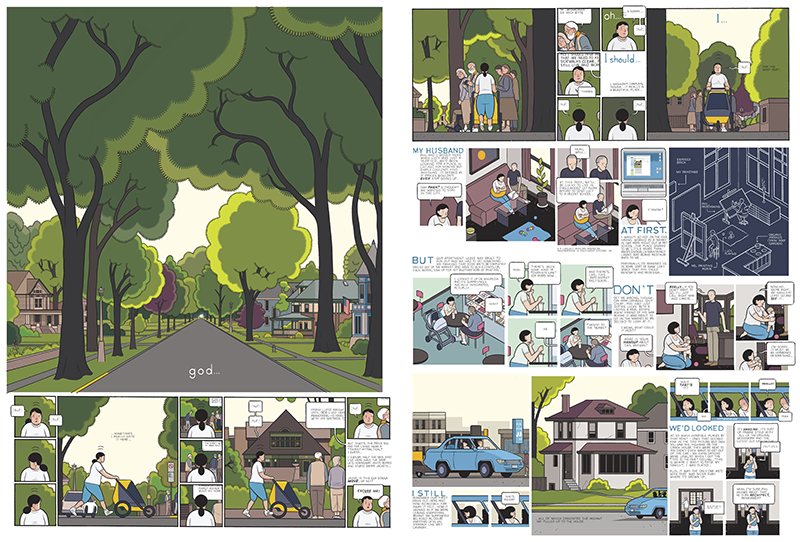
Following his appearance at the Edinburgh international book fair, Cartoonist Chris Ware spoke with Stuart Kelly of The Guardian about his recent work Building Stories:

“As soon as a screen can produce something that can move, it becomes a passive medium, whereas I feel that comics are a very active medium. The appeal is they masquerade as a passive medium, but they’re not at all. It takes a lot of effort to read comics, even though it seems like they’re easy. It seems like they need to be fixed on paper to have a certain power – my wife always tells me never to use the word magic, but I can’t help it, there is no other word: there is a magic when you read an image that you know doesn’t move but you have a sense that something is moving, if not on the page then in your mind.”

Read the whole interview.

Comments closed

Voldemort’s One Hour Service

Today was a busy day at the end of a busy week, so no weekend round-up this week I’m sorry to say. I could not, however, go without mentioning Voldemort’s One Hour Service by Stuart and Kathryn Immonen:

If you’ve read the Harry Potter books, or seen the latest movie, you will of course, get the reference:

“You have one hour. Dispose of your dead with dignity. Treat your injured. I speak now, Harry Potter, directly to you. You have permitted your friends to die for you rather than face me yourself. I shall wait for one hour in the Forbidden Forest. If, at the end of that hour, you have not come to me, have not given yourself up, then battle recommences. This time, I shall enter the fray myself, Harry Potter, and I shall find you, and I shall punish every man, woman, and child who has tried to conceal you from me. One hour.”

It’s brilliant stuff. And, if you haven’t read Moving Pictures by Kathryn and Stuart, I strongly recommend it.


1 Comment

Midweek Miscellany, Dec. 10th, 2008

NPR’s Best Graphic Novels of 2008 include Josh Cotter’s Skyscrapers of the Midwest, Local by Brian Wood and Ryan Kelly, Yoshihiro Tatsumi’s Goodbye, and Alan’s War by Emmanuel Guibert (pictured). There’s an excerpt available of each book selected. Nice. (Thanks Ehren!)

A new way to express an old idea – An interesting interview with Canadian designer David Drummond at Books Covered (via Design Observer):

I tend to start with a list of words. For example I am working on a cover now that is about a dog but can’t show the dog on the cover. I like those kind of problems. How do you show this without showing it?

Amazon’s Jeff Bezo is PW‘s Person of the Year.

“Suburban surrender”: James Wood revisits Richard Yates’ blistering novel Revolutionary Road in the latest The New Yorker.

Little to do with booksThe New York Times looks at the infighting and the politics of book groups:

Yes, it’s a nice, high-minded idea to join a book group, a way to make friends and read books that might otherwise sit untouched. But what happens when you wind up hating all the literary selections — or the other members? Breaking up isn’t so hard to do when it means freedom from inane critical commentary, political maneuvering, hurt feelings, bad chick lit and even worse chardonnay.

Russell Davies on “analogue natives”:

So much joyful digital stuff is only a pleasure because it’s hugely convenient; quick, free, indoors, no heavy lifting. That’s enabled lovely little thoughts to get out there. But as ‘digital natives’ get more interested in the real world; embedding in it, augmenting it, connecting it, weaponising it, arduinoing it, printing it out, then those thoughts/things need to get better. And we might all need to acquire some analogue native skills.

Comments closed