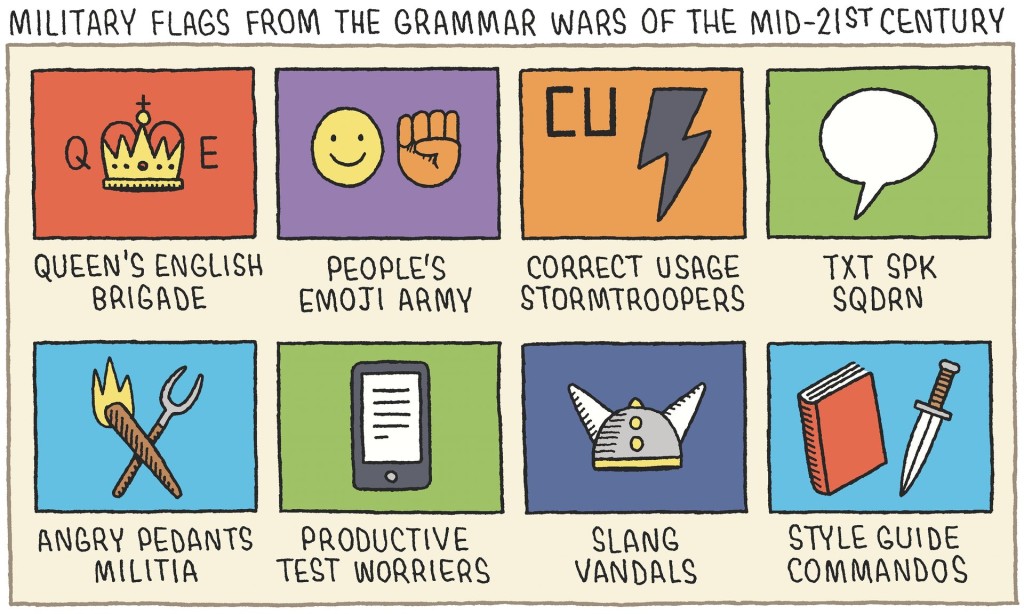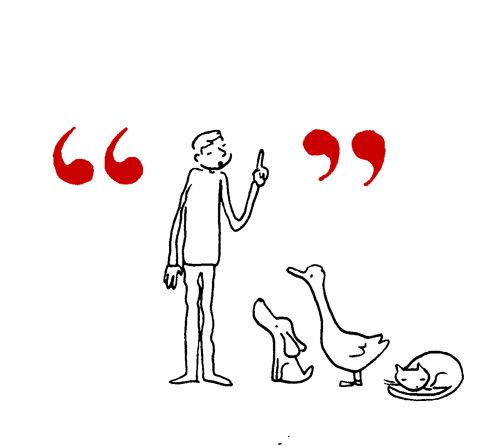
Grant Snider has drawn a lovely series of cartoons on punctuation for The New Yorker.


Books, Design and Culture
Grant Snider has drawn a lovely series of cartoons on punctuation for The New Yorker.
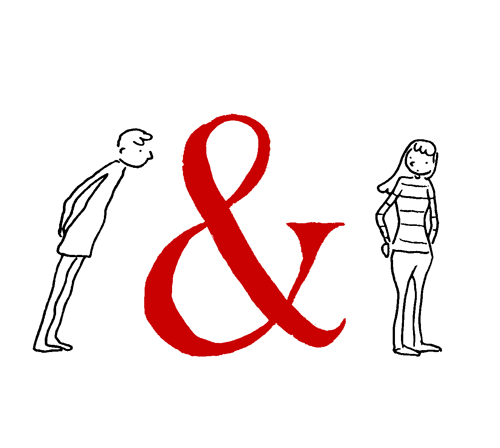
Comma Queen Mary Norris takes a quick look at the origins of the beloved ampersand for The New Yorker:
Comments closedThe New Yorker‘s Mary Norris, author Between You & Me: Confessions of a Comma Queen, clarifies the difference between the hyphen (-), the en dash (–), and the em dash (—):
Comments closedIn the second episode of The New Yorker‘s Comma Queen video series, copy editor Mary Norris tackles using an apostrophe to form the possessive:
I am one of those people who annoy Norris by dropping the ‘s’ after the apostrophe when a name ends in ‘s’. I’m sure she is right — I’m certainly not going to argue with her! — but the exceptions seem completely infuriatingly arbitrary to me!
UPDATE: Mary Norris, whose memoir Between You & Me is out next week, is profiled in today’s New York Times:
Ms. Norris says she tries not to bring her work home with her. But she often has to restrain herself. Bad punctuation leaps out at her. Sloppy diction and grammatical errors in conversation register as minor assaults on her ear, as if her headphones had suddenly erupted into high-pitched feedback.
Her pet peeves include poorly punctuated signs; people who call the serial comma the Oxford comma; the wrong sort of pencil; the misuse of “who” and “whom” and other crimes against the accusative; book introductions by writers other than the author; incorrectly deployed apostrophes; people she meets on vacation who harass her about The New Yorker’s style; and grammatical errors in popular songs. She is particularly irked, she said, by the line “Till the stars fall from the sky for you and I” from “Touch Me” by the Doors.
Me, I’m just irked by The Doors.
Comments closed
The New Yorker has launched a new video series “devoted to language in all its facets” called Comma Queen. In the first episode, copy editor Mary Norris talks about commas, the “little squiggle” with “a history rich in controversy”:
On a related note, Julia Holmes reviews Mary Norris’ book, Between You & Me: Confessions of a Comma Queen, for the New Republic:
Comments closedcopy-editing can also be a soul-crushing enterprise. Not the work itself, which is perfectly pleasant and definitely necessary, but the surprising and strictly enforced class system that almost always accompanies it. Magazines are rigidly hierarchical places, no matter how outwardly easygoing and free-spirited and ad hoc they may endeavor to look on a visit to the office. A funny thing about publishing is that it’s populated almost exclusively by frustrated writers. It’s a kind of slow-burn Stanford Prison Experiment, in which former English majors are randomly assigned the roles of language guard and word prisoner, affirming once more how quickly and insanely people will adapt to new, relative states of power and powerlessness.
Mary Norris’s very funny, lucid, and lively new book, Between You & Me: Confessions of a Comma Queen, illuminates this shadow world at last. It’s part memoir, part language guide, and part personal account of life at The New Yorker (where Norris has worked as a copy editor since 1978). “One of the things I like about my job,” she writes, “is that it draws on the entire person: not just your knowledge of grammar and punctuation and usage and foreign languages and literature but also your experience of travel, gardening, shipping, singing, plumbing, Catholicism, midwesternism, mozzarella, the A train, New Jersey.”
Norris exemplifies what David Foster Wallace observed in “Authority and American Usage”: “We tend to like and trust experts whose expertise is born of a real love for their specialty instead of just a desire to be expert at something.”
In a long and charming essay for The New Yorker, the magazine’s query proofreader Mary Norris muses on her career, and the history and uses of the comma:
Then I was allowed to work on the copydesk. It changed the way I read prose—I was paid to find mistakes, and it was a long time before I could once again read for pleasure. I spontaneously copy-edited everything I laid eyes on. I had a paperback edition of Faulkner’s “The Hamlet” that was so riddled with typos that it almost ruined Flem Snopes for me. But, as I relaxed on the copydesk, I was sometimes even able to enjoy myself. There were writers who weren’t very good and yet were impossible to improve, like figure skaters who hit all the technical marks but have a limited artistic appeal and sport unflattering costumes. There were competent writers on interesting subjects who were just careless enough in their spelling and punctuation to keep a girl occupied. And there were writers whose prose came in so highly polished that I couldn’t believe I was getting paid to read them: John Updike, Pauline Kael, Mark Singer, Ian Frazier! In a way, these were the hardest, because the prose lulled me into complacency. They transcended the office of the copy editor. It was hard to stay alert for opportunities to meddle in an immaculate manuscript, yet if you missed something you couldn’t use that as an excuse.
Norris’s book, Between You & Me: Confessions of a Comma Queen, will be published by W. W. Norton in April.
Comments closedOne for the editors…
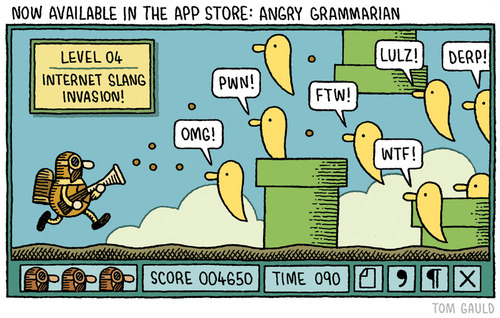
Tom Gauld.
Do It Yourself — John Self, of the excellent Asylum blog, on the power of independent readers, at The Guardian:
if publishers and authors are limited in what they can do for a book online, who is left? They want to harness word of mouth, and power lies collectively in the independent readers – you and me. Can we make a difference when the bookselling world is full of outlets, online and off, which primarily sell what already sells, or can be related to a proven success (“It’s Fifty Shades of Grey meets Harry Potter!”)? If social media has inspired a new age of grassroots political activism, why not literary activism, too?
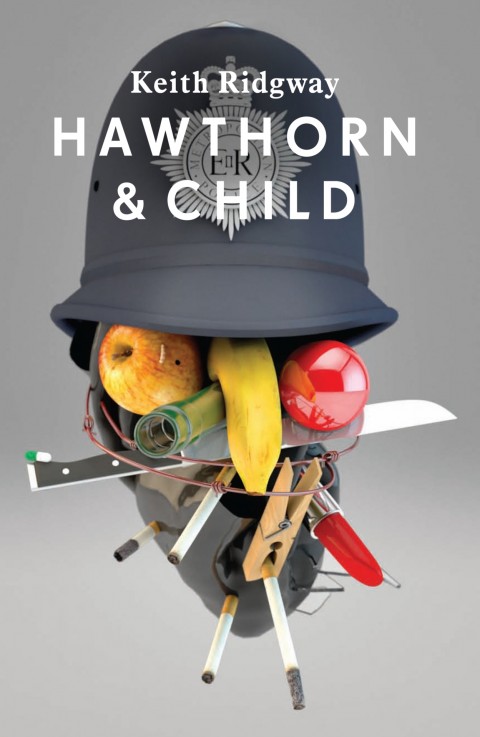
I picked up Keith Ridgway’s new book Hawthorn & Child almost entirely on the basis of John’s recommendation (I also read Colony by Hugo Wilcken, one of my favourite books of recent years, as a result of John’s review). The astonishing cover (pictured above) is by Tom Darracott by the way.
(Semi) Colonoscopy — Mary Norris on how to use the semicolon, at The New Yorker:
So the semicolon is exactly what it looks like: a subtle hybrid of colon and comma. Actually, in ancient Greek, the same symbol was used to indicate a question.
And it still seems to have a vestigial interrogative quality to it, a cue to the reader that the writer is not finished yet; she is holding her breath.
And finally…
Imaginary Buildings — Jimmy Stamp on the locations of 221B Baker Street, for The Smithsonian:
Comments closedThe mystery of 221B Baker Street is not one of secret passages or hidden symbols. Rather, it could be described as a sort of existential spatial riddle: how can a space that is not a space be where it is not? According to Arthur Conan Doyle’s stories, Sherlock Holmes and John Watson lived at 221B Baker Street from 1881 to 1904. But 221B Baker street did not exist in 1881, nor did it exist in 1887 when A Study in Scarlet was published and Baker Street house numbers only extended into the 100s. It was a purely fictional address – emphasis on was. Time marches on, Baker Streets are renumbered, and 221Bs are revealed…
Short and sweet today…
“All they do is show you’ve been to college” — Ben Dolnick on his love of the semicolon, at the New York Times:
And so, far from being pretentious, semicolons can be positively democratic. To use a semicolon properly can be an act of faith. It’s a way of saying to the reader, who is already holding one bag of groceries, here, I know it’s a lot, but can you take another? And then (in the case of William James) another? And another? And one more? Which sounds, of course, dreadful, and like just the sort of discourtesy a writer ought strenuously to avoid. But the truth is that there can be something wonderful in being festooned in carefully balanced bags; there’s a kind of exquisite tension, a feeling of delicious responsibility, in being so loaded up that you seem to have half a grocery store suspended from your body.
(You’ve surely read this by now, but…) Also in the NYT … Tim Kreider on the ‘Busy’ trap:
Busyness serves as a kind of existential reassurance, a hedge against emptiness; obviously your life cannot possibly be silly or trivial or meaningless if you are so busy, completely booked, in demand every hour of the day… More and more people in this country no longer make or do anything tangible; if your job wasn’t performed by a cat or a boa constrictor in a Richard Scarry book I’m not sure I believe it’s necessary. I can’t help but wonder whether all this histrionic exhaustion isn’t a way of covering up the fact that most of what we do doesn’t matter.
And finally…
Busted — Leah Price, author of How to Do Things with Books in Victorian Britain, on the history of reading at The Browser:
1 CommentErnest Hemingway had this to say about James Joyce: “I like him very much as a friend and think no one can write better, technically. I learned much from him.” But if you look at Hemingway’s copy of Ulysses, which is kept today in a library in Boston, you see that the first and last pages are the only ones that have been cut. So you can’t always trust people to tell the truth about their own reading. What makes it fascinating and also frustrating to study is that reading is one of the most private things we do.

Designer Catherine Casalino discusses her cover design for Darren Shan’s Procession of the Dead at Faceout Books.
50 / 50 — An interesting Design Observer piece by Ernest Beck on the controversy around AIGA’s 50 Books/50 Covers and the changing roles of book designers:
“The design aspect hasn’t changed, but it will,” notes [Chris] Sergio, who like other book designers believes that books and covers will endure in both print and electronic versions. “Digital versus print is a zero-sum argument,” he says. “These roads are not mutually exclusive. If anything, we want to see more competition and more critical exploration [of book design]. That’s why it would have been a shame to blend it all down into one big thing.”
Paula Scher, a partner at Pentagram Design, agrees that book design — in whatever form — is important because people still relate to visual imagery. “It’s the emotional connection,” she says. “People still remember record covers although nobody has records anymore.” Book jackets matter, whether they are on a piece of paper or in an electronic version, she continues “because when none of it matters because it’s digital or nobody does it or it doesn’t save the planet, then we murder our own craft and give excuses to be mediocre and lower standards bit by bit.”
Indelible Replicas — Author Philip Ball (Unnatural: The Heretical Idea of Making People) reviews The Information by James Gleick for The Observer:
Robert Burton, the Oxford anatomist of melancholy, confessed in 1621 that he was drowning in books, pamphlets, news and opinions. All the twittering and tweeting today, the blogs and wikis and apparent determination to archive even the most ephemeral and trivial thought has, as James Gleick observes in this magisterial survey, something of the Borgesian about it. Nothing is forgotten; the world imprints itself on the informatosphere at a scale approaching 1:1, each moment of reality creating an indelible replica.
Also in The Observer…
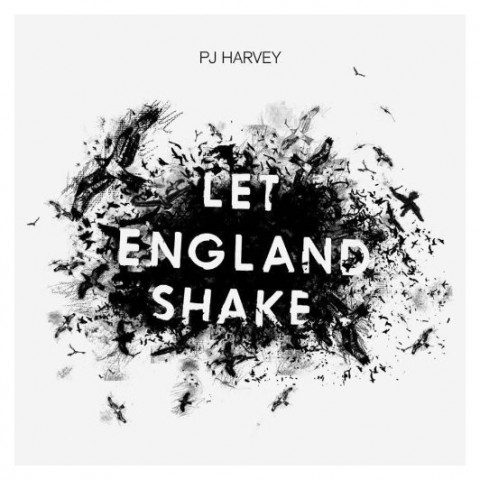 P. J. Harvey on writing and her new album Let England Shake (via A Piece of Monologue):
“I certainly feel like I’m getting somewhere that I wanted to get to as a writer of words. I wanted to get better, I wanted to be more coherent, I wanted there to be a greater strength and depth emotionally, and all these things require work – to hone something, to get rid of any superfluous language. I’m inspired by the other great writers I go back to and read again and again, and think how did they do that?”
Such as? She indicates a volume of Harold Pinter’s poetry that she has brought with her. “Pinter leaves me speechless. Just unbelievable. A poem like ‘American Football’ or ‘The Disappeared’. TS Eliot of course. Ted Hughes. WB Yeats. James Joyce.” She leans forward, freshly excited. “Just that feeling of reading something profound and having your breath quite literally taken away by the end of a piece. I’m reading John Burnside’s poems at the moment. Do you know his work? I’m getting that feeling – just reaching the end of every poem, going ‘Oh my God!'” She clutches her chest and laughs. “And all of these writers offer me a greater understanding of what it is to be alive, and that is such an incredible thing art can do for other people. It made me want to try and get close to this strange, mysterious thing that people can do with words.”
And finally…
The Local Grammar Nazi — Robert Lane Greene, author of You Are What You Speak, on the fluidity of language:
Comments closedIt’s certainly easier to know one set of rigid rules than to develop a fingertip-feel for the nuances of syntax, word choice and mechanics. This is why the book “Elements of Style” is such a hit. William Strunk and E.B. White’s canonised system for language use is short and sharply worded. Read, memorise and you need never think again… Readers are taught any number of things, such as when to use “that” instead of “which” and how one should never begin a sentence with “However, …”. But such guidelines should be understood as the authors’ preferences, not grammatical commandments.
Writing in English offers far more room for manoeuvre than some may realise… A lot of people don’t like this fluidity. Life is tricky in a world without rules. Fortunately, language does have rules, but they are more like bedrock principles than a detailed set of by-laws covering every do and don’t. A good usage dictionary should explain the principles, not simply command.