Skip to content

Tag: george orwell

1984

1984 by George Orwell; design by WH Chong (Text Publishing)

The dystopia described in George Orwell’s nearly 70-year-old novel “1984” suddenly feels all too familiar. A world in which Big Brother (or maybe the National Security Agency) is always listening in, and high-tech devices can eavesdrop in people’s homes. (Hey, Alexa, what’s up?) A world of endless war, where fear and hate are drummed up against foreigners, and movies show boatloads of refugees dying at sea. A world in which the government insists that reality is not “something objective, external, existing in its own right” — but rather, “whatever the Party holds to be truth is truth.”

“1984” shot to No. 1 on Amazon’s best-seller list this week, after Kellyanne Conway, an adviser to President Trump, described demonstrable falsehoods told by the White House press secretary Sean Spicer — regarding the size of inaugural crowds — as “alternative facts.” It was a phrase chillingly reminiscent, for many readers, of the Ministry of Truth’s efforts in “1984” at “reality control.” To Big Brother and the Party, Orwell wrote, “the very existence of external reality was tacitly denied by their philosophy. The heresy of heresies was common sense.” Regardless of the facts, “Big Brother is omnipotent” and “the Party is infallible.”

Michiko Kakutani, New York Times

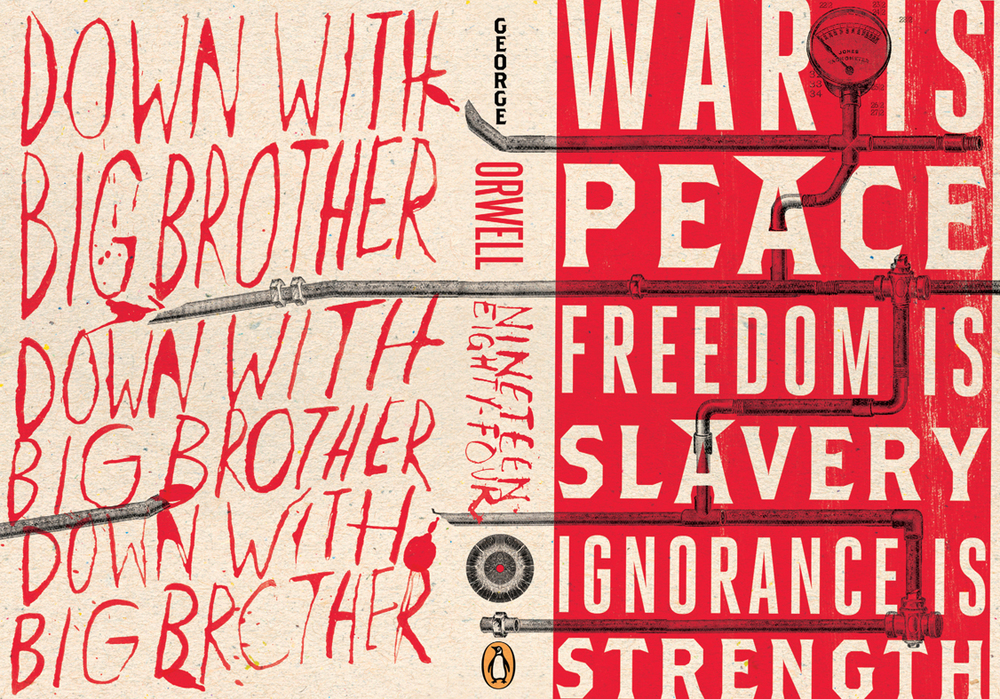
As Nineteen Eighty-Four is suddenly more relevant than ever, I thought I would share a few of the recent covers for Orwell’s classic novel…

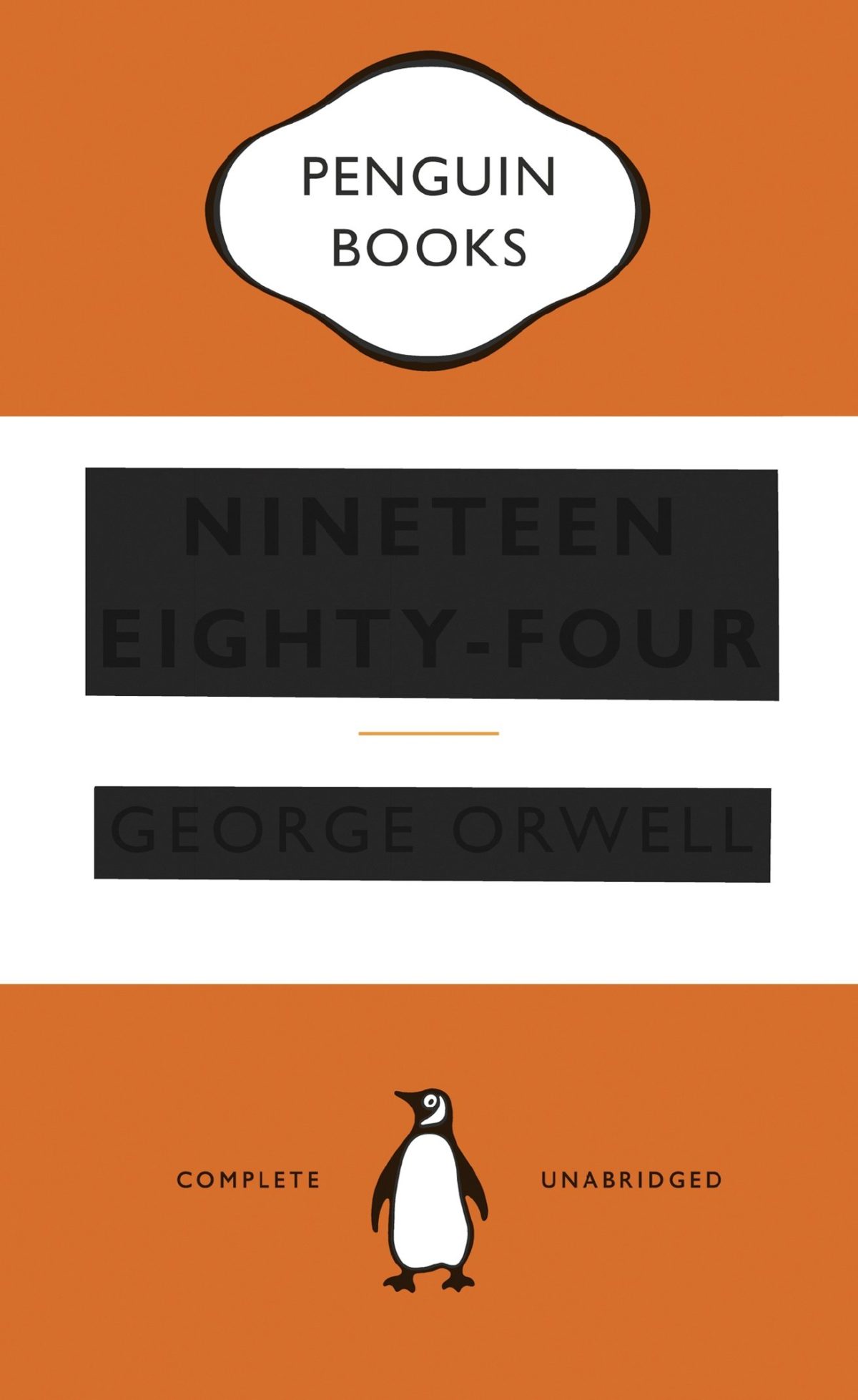
1984 by George Orwell; design by David Pearson (Penguin Classics)
1984 by George Orwell; design by Gray318 (Penguin)

1984 by George Orwell; illustration Daniel Mitchell (Penguin Random House Spain)
1984 by George Orwell; illustration by Marion Deuchars (Penguin Modern Classics)
1984 by George Orwell; design by Shepard Fairey (Penguin)


Save

2 Comments

Midweek Miscellany

WHAAM! — Comics historian Paul Gravett on Roy Lichtenstein’s appropriation from comics:

Lichtenstein’s… success, his getting away with turning supposedly anonymous ‘found’ comic art into high-priced paintings, continues to directly encourage others to do the same. But there is a difference—comics are no longer uncredited, trashy mass culture, and what worked as a lucrative schtick back in the Sixties art world is now largely drained and devoid of any shock value or irony… Five decades on… it is high time for the comics world and the art world to properly debate these issues, and to celebrate these hugely talented but still largely ignored visual storytellers.

(Pictured above: a page from ‘The Star Jockey’ drawn by Irv Novick, from All-American Men of War #89 February 1962)

See also: David Barsalou’s Deconstructing Lichtenstein project

(If Gravett underestimate’s Lichtenstein’s ingenuity in recontextualizing comic book panels, and his lasting influence on art AND comics, it is truly astonishing to see how poor Lichtenstein’s paintings are in direct comparison to the work he borrowed from.)

Blowing Shit Up — A long essay by Richard Nash on the business of literature at the VQR:

Selling a book, print or digital, turns out to be far from the only way to generate revenue from all the remarkable cultural activity that goes into the creation and dissemination of literature and ideas. Recall again all the schmoozing, learning, practice, hustling, reading upon reading upon reading that goes into the various editorial components of publishing; the pattern recognition; the storytelling that editors do, that sales reps do, that publicists do, that the bookstore staff does. Recall the average feted poet who makes more money at a weekend visiting-writer gig than her royalties are likely to earn her in an entire year. You begin to realize that the business of literature is the business of making culture, not just the business of manufacturing bound books. This, in turn, means that the increased difficulty of selling bound books in a traditional manner (and the lower price point in selling digital books) is not going to be a significant challenge over the long run, except to free the business of literature from the limitations imposed when one is producing things rather than ideas and stories. Book culture is not print fetishism; it is the swirl and gurgle of idea and style in the expression of stories and concepts—the conversation, polemic, narrative force that goes on within and between texts, within and between people as they write, revise, discover, and respond to those texts.

See Also: Book Publishers Scramble to Rewrite Their Future by Evan Hughes for Wired.

And finally…

The New Statesman has posted five classic book reviews from their archive, including V. S. Pritchett’s review of 1984 by George Orwell:

Nineteen Eighty-Four is a book that goes through the reader like an east wind, cracking the skin, opening the sores; hope has died in Mr Orwell’s wintry mind, and only pain is known. I do not think I have ever read a novel more frightening and depressing; and yet, such are the originality, the suspense, the speed of writing and withering indignation that it is impossible to put the book down. The faults of Orwell as a writer – monotony, nagging, the lonely schoolboy shambling down the one dispiriting track – are transformed now he rises to a large subject. He is the most devastating pamphleteer alive because he is the plainest and most individual…


Comments closed

Midweek Miscellany

Tell Me a Story From Before I Can Remember — A silkscreen poster of an ideal bookshelf of 100 books designed by Athens-based design studio KEIK Bureau.

Going Back to Bed — Jonathan Jones on the art of Robert Rauschenberg, for The Guardian:

Bed belongs to what is arguably the greatest series of works of art ever made in America. It is said to have been Johns who came up with the word “combines” to describe the works Rauschenberg started to assemble in 1954, putting together found photographs, newspaper clippings, fabrics, furniture, tyres and stuffed animals in intense configuations, all soaked and veiled in abstract expressionist paint. Thinking about them, I find myself struggling to find any match for what Rauschenberg achieved, not just in visual art, but in other arts, such as fiction. For what he created in these complex, tantalising, epic works was that elusive cultural totem, the “great American novel”.

Airstrip 1 — David Aaronovitch on George Orwell’s vision of a totalitarian future, for the BBC Magazine:

I was brought up in a house full of books, none of them by George Orwell.

Simone de Beauvoir was there, as was Sartre and Aldous Huxley and even Lenin. The last is actually a clue as to the absence of the first.

My parents were Communists. To them Orwell was on the other side of politics – someone whose principal writings were hostile to them and what they wanted to achieve….

Comments closed

Something for the Weekend

Snowstorm…something, something… Snowstorm… Hmm, what? Oh right. Here we go…

Pick Up a Pearson — A profile of book designer David Pearson in the New York Times:

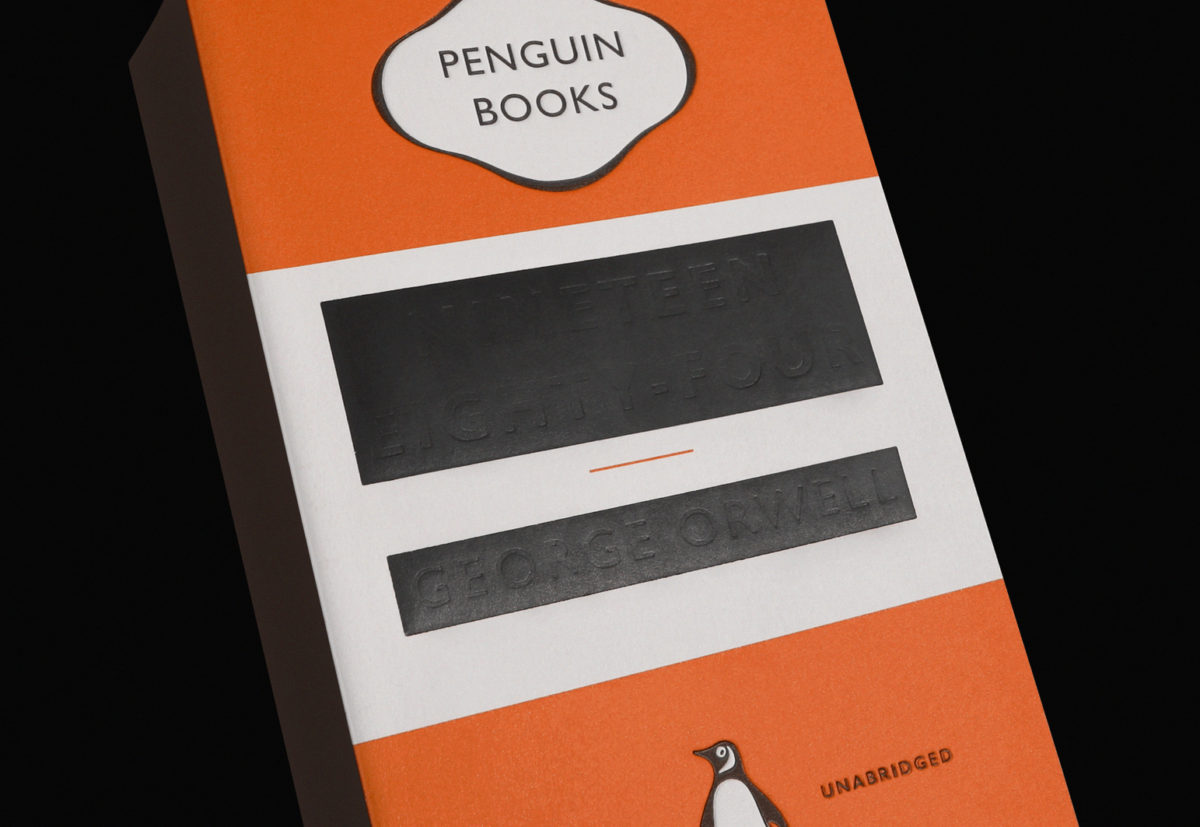
 The chillingly eloquent jacket of “Nineteen Eighty-Four” is the work of the British graphic designer David Pearson He is responsible for the design of four more books that have been reissued by Penguin in the Great Orwell series of paperbacks. From the horror movie typography on “Animal Farm” to the Vorticist-inspired illustration that Mr. Pearson commissioned from Paul Catherall for “Down and Out in Paris and London,” each of the covers exhibits the wit, thoughtfulness and ingenuity that have come to distinguish his work.

“David manages to combine respect for tradition with playfulness and a light touch,” said the graphic design historian Emily King. “He also has a brilliant understanding of the book as a physical object.”

Kvelling — Gerald Howard on the 50th anniversary of the New York Review of Books, at Salon:

Last week, my colleague at Doubleday came by my office with an austere-looking 11-by-15-inch broadsheet. Good God! It was a facsimile edition of the first issue of the New York Review of Books, Feb. 1, 1963. The advertising director and I sat there kvelling over this wondrously manifested printed object from another universe, with its Murderers Row of reviewers weighing in on many books that all these years later still matter, its old-school book ads with their quaint frontal appeals to the reader’s higher cultural aspirations…

The Literaries — A great essay Eddie Campbell about comics criticism at The Comics Journal:

Moving sideways at this point takes me to another recurring argument that falls within the jurisdiction of the present rant. I refer to the incessant debate over who authored Marvel Comics, was it Stan Lee or was it Jack Kirby?… The literaries are inclined to debate whether the furnishing of a plot is enough of a claim to authorship, or whether the real writer in this case was the artist. Once the argument gets started it can go in any direction, and is just as likely to deny that a plot was ever given in the first place, because it is obligatory that everybody who wasn’t there have an opinion and take sides. None of that has ever mattered, as far as I’m concerned, though I acknowledge that the ownership of successful movie franchises could make a difference to this party or that. But the movies do not interest me and I do not care. None of them have ever captured the thing that made Marvel comics exciting to me in 1965 when I discovered them for myself.

And finally…

Amazon Unpacked — A long, must-read piece at the FT on Amazon’s warehouse in the former mining -town of Rugeley, Staffordshire:

As online shopping explodes in Britain, helping to push traditional retailers such as HMV out of business, more and more jobs are moving from high-street shops into warehouses like this one. Under pressure from politicians and the public over its tax arrangements, Amazon has tried to stress how many jobs it is creating across the country at a time of economic malaise. The undisputed behemoth of the online retail world has invested more than £1bn in its UK operations and announced last year that it would open another three warehouses over the next two years and create 2,000 more permanent jobs. Amazon even had a quote from David Cameron, the prime minister, in its September press release. “This is great news, not only for those individuals who will find work, but for the UK economy,” he said.

People in Rugeley, Staffordshire, felt exactly the same way in the summer of 2011 when they heard Amazon was going to occupy the empty blue warehouse on the site of the old coal mine. It seemed like this was the town’s chance to reinvent itself after decades of economic decline. But as they have had a taste of its “jobs of the future”, their excitement has died down…

You can probably guess where it goes from there (but you should still read it)…

Comments closed

David Pearson’s 1984

Although I’ve only just posted my favourite book covers of 2012, here’s an early contender for the 2013 list: George Orwell’s 1984 designed by David Pearson for Penguin UK.

According to David, his initial proposal was a die-cut version of the cover, but the final design (more effective in my opinion) uses matt black foil to obscure the lettering instead.

This new edition will be available on January 3rd.

14 Comments

Midweek Miscellany

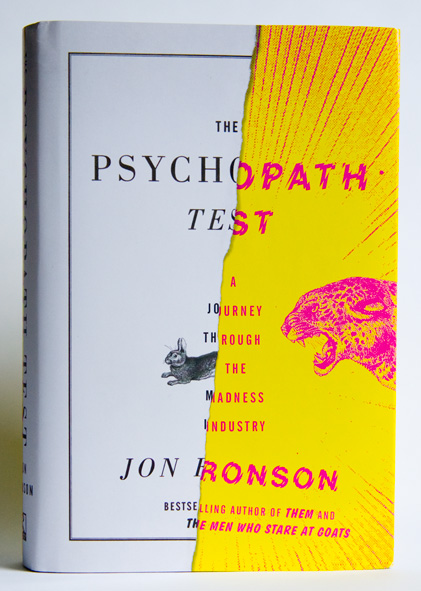
Half Crazy — Matt Dorfman on his great book cover design for The Psychopath Test by Jon Ronson, published by Riverhead Books:

Riverhead did not skimp on the production touches for this one. They sprung for a combination gritty matte finish (which covers the white paper portions of the jacket) and a shiny gloss for the yellow/magenta “crazy” half, thereby giving your sense of touch a noticeable edge if you find yourself blindly scanning your shelf for this book in a dark room (which I have done).

The Intimate Orwell — Simon Leys reviews Diaries by George Orwell, edited by Peter Davison, and George Orwell: A Life in Letters also edited and annotated by Davison, for the NYRB:

From the very start, literature was always Orwell’s first concern. This is constantly reflected in his correspondence: since early childhood “I always knew I wanted to write.” This statement is repeated in various forms, all through the years, till the end. But it took him a long time (and incredibly hard work) to discover what to write and how to write it. (His first literary attempt was a long poem, eventually discarded.) Writing novels became his dominant passion—and an accursed ordeal: “writing a novel is agony.” He finally concluded (some would say accurately), “I am not a real novelist.” And yet shortly before he died he was still excitedly announcing to his friend and publisher Fredric Warburg, “I have a stunning idea for a very short novel.”

Investigative Self-Repair — Author James Lasdun (It’s Beginning to Hurt) reviews Edward St. Aubyn’s latest semi-autobiographical Patrick Melrose novel At Last for The Guardian:

This act of investigative self-repair has all along been the underlying project of these extraordinary novels. It is the source of their urgent emotional intensity, and the determining principle of their construction. Not much gets into these books that doesn’t bear directly on Patrick’s predicament. Exposition is kept to a minimum; there are few descriptive passages, no digressions. For all their brilliant social satire, they are closer to the tight, ritualistic poetic drama of another era than the expansive comic fiction of our own.

And finally…

The General Specialist — Designer, illustrator, and letterer Jessica Hische talks to Method & Craft:

I love learning about new things whether or not they directly connect to how I earn a living and I think that this desire to pay attention to related industries is one of the reasons why I’m a figure in the design community. It’s by learning about many things that you’re able to understand specialization—that design is broken into countless micro-industries. If you don’t understand the differences between them (or acknowledge that they exist), there is no way for you to find your own specialized niche with in it.

Comments closed

Midweek Miscellany

In the Land of Punctuation published by Tara Books (seen at DesignWorkLife):

Written in 1905 by the German poet Christian Morgenstern, In the Land of Punctuation is a darkly comic linguistic caprice that holds a resonant mirror to our times. Situated at the crossroads of language, design, and politics, this illustrated edition is a unique picture book for adults. Translated faithfully by Sirish Rao, with typographic illustrations by Rathna Ramanathan, this is a brilliantly inventive dance of text and image.

More on the illustrations at Rathna Ramanathan’s blog.

Quality. Interest. Significance — Robert McCrum profiles literary agent Andrew ‘The Jackal’ Wylie in The Observer:

The more he talks, the more Wylie’s innate puritan zeal comes to life within the clerical black of his undertaker’s suit and tie. “I’m a books person. Yes, I have a Kindle. I used it for an hour and a half and put it in the closet. I’m not interested in mass culture. When I started out I saw nine out of 10 people heading for the door marked Money, Commerce, Trash. So I chose the door marked Quality. Interest. Significance…”

Battle Royale — In a much linked to article, Ken Auletta, author of Googled: The End of the World as We Know It, discusses the iPad, the Kindle, and, yes, Google, in The New Yorker:

Publishing exists in a continual state of forecasting its own demise; at one major house, there is a running joke that the second book published on the Gutenberg press was about the death of the publishing business.

There’s not much (if anything) new in the article and more than a few of the usual suspects (and clichés) appear, but it does cover a lot of ground and provides a decent summary of where things currently stand in the publisher-Apple-Amazon-Google pissing match.

Revolution Betrayed — Christopher Hitchens on George Orwell’s Animal Farm for The Guardian:

It is affecting to imagine battle-hardened ex-soldiers and prisoners of war, having survived all the privations of the eastern front, becoming stirred by the image of British farm animals singing their own version of the discarded “Internationale”, but this was an early instance of the hold the book was to take on its readership. The emotions of the American military authorities in Europe were not so easily touched: they rounded up all the copies of Animal Farm that they could find and turned them over to the Red Army to be burnt. The alliance between the farmers and the pigs, so hauntingly described in the final pages of the novel, was still in force.

And finally…

[space]

Massimo Vignelli says we use too many fonts.  I Love Typography has a smart response. The full 36-minute interview with Vignelli is available from Big Think.

2 Comments