
Remember Those Great Volkswagen Ads? is a short documentary about the classic, highly influential ad campaigns created by Manhattan advertising agency Doyle Dane Bernbach (DDB) for Volkwagen in the 1950s and 60s:
(via Kottke)
Comments closedBooks, Design and Culture
Remember Those Great Volkswagen Ads? is a short documentary about the classic, highly influential ad campaigns created by Manhattan advertising agency Doyle Dane Bernbach (DDB) for Volkwagen in the 1950s and 60s:
(via Kottke)
Comments closed
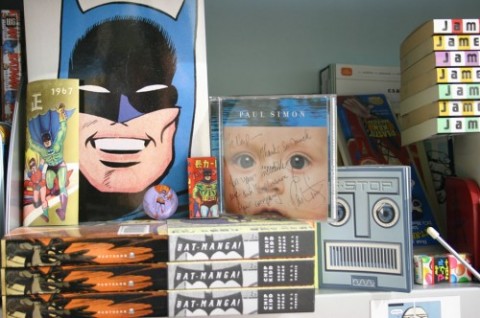
Peter Mendelsund chats with Chip Kidd about his office for the redesigned From The Desk Of:
I’ve always been a ‘nester’, I think most designers are. The difference now between my office and my bedroom as a child is the dearth of KISS posters (I mean NOW, not then).
(Frankly I’m surprised the universe didn’t collapse from all that awesomeness contained in a single room)
And on a related note, Mendelsund is one of many designers who work is included in AIGA’s recently announced 50 Books / 50 Covers list (although several covers appear to be attributed to their art directors rather than the designers themselves, no?).

Math-Lit — Helen DeWitt, author of The Last Samurai and the forthcoming Lightning Rods, interviewed at BookForum:
Chance often plays a big part in fiction, but it is generally not chance as this is mathematically understood, which tends to be counter-intuitive. A while back I discovered Edward Tufte’s brilliant books on information design, The Visual Presentation of Quantitative Information, Envisioning Information, and so on. I read Gerd Gigerenzer’s Reckoning with Risk, about why we have trouble calculating probabilities using percentages, even when it’s a matter of life and death (a doctor working out the likelihood that someone is genuinely HIV-positive, based on a positive test result); I read Peter Bernstein’s Against the Gods on the history of risk; I read Michael Lewis’s Moneyball, on the way sabermetrics had transformed professional baseball. It seemed to me that one could use Tufte’s methods to incorporate this tremendously interesting subject into fiction.
The cover design for Lightning Rods is by Steven Attardo for Rodrigo Corral Design.
And finally…
The legendary George Lois talks about his covers for Esquire with Gym Class Magazine. There’s no shortage ego, but I love this anecdote about playing a soft ball game against The New Yorker:
Comments closedSo I go over there with my glove and my sneakers, and I could not believe it. I looked at the team. The third baseman was Gay Talese. The second baseman was Gore Vidal. It was not a team of athletes. I said: ‘Oh my god, they’re all literary geeks.’ He said: ‘No, no, we’re going to have fun.’
Now I’m serious about playing softball or basketball. I don’t screw around, I play with great ballplayers, I’m a good athlete. I said: ‘Harold, this side is terrible.’ He said: ‘No no!’
We went over and played THE NEW YORKER, and I think we lost 18–3, and the only reason we got three runs is because I hit three homers. I don’t remember being there for any other reason.
 Designers & Books — A beautiful new site compiling lists of books that designers identify as “personally important, meaningful, and formative.” Nice.
Rules Are What Make You — Michael Bierut at Designer Observer on his modernist upbringing at Vignelli Associates:
The rules weren’t written down anywhere or even explicitly communicated. They were more like unspoken taboos. Using Cooper Black, like human cannibalism or having sex with your sister, simply wasn’t done. For many young designers in the studio, the rules were too much. They resisted (futilely), grew restless (eventually), and left. By staying, I learned to go beyond the easy-to-imitate style of Helvetica-on-a-grid. I learned the virtues of modernism.
Thoughts on Design — The legendary George Lois at 10 Answers
When I was 14, aspiring to be a designer, 26 year-old Paul Rand published his iconic book, THOUGHTS ON DESIGN. My copy of it, bought, dime by dime with tip money delivering flowers all over the five boroughs for my fathers florist shop, remains the most important book in my library of over 10,000 art books. It’s thread-bare condition is witness to my reading, and memorizing, his revolutionary approach to the creation of communicative design.
Autodestruct — Author Ursula K. Le Guin reviews Monsieur Pain by Roberto Bolaño for The Guardian:
Surrealist narrative is a literary form at war with itself; disconnection is a primary tactic of surrealism, and story is a process of making connections, however unexpected. Readers open to the autodestructive element of modern art may find the surrealist devices in Monsieur Pain more deeply engaging than coherent narrative. I find them curiously old-fashioned, overly cinematic, and all too close to self-parody. But this early Bolaño novel has a moral and political urgency that obliges me to accept its noir banalities. Its tortuous method of approaching the unspeakable reveals the face of evil without glamorising it, as popular literature and film so often do. By indirection it avoids collusion.
And finally…
A stop motion digital magazine cover by Adam Voorhes and Will Bryant for Bluetooth’s publication Signature:
(via DesignWorkLife)
Comments closed The mighty George Lois at home in New York City at The Selby.
Start the Press — Robert Pinsky reviews The Book in the Renaissance by Andrew Pettegree for the New York Times:
The story begins with money. Johannes Gutenberg did not find a way to profit from his technical achievements. The Gutenberg Bible, a gigantic project, required large amounts of capital that needed replenishing over time, long before there was any hope of profit. The finished product inspired awe, but the print run was 180 copies. Gutenberg “died bankrupt and disappointed.”
Nor was he alone. Apparently, it took decades before some people figured out how to make money from this remarkable invention. For decades after Gutenberg, it was not even clear that print would become a success. How do you market books? How many should you run off at one time? Piracy was a problem, as were texts changed, mutilated or combined in unauthorized editions. Many printers were ruined, trying to exploit the new medium.
And at the other end of the spectrum (or, at least, the other side of the Atlantic)…
Seeing Things Flat — Jenny Turner reviews Tom McCarthy’s C for the London Review of Books:
Remainder works as an allegory of a certain flâneurish model of artistic production, in which a gentleman’s independence of income and education loom pretty big. That, we might say, is Remainder’s material remainder; and it is that of C also, though C moves the argument on a little, investigating the conditions, as it were, of its own existence: family inheritance, war, imperialism, technology; spreading information, spreading death. It’s this core of historical and philosophical seriousness that separates McCarthy’s work completely from the current fashion for baroque narratological cleverness in fiction… There are differences between cleverness and intellect. McCarthy has many things he’s trying to do in his novels, none of which have much to do with pleasing producers or publishers or even an audience, unless by pleasing one means leaving purged.
The Googleable Future — Author William Gibson, whose new novel Zero History is published next week, on Google for the New York Times (via MDash):
We never imagined that artificial intelligence would be like this. We imagined discrete entities. Genies. We also seldom imagined (in spite of ample evidence) that emergent technologies would leave legislation in the dust, yet they do. In a world characterized by technologically driven change, we necessarily legislate after the fact, perpetually scrambling to catch up, while the core architectures of the future, increasingly, are erected by entities like Google.
Cyberspace, not so long ago, was a specific elsewhere, one we visited periodically, peering into it from the familiar physical world. Now cyberspace has everted. Turned itself inside out. Colonized the physical. Making Google a central and evolving structural unit not only of the architecture of cyberspace, but of the world.
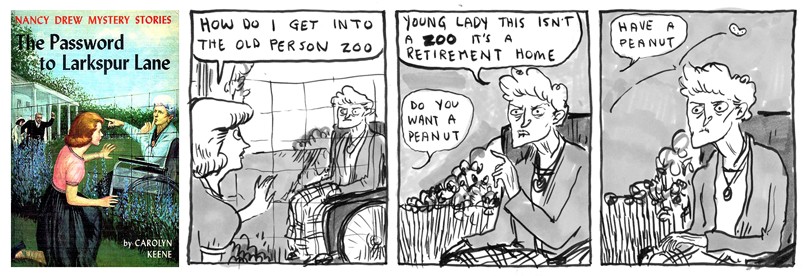 Kate Beaton interprets Nancy Drew book covers in her own unique way at Hark! A Vagrant.
And finally…
 Kevin Huizenga has posted his head-spinning Glenn Ganges comic ‘Time Travelling’ at What Things Do.

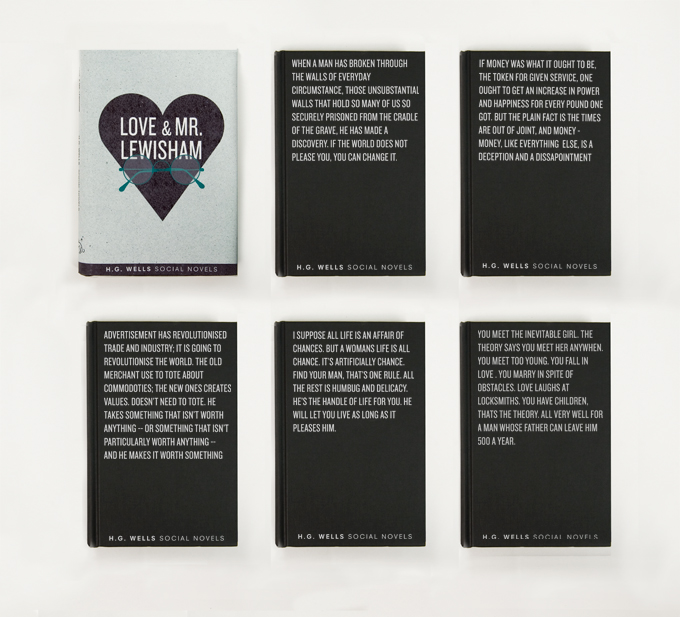
Some nice book design from graphic design student Tom Pollard, spotted at FormFiftyFive…
And speaking of FFF…

Some beautiful print design work by FormFiftyFive contributor Daniel Gray (via Cosas Visuales).
The Dramatist — A great profile of David Simon, creator of HBO series The Wire and Treme, in New York Magazine (via Mark Athitakis’ American Fiction Notes):
“Fuck the exposition,” he says gleefully as we go back into the bar. “Just be. The exposition can come later.” He describes a theory of television narrative. “If I can make you curious enough, there’s this thing called Google. If you’re curious about the New Orleans Indians, or ‘second-line’ musicians—you can look it up.” The Internet, he suggests, can provide its own creative freedom, releasing writers from having to overexplain, allowing history to light the characters from within.
Sympathy for the Librarian — A lovely quote from Keith Richards in The Times (via MobyLives):
“When you are growing up there are two institutional places that affect you most powerfully: the church, which belongs to God, and the public library, which belongs to you. The public library is a great equaliser.”
Amen.
And finally…
After posting about the big man earlier this week, I would be remiss if I didn’t mention The Ten Commandments of George Lois t-shirts available from TypographyShop:

“Great ideas can’t be tested. Only mediocre ideas can be tested.” Awesome.
Comments closedLike Dieter Rams, George Lois seems to be a recurrent theme here and I was wondering why that was. Sure, he has a new book out (published by Assouline), but why is he still relevant? Thinking about this, I kept coming back to his April 1968 Muhammad Ali cover for Esquire.
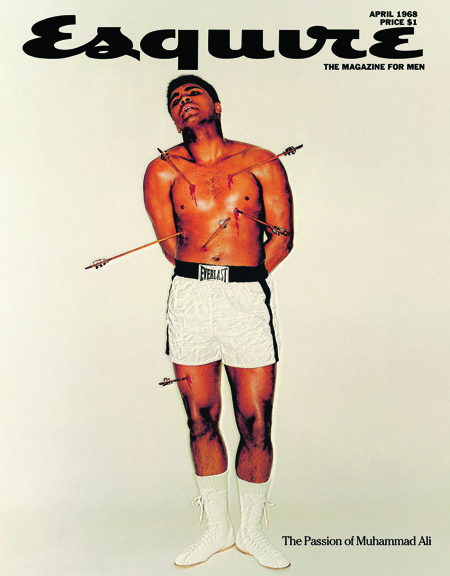 In 1964 Muhammad Ali, the heavyweight champion of the world, had controversially joined The Nation of Islam and changed his name from Cassius Clay. Three years later he refused to be drafted into the U.S. army because of his religious beliefs and opposition to the Vietnam War. He was stripped of his world title and had his professional boxing license suspended.
At a time of racial tension in the US (there were race riots and civil rights protests across the country in 1967 as well as protests against the Vietnam war) Ali was a successful, outspoken, controversial and self-confident black man refusing to fight for his country. He was reviled and, one suspects, feared by white conservative America.
By 1968, Ali was on bail awaiting his appeal to the Supreme Court. He was still unable to fight and the magazine was planning a story on his exile from the ring.
Putting the boxer on the cover was certainly controversial. But Lois did not make the fighter ‘respectable’ (one doubts the thought even entered his head). Instead, in a photograph taken by Carl Fischer, he presented Ali bare-chested and pierced with arrows.
It is a striking, bloody, and shocking image — especially given the context.
 Yet it is also witty, irreverent and surprising: a complex “big idea” rendered with beautiful simplicity.
Lois posed Ali as Saint Sebastian, a 3rd Century Christian soldier and martyr who was bound to a post and shot full of arrows for his beliefs (the arrows, incidentally, didn’t kill him — a subsequent beating took care of that).
The reference was a postcard of a 15th Century painting by attributed to Castagno in the Metropolitan Museum in New York (the Met have since re-attributed the painting to Francesco Botticini).
Like so many of Lois’ other covers for Esquire — this is unquestionably an attack on the establishment. But ‘Ali as St. Sebastian’ is also just about the most elegant and incisive “fuck you” imaginable. It is not the shocking irreverence that makes it resonate — it’s the lacerating wit.
From race to sex to Vietnam — this stuff mattered to Lois. And that never, ever gets old.
Links:
George Lois
George Lois AIGA Medalist
The Passion of George Lois, Design Observer
George Lois 12 Favourite Classic Esquire Covers, New York Magazine
George Lois, Wikipedia
Trailer for the documentary Art & Copy featuring a movie-stealing George Lois (just guess which one he is):
1 Comment

Flaunt it — Designer Armin Vit discusses the UnderConsideration book Flaunt: Designing Effective, Compelling and Memorable Portfolios of Creative Work at For Print Only.
How Art Became the Media — Lewis Lapham, editor of Lapham’s Quarterly (formerly editor of Harper’s Magazine), at Guernica magazine (via Bookslut on Twitter):
It isn’t that the country now lacks for painters painting pictures or poets writing poems, nor is it to say that stores of human energy and hope aren’t to be found in the novels of Elmore Leonard or the songs of Bruce Springsteen. It is to say that with the dawn of Reagan’s bright new morning in America, the notion of art as the way into a redemptive future had withered on the vine. Once again, as had been customary throughout most of the country’s history, art was seen as an embodiment of the good, the true, and the beautiful only to the extent that it could be exchanged for money.
George Lois on the iPad in the New York Observer (no, I’m not entirely sure how I missed this last week either):
“magazines will never die because there is a visceral feeling of having that thing in your hands and turning the pages. It’s so different on the screen. It’s the difference between looking at a woman and having sex with her.”
Flying the Coop — Another interesting installment of the National Post‘s ‘Ecology of Books’ series, this time on authors moving from small presses to big publishing. And there’s an interesting follow up from Daniel Wells, the publisher of Biblioasis one of the aforementioned Canadian small/independent presses (via Steven Beattie).
Microdistribution — This is fascinating… The Boulder Bookstore (Colorado) is experimenting with charging self-published authors for shelf-space and promotion (via Sarah Weinman on Twitter):
“Most people will come in at one of the higher fee amounts,” Arsen Kashkashian, the store’s head buyer and the architect of the program, told me. “That surprised us.” In fact, when the store first began charging its consignment authors back in 2007 (the fee-structure idea emerged when the store’s employees found themselves “inundated with self-published books, and there was a lot of work involved and not much reward”), its staff “thought people would grumble and complain” about the charges. But authors, Kashkashian says, have been generally grateful for the opportunity to sell and promote work that might otherwise be seen and appreciated only by their friends/spouses/moms: “‘I want the marketing, I want the exposure. I worked so hard on this project, and you guys are the only ones who could help me with it.’”
And finally…
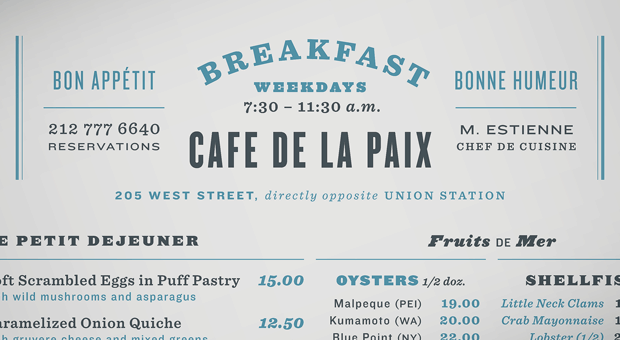
Four Ways to Combines Fonts by H&FJ, built around a beautifully simple principle: “keep one thing consistent, and let one thing vary.”
2 Comments 
Big Shit-Eating Grin — George Lois chooses 12 of his favourite Esquire covers at New York magazine. There are more iconic Esquire covers at George Lois’ website and there is, of course, a new book, George Lois: The Esquire Covers @ MOMA, published by Assouline. (NB the image above is not one of Lois’ 12, but it is great).
Objects of Desire — An interesting University College London podcast about the history of books and publishing featuring Professor Henry Woudhuysen, co-editor of the The Oxford Companion to the Book, and Professor Iain Stevenson, author of Book Makers: British Publishing in the Twentieth Century (available in the US from University of Chicago Press) (via Ernesto Priego on Twitter).
The Dark Side — The Economist on Scandinavian crime fiction:
The cold, dark climate, where doors are bolted and curtains drawn, provides a perfect setting for crime writing. The nights are long, the liquor hard, the people… “brought up to hide their feelings” and hold on to their secrets.
Somebody’s Sins, But Not Mine — A two part interview with Patti Smith about her new memoir Just Kids at KCRW’s Bookworm. Part two is here.
1 Comment

Well, oh shit. Go fuck yourself — The pugnacious George Lois in BlackBook magazine:
The design was the idea. I don’t design, if you know what I mean. If you want Andy Warhol being devoured by his own fame in a can of Cambell’s soup, you just put the can there and you have him drowning in it. Case closed.
You’re knocked down by the idea, and the fact that it’s got complete clarity visually. Don’t complicate it with busy work.
That’s the way I do everything. If I was a doing a magazine, it’s not a question of if I’d be having more white space. It’s a question of every third or fourth spread I’d make a spread that would take your breath away — or piss you off. Or something.
“Yoda” — An interview with Dieter Rams at More Intelligent Life (Thanks Ben S.):
We have enough products. If you look at the market you have ten or 20 coffee makers that basically look all the same, doing all the same thing: they are making coffee. We don’t need 20 of these things, we need one good one.
Less, But Better… Less, But Better… [REPEAT].
The View From Toronto — National Post book critic Philip Marchand (formerly of the Toronto Star) talks to Conversations in the Book Trade:
I’m not sure how much “trouble” literature is in. The age of Tennyson was the last period in literature when “serious” literature found a mass market. Ever since, we’ve had a very small minority of readers for “serious” stuff, and a fairly large audience for thrillers, romance novels, detective novels, and so on. Then there’s the Da Vinci Code phenomenon in which everybody, from your dentist to your car mechanic, is reading a certain book – in order to be able to join in discussions about the book on social occasions, if for no other reason.
Frontmatters — Alex Camlin, Creative Director at Da Capo (interviewed here), has started a blog! Yay Alex!

This is Display! — Another site (along with the Alvin Lustig archive) that probably should have been on yesterday’s list of inspiring websites, Display is a “curated collection of 59 (and growing) important graphic design books, periodicals and ephemera.”
Comments closed