Skip to content

Tag: genre

The Fantastic Ursula K. Le Guin

illustration Essy May

Julie Phillips long profile of author Ursula K. Le Guin for The New Yorker is wonderful:

Starting in the nineteen-eighties, [Le Guin] published some of her most accomplished work—fiction that was realist, magic realist, postmodernist, and sui generis. She wrote the Borgesian feminist parable “She Unnames Them,” and in 1985 an experimental tour de force of a novel, “Always Coming Home.” She produced “Sur,” the epic tale of an all-female Antarctic exploring party that may be her greatest and funniest feminist statement. Her short stories began appearing in The New Yorker, where her editor, Charles McGrath, saw in her an ability to “transform genre fiction into something higher.”

In fact, it was the mainstream that ended up transformed. By breaking down the walls of genre, Le Guin handed new tools to twenty-first-century writers working in what Chabon calls the “borderlands,” the place where the fantastic enters literature. A group of writers as unlike as Chabon, Molly Gloss, Kelly Link, Karen Joy Fowler, Junot Díaz, Jonathan Lethem, Victor LaValle, Zadie Smith, and David Mitchell began to explore what’s possible when they combine elements of realism and fantasy. The fantasy and science-fiction scholar Brian Attebery has noted that “every writer I know who talks about Ursula talks about a sense of having been invited or empowered to do something.” Given that many of Le Guin’s protagonists have dark skin, the science-fiction writer N. K. Jemisin speaks of the importance to her and others of encountering in fantasy someone who looked like them. Karen Joy Fowler, a friend of Le Guin’s whose novel “We Are All Completely Beside Ourselves” questions the nature of the human-animal bond, says that Le Guin offered her alternatives to realism by bringing the fantastic out of its “underdog position.” For writers, she says, Le Guin “makes you think many things are possible that you maybe didn’t think were possible.”
Comments closed

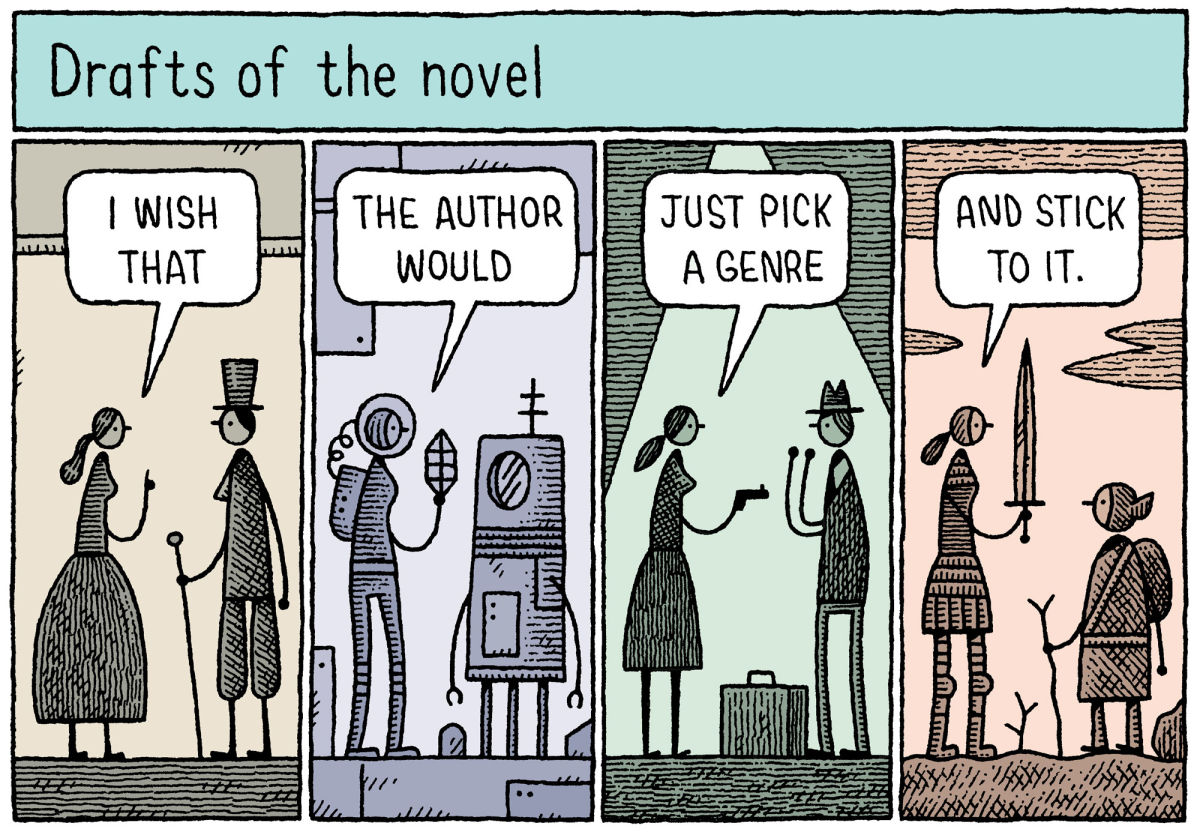
Drafts of the Novel

gauld-tom-genre-090616-1200

Tom Gauld for The New Yorker.

Tom’s new graphic novel Mooncop is out now.

Comments closed

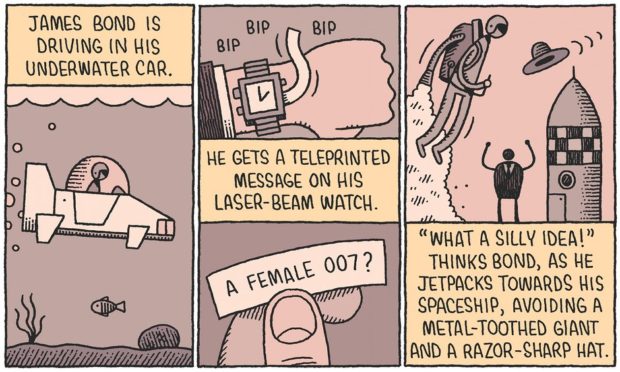
“What a Silly Idea”

James Bond Tom Gauld

Tom Gauld on women leads in spy fiction for The Guardian. See also, people of colour in fantasy films.

Comments closed

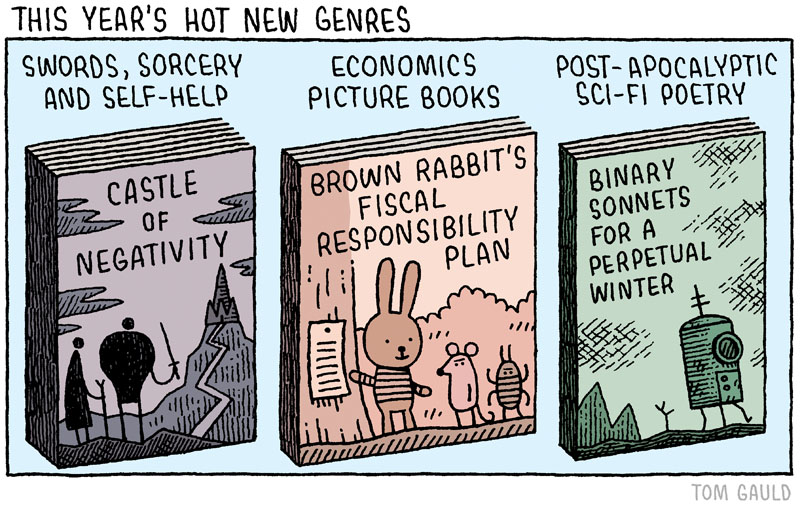
This Year’s Hot New Genres

hot new genres tom gauld

Tom Gauld.

Comments closed

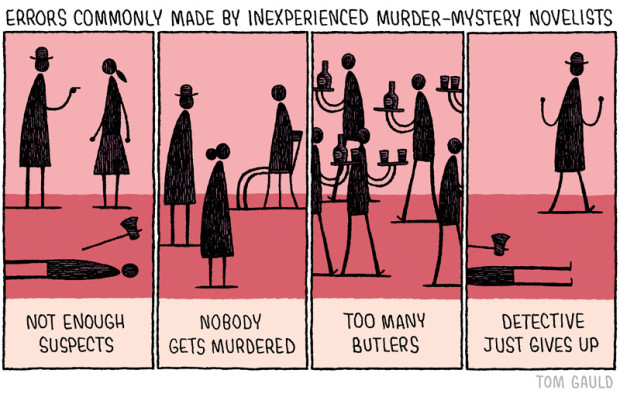
Errors Commonly Made by Inexperienced Murder-Mystery Novelists

errors-commonly-made

Tom Gauld.

Comments closed

Why Star Wars?

In the most recent installment of the Laser Age, the Dissolve’s fascinating history of science fiction films from the 1960s to the 1980s, Keith Phipps turns his attention to Superman, Star Trek, and Flash Gordon — three movies released in the immediate wake of Star Wars. It’s a great read if you are at all interested in this stuff,  but it’s also a perfect excuse to revisit Phipps’s earlier — but oh, so timely — essay, ‘Why Star Wars?’:

Why? Of all the science-fiction films released in the long wake of 2001: A Space Odyssey and Planet Of The Apes, why did Star Wars take hold in a way no film before it had? None of the many answers are entirely satisfying. But combining a few of them lets us make some sense of the question.

1 Comment

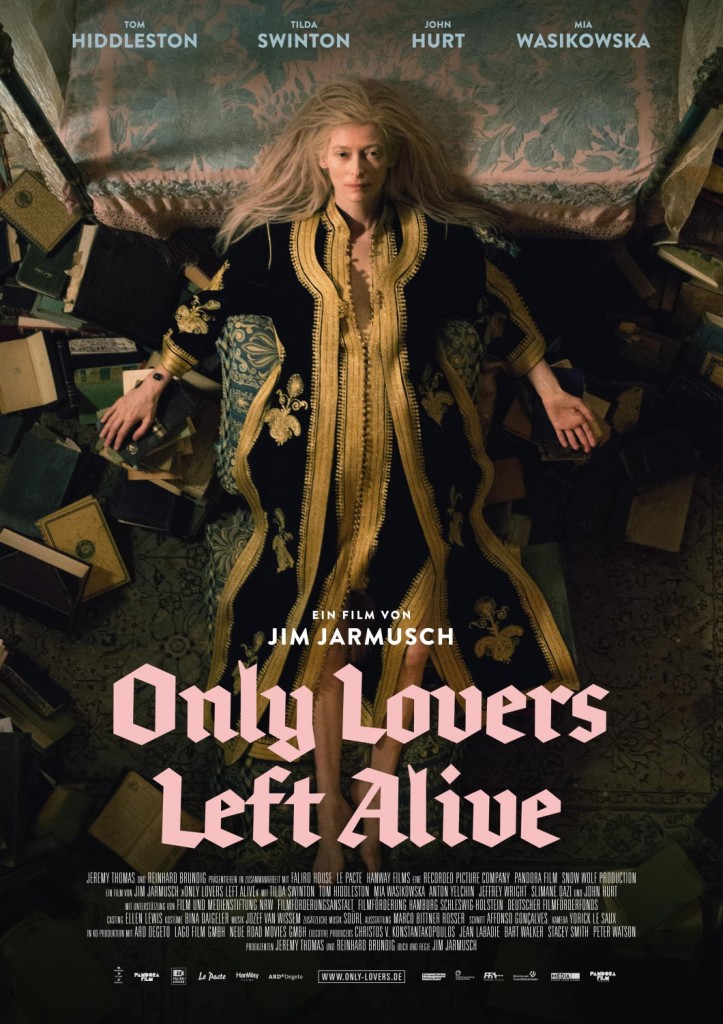
Jim Jarmusch on Genre

only_lovers_left_alive

Jim Jarmusch talks to The Playlist about his new film Only Lovers Left Alive, and his interest in genre:

I just like genres… I really like the whole history of vampire films that are more the kind of marginal, the less conventional ones. Starting with “Vampyr” by Carl Dreyer in the ‘30s, and many, many interesting films – “Shadow of the Vampire” with Willem Dafoe, then in the ‘80s the “Hunger” with David Bowie and Catherine Deneuve. I liked George Romero’s film “Martin” a lot, Katheryn Bigelow’s film “Near Dark,” Abel Ferrara’s “The Addiction,” Clair Denis’ “Trouble Every Day,” Polanski’s “Fearless Vampire Killers.” I loved “Let The Right One In”—that was from like five, six years ago, beautiful… I’ve always loved… that type of approach. Rather than the sort of more obvious one and I wanted to make a love story for quite a long time. It’s had different variances to it, but somehow it got merged maybe eight years ago into my vampire film. So, I wanted to make a love story that involved vampires. Why, I can’t really tell you… It interests me. And I like genres too sometimes because they imply a kind of metaphoric element. Just by the fact that they are a genre. So you can work within [that genre] and do something different inside of that frame. So, that always appeals to me, or not always, but in the case of the few films where I’ve referred to genres, there’s something attractive there for me too.

Comments closed