Skip to content

Tag: gary shteyngart

Little Failure: It’s Funny and It’s True


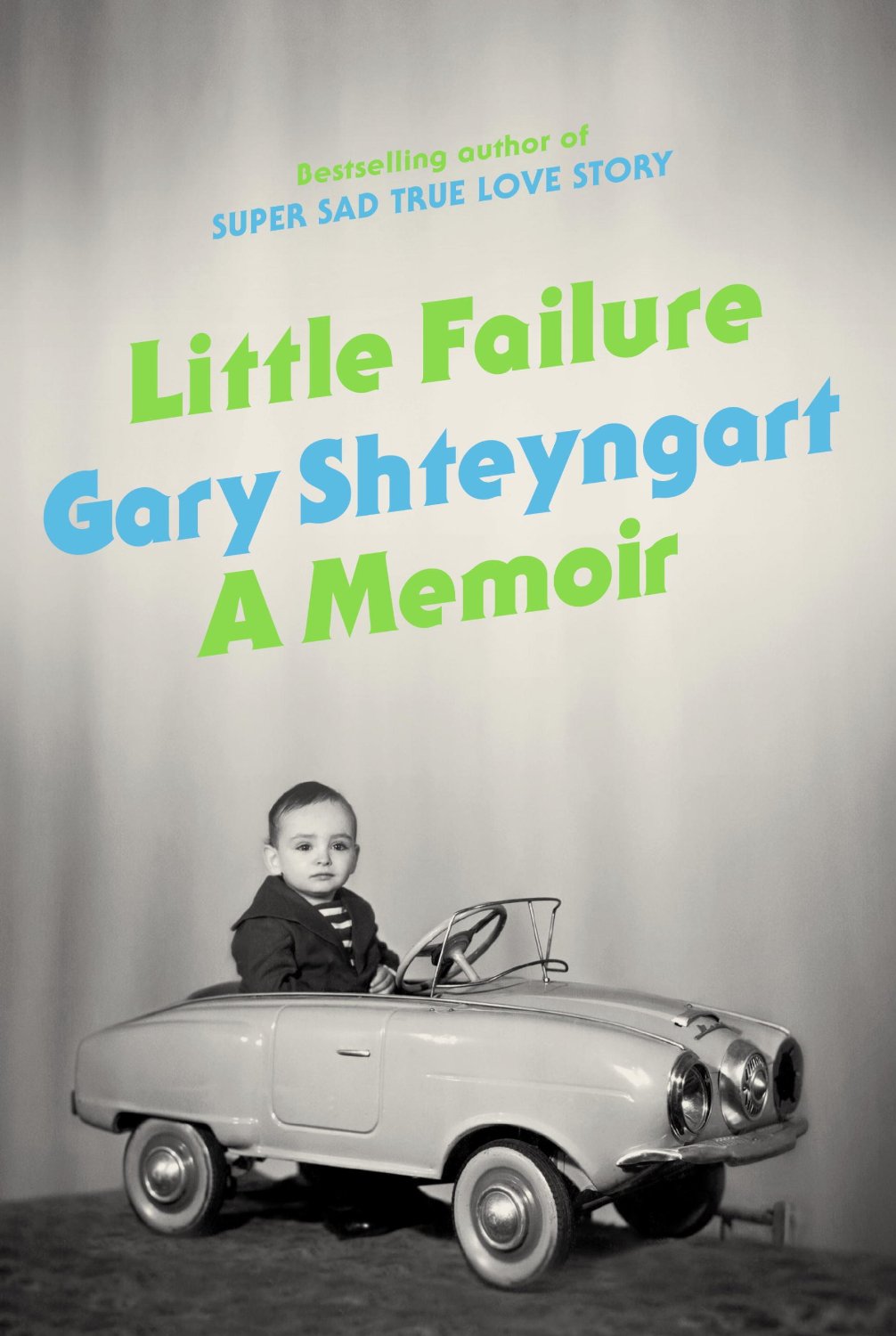
Surely just about everyone has seen this already, but in case you missed it, the new video for Gary Shteyngart’s forthcoming memoir Little Failure, which features James Franco as his husband and Jonathan Franzen as his therapist, is pretty great:

The video also stars David Ebershoff, Rashida Jones, Sloane Crosley, and Alex Karpovsky.

2 Comments

Midweek Miscellany

Everybody Thinks Their an Auteur” — Film director and critic Peter Bogdanovich at New York Daily News book blog Page Views:

Auteurism today? Well, everybody thinks they’re an auteur. But nobody seems to understand what the whole auteur thing was. It wasn’t a theory as far as the French were concerned. It was a political statement called la politique des auteurs. Truffaut and Godard were attacking the old-fashioned, well-made film, Franch or American. They thought Howard Hawks was an infinitely better director than Fred Zinnemann. They thought Alfred Hitchcock was a greater director than David Lean. They were against Marcel Carné  and for Jean Renoir. Personal films were what they looking for, where a director’s personality dominated despite who wrote it or who was in it or who photographed it.

Nothing But a Number — An interview with Gary Shteyngart, author of Super Sad True Love Story, at CultureMap Austin:

“There’s a kind of anxiety, I think. When you’re ranked you sort of know who you are and where you stand, and people become obsessed in their rankings. The quantitative takes the place of qualitative.”

Does this mean we are starting to reject the belief that we will never be just a number? “That’s the big generational shift from the ’60s of ‘I am not a number’ to 2012, where ‘I am a number but hopefully I’m a good number. I’m a high number,’” he laughs.

A Slow Books Manifesto: “Read books. As often as you can. Mostly classics.”

Not Your Conventional Hell — British horror writer Ramsey Campbell (The Darkest Part of the Woods) on the mighty H. P. Lovecraft for the BBC:

Lovecraft developed his own invented mythology, at least as influential on fantastic fiction as Tolkien’s work. Most of it is set in a New England steeped in history and in hidden occult influences, although the monstrous creatures glimpsed by his characters are frequently from outer space rather than from any conventional hell.

And finally…

Do We Need Stories? — Tim Parks continues his one-man argument with everything Jonathan Franzen has ever said ever:

Of course as a novelist it is convenient to think that by the nature of the job one is on the side of the good, supplying an urgent and general need. I can also imagine readers drawing comfort from the idea that their fiction habit is essential sustenance and not a luxury. But what is the nature of this need? What would happen if it wasn’t met? We might also ask: why does Franzen refer to complex stories? And why is it important not to be interrupted by Twitter and Facebook? Are such interruptions any worse than an old land line phone call, or simply friends and family buzzing around your writing table? Jane Austen, we recall, loved to write in domestic spaces where she was open to constant interruption.

Comments closed

Midweek Miscellany

Book Sniffing — Six writers on their book collecting habits, including Gary Shteyngart:

I’m big on sniffing books. The old Soviet ones really have this strong smell, reminding me, for some reason, of tomato soup in a cheap Soviet cafeteria.

Fear of a Blank Canvas — Book designer Chip Kidd interviewed at Azure Magazine:

If I’m designing a book for myself, that’s a very different thing than if I’m designing a book for Murakami – he’s ultimately the boss. For 1Q84, what I’m really trying to do, as pretentious as it sounds, is to create a work of art that services a greater work of art. It’s him. It’s not about me. But at the same time, I want to make something great for him. If I’m designing something for myself, it can be liberating and potentially stifling at the same time. It’s the literary equivalent of being given a blank canvas. And I’m not a great blank canvas kind of guy. I want the canvas filled in, in terms of content, by Murakami, and then I can make it look like something.

See also: Book designers Lauren Duffy, Kimberly Glyder, Henry Sene Yee and David Drummond on the ins-outs of book design at The Book Deal.

The Incommunicability of Difference — David Bellos discusses translation and his new book Is That A Fish In Your Ear? on Talk of the Nation:

For translation to exist, you have to accept the fact that languages are all different and they don’t describe the world in quite the same way. You also have to accept that languages are all the same in that anything you can say in one language can be said in any other. And it seems to me [that the] tension between the incommunicability of difference and … the sharing of a common set of messages and meanings is … human. I mean, we all live in that state, that I am not like you. My experience is not directly commensurable with yours, and yet, for us to get on and to be human and to be in a society, we have to also make the assumption that in another dimension, we’re all the same. We have the same needs, the same fears, the same desires.”

And finally…

James Parker on George Smiley, John le Carré’s literary spy, and why he is the antithesis of James Bond at The Atlantic:

Bureaucratically dowdy, rarely spotted in the field, a dull fucker by both instinct and training, Smiley drops no one-liners, romances no tarot-card readers, roars no speedboats through the Bayou… When John le Carré dies, there will be no pseudo–le Carrés, rotating the clichés of Smileydom through their potboilers. Not only is le Carré more or less inimitable—less imitable, certainly, than Ian Fleming, whose style was essentially that of a school bully with a typewriter—but Smiley himself is too elusive a creature to be captured by any pen other than that of his creator.

Comments closed

Midweek Miscellany

Expanded Original — Geoff Dyer, author of Otherwise Known as the Human Condition, on Penguin Modern Classics and the paintings used on their covers:

The use of different paintings meant each book was a “modern classic” in its own particular way. A side effect was that books I was reading for an education in literature doubled as an introduction to art history… Since then the happiest moments in 35 years of museum-going have occurred when I’ve seen these Penguin Modern Classic paintings on a gallery wall. Especially since the cover often showed only a detail of the original. Seeing the works themselves revealed exactly what had been lost, though I invariably saw it the other way around, with the painting as an expanded version of the Penguin original.

Sci-Fi Diet — Mike Doherty interviews Gary Shteyngart, author of Super Sad True Love Story and Absurdistan, in Caplansky’s Delicatessen in downtown Toronto:

“My cholesterol is in the science-fiction realm,” he says. You’d expect him to be gargantuan, like Misha Vainberg, the gourmand oligarch from Absurdistan who’s always asking his manservant to make him meat pies, but Shteyngart is a slight fellow, with big black-rimmed glasses and a perpetually amused mien. He’s an ideal dining companion, if you’re not a rabid vegetarian, his speech a mixture of astute cultural observations, probing bons mots and moans of contentment.

That Synching Feeling — James Meek, author of  The People’s Act of Love, on e-books and social reading:

Once there were private libraries; then there were public libraries; now there is the ghost library, where poltergeistic fellow readers may not only be reading the same book as you at any moment but actually underlining the page of the book you are reading seconds before you get to it. They may be next door; they may be in Kamchatka; they may be anywhere, so long as they have Kindle and wifi.

And finally…

An epic twopart interview with John Hodgman, whose new book That Is All has just been published, at the AV Club. It is totally worth it, if only for the extended rant about children, mortality, the apocalypse and Cormac McCarthy’s The Road:

I did a little math, and was like, “Wait a minute, Cormac McCarthy is like 75 years old! And he has a 12-year-old son! No wonder he wrote this book!” I’m like, “Cormac McCarthy, you jerk, you’re not talking about the apocalypse, you’re talking about your personal apocalypse, because you’re an old man who’s not going to get to see his son grow up. That’s what this book is about. And for you, it feels like the end of civilization, and an intolerable world, and you can’t say goodbye to a son that you can’t guide through this awful world that allows you, an old person, to die.” I’m like, “How dare you, Cormac McCarthy, put me through all that when you’re the one going through this personal apocalypse?”

Comments closed

Something for the Weekend

Issue #56 — Jessica Abel and Matt Madden discuss the latest volume of The Best American Comics at Comic Book Resources:

The problem with superheroes is it’s not a personal taste so much as it just requires so much insider knowledge to read these things. They don’t stand on their own. There have been about three superhero comics, maybe two, in the past five years that stand on their own. That you can just read and not have to know what happened in issue #56 and ever since. It’s a real problem, I think, and it’s a problem for the industry. How do you get into this stuff if you’re not into it already?

The Highs and Lows — Steven Heller, author of bazillion books on design, profiled in the Village Voice:

“The worst design writer is one who doesn’t tell a story,” Heller tells his students. “Facts are nice, but it’d be better to have the facts telling you some tale of highs, lows, and woes.”

Remaining Solvent — Bert Archer interviews Brooke Gladstone, author of The Influencing Machine, for the Toronto Standard:

“I see new structures already emerging, we are in the midst of a big, big change; it’s so obvious it’s pathetic to even say. We have to form new business models, modulate the ones that are already there; we need to acknowledge the role of the news consumer in the creation of news now, and acknowledge… that the precepts and principles that dominated during the time of television and mass media are beginning to disintegrate and fall back to the precepts and principles that guided journalism back when it was not a mass medium, back when you didn’t need to amass audiences at unprecedented size in order to remain solvent.”

Antisocial Behaviour — Gary Shteyngart on his novel Super Sad True Love Story and the effects of social media:

I know professors who can’t read an entire book–professors of English literature, mind you. So everyone’s attention span has been shot. We’re no longer used to processing long strings of information. When a book is no longer a book but yet another text file, it’s very hard to say, “OK, I’m gonna devote myself to the 300 pages of text on my screen” when I have all this other stuff that I need to do.

That’s why channels like HBO and Showtime have taken over to a big extent. The kind of stuff that used to appear in novel form now appears in “The Wire” or “Breaking Bad.” They deliver the narrative thrust that we need. They teach us about different worlds and different ways of living. But at the same time, they don’t require textual immersion. You just passively sit there and let these things happen on the screen.

And finally…

PJ Harvey on writing her award-winning album Let England Shake at GQ Magazine:

As I was doing my research to write this record I realized quite quickly I needed to gather a lot of historical information in order to understand more about our current-day wars, in Afghanistan and Iraq, for example. So I started going through my history books and became so interested in the Gallipoli campaign. It really resonated in me. I felt like I could relate it in a way to some of our contemporary wars and I learned a lot by looking at it, but also just the sheer scale of the mismanagement of that campaign and the scale of the loss of life affected me very deeply. And I really wanted to write about it.

I have played Let England Shake a lot this fall.

Comments closed

Midweek Miscellany

Canadian illustrator and typographer Darren Booth at From The Desks Of

There’s on more on Darren’s cover for An Object of Beauty on his blog.

Misery — Editor and author Diana Athill profiled at The Telegraph (via PD Smith):

‘I have always been a watcher,’ she says. ‘Of myself in particular. Even at times of acute unhappiness I’ve watched myself being unhappy. I also think I’m one of those people who has never been wholly involved in an emotion, but then I think a lot of writers are like that.’

Is Modernism Boring? — Rhys Tranter at The Spectator Book Blog:

If modernism means anything in Woolf or Joyce, it is the struggle for what it means to be modern. Both present us with an array of fascinatingly complex characters, seeking to question their identity and their place in the modern age. Language becomes a character, too, an all-pervading texture that sets the mood of each story, and playfully subverts the ABC plots of yesteryear. Amid a proliferation of new technologies, of political upheaval and social change, Joyce, Woolf and the literary modernists actively interrogate the way we perceive the world around us, in ways still relevant today. In this way, modernism is not something we leave on our shelves and neglect to pick up. Modernism is that which speaks to modern life.

What’s the Worst that can Happen? — Gary Shteyngart, author of the dystopian Super Sad True Love Story, interviewed at the new and great looking book blog Full Stop:

Most people don’t care anymore because they’re beyond caring. The endless cult of self-expression that makes people stream or write about themselves day in and day out without any kind of filter. If you write a novel, you’re often writing about yourself as well, but you’re clearly filtering it through a bunch of things, not least of which is technique. So it’s not an entirely plausible future, but in some ways it could be. What if all the worst things happen politically, socially, and in terms of our literacy?

Top 10 fonts of 2010 lists from You Work For Them and Fontwerk (Google Translate version here).

And finally…

The 50 best comic book covers of 2010 as chosen by Robot 6

4 Comments

Something for the Weekend

I’ve not been entirely convinced by all of the artists’ books covers I’ve seen coming out the Never Judge…? show at StolenSpace in London (to be fair, I’ve not been to the exhibition in person), but Gary Taxali’s design for The Confederacy of Dunces is just great. I believe this edition will be available from Penguin UK in April 2011. There’s more on the exhibition at Creative Review.

What Font Should I Use?Smashing Magazine’s 5 principles for choosing and using typefaces.

The Collectors — NPR on e-readers, data collection and personal privacy (via MobyLives):

Most e-readers, like Amazon’s Kindle, have an antenna that lets users instantly download new books. But the technology also makes it possible for the device to transmit information back to the manufacturer.

“They know how fast you read because you have to click to turn the page,” says Cindy Cohn, legal director at the nonprofit Electronic Frontier Foundation. “It knows if you skip to the end to read how it turns out…”And it’s not just what pages you read; it may also monitor where you read them. Kindles, iPads and other e-readers have geo-location abilities; using GPS or data from Wi-Fi and cell phone towers, it wouldn’t be difficult for the devices to track their own locations in the physical world.

(It’s also worth noting, as Steven W. Beattie does, that this all applies equally (if not more so) to  Kobo’s new Reading Life app.)

Not Just a Stereotype — Michael Bhaskar, Digital Publishing Manager at Profile Books, offers some final thoughts on 2010 at Book Brunch, dispelling a few myths along the way:

Like many groups, publishers are easily stereotyped, and like such groups too, they find that the media usually plays along with the stereotype rather than discovering the nuances behind it. So we hear about a slightly staid world of boring pedants, blinking helplessly at the on-rushing lights of the digital juggernaut and eagerly burrowing their way back to the 1950s… But this isn’t the industry I know. Far from being terrified of digital, publishing has actually already become well adapted to the digital world.

In his recent study of publishing, Cambridge academic John Thompson makes the point that, from the industry’s point of view, much of the digital transition has already taken place. In the workflows of most publishers the only time we see printed material is at the very end of the process… The day to day reality of a publishing house is one of dealing with digital products…

Wave of Information — Gary Shteyngart, author of Super Sad True Love Story, in conversation with Robert Birnbaum for The Morning News:

Sure the novel has survived. Television, radio, telegraph, film—just about anything that has been thrown at it. It’s a very durable form. And the novels are getting better and better. I am shocked at the quality of literature. What I worry about more than anything is—maybe this anecdotal “living in New York”—is the exhaustion of people… The difficulty people have of opening up a book after a day of being bombarded with bits of information, most of it useless. And much, if redundant, certainly information that is ceaseless. Ceaseless waves of it. You come home, the quest for narrative is still there—you want narrative. What’s the water-cooler discussion going to be about? It’ll be about Mad Men, which you can sit there and passively take in—it’s a wonderful show—as opposed to something that requires a mass of concentration and effort. That’s my fear. Who knows, maybe it’s completely unfounded.

And finally…

Carolyn Kellogg chooses her 13 favourite bookplates from Etsy for the LA Times ‘Jacket Copy’ blog (pictured above: Skull and Crossbones bookplates by rxletterpress).
1 Comment

Gary Shteyngart, Paid in Cheese

Gary Shteyngart, author of Absurdistan and Super Sad True Love Story, interviewed by Eleanor Wachtel for CBC Radio’s Writers & Company:

Writers & Co Interview with Gary Shteyngart Mp3

Comments closed