Skip to content

Tag: gabriel josipovici

Midweek Miscellany

Nothing is Forgotten — A dark and beautiful wordless webcomic by Ryan Andrews (via Drawn).
And on the subject of comics, Kelly Thompson of the brilliantly named 1979 Semi-Finalist blog picks her top 20 favourite female comics creators of 2010, including Kate Beaton and Emily Carroll, for Comics Should Be Good: Part One and Part Two.

Most Anticipated… The Millions list of interesting new books coming out in 2011 (not that I’ve caught up with 2010 yet).

The Best Fonts of 2010 as chosen by FontShop.

Wordmark — A handy online tool that allows you to preview and compare all the fonts installed on your computer (via Fontblog).

And lastly…

Critical Life — Ramona Koval interviews Gabriel Josipovici, author of What Ever Happened to Modernism?, for The Book Show on ABC Radio National. From the transcript:

[F]or all my writing life I felt one shouldn’t comment critically about one’s contemporaries, because in a way that is self-defeating. What one should do is praise the works one likes and gradually people will see their value. I suppose I was being unduly idealistic and I felt that I was only talking to the converted, as it were, and I wanted just for once to actually make people sit up a little more and to let out in print what I have said and talked about with friends, this feeling that English culture had become this thing that was rather mean and dispiriting, aided and abetted not just by…it wasn’t just something in the writers but it was something in the whole culture…

(via ReadySteadyBlog)

HAPPY NEW YEAR!

Comments closed

Midweek Miscellany

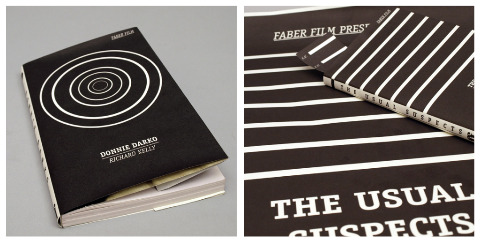
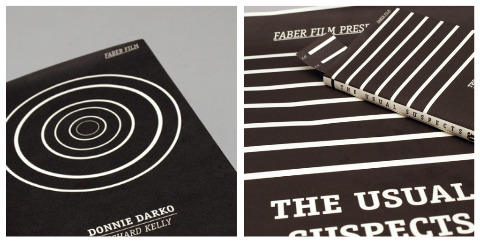
Another great set of designs for the 2009 D&AD student award brief for typography sponsored by Faber and Faber, this time by Rinse Design (via Cosa Visuales). See also: Ed Cornish’s designs for the brief.

Phaidon have relaunched their website and it is really rather nice (via FormFiftyFive).

The Imaginary PresentMike Doherty interviews William Gibson about his new novel Zero History for The National Post:

In his earlier books, Gibson says, he aimed to devise “futures that felt as though they were filled with designed artifacts, as indeed they would be. I can’t think of too many science fiction writers who’d bother trying to do that.” In the [new] series, his devotion to design has gone into overdrive, reflecting the idea that “everything is ‘designer,’ ” even though “with most things, you’ll never know the name of a designer.”

PopMatters also spoke to the author about the new book.

Code — Jennifer Egan, author of A Visit From the Goon Squad, reviews Tom McCarthy’s C for The New York Times:

[McCarthy] aligns disparate things into larger patterns full of recurring images: analogies between the human body and earth, and machinery; hums and whirs; film screens; bowels and tunnels; electric circuits; cauls and other silken membranes. These repetitions come to feel like the articulation of a larger code — as if, were readers to plot their exact positions throughout the novel, they would discover a hidden message.

What Ever Happened to Reading Properly? — ReadySteadyBlog’s Mark Thwaite on critics misreading of  Gabriel Josipovici’s What Ever Happened to Modernism?:

It’s interesting that Josipovici’s book which, in many ways, is both a call to read more carefully and an enquiry into why reading carefully is beyond so many cultural gatekeepers, has been read so sloppily by so many of its critics… Josipovici doesn’t invoke marginal or avant-garde writers, nor praise typographical or narrative playfulness over stale traditionalism, but rather brings us back to canonical writers (a good part of his essay is taken up with Wordsworth) and allows us to see what was at stake for those artists in their work, and what is at stake for us as readers.

And finally… It’s Vignelli week at Design Observer:

Debbie Millman’s 2007 interview with Massimo Vignelli (excerpted from her book How To Think Like a Graphic Designer):

I’m interested in “essence” — my major aim is really to get to the essence of the problem. And just throw away everything that’s not pertinent to it. At the end of a project, my work should be the projection of that experience, the essence of effect. It’s a habit that you get into… The essence is what is left when there’s nothing else that you can throw away.

Michel Bierut profiles Lella Vignelli:

Massimo has often defined their working relationship like this: “I’m the engine, and Lella is the brakes.” The first time I heard this as a young designer, it was clear to me which was more important. If you were a designer, wouldn’t you want to be the engine, powerful, propulsive, driving forward? It was only years later that I remembered something my high school driving instructor once said: “You don’t get killed in a car accident because the car won’t start. You get killed because the breaks fail.”

And, there is an interesting, beautifully shot, video interview with Massimo Vignelli by photographer John Madere here.

There will surely be more good stuff as the week progresses…

Comments closed

Midweek Miscellany

Killing Her Softly — Joseph O’Neil reviews Martin Stannard’s biography of Muriel Spark for The Atlantic (thx Ben):

In one of her memoirs, [Doris] Lessing suggests: “Writers, and particularly female writers, have to fight for the conditions they need to work.” This sounds like an understatement, particularly in relation to the last pre-feminist generation, to which she belonged. Dipping into it, we see that Penelope Fitzgerald, a mother of three, did not publish until the age of 58, that Iris Murdoch and Flannery O’Connor and Patricia Highsmith were childless. Spark may not have been alone in associating motherhood with artistic and personal annihilation. (Other patterns emerge. Highsmith, Lessing, and Spark all loved cats, and in fact Spark received a cat from Highsmith, with whom she also shared itinerancy and a gleefully vicious imagination. If you took scoops of the temperaments of Doris Lessing and Patricia Highsmith and added a dollop of Flannery O’Connor—for the cold Catholicism—the resulting gelato would taste a lot like Muriel Spark.)

Sensory Deprivation — The ubiquitous Jonathan Franzen, author of Freedom,  interviewed at the A.V. Club:

Where does this stuff come from? It comes from sensory deprivation. It comes from turning down all the volume knobs to the one setting—or somewhere between zero and one—on everything, so I can actually hear myself think and I can actually poke around inside myself. We’re all so used to cultural noise being played at full volume. It can come as a surprise, even to myself, how much you can know about what’s going on by listening to almost nothing. It’s important, because if you have it up at full volume, you can’t hear yourself think, and all you want to do is chase after the stuff that’s going on.

And if you think Mr Franzen might have got a little too big for his boots, then following Emperor Franzen on Twitter might be for you (“I was on the cover of TIME. That’s TIME magazine, bitches…”).

Fighting the Last War — John Le Carré talks to the BBC Radio 4 Today Programme about his new novel Our Kind of Traitor (released next month):

“I was laughed at, in a way, when the Cold War ended and the wall came down… ‘Poor old Le Carre, what will become of him? Nobody’s spying anymore.’ The reality is, the budgets have never been bigger, the recruitment has never been more wholesale.”

Boredom — Lee Rourke, author of The Canal, interviewed for 100th issue Bookslut:

We’re in constant thrall, either waiting to be used by technology or desperately trying to catch up with it. Boredom is the realization of an acute emptiness caused by this widening void… There’s nowhere for us to go now. We are stranded. We have been marooned. My novel, The Canal, is a summation of this sense of dread: this slow realization that things, everything, is speeding up and moving away from us. We have been left with the inability to deal with what this distance creates within us…

And finally…

Living in Conservative Times — Tom McCarthy reviews What Ever Happened to Modernism? by Gabriel Josipovici for The Guardian:

In cultural terms, we live in deeply conservative times… We shouldn’t imagine, though, that things were that different in the golden age of modernism. Ulysses was printed, in 1922, on a small, private press in Paris, in a run of 1,000; Kafka’s Metamorphosis, on its small-press publication in 1915, sold 11 copies – of which 10 were bought by Kafka. Yet can anyone, now, name the successful middlebrow writers of 1922 or 1915? Of course not.

(And, as this is a blog for people who like to live under rocks, Tom’s novel C was shortlisted for the 2010 Man Booker Prize yesterday.)

3 Comments