Skip to content

Tag: fritz lang

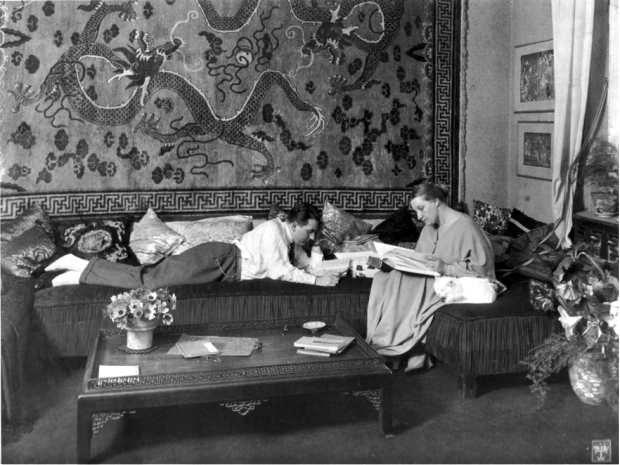
Kriemhild’s Revenge: The Strange, Working Romance of Fritz Lang and Thea von Harbou

langvonharbou

At the Paris Review blog, Henry Giardina considers the relationship between film director Fritz Lang and writer Thea von Harbou, with particular reference to their adaptation of the epic poem Die Nibelungenlied for the screen:

Fritz Lang and Thea von Harbou weren’t collaborators so much as co-conspirators: they had one of the strangest, most fruitful partnerships in the history of film, an erotic and artistic alliance that helped the new medium establish an emotional and political grammar. In the course of their eleven-year marriage, the pair, who met in 1920, made roughly a dozen films, often with Von Harbou writing the screenplays—adapted largely from her own work—and Lang in the director’s chair. They shared an expressive aesthetic vision, an exacting work ethic, and an almost tyrannical unwillingness to compromise with others. They changed people’s minds about their movies and, in radical ways, they changed each other. Their dedication manifested in odd ways—even though, a year into their affair, the bloom had already gone off the rose, they continued to live together, work together, and keep up the pretense of monogamy for another decade. She looked past his philandering; he looked past her increasingly fascist politics; they kept a full calendar. “We were married for eleven years,” von Harbou said later, “because for ten years we didn’t have time to divorce.”


2 Comments

The Sprawling, Obsessive Career of Fritz Lang

As part of the The Dissolve’s ‘Career View‘ series,  Noel Murray surveys the work of German-American film director Fritz Lang:

Over his first two decades as a movie director, Lang was responsible for some of the most memorable images in cinema’s early history, but he’d never filmed anything as shocking as one shot at the start of his 1941 thriller Man Hunt. As renowned hunter Alan Thorndike (Walter Pidgeon) settles into a shooting position on a brushy hill, he looks through his telescopic sight at his target: Adolf Hitler. Given that the United States wasn’t yet involved in World War II when Man Hunt was made (or even when it was released), even the implication that a movie hero might assassinate Hitler was a major provocation, which put Lang in a bit of hot water with the U.S. government and the gatekeepers of the industry’s production code. But Lang held firm, and Man Hunt set the tone for all the war movies he’d make in the 1940s. Even after America entered the war—and even after the war was over—Lang made action movies where the enemy wasn’t some vague antagonist in a different-colored uniform. In Lang’s war films, the villains frequently looked and talked a lot like the heroes, and posed a real, specific threat to ordinary citizens, not just soldiers.

It’s a long post — it spans a 40-year career! — but a really great read if you are interested in film history. I really hope The Dissolve publish more of these.

Comments closed