Skip to content

Tag: francoise mouly

The Wall

cover-story-staake-the-wall-875x1200-1478824922

Bob Staake for The New Yorker

Comments closed

Françoise Mouly: No House Style

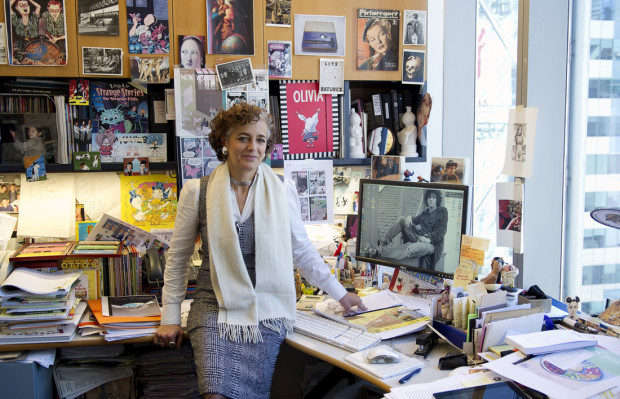
Sarah Shatz: Françoise Mouly

It’s Nice That has a great interview with the remarkable Françoise Mouly, co-founder of comics anthology Raw, editorial director of TOON Books, and, of course, art editor at The New Yorker:

“One of the things we had at Raw which I have tried to keep is not having a house style, it doesn’t all look alike. Raw really was the sum of its parts but you can’t say that Raw magazine was Joost Swarte or Charles Burns or Sue Coe.

“At The New Yorker when I came in there was a house style, a nice cat-on-the-windowsill type watercolour and you could look at the covers and see the common denominator. I have tried to never let it settle into, ‘Oh that’s a New Yorker cover’ except in the approach.”

Comments closed

Françoise Mouly on Voice

francoise-mouly-photo-sarah-shatz.

Grace Bello interviews the always interesting Françoise Mouly, art director of The New Yorker and founder of Toon Books, for Guernica:

I know what I respond to is a voice. A voice is not just a stylistic thing, but it means someone who really has something to say. I think a lot of what I get from books—whether they be books of comics or books of literature—is a window into somebody’s mind and their way of thinking. I love it when it’s so specific. It’s a new way to look at the world. It’s as if I could get in and see it through their eyes. It also reaches a level of universality because, somehow, I can recognize some of my feelings in seeing somebody who is actually expressing their own inner reality. Even though Flaubert has not been in Madame Bovary’s skin, you do get a sense of what it’s like to be that person. It’s a kind of empathic response when you’re reading it.

Comments closed

Françoise Mouly on TOON Books

trip-to-the-bottom-of-the-world

At Mutha Magazine, Meg Lemke talks to Françoise Mouly, Art Editor of The New Yorker and co-founder of RAW magazine, about TOON Books, her line of comics for kids:

When I go to schools, even in very impoverished school districts, and I say that I’m here to read a book—it’s fantastic to see how kindergarteners and first graders love story time. They love being read to. I go to schools to see the actual response from the kids, not what I think they will say. Reading is a canvas that they use to construct their understanding of the world. Comics are great that way, even better than illustrated stories, because, in comics, the story is told sequentially in pictures, and you, the reader, make connections between the panels. It’s a truly interactive medium, where the story itself stays on the page but you are the one making up what happens between the panels, making it move in space and in time.

When you talk to teachers, you will hear words such as making inferences and connecting and finding the context. It’s elaborate thought but it’s congenial to kids—they do it naturally. They’re always trying to make sense of the world around them. Nobody has ever had to teach a child how to find Waldo—they intuitively get it, and they find Waldo far quicker than most literate adults. Comics take advantage of the thing that children know how to do, of what their strength is, and puts them in the driver’s seat of reading.

Comments closed

Françoise Mouly and the One-Image Narrative

R. Fiore reviews In Love With Art, Jeet Heer’s shory book on Françoise Mouly, for The Comics Journal:

At this point is there any more important editor in periodical illustration than Françoise Mouly? With so many erstwhile venues for illustration being driven online, where any illustration is rendered into spot illustration, The New Yorker could be the big time all by itself. Unless Spiegelman comes into the office with her we have to assume this is an adventure without him. The New Yorker cover of the William Shawn era was essentially wallpaper, the perfect decoration for the better kind of dentist’s office. (Not least because it didn’t matter how old the magazine was.) The New Yorker cover of the Mouly era is not only more topical than it used to be, but is also frequently a one-image narrative. The ultimate Mouly-era narrative cover is Adrian Tomine’s November 8, 2004 cover: A young man and woman spot each other reading the same book in subway trains going in opposite directions, and not only have not encountered but will lose each other in a second’s time. (Though it would have been a hell of an advertisement for Chance Encounters classifieds if they had them.) The effect is to put the cartoonist at the center of the world of illustration.

Comments closed

Françoise Mouly: “Can I just show you, and not have to tell?”

At the L.A. Review of Books Sarah Boxer interviews Françoise Mouly, art editor of The New Yorker and the editorial director of Toon Books:

At RAW, I felt I was the advocate for white space. There’s a certain kind of comic esthetic that is chock full, you know, very Mad magazine, with a million different details. Art is more tolerant of this. I can be brought to tears by a few simple lines. There are so many things where we complement each other very well.

To me design and printing are important. For Art these are a means to an end. When I met him, and he was doing production for [his first book] Breakdowns, he was thinking about printing because the cover was about the printing process. For him, this was something he had to master to sell his ideas. I’m a much more limited thinker. I’m not an abstract person. I can only find things when I’m touching them and making them. I’m eager to do paste-up, mechanical, production. I love to learn new programs, techniques to art, I like things that stand in the way… Art makes things because that’s something he has to do in order to express his ideas. I don’t have ideas outside of making things. I can’t do what he does, expounding on the theory of this and that. I’m like, “Can I just show you, and not have to tell?”

I know I’ve been posting a lot of links to interviews with Mouly recently, but I think it’s really interesting that an art director — someone deliberately behind the scenes — is talking so much about her work and her approach to magazines right now.

(Pictured above: the cover of the most recent New Yorker by Frank Viva)

Comments closed

Jeet Heer: In Love With Art and The Superhero Reader


At the Comics Reporter, Jeet Heer discusses his two recent books on comics, The Superhero Reader edited with Charles Hatfield and Kent Worcester, and In Love With Art: Françoise Mouly’s Adventures in Comics with Art Spiegelman, with Tom Spurgeon: 

Strange to say, when I work on a biographical essay, I’m also often writing a type of disguised autobiography. The introduction to the first volume of the Walt and Skeezix books deals with father/son relationships. I wrote it not long after my father died. The introduction of first volume of the Orphan Annie series touches on the fact that Harold Gray never had kids and examines the theme of infertility in the strip. It was written while my partner and I were struggling with our own fertility problems. In the case of Mouly, yes, it’s true that she, like me, learned English as a second language, aided by comics. And in general, Mouly’s experiences as an immigrant speak to my own history (and perhaps even more, the lives of my parents). Mouly’s cultural interests are another commonality. One of the nicest compliments I’ve received is from Mouly herself, who told my publisher that she was happy that I wrote this book because I was someone who not only knew about comics but had a wider cultural frame of reference. One of the attractive things about Mouly is that she understands comics but has a horizon that is wider than comics culture. It might be a form of pernicious self-flattery, but I like to think the same is true of me.

The fact that Mouly is such an anomalous figure in comics makes her story interesting to me since I also feel like I’m an odd duck in the comics world. Even when I was a kid first reading comics, I paid attention to the credits to see if there were other outsiders in the field. I got a secret thrill whenever I saw Ben Oda (hey, he doesn’t sound like he’s white!) listed as letterer. And I took note of the few women in comics as well, not just Mouly but also Marie Severin, or Glynis Wein. Even as a kid, I noticed that the few women in comics were almost invariably colorists. I often wondered why. I wasn’t a particularly politically astute kid but I did notice a few things.

3 Comments

Françoise Mouly: In Love With Art

Jeet Heer discusses the work Françoise Mouly and his new book, In Love With Art: Françoise Mouly’s Adventures in Comics with Art Spiegelmanwith Dave Berry at The National Post:

She’s open to the wider world in a way that was very rare for North American comics, which was a very provincial scene. But combined with that is not just the European comics themselves, but the European fine art tradition, which she had been educated in and made her very responsive to certain types of art. That’s very distinct from North America, even in the undergrounds, which were much more rooted in satire and lowbrow comedy and pulpishness. The other thing that she brought to the table is a sense of design, which is very rare in comics to that point. There was no one designing magazines and books in that format. Even people who believed in mature comics, they didn’t have that. Fantagraphics, their comics in the ’80s, even though the content is great, when they put it together in a book, they have no idea how to design that kind of product.

In a lot of ways, that sense of design really made the whole idea of the graphic novel possible. The distinguishing thing of the graphic novel isn’t just the length, but that it’s conceived of as a book. In the ’70s and ’80s, people thought that if you had a 64-page Hulk story, that’s a graphic novel – better paper, but all the same design elements as the regular comic… what made Maus and the other books that she did seem like bookstore material, library material was her book design sensibility. Everybody who’s doing interesting comics since then has learned from that.

Earlier this week, The Atlantic ran an excerpt from the book about the now iconic 9/11 New Yorker cover created by Mouly and Spiegelman:

It was a true example of collaborative art. Many of the hallmarks of Mouly’s tenure as New Yorker art editor can be seen in the 9/11 cover, including a direct engagement with current events—an enormous tonal shift in New Yorker cover history. But the cover doesn’t deal with this tragedy in the didactic manner of, say, a political cartoon, but rather through artful means: using subtlety and ambiguity, strong design, a compelling use of color (or in this case, a memorable absence of color) and the distillation of experience (rather than ideas or ideologies) into an iconic image. The dialogue between Mouly and Spiegelman was also typical of the strongly collaborative way she always has worked with, and continues to work with, her artists.

In Love With Art: Françoise Mouly’s Adventures in Comics with Art Spiegelman is published by Toronto’s Coach House Press, and if you are in Toronto this evening, Françoise Mouly and Sean Rogers will be in conversation Jeet Heer at Revival on College Street, starting at 7:30pm

Comments closed

Françoise Mouly: In the Service of What the Artist is Saying

In a follow up to his short Q & A with Françoise Mouly and her partner Art Spiegelman for the National Post, David Balzer has a fascinating full-length interview with Mouly, publisher of Toon Books and art editor of the New Yorker, at Hazlitt:

I think that if you set out with a scripted outcome, you don’t succeed. I’m acting out things that work on me. I spent most of my terribly unhappy childhood years immersed in books. I found early on that it was a great way to escape any kind of arguments with my parents or emotional upheaval. I loved reading and being lost in a book. I trained as an architect. As an architect you’re part of a team and no architect can build a house by themselves. But a bookmaker can make a book all by themselves. And an author: look at my husband’s book, or Marjane Satrapi’s Persepolis—she manages to convey a very rich world, and her personality is very well expressed in a book that shows her handwriting, that has a sense of her.

In a way I got a very classical education growing up in France in the sixties, and learning Latin, Greek, French and English. But I’m well versed in the technological part of the 21st century. The common denominator for me is stories, narrative structure. That’s how I understand things. I find them, books, the right recipient for something that is both complex and nourishing. I watch movies and enjoy them; I watch, you know, The Wire and TV shows, but still, the stories I read in books inhabit my brain in a special way. Those characters are very present in my thinking. And children’s books are a very real part of how I think. So I find it a privilege to actually be in communication, to leave a trace of something that’s actually going to be read.

Hazlitt

Comments closed

Something for the Weekend

They Call it Madness — Jess Nevins  reviews the H.P. Lovecraft collection The Classic Horror Stories for the L.A. Review of Books:

Lovecraft was not the best of his era in any of the genres he wrote in. Clark Ashton Smith was a better stylist. Algernon Blackwood wrote better horror. Olaf Stapledon wrote better science fiction. Yet it is Lovecraft who has been canonized with a Library of America edition, who has provided the source material for academic writings, comic books, and even game shows like Jeopardy, and who has been assimilated by capitalist culture to the point that there are plushies made of his characters.

One would never have guessed this fate for Lovecraft at the time of his death in 1937…

Nevins has been heroically annotating all of The League of Extraordinary Gentlemen series by Alan Moore and Kevin O’Neill and, most recently, compiled notes to the very Lovecraftian Nemo: Heart of Ice (pictured above). But before you get sucked in, be warned: the annotations have a kind of Borgesian horror all of their own.

(And while were on the subject of Lovecraft and comics, you could do worse than picking up I. N. J. Culbard’s adaptations of The Mountains of Madness and The Case of Charles Dexter Ward published by SelfMadeHero)

Also at the LA Review of Books, Michael Nordine on enigmatic filmmaker Terrence Malick:

Malick has the rare distinction of becoming a celebrity — at least in part — for rejecting the notion of celebrity. At a time when we’re given a direct line into our favorite stars’ streams of consciousness via the social media avenue of our choosing, the 69-year-old continues to let his films speak for themselves. When he was nominated for Best Director at the 1998 Academy Awards, the picture that appeared onscreen was of a chair with his name on it; at last year’s ceremony, a different on-set photo from the same production was used. Each new project of Malick’s is said to come with a contractual stipulation that no photos of him may be used in the film’s promotional materials. No matter: people have repeatedly proven able and willing to create an image of their own. That this picture is incomplete at best and may well be wholly inaccurate matters little. Now more than ever, it seems we still can’t conceive of a famous person who doesn’t want to be famous, and even caricatures are more satisfying than a note reading “not pictured” in the celebrity yearbook.

And finally…

David Berry in conversation Art Spiegelman and Françoise Mouly at the National Post. Here’s Mouly’s take on RAW:

Basically, there were no venues for comics, and I just thought, “Well, I can do it myself.” The idea was to show people what actually could be done … that it wasn’t so much a style that was one answer to where comics should go, but was more that each person had their own voice.

Comments closed

Midweek Miscellany

A few remembrances of art critic Robert Hughes, author of The Shock of the New, Nothing If Not Critical and Things I Didn’t Know among others, who died earlier this week aged 74…

Maria Bustillos for The Awl:

“The Shock of the New”… brought him fame, and no wonder. It’s a marvel: a solid education in post-Impressionist modern art of the 20th century in the form of a luscious entertainment stretching over hours and hours; awareness, scholarship, wit, and a visual sensitivity matched for once by an equally sensitive sense of language, all delivered in a brisk, whip-smart, slightly clipped Anglo-Australian voice of enormous power and beauty.

Adam Gopnik for The New Yorker:

Hughes believed in modern art with something close to innocence. Although “The Shock of the New” is in many ways an account of the tragedy of modernism—the tragedy of Utopias unachieved, historical triumphs made hollow, evasions of market values that ended by serving them—that tragedy is more than set off by the triumph of modern artists.

Jonathan Jones for The Guardian:

Hughes believed in modern art, whose story he told more eloquently than anyone else ever has. He was not some stick-in-the-mud. But he compared art in the 1900s with the art of today and observed that even our best do not deserve comparison with the pioneers of modernism. This is a truth that is hard to refute. The words of Robert Hughes have cost me a lot of sleep.

I’m sure there are many more… What a loss…

See also: obituaries in The Guardian,  New York Times, and The Telegraph.

Fertilizer — The always fascinating Jeet Heer reviews Blown Covers: New Yorker Covers You Were Never Meant to See by Françoise Mouly, for the LA Review of Books:

the deeper value of Blown Covers is the insight it gives us into Mouly’s editing process. Editing is a very difficult art to write about, being by its very nature invisible, and based on thousands of tacit, unstated backstage decisions. Blown Covers shows that every idea that makes the page requires an editorial environment where new concepts are constantly being generated. Since the rejection rate is high, this can be frustrating for artists, but Mouly gets around this problem in part by allowing her artists to go all out during the brainstorming sessions, so that even if the idea doesn’t make the cover there is still the pleasure of daring to think of something new and fresh. The failed ideas are the necessary fertilizers of successful covers.

And finally…

Collective Unintelligence — James Gleick, author of The Information, on Autocorrect, for the New York Times:

In the past, we were responsible for our own typographical errors. Now Autocorrect has taken charge. This is no small matter. It is a step in our evolution — the grafting of silicon into our formerly carbon-based species, in the name of collective intelligence. Or unintelligence as the case may be.


 

2 Comments

Something for the Weekend

Blown Covers — The New Yorker art editor Françoise Mouly has a Tumblr (pictured above:  “Eustace at a Stoplight—Right?,” by David Urban)

Spanking — Charles McGrath remembers the late Barney Rosset in the New York Times:

Mr. Rosset was far from a highbrow. Sometimes he signed up books without having read them. He determined to publish “The Autobiography of Malcolm X,” for example, while riding in a cab and hearing on the radio that other publishers had turned it down. And he was proud of publishing a profitable line of Victorian spanking pornography. To a considerable extent the dirty books made the arty ones possible, and Mr. Rosset wasn’t the least abashed about it.

See also: WNYC has reposted two archive interviews with Rosset from 1995 and 2008, and John Gall has posted a collection of links to reminiscences about Rosset on his blog Spine Out.

Form and Fortune — A fascinating  review  of  Walter Isaacson’s biography of Steve Jobs by Evgeny Morozov, author of The Net Delusion, in The New Republic which discusses Apple’s relation to the Bauhaus and Braun:

The design philosophy of Dieter Rams, Braun’s legendary designer, has shaped the feel and the look of Apple’s latest products more than any other body of ideas. Since joining Braun in 1955, Rams—who likes to describe his approach to design as “less, but better”—began collaborating with the faculty at the Ulm School of Design, which tried to revive the creative spirit of Bauhaus with a modicum of cybernetics and systems theory. Eventually Rams produced his own manifesto for what good design should accomplish. His “ten principles of good design” encouraged budding designers to embrace innovation and make products that were useful but environmentally friendly, thorough but simple, easy to understand but long-lasting, honest but unobtrusive. Rams wanted his products to be like English butlers: always available, but invisible and discreet.

See also:  Maureen Tkacik’s on Steve Jobs and Isaacson’s biography at Reuters.

And lastly…

James Wood reviews Edward St. Aubyn’s Patrick Melrose novels for The New Yorker:

Patrick Melrose, the protagonist of what is now a quintet of novels devoted to the Melrose family, is the scion of a wealthy dynasty almost as monstrous as the dodgier Roman emperors; he has spent much of his adult life trying to kill himself with drugs and booze. St. Aubyn’s novels have an aristocratic atmosphere of tart horror, the hideousness of the material contained by a powerfully aphoristic, lucid prose style. In good and bad ways, his fiction offers a kind of deadly gossip, and feeds the reader’s curiosity like one of the mortal morsels offered up by Tacitus or Plutarch in their chatty histories.

Comments closed