Skip to content

Tag: fantagraphics

Something for the Weekend

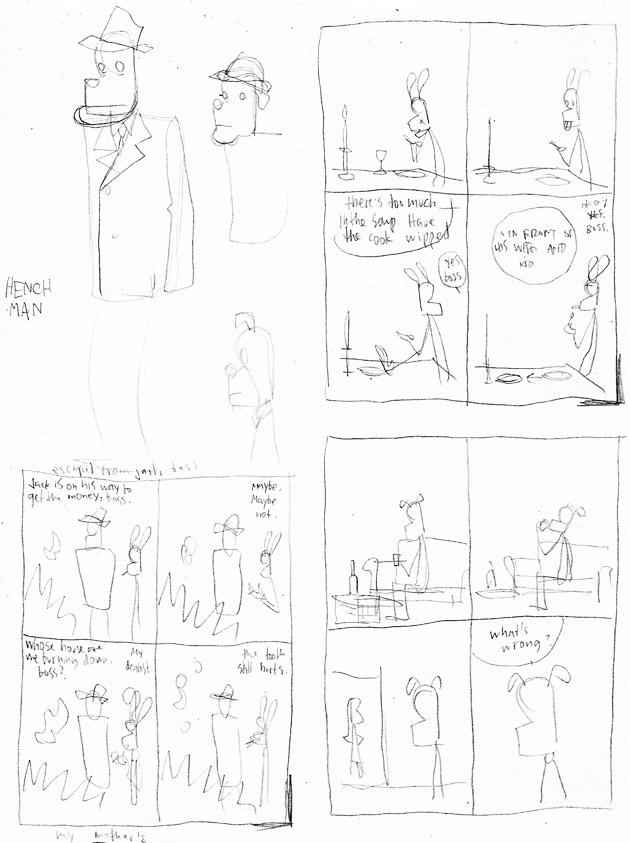
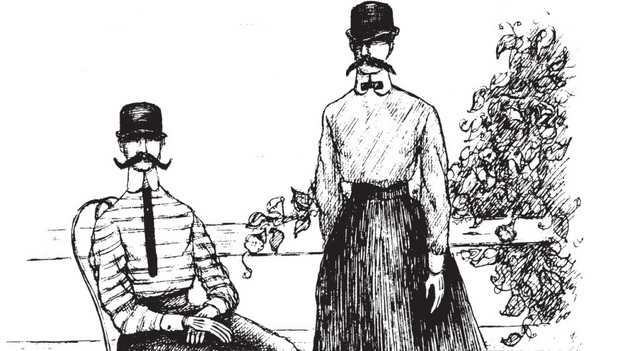
It Will All Be Over Before You Know It… — A six-page, six-chapter comic by the brilliant Richard Sala (a must for fans of Edward Gorey, I’d say).

Something Lost — Edmund de Waal, ceramicist and author of The Hare with Amber Eyes, on inspiration for writing and art at The Browser:

[T]here is still something extraordinary about art which comes out of an encounter between a person and a material. The further you get away from that, the more you get into something which is commodified and reduced to a series of other people’s interactions with it. There is something extraordinary which is lost.

Talking Covers — A new blog, edited by writer Sean Manning, where authors, designers, and artists discuss book covers. The cover to Sean’s own book, The Things That Need Doing is discussed here.

The Solitary World — Ellen Handler Spitz, author of Illuminating Childhood, on the late Maurice Sendak:

Sendak knew from within the profound sense in which every child, from time to time, perceives himself or herself to be alone—an outsider—and feels the need to retreat into some private space, some nook or secret hiding place. Sendak’s books are themselves such places; they can so function even when being read aloud by an adult. Sendak’s supreme gift, as visual artist as well as author, was to discover pictorial as well as verbal and narrative means to portray the existential separateness of childhood.

And finally…

Championship Hoarding — Steven Heller on “stuff”:

It is one thing to have stuff and another to collect it. It is one thing to accumulate stuff and another to exhibit it. What’s the point in just keeping stuff in drawers, out of view? Stuff is/are trophies, evidence of championship hoarding — finding the perfect rarity that no one else has found. Collecting stuff can be competitive, even if only in the mind. Therefore, showing one’s bounty is essential to having stuff. So the vehicle for display is just as essential as the objects themselves.

Have a great weekend.

Comments closed

Something for the Weekend

Jacob Covey’s stunning cover for Nancy Is Happy: Complete Dailies 1943-1945 due in March 2012 from Fantagraphics.

Anxiety and Time — Adam Roberts, author of By Light Alone, on science fiction at The Browser:

The common belief that SF is in some sense “about” the future isn’t wholly wrongheaded. One feature of 19th and 20th century science fiction is that it is fascinated with time in a deep way. Time only opens up, as a wholly new dimension to be imaginatively explored, at the very end of the 18th century. It’s a puzzle, actually, why this should be. [The critic] Darko Suvin thinks it has something to do with the French Revolution. But before about 1800 people almost never wrote stories set in the future, and then after 1800 lots of people did just that. SF as a mode of projecting oneself into the to-come connects powerfully with human concerns in the way that specific prophesy – pedantic, fiddly, bound to be wrong – doesn’t.

Writing Machines — Tom McCarthy on technology in The Guardian:

I must belong to the only generation of writers who’ve written with all three of inkpen, typewriter and computer. It definitely matters: the technology colours not only the rhythm but the whole logic of what you write. Think of Kafka’s obsession with writing machines: the harrow that inscribes the law onto the skin in In the Penal Colony or the mysterious writing desk in Amerika: writing technologies themselves are imbued with terrifying and sacred dimensions, and become the subject, not just the medium, of the story. I used to have a beautiful old German typewriter, that you had to throw your fingers at and the keys would smash into the roller. It felt like a machine-gun or something.

And finally…

Brian Appleyard on Andy Warhol for Intelligent Life magazine:

Warhol now endorses a way of life. One simple technology—silk-screen printing—dominated his career. But it was enough to show today’s technology-laden, hyper-connected youth that they could do it too. With the instant publication of digital pictures and videos, anybody can become a cyber-Warhol, swimming in the great ocean that pop imagery has become. Apple’s Photo Booth software reduces the whole thing to a single click—just by selecting “pop art” under “effects” you can change your face into a very credible Warhol multiple self-portrait. Andy, in death, is a generation’s mentor.

Comments closed

Q & A with Jason

I’ve written about Norwegian cartoonist Jason for The Casual Optimist before and his work appears here with unerring regularity — if you are a frequent reader you are no doubt already familiar with it.

Like British cartoonist Tom Gauld who I interviewed early this year, Jason’s comics are immediately identifiable. You cannot mistake them for the work of someone else. And again, like Tom, Jason’s work references both the pop and the high-brow: zombies and werewolves on the one hand; Hemingway and the Beats on the other. The result is both original and off-beat. His protagonists are like renegades from a Max Fleischer cartoon who’ve inadvertently wandered into a Jim Jarmusch movie… Anthropomorphic animals smoking cigarettes, drinking coffee, talking about French actresses. Action and slapstick wrestle with ennui and loneliness.
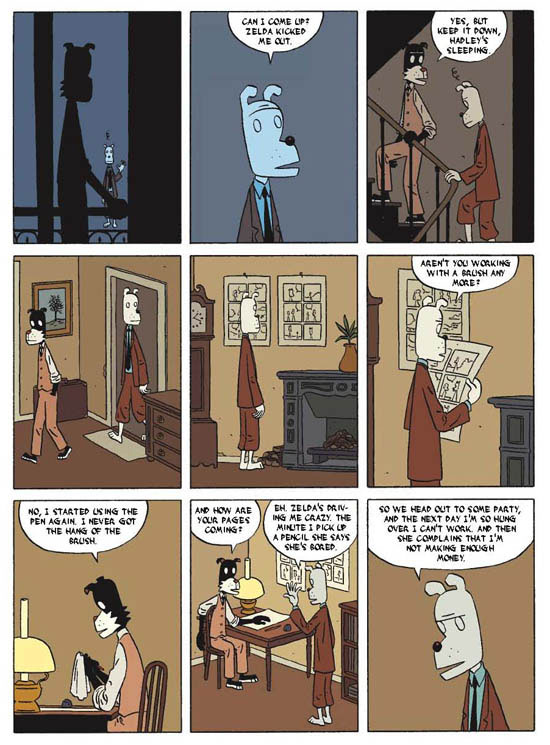
Jason, whose work has been translated into Swedish, Spanish, German, Italian and French, currently lives in Montpellier, France. He was kind enough to talk to me in English. His new short story collection Athos in America will be published in December by Fantagraphics.
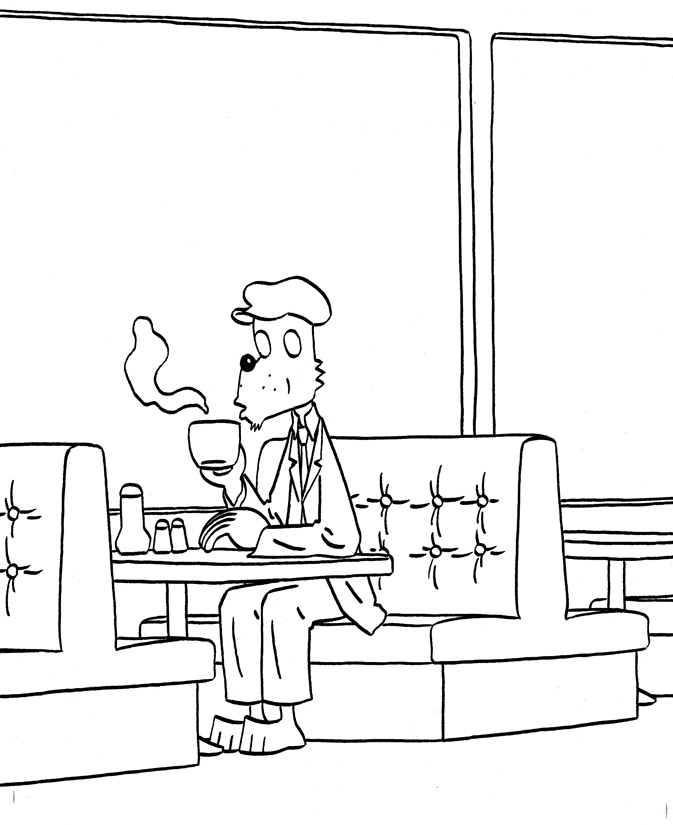
 

When did you first start drawing cartoons?

Around age 13, I guess. And then at age 16 I started selling cartoons and one page strips to a Norwegian humour magazine. I did that through high school.

Did you always want to be a professional cartoonist?

No, it was a hobby. To become a cartoonist in Norway was not much of an option. I went to art school to become an illustrator, but my career never took off, so I kept doing comics. I met other cartoonists in Oslo, there was sort of a little scene. And then I moved to France to be closer to the French comic book industry. I did books that were translated into English, French plus some other languages, and the last seven or eight years I’ve been able to have an income almost exclusively from doing comics.
How did you become involved with your US publisher Fantagraphics?

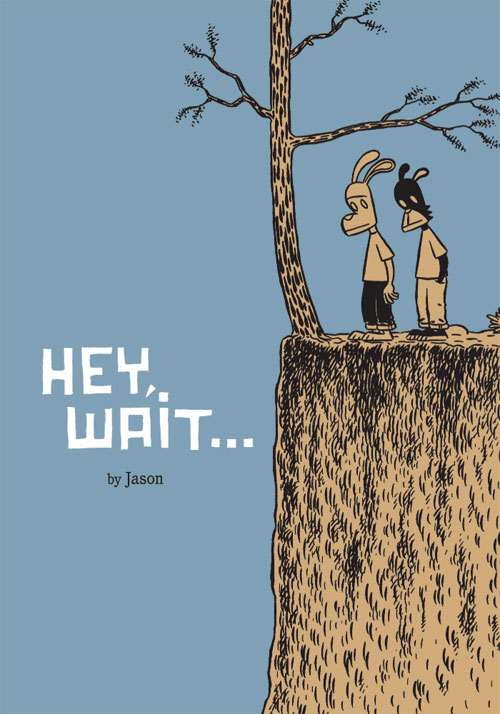
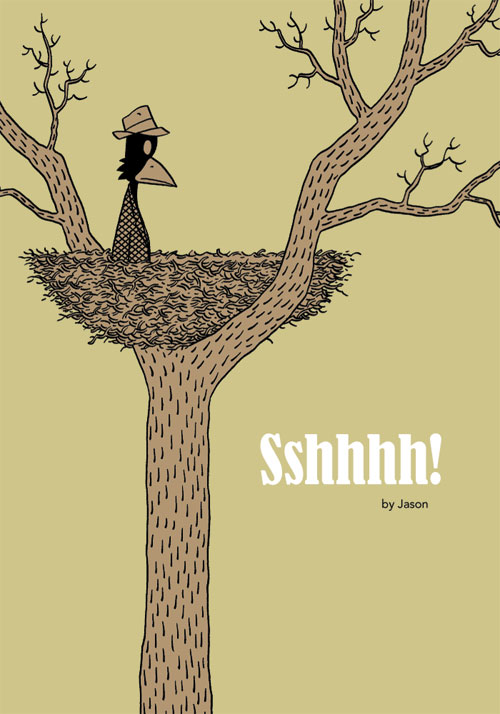
We sent — that is me and my Norwegian publisher, Jippi — we sent Hey, Wait… to Fantagraphics. I’m still not quite sure if Kim Thompson read our submission or if he had already read the French version, but anyhow, they decided to publish the book, and then later Shhh! And The Iron Wagon. And for some strange reason, the books seem to sell okay, so I’m still published by them. [Hey, Wait…, Shhh! and The Iron Wagon are collected in the book What I Did]
Briefly, could you describe your working process?

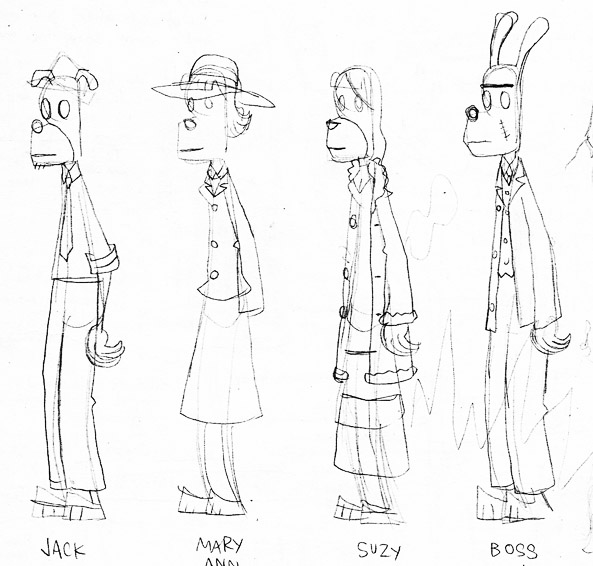
I have ideas in my brain, just lying there, that I sometimes think about. This can last years. Then suddenly I can get ideas for dialogues. I write this down. It’s maybe four or five pages. I can start working on those, and at the same time think about what’s going to happen next. I don’t write a full script. It’s based on improvisation. I write pieces of dialogue. Or sometimes I sketch out the pages first, the images, and write the dialogue after. I usually work on nine or ten pages at the same time, pencil a bit here , then ink it, and then pencil a bit there and ink that. It’s the completely wrong way of doing it, by the way, but it seems to be the only way I can work.
Your work often references classic movies. What are some of your favourite films?

How much room do you have? I like Fred Astaire and Ginger Rogers films, film noir, Brian De Palma, John Ford, especially The Searchers and Howard Hawks, especially Rio Bravo, Buster Keaton, Laurel and Hardy. Paris, Texas, Down by Law, Animal House, Blues Brothers, Fanny and Alexander, Five Easy Pieces, The Last Picture Show, Miller’s Crossing, Roman Holiday, On The Waterfront, Life of Brian. Days of Heaven by Terrence Malick is probably my favourite film.
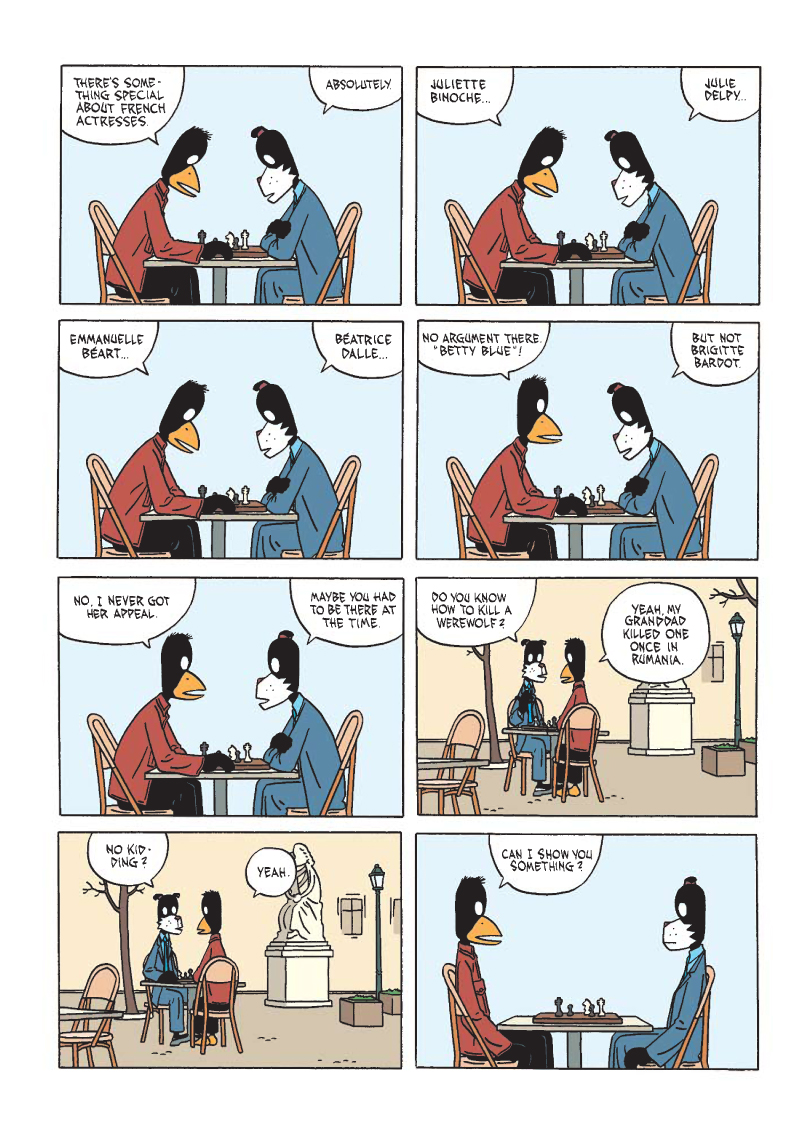
In your recent book Werewolves of Montpellier, one of the characters says they don’t understand the appeal of Brigitte Bardot. Really?

Yes, really! What, you like her? She just looked a little stupid to me. I find Catherine Deneuve a lot more appealing, or Emmanuelle Beart and Julie Delpy to stick with French actresses.
You recently post a list of your 5 favourite Tintin books. Has Hergé been an influence on your work?

Yes, very much so. It was one of the first cartoonists that appealed to me. I borrowed his albums at the library as a kid. I started drawing my own cartoons. And I think you can have a much worse teacher than Hergé. It’s not really the clear line that is the most important thing, even if that is part of what I like with him, it’s more the very clear storytelling that you find in his books. On page three you’re hooked. I think you can read his books in a foreign language, in Russian, and still understand the story and enjoy it. I don’t re-read the books that often, but I often take them out, my favourite albums like The Broken Ear and The Shooting Star, and just look at the drawings.

What do think about the new Steven Spielberg adaptation?

I’ve only seen the trailer. It doesn’t look that bad. I don’t want to just completely rule it out, like its a sacrilege and that Spielberg has no right to adapt Hergé. Not sure about the computer animation, but the original plan was apparently live action with a computer animated Terry [Milou/Snowy], and I think I really would have hated that. And the European animation films, based on each album, are just terrible. Everything that is exciting and funny in the albums are completely lost in the animation films. So I don’t think the Spielberg film can be any worse.
Who are some of your other creative heroes?

Jim Jarmusch, Hal Hartley, Wes Anderson, Aki Kaurismäki. Jaime Hernandez, Jim Woodring, Daniel Clowes, Chester Brown.

Who else do you think is doing interesting work right now?

There are two Argentinian cartoonists I like, Liniers and Pablo Holmberg. The French cartoonist Christophe Blain. Calef Brown’s children books. I like the Mutts books by Patrick McDonnell. I’m not sure if it’s necessarily «interesting», but I find them appealing. It’s like the last, good newspaper strip. I like the old newspaper strip collections: Captain Easy, Prince Valiant, Little Orphan Annie, Gasoline Alley.
What books have you read recently?

This summer I read The Selected Letters by Jack Kerouac, Off The Road by Carolyn Cassady. I tried to read The Subterraneans by Kerouac, but gave up. I read Chronicles by Bob Dylan, Positively 4th Street by David Hadju and A Freewheelin’ Time by Suze Rotolo. I also read Dave Van Ronk’s memoirs, The Mayor of MacDougal Street, so I look forward to the new film by the Coen brothers, based on his life. What else? Blood Meridian by Cormac McCarthy, Last Night in Twisted River by John Irving and Freedom by Jonathan Franzen. I’m currently reading Volume 1 in The Letters of Ernest Hemingway.
What are a few of your favourites books?

Well, Hemingway. The Sun Also Rises and A Farewell to Arms, his short stories. Bukowski, mostly his novels, but I’ve also started reading his poetry. Raymond Carver and Tobias Wolff. Lorrie Moore, her short stories. Kelly Link. There’s a British writer I like, Rupert Thomson. John Fante, especially Ask The Dust, John Steinbeck, especially East of Eden and Grapes of Wrath, Cormac McCarthy, especially The Road and No Country for Old Men. Raymond Chandler and other old pulp writers like Charles Willeford and David Goodis. I like Elmore Leonard. Paul Auster. John Irving. Every four or five years I re-read Cider House Rules, Garp and Hotel New Hampshire.

Are there any stories you would like to illustrate?

Yes, there are one or two books I’d like to adapt to comics. But I’ll probably wait until I’ve run out of ideas myself.
Do you worry about the future of books and print?

No. I don’t know. The bike didn’t disappear when the car came. There are hopefully room for both books and electronic media. Personally I’ll stick with paper. I’ve no interest in reading on a screen. And I’ll be dead in 40 years anyhow. How much can they screw it up by then?

Thanks Jason!
 

6 Comments

Something for the Weekend

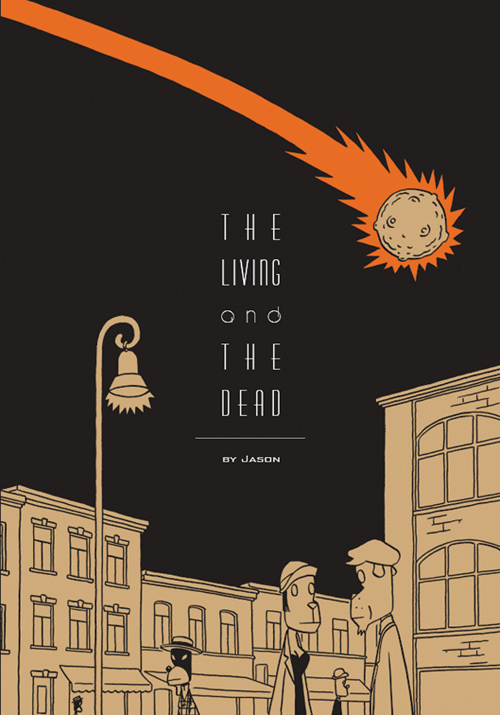
Jason’s cover drawing for his new book Athos in America (above).

Nordic Provenance — A lovely essay by Matthew Battles on writer and cartoonist Tove Jansson, creator of the Moomintrolls and author of brilliant novels such as The True Deceiver and The Summer Book:

The trolls, singers, and creeps in the Moomin books have about them all of the absurd rigor of Roald Dahl’s characters — only the hatred goes missing. In place of dread, Jansson’s characters struggle with vague longings, forever discovering that their worst enemies are not tempests or monsters or maiden aunts, but themselves. While they’re quite capable of getting up to mischief and putting themselves into dire circumstances, they see their way through troubles not by means of sentimentality but with a kind of philosophically playful savoir-faire.

The Death of a Plaything — Brian Dillon reviews Paraphernalia: The Curious Lives of Magical Things  by Steven Connor for The Guardian:

Though we know, even if vaguely, how an AA battery works, that it has a functional interior, it nonetheless seems a thing solid and uniform to the core, stonelike in its simplicity and selfsameness. We appear to learn from things not just about the practicalities of our local material world, but about the expanding world of metaphor: “A teacup asks to be picked up by the handle; a brandy glass invites us to cradle it, tender as a dove, from underneath.” Nor are the desires we bring to things entirely devotional or affectionate; in an echo of Baudelaire’s essay on toys – the poet’s immediate desire as a boy was to smash a toy and find its soul – Connor conjectures: “Perhaps all play has at its horizon the death of the plaything.”

And let’s finish how we started with the back cover for Athos in America by Jason:

I feel like that some days…

Comments closed

Midweek Miscellany

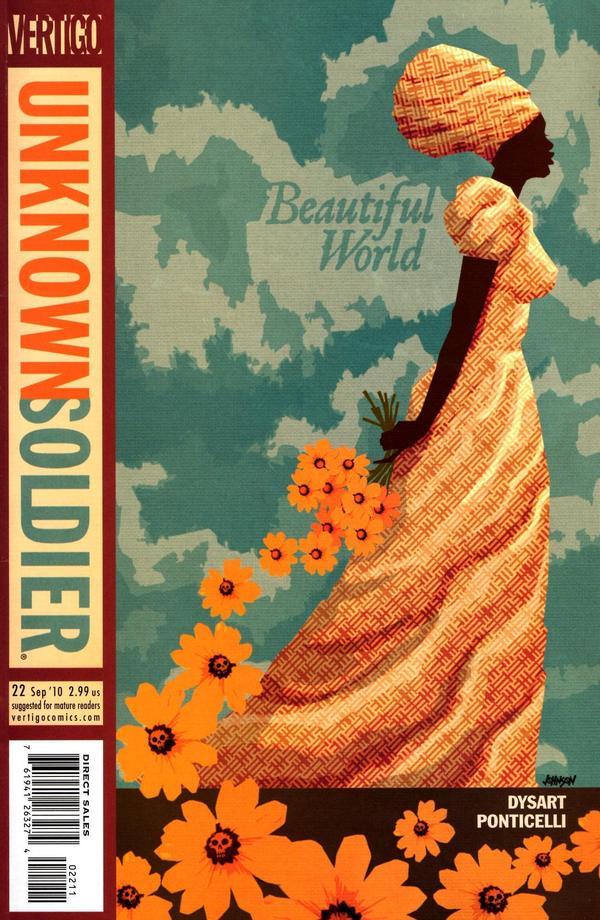
Kelly Thompson chooses her favourite 52 comic book covers from the past year on her blog 1979 Semifinalist. The cover above is by Dave Johnson for Unknown Soldier #22. Other personal favourites of mine on the list include the very retro Deadpool Pulp #4 by Jae Lee, and Hellboy: The Fury # 1 by Mike Mignola (you just can’t go wrong with a big axe really…)

And if you don’t read Kelly’s regular three sentence or less drunken demolitions of Marvel and DC covers you really are missing out. “Motherfucking gangbusters.”

Comics Dwindling Gene Pool — Alan Moore talks about the latest instalment of The League of Extraordinary Gentlemen, Century: 1969, and more with The Guardian:

These days, the majority of the comic book audience is 40-somethings who are not necessarily interested in comic books as a medium or panel progression or sequential narrative. They are probably interested in Wolverine. There is a large nostalgic component in there and there’s nothing wrong with it. But if those people then begin to influence the books themselves or increasingly the movies or the television series then they will want their story to refer to stories that they remember. It becomes very incestuous and over a few decades you get a very limited dwindling gene pool. And you get stories that have become weak through inbreeding.

And sticking with comics for a moment… Eric Reynolds talks about comics and Fantagraphics’ Mome Anthology in a four-part interview The Daily Cross Hatch:

Putting comics online is definitely of interest to myself and all of us at Fantagraphics, for sure. We know that that’s only going to continue to grow. It has certain advantages and disadvantages. But I don’t know if I necessarily want to edit an online anthology, per se. I don’t know why… I know if it’s just that I enjoy the tactile pleasures of print, or what, but—and this is my own personal preference—it doesn’t seem to quite exist when it’s on the Internet, which is quite paradoxical. The Internet has the potential to reach a lot more people that print, in this day and age, and yet, you don’t have that physical object to hold as proof that you did what you did.

Meanwhile, if you are looking for some ‘serious’ books for your vacation, the indefatigable Largehearted Boy is doggedly aggregating online summer reading lists for the year.

While at Slate Robert Pinsky explains  how not to write a book review (whether you’ve read the book in question or not).

And finally (in the likely instance you haven’t seen these yet)…

Cardon Webb’s clever designs for a new series of Oliver Sacks paperbacks from Vintage (via John Gall).


Comments closed

Something for the Weekend

Sweet Nuttin’ — A primer on George Herriman’s classic and wonderfully idiosyncratic comic strip Krazy Kat at Robot 6:

Krazy Kat is far from a chore… Indeed, it is rarely anything less than a delight to read, although it can be a bit challenging for newcomers. The early strips are dense with wordplay, while the later strips take on the quality of near-abstract paintings at times. Then there’s Krazy’s off-kilter dialogue (“If only I could be star or a moom or a komi or ivin a solo eeklip. But me, I’m nuttin”). Thus, whichever book you decide to dive into first, I’d recommend taking your time. Read (and reread) the strips slowly and don’t feel the need to rush through.

Unhappy Endings — Jason Zinoman, author of Shock Value: How a Few Eccentric Outsiders Gave Us Nightmares, Conquered Hollywood and Invented Modern Horror, talks to Terry Gross for NPR’s Fresh Air:

I think that as you look at this period from ’68 to the end of the ’70s, generally, first of all, you see a lot more unhappy endings. There isn’t this kind of catharsis at the end that you see in a lot of movies before that.

The central kind of monsters are no longer werewolves and vampires and the supernatural. The central monsters are – or I guess I would say the central monsters become serial killers and zombies… And I think the other thing that marks it is there’s a certain kind of moral ambiguity about these movies and just generally a sort sense of confusion and disorientation that marks most of these films.

Meanwhile, over on KCRW filmmaker and author John Sayles talks about his hefty new book A Moment in the Sun with Michael Silverblatt for Bookworm.

And finally…

Rick Poynor on the dictionary as art concept for Designer Observer:

With book design, we should value appropriateness to subject, vivid animation of content, and the dexterity and panache with which the designers interpret every purposeful, cherishable convention of the book. The notion of continual reinvention as a worthwhile or attainable goal is particularly misplaced here…

Comments closed

Midweek Miscellany

There’s been much speculation online about who designed the wonderful hand-drawn cover for Big Machine by Victor LaValle (pictured above). Thanks to the nice folks at UK publisher No Exit, I can finally identify the designer as Lynn Buckley, who originally designed the cover for the US publisher Spiegel & Grau.

Collected — Gary Groth, co-founder of alternative comics publisher Fantagraphics, talks about the state of the industry with the Comic Book Reporter (via Robot 6):

By and large, nobody publishes alternative comic books anymore. The reason is fairly obvious; since the reader knows it’s going to be collected in a graphic novel, there’s very little reason for them to buy a twenty-four page comic of something he’s going to get a year or two down the line as a graphic novel, and in the way it probably ought to be published anyway, collected in a single work. I think it’s just an inevitability of the rise of the graphic novel as the dominant form of alternative comics. I don’t know how accelerated that’s going to be for mainstream comics. It feels like it’s headed that way.

Lingua Franca — Tim Parks on translation and international literature for the NYRB:

[N]either readers nor writers are happy any longer with the idea that a literary text’s nation or language of origin should in any way define or limit the area in which it moves, or indeed that a national audience be the first and perhaps only arbiter of a book’s destiny. We feel far too linked, and linked in the immediate present, not to want to see immediately what books are changing or at least entertaining the whole world. And if we are writers, of course, we want our own books to travel as widely as possible.

And finally…

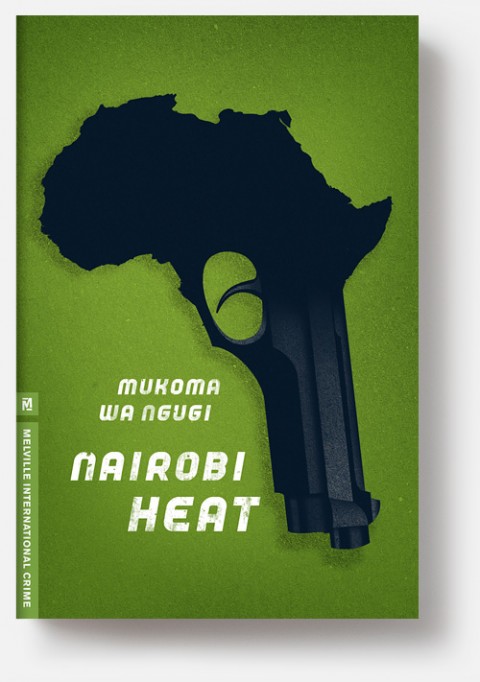
Chisel Away — An interview with designer Christopher Brian King, art director at Melville House, at Slated Magazine:

On a conceptual level, [designing for book covers] actually isn’t much different from designing a logo, for example. After all, a logo has to give you a glimpse into the whole story of a company, so it comes down to the same challenge: how do I chisel away at this big, complicated story until it becomes a single elegant image which explains what the whole thing is about? Where book covers differ is that you have a much larger toolkit to work with—typography, color, illustration photography, production tricks, or anything else. Since it’s so open-ended, the real challenge starts to become figuring out which tool is best to use on any given project.

3 Comments

Edward Gorey

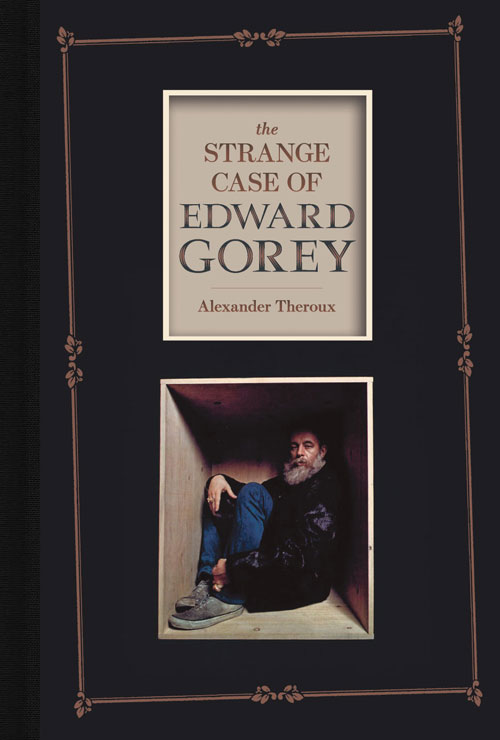
Alexander Theroux, author of The Strange Case of Edward Gorey (recently revised and republished by Fantagraphics), talks to NPR’s Weekend Edition Sunday about the writer and illustrator Edward Gorey, who would have been 86 years old today:

Violence is the essential Gorey ingredient. It is used in his books with such off-hand wit and inevitability that, having become his signature, if it were suddenly missing, you would begin to worry or at least feel you are being fobbed off by work not of the master’s hand.

NPR THE WEEKEND EDITION: THE LIFE OF EDWARD GOREY

Theroux also talks about his peculiar friend with Tom Spurgeon at The Comics Reporter:

I was telling someone the other day, there a division in the 20s and post WWI era, especially growing up in England. I think Gorey inherited this. There were the athletes, the muscular types — on one side of the tennis court, as it were. Then there were these kind of fey, bright young things on the other side of the tennis court. There has always been a kind of mocking, derisive look that they took regarding each other. I think Gorey grew out of that kind of gay interest, that fascination with ’20s movies, ’20s styles; there’s a tradition, I think. He was unhappy in the military and when he was at Harvard he was always in an artsy world. He went to the ballet every night in New York. He was almost a caricature of that Ronald Firbank type of character. He was very fey. He didn’t hide any of that.

Comments closed

Midweek Miscellany

Fantagraphics find a cache of signed, limited-edition bookplates by artists including Dan Clowes, Jaime Hernandez and Gilbert Hernandez.

The Case & Point — A new website showcasing the best in custom type design and lettering curated by Vancouver-based design studio Working Format.

Designer, educator and author Ellen Lupton interviewed at From the Desks Of… (My Q & A with Ellen from 2009 is here).

And finally…

The New Thing — William Gibson, author most recently of Zero History, interviewed at Jack Move Magazine (via the man himself @GreatDismal):

The genuinely new things are really hard to imagine. When you do imagine them, they’re very hard to relay in anything like a sense in which the people who are totally used to them would use them. There’s always this factor in future-tech science fiction where somebody, be it the characters or the narrative voice, is really kind of wowed by future tech. It’s a powerful impulse. You want the reader to get a wowie. But there’s a way in which it’s not naturalistic; it’s not a genuinely naturalistic vision of the future, because that would be one in which people take it utterly for granted.

2 Comments

Jason, Mon Amore

A few years ago when I still worked at Pages, one of the creative/media executives who frequented the bookstore sent his assistant to exchange a copy of comic book by award-winning Norwegian cartoonist Jason that he’d bought from us earlier that day. The book, she said, was faulty. Apparently there were pages missing so the story didn’t make sense and her boss wanted a new copy. She had a receipt so I swapped the book without much thought. It wasn’t until after she’d left and I looked through the returned book that I realised there was nothing wrong with it. The pages were all there, her boss just hadn’t got it. She would be back later for a refund.

In a sense, the confusion was understandable: Jason’s anthropomorphic comics are surreal and require concentration to follow.

In another sense, the dude was simply an idiot because Jason is awesome.

Jason is perhaps the most unique visual stylists working in comics today. Each individual panel is a work of ligne claire pop art: flat, beautifully coloured and amplified for effect.

The deceptively simple stories — often thrillers and off-beat romances — feature anti-heroes, guns, girls, historical figures, b-movie monsters, robots, and aliens. They’re a brilliant mix of silent pictures, film noir, La Nouvelle Vague, classic literature, crime fiction, sci-fi and pulp magazines. There are obvious elements of Hergé, but strange, deadpan, and imbued with ennui and loneliness, Jason’s comics also evoke Hitchcock, Godard, Jarmusch, and Lynch.

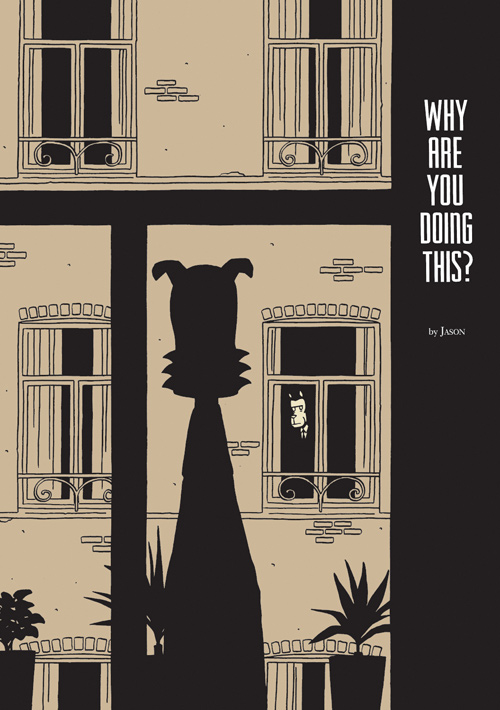
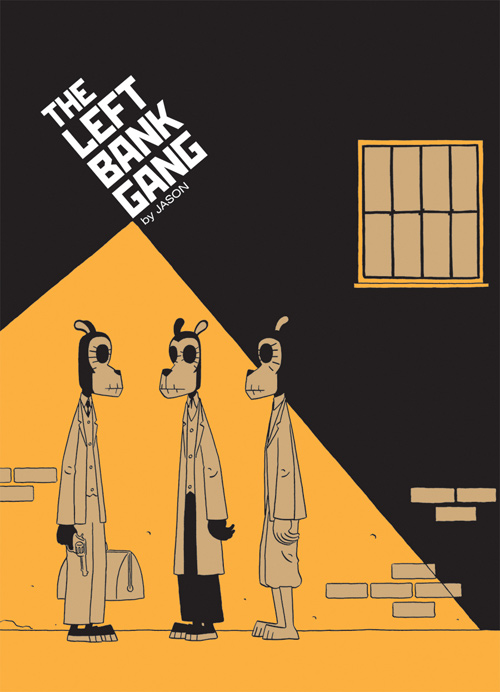
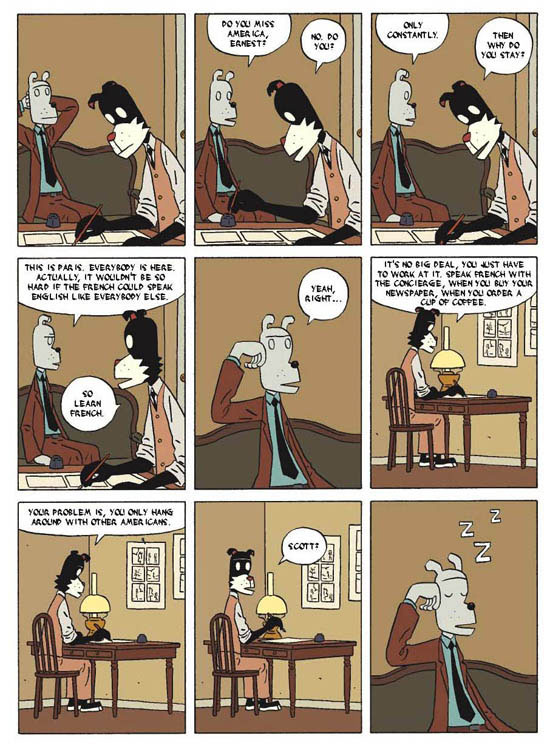
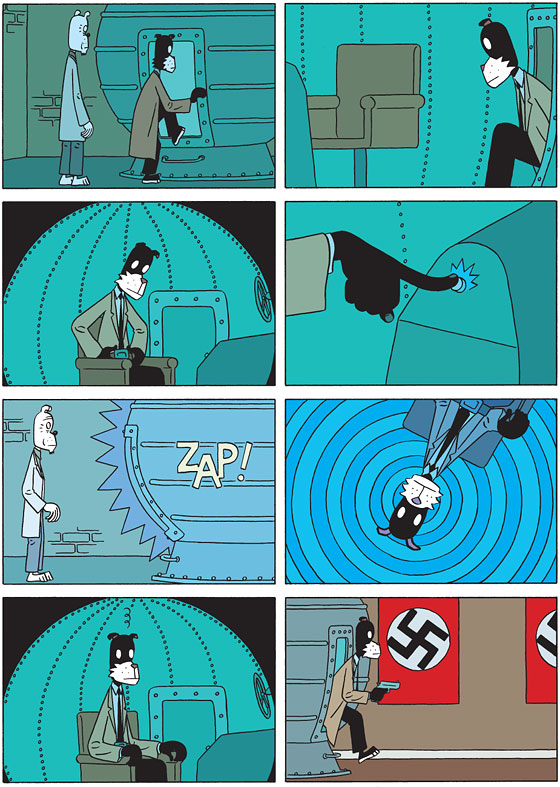
In I Killed Adolf Hitler a hit man goes back in time to assassinate Adolf Hitler with unexpected personal consequences. In The Left Bank Gang Fitzgerald, Hemingway, Pound, and Joyce are graphic novelists planning a heist in 1920’s Paris. In Why Are You Doing This? Alex is framed for the murder of his best-friend.

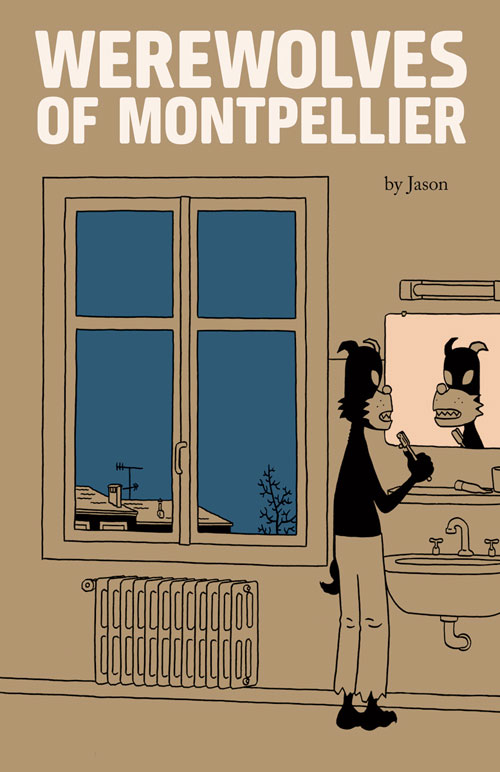
Published in North America by Fantagraphics, Jason’s most recent book, Werewolves of Montpellier, features a thief who disguises himself as a werewolf. A 6 page preview is available on the Fantagraphics blog. If you haven’t checked out Jason’s work already, now’s a great time…

More of Jason’s artwork can be seen on the Fantagraphics’ on Flickr photostream.

6 Comments

What Is All This?

Fantagraphics Art Director Jacob Covey‘s first foray into designing for prose fiction is this cover for a 600-page collection of short stories by Stephen Dixon, What Is All This?

Incidently, Jacob also did a nice job colouring Gilbert Hernandez‘s cover art for Kristen Hersh‘s new memoir, Rat Girl. The design is by Jaya Miceli at Penguin Books:

You can read my interview with Mr. Covey here.

I colored Gilbert Hernandez’s cover art to Kristen Hersh’s new memoir, Rat Girl. Fairly easy job but it gives me an excuse to plug the book and the design work of Jaya Miceli over at Penguin Books.

2 Comments

Something for the Weekend

David Drummond’s Parker Series for University of Chicago Press.

“a little bit Warhol, a little bit Factory Records” —  Christian Schwartz explains why he started type foundry Commercial Type at I Love Typography:

It’s much easier to be an “armchair quarterback,” second-guessing everyone else’s seemingly questionable decisions regarding everything… than it is to deal with the actual reality of budgets, technology, and timelines. Theorizing about how and why things work is all well and good, but putting our ideas into practice is of course the real test…

Typography and JudaicaSteven Heller interviews book designer and typographer Scott-Martin Kosofsky. Fascinating stuff:

It’s the best of times and the worst of times, but I have a feeling that people have always said that… In regard to print, I think we’re at a great moment, with access to mature technology and aesthetics… There’s no excuse for anything looking less than great. But books (and print in general) have lost their pride of place. Book publishers, a group nearly always behind the curve, have failed to grasp that their online counterparts spend a lot of time and money concentrating on User Experience, while they remain unfamiliar with the concept. It wasn’t always that way, but when the professionalism and discipline that was demanded by metal type fell away, things got worse and worse, especially typographically.

Punk — An interview with Jaime Hernandez about Love and Rockets and the recently published The Art of Jaime Hernandez at NYC Graphic:

“That’s how Love and Rockets started: we were just cocky and didn’t know we could fail. We went ahead and published the first one ourselves and didn’t care what the outcome would be, we just wanted to be printed. Hopefully we could sell it and make money, but there was no one to tell us not to. That was the punk part of it. The more we got good response, the more we kept doing it.”

And finally…

The Pollak Coffee Table Book seen at UnderConsideration’s FPO. Breathtakingly beautiful.

Comments closed