Skip to content

Tag: exhibition

Moholy-Nagy: Future Present

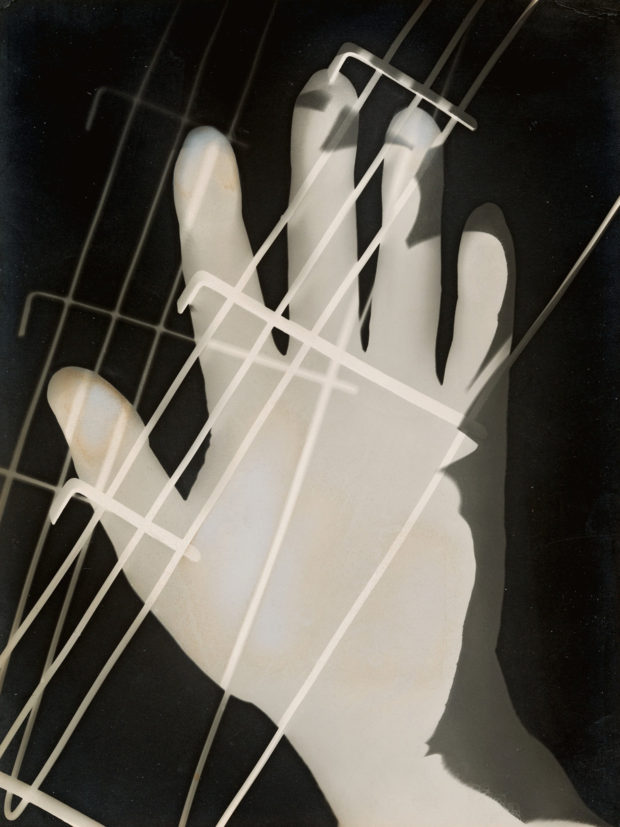
“Photogram” (1926) by Lazlo Moholy-Nagy.
“Photogram” (1926) by Lazlo Moholy-Nagy

The New York Times on a new exhibition of work by Hungarian artist and designer Laszlo Moholy-Nagy at the Guggenheim in New York:

The first large Moholy-Nagy exhibition in this country in over 50 years may also be, its organizers say, the largest anywhere. It packs around 300 works into Frank Lloyd Wright’s great spiral — perhaps a record itself. They represent some dozen mediums including painting and sculpture, film and projection, works on paper as well as graphic, set and exhibition design and several forms of photography.

The show provides a bracing picture of both the extent and the unity of Moholy-Nagy’s art as it moves up the ramp, superbly styled for the occasion by Kelly Cullinan, the museum’s senior exhibition designer. Her scheme separates Moholy-Nagy’s achievement into separate strands and then braids them together fluidly. The abstract paintings and sculptures dominate the museum’s signature bays; most films are displayed in small alcoves between the ramps. Moholy-Nagy’s extensive writings and graphic design are displayed on each level in vitrines, whose bright rectangular lids manage to evoke the colorful trapezoids in his paintings. And his complex involvement with photography is played out on free-standing partitions, enabling close study of the interplay of documentary, photomontage and camera-less photograms — a term he invented — sometimes made using his own sculpture. Certain forms and motifs reappear in different mediums, and the give and take between photography and painting is one of the show’s driving forces.

It sounds like a must-see.

Moholy-Nagy: Future Present is at the Guggenheim until September 7. The exhibition is also travelling to Chicago and Los Angeles.

Comments closed
Modernity as Catastrophe

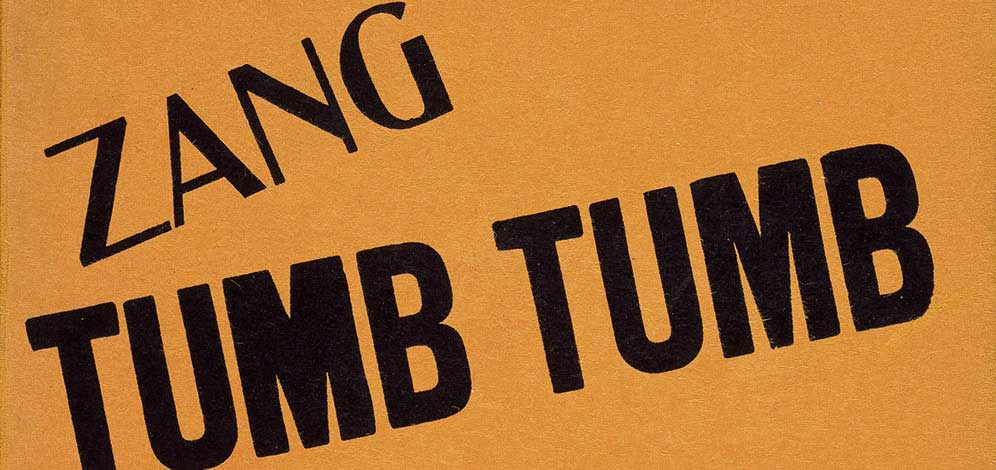
futurism_words_marinetti_zang_tumb_tumb

At the London Review of BooksHal Foster reviews the exhibition of Italian Futurism currently at the Guggenheim in New York:

Futurism wasn’t all bravado; it did have an aesthetic (or anti-aesthetic) of its own, which was to modernise the arts through a mimicry of the effects of new media, such as the adaptation of chronophotography and cinema to painting, photography and sculpture, or the application of the phonograph to musical performance. More ambitiously, the futurists sought to refashion the human sensorium along the lines of these new techniques of perception, and to this end they updated the ideas of synaesthesia, or the fusion of the senses, and kinaesthesia, or the mixing of bodies in motion and at rest. At the same time (and this is just one of many contradictions), the futurists were conservative stylistically; for all their nationalist pride, they relied on French sources, especially the divisionist brushstroke of neo-impressionist painting, which they adapted to themes of the modern city. Thus in Street Light (1909) Giacomo Balla offers the streetlamp as an improvement on the moon: both kinds of illumination are represented as waves of energy, but the artificial light dominates the natural one. So too in The City Rises (1910-11) Boccioni shows us the metropolis as a firestorm of colour greater than any in nature, where construction is difficult to distinguish from destruction; here the futurists thrill to modernity as catastrophe.

Comments closed

TateShots: Bruce Davidson’s London

Bruce Davidson talks to TateShots about his photographs of London in the early Sixties, a series he undertook after photographing teenage gangs in Brooklyn:

The photographs are on display as part of the Another London exhibition at Tate Britain, until September 16th.

Comments closed

Midweek Miscellany

The Creative Review previews an exhibition of the graphic design of the Eames opening at the PM Gallery in London next month.

Gravity — A profile of playwright Tom Stoppard, at Intelligent Life:

He gets the old books he needs from the London Library, the open-stack treasure-house in St James’s Square. It was founded by Thomas Carlyle and others in 1841, and Stoppard has been its energetic president since 2005. “I get a big kick out of the very existence of the London Library. I’d say it was an ornament to society, only it is more than an ornament. The centre of gravity of our morality is our literary culture.”

Special — China Miéville’s keynote speech at the 2012 Edinburgh World Writers’ conference on the future of the novel:

The blurring of boundaries between writers, books, and readers, self-publishing, the fanfication of fiction, doesn’t mean some people won’t be better than others at the whole writing thing, or unable to pay their rent that way – it should, though, undermine that patina of specialness. Most of us aren’t that special, and the underlining of that is a good thing, the start of a great future. In which we can maybe focus more on the books. Which might even rarely be special.

And finally…

Girls — Writing at CNN’s Geek Out! blog, Danica Davidson looks at manga’s popularity with women:

“I honestly believe women are just as interested in the comic format as men no matter the country of origin,” said Robin Brenner… author of Understanding Manga and Anime.

“Women are just are more likely to pick up titles that acknowledge or seek them as an audience,” she said.  Japan has been pursuing women and girls as an audience in earnest since the 1970s, whereas we here in the States left that audience behind in the 1970s”

Comments closed

All That Remains

From its abstract roots in Cubism to the political and counter culture movements of Dada and Punk, collage has always been a product of its environment. With the rise of 24 hour media cycles, social networks and search engines, contemporary culture has effectively rendered print media obsolete, creating a virtual boom in discarded paper ephemera for collage artists to examine and reinvent. Through these discarded remnants collage artists have become the archivists and activists of this post modern age, paralleling the frenetic pace in which we live while exposing the voyeuristic and often disjointed nature of popular culture.

If you’re going to be in New York at the end of this month, you might want to check out All That Remains, an exhibition of international collage at the Ugly Art Room in Brooklyn. Among the exhibitors is one John Gall, art director at Vintage/Anchor Books. You can read my interview with John about his collage here.

UGLY ART ROOM PRESENTS: ALL THAT REMAINS

October 21st – November 19th, 2011
Ugly Art Room (via Picture Farm)
338 Wythe Ave, Brooklyn, NY 11211

Opening Reception: 7-9pm, Friday, October 21st, 2011

Comments closed

Reverting to Type

Curated by Graham Bignell & Richard Ardagh, Reverting to Type at the Standpoint Gallery in London will showcase the work of twenty contemporary letterpress practitioners from around the world:

Reverting To Type runs from December 10th–24th and continues January 4th–22nd, 2011. The Creative Review has more on the exhibition here.

Comments closed