Skip to content

Tag: essays

Geoff Dyer on Photographs and Essays

Geoff Dyer, whose new book The Street Philosophy of Gary Winogrand features personal essays inspired by Winogrand photographs, considers other books that combine images and essays in The New York Times:

John Szarkowski was for many years the head of photography at the Museum of Modern Art in New York. In 2000, in the twilight of a provocative, highly influential career, he published “Atget,” a selection of 100 images by the French photographer Eugène Atget, each reproduced on the recto page with an accompanying caption-essay on the facing verso page. With Szarkowski as the best kind of guide — one whose itinerary allows interludes of undisturbed contemplation — we wind our way through the haunts of old Paris, emerging from time-shuttered streets into the open skies of the surrounding countryside. Szarkowski had always been a distinctive stylist, but this format enabled him to give free rein to his talents as a writer, which were usually securely tethered by curatorial obligation. He also drew confidence, I think, from an earlier assay at the same form, “Looking at Photographs” (1973), in which he used a single picture by each of the most important photographers in the museum’s holdings to compile a radically synecdochic survey of the medium’s history. The obligation to cover so much ground, to balance what he had to say about so many major figures on such slender plinths, rather limited Szarkowski’s range of literary and thematic movement. With Atget — whose photographs, appropriately enough, were originally offered as “Documents for Artists” — the combination of abundance of subject matter and limited space encouraged a kind of tight flourishing or contained extravagance. Szarkowski’s knowledge of Atget’s work was so extensive that he had scarcely even to think about what he knew. And so the photographs serve as starting-off points for reflections on all sorts of things, including how photography has changed our view of the world: “I do not think that empty chairs meant the same thing before photography as they mean to us now.”

You can find reviews of Dyer’s Winogrand book in the New York Times and The Guardian.

Comments closed
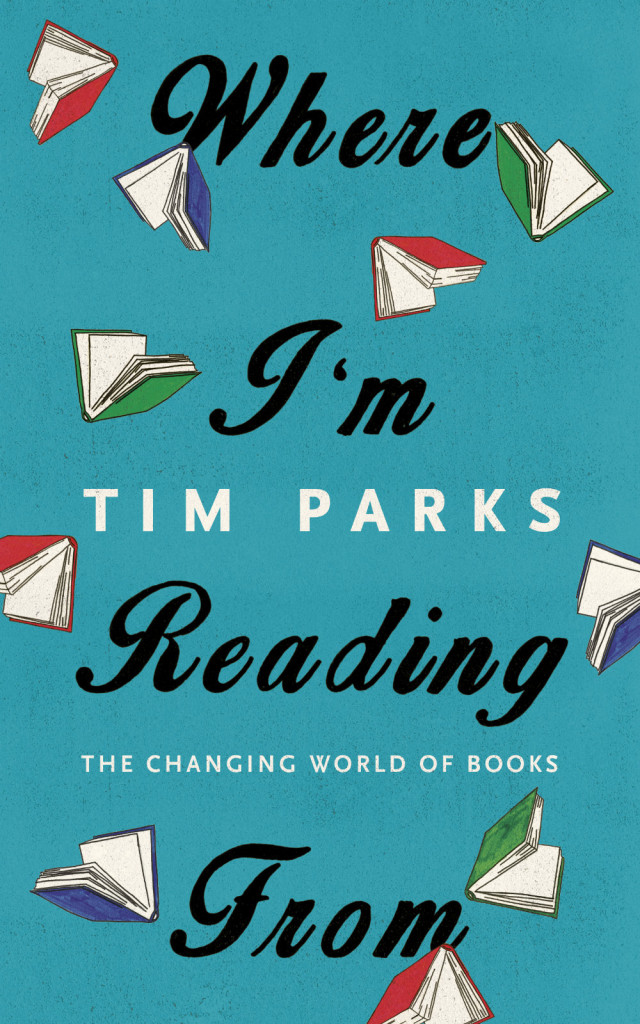
Tim Parks on Where I’m Reading From

Where I'm Reading From (1)

At BOMB Magazine, writer Tim Park discusses his new book Where I’m Reading From, a collection of his essays from the NYRB Blog, with Scott Esposito (co-author of The End of Oulipo):

In a way, this book is an autobiography of someone brought up with a very particular relation to books, in a religious family, in an English literary tradition, who on becoming an adult, for private personal reasons, set himself literary goals that were gradually revealed as spurious. Also, it’s about a person from the literary center—English, London— who has spent more than thirty years in another country, Italy, that is out of the literary mainstream. And a writer who also, by chance, became a translator and went on to teach translation. My life has been a long process of awakening to the reality, the changing reality, of the contemporary book world, which is a million miles from the naïve vision I had when I started writing books at twenty-two. Since it is in the publishers’ interests, and indeed the University’s, to sustain a false picture of what the book world is like and what the contemporary experience of books amounts to, my articles were a response to this, and an attempt to get my own head straight about what I’m really doing and the environment I move in. One is seeking at last to be unblinkered about it all.

And, if you missed it, Park reviewed What We See When Read by designer Peter Mendelsund on the NYRB Blog earlier this month:

One of the pleasures of his book is his honesty and perplexity at the discovery that every account he offers of the process of visualization very quickly falls apart under pressure. We do not really “see” characters such as Anna Karenina or Captain Ahab, he concludes, or indeed the places described in novels, and insofar as we do perhaps see or glimpse them, what we are seeing is something we have imagined, not what the author saw. Even when there are illustrations, as in many nineteenth-century novels, they only impose their view of the characters very briefly. A couple of pages later they have become as fluid and vague as so much of visual memory. At one point Mendelsund posits the idea that perhaps we read in order not to be oppressed by the visual, in order not to see.

(Pictured above is the cover of the UK edition, published by Harvill Secker in December last year, of Where I’m Reading From designed by James Paul Jones. The US edition, which has a more utilitarian cover, was just published by New York Review of Books)

Comments closed

Something for the Weekend

Decaying Rabelaisians — An interesting look at the current state of French literature by Florence Uniacke for The Spectator:

Will Hobson, former contributing editor at Granta, says that fiction, philosophy, memoir and non-fiction (amongst other genres) are not clearly defined in France like they are in the UK, and this ‘super-genre’ doesn’t tend to sit well with English readers. The French philosophise, intellectualise, internalise, characterise and analyse; and in the mean time the storyline forgets to materialise. It’s not hard to believe that an English translation of The Roving Shadows by Pascal Guignard, winner of the Prix Goncourt in 2002, which was described as ‘a sequence of beginnings of novels, stories, landscapes and autobiographical fragments’, sold hardly any copies.

Lowered Expectations — Philip Lopate on essays and doubt, for the New York Times:

I like the freedom that comes with lowered expectations. In the area of literary nonfiction, memoirs attract much more attention than essay collections, which are published in a modest, quasi-invisible manner, in keeping with anticipated lower sales. But despite periodic warnings of the essay’s demise, the stuff does continue to be published; if anything, the essay has experienced a slight resurgence of late. I wonder if that may be because it is attuned to the current mood, speaks to the present moment. At bottom, we are deeply unsure and divided, and the essay feasts on doubt.

See also: Adam Kirsch on the ‘new essayists’ for The New Republic (which only reinforces my belief that I am the only person in the known world who was ambivalent about Pulphead and hasn’t the slightest interest in How Should A Person Be)

The Dream Book of Blank Pages — Andrew Gallix on unread (and unreadable) books for The Guardian:

There was a time when a learned fellow (literally, a Renaissance man) could read all the major extant works published in the western world. Information overload soon put paid to that. Since there is “no end” to “making many books” – as the Old Testament book Ecclesiastes prophesied, anticipating our digital age – the realm of the unread has spread like a spilt bottle of correction fluid. The librarian in Robert Musil’s The Man Without Qualities only scans titles and tables of contents: his library symbolises the impossibility of reading everything today. The proliferation of lists of novels that you must, allegedly, have perused in your lifetime, reflects this problem while compounding it. On a recent visit to a high street bookshop, I ogled a well-stacked display table devoted to “great” novels “you always meant to read”. We measure out our lives with unread books, as well as coffee spoons.

And finally…

A wonderful post by Charles Simic on Aperture Magazine, for the NYRB Blog:

In one of the older issues, Minor White had an essay called “What is Meant by ‘Reading’ Photographs” that made a big impression on me. He writes in it about hearing photographers often say that if they could write they would not take pictures. With me, I realized, it was the other way around. If I could take pictures, I would not write poems—or at least, this is what I thought every time I fell in love with some photograph in the office, in many cases with one that I had already seen, but somehow, to my surprise, failed to properly notice before. There is a wonderful moment when we realize that the picture we’ve been looking at for a long time has become a part of us as much as some childhood memory or some dream we once had. The attentive eye makes the world interesting. A good photograph, like a good poem, is a self-contained little universe inexhaustible to scrutiny.

Comments closed

Susan Sontag on Writers and Company

Eleanor Wachtel’s conversation with the late American writer and critic Susan Sontag, originally recorded in 2000, was recently rebroadcast by CBC Radio’s Writers and Company:

CBC Radio Writers and Company: Susan Sontag mp3

Comments closed

Rousseau Deep, Montaigne High

Anthony Gottlieb writes on the renewed interest in 16th Century French essayist Michel de Montaigne for The New York Times:

Like Socrates, Montaigne claims that what he knows best is the fact that he does not know anything much. To undermine common beliefs and attitudes, Montaigne draws on tales of other times and places, on his own observations and on a barrage of arguments in the ancient Pyrrhonian skeptical tradition, which encouraged the suspension of judgment as a middle way between dogmatic assertion and equally dogmatic denial. Montaigne does often state his considered view, but rarely without suggesting, explicitly or otherwise, that maybe he is wrong. In this regard, his writing is far removed from that of the most popular bloggers and columnists, who are usually sure that they are right.

And, funnily enough, Sarah Bakewell author of How To Live: Or, A Life of Montaigne in One Question and Twenty Attempts at an Answer — one of the books mentioned by Gottlieb — recently spoke to Eleanor Wachtel about Montaigne for CBC  Radio’s Writers & Company:

CBC RADIO WRITERS & Co. WITH SARAH BAKEWELL

The cover of the US edition of How To Live, published by Other Press, is by Mr. John Gall (pictured above). But you knew that already of course….

Comments closed