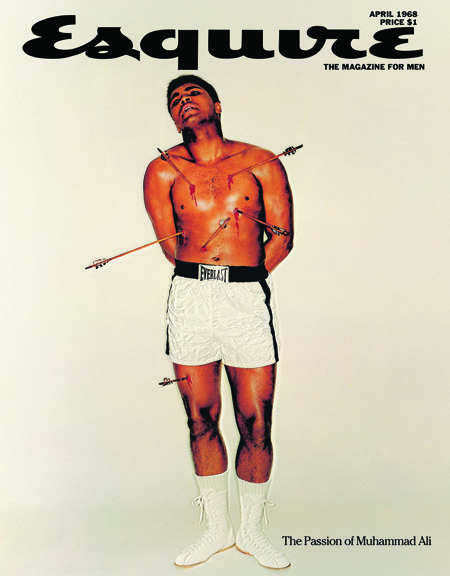
Like Dieter Rams, George Lois seems to be a recurrent theme here and I was wondering why that was. Sure, he has a new book out (published by Assouline), but why is he still relevant? Thinking about this, I kept coming back to his April 1968 Muhammad Ali cover for Esquire.
 In 1964 Muhammad Ali, the heavyweight champion of the world, had controversially joined The Nation of Islam and changed his name from Cassius Clay. Three years later he refused to be drafted into the U.S. army because of his religious beliefs and opposition to the Vietnam War. He was stripped of his world title and had his professional boxing license suspended.
At a time of racial tension in the US (there were race riots and civil rights protests across the country in 1967 as well as protests against the Vietnam war) Ali was a successful, outspoken, controversial and self-confident black man refusing to fight for his country. He was reviled and, one suspects, feared by white conservative America.
By 1968, Ali was on bail awaiting his appeal to the Supreme Court. He was still unable to fight and the magazine was planning a story on his exile from the ring.
Putting the boxer on the cover was certainly controversial. But Lois did not make the fighter ‘respectable’ (one doubts the thought even entered his head). Instead, in a photograph taken by Carl Fischer, he presented Ali bare-chested and pierced with arrows.
It is a striking, bloody, and shocking image — especially given the context.
 Yet it is also witty, irreverent and surprising: a complex “big idea” rendered with beautiful simplicity.
Lois posed Ali as Saint Sebastian, a 3rd Century Christian soldier and martyr who was bound to a post and shot full of arrows for his beliefs (the arrows, incidentally, didn’t kill him — a subsequent beating took care of that).
The reference was a postcard of a 15th Century painting by attributed to Castagno in the Metropolitan Museum in New York (the Met have since re-attributed the painting to Francesco Botticini).
Like so many of Lois’ other covers for Esquire — this is unquestionably an attack on the establishment. But ‘Ali as St. Sebastian’ is also just about the most elegant and incisive “fuck you” imaginable. It is not the shocking irreverence that makes it resonate — it’s the lacerating wit.
From race to sex to Vietnam — this stuff mattered to Lois. And that never, ever gets old.
Links:
George Lois
George Lois AIGA Medalist
The Passion of George Lois, Design Observer
George Lois 12 Favourite Classic Esquire Covers, New York Magazine
George Lois, Wikipedia
Trailer for the documentary Art & Copy featuring a movie-stealing George Lois (just guess which one he is):
1 Comment