A few weeks ago, I mentioned Stuart Wilson’s unsettling redesigns for the Picador (UK) editions of the Patrick Melrose novels by Edward St. Aubyn. Here’s the full the set:


Books, Design and Culture
A few weeks ago, I mentioned Stuart Wilson’s unsettling redesigns for the Picador (UK) editions of the Patrick Melrose novels by Edward St. Aubyn. Here’s the full the set:

In a fascinating conversation, Eleanor Wachtel talks to Edward St. Aubyn about his Patrick Melrose novels on CBC Radio’s Writers and Company:
CBC Radio Writers & Company: Edward St. Aubyn mp3
KCRW’s Bookworm also recently broadcast a two-part interview with St. Aubyn about the books.
Part One:
KCRW Bookworm: Edward St. Aubyn Part One mp3
Part Two:
KCRW Bookworm: Edward St. Aubyn Part Two mp3
Full disclosure: The collected edition of the first four Patrick Melrose novels has just been published in the US by Picador Books who are distributed in Canada by my employer Raincoast Books. At Last, the latest Patrick Melrose novel is published separately by Farrah, Strauss & Giroux who are distributed in Canada by Douglas & McIntyre (not my employer).
Comments closed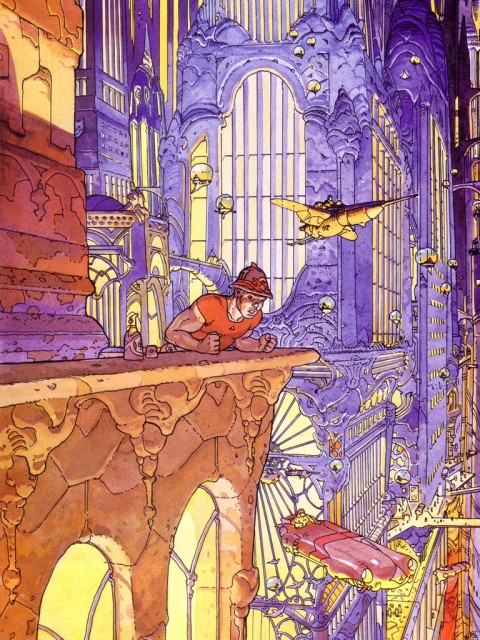
Tim Maughan on the influence of the Jean Giraud on science fiction for Tor.com:
[The] combination of neon-lit noir streets, cramped towering city blocks, airborne traffic jams and scruffy characters seems almost a cliche today. But this was the first time anything like this had been drawn; and the first time science fiction had embraced the visual chaos of realistic urban environments. And the groundbreaking work is not just there in the architecture and mechanical designs; it’s apparent in the fashions and clothes of the city’s inhabitants. Although fantastic, exaggerated and other-worldy the city of The Long Tomorrow comes alive from the page because it feels so real, so layered and built — it is the urban paradise and nightmare of every industrial city from Tokyo to London.
The Catharsis of Exhaustion — Tim Parks on when to finish a book for the NYRB:
Other writers deploy what I would call a catharsis of exhaustion: their books present themselves as rich and extremely taxing experiences that simply come to an end at some point where writer, reader and indeed characters, all feel they’ve had enough… [These] writers it seems to me, by suggesting that beyond a certain point a book might end anywhere, legitimize the notion that the reader may choose for him or herself, without detracting anything from the experience, where to bow out.
Detachment — Edward St. Aubyn, Patrick Melrose Novels and At Last, profiled in the New York Times:
“[There] is something morally condescending about forgiveness… Detachment is what interests me, seeing how people couldn’t have been any other way, how they were the product of forces that they had no control over… I was in the downstream of my father’s unhappiness, but it must have been hell to be him.”
And finally…
The Beat Hotel — A new documentary about the cheap no-name hotel at 9 rue Git le Coeur in Paris that harboured the likes of Allen Ginsberg and William Burroughs:
1 Comment
Blown Covers — The New Yorker art editor Françoise Mouly has a Tumblr (pictured above: “Eustace at a Stoplight—Right?,” by David Urban)
Spanking — Charles McGrath remembers the late Barney Rosset in the New York Times:
Mr. Rosset was far from a highbrow. Sometimes he signed up books without having read them. He determined to publish “The Autobiography of Malcolm X,” for example, while riding in a cab and hearing on the radio that other publishers had turned it down. And he was proud of publishing a profitable line of Victorian spanking pornography. To a considerable extent the dirty books made the arty ones possible, and Mr. Rosset wasn’t the least abashed about it.
See also: WNYC has reposted two archive interviews with Rosset from 1995 and 2008, and John Gall has posted a collection of links to reminiscences about Rosset on his blog Spine Out.
Form and Fortune — A fascinating review of Walter Isaacson’s biography of Steve Jobs by Evgeny Morozov, author of The Net Delusion, in The New Republic which discusses Apple’s relation to the Bauhaus and Braun:
The design philosophy of Dieter Rams, Braun’s legendary designer, has shaped the feel and the look of Apple’s latest products more than any other body of ideas. Since joining Braun in 1955, Rams—who likes to describe his approach to design as “less, but better”—began collaborating with the faculty at the Ulm School of Design, which tried to revive the creative spirit of Bauhaus with a modicum of cybernetics and systems theory. Eventually Rams produced his own manifesto for what good design should accomplish. His “ten principles of good design” encouraged budding designers to embrace innovation and make products that were useful but environmentally friendly, thorough but simple, easy to understand but long-lasting, honest but unobtrusive. Rams wanted his products to be like English butlers: always available, but invisible and discreet.
See also: Maureen Tkacik’s on Steve Jobs and Isaacson’s biography at Reuters.
And lastly…
James Wood reviews Edward St. Aubyn’s Patrick Melrose novels for The New Yorker:
Comments closedPatrick Melrose, the protagonist of what is now a quintet of novels devoted to the Melrose family, is the scion of a wealthy dynasty almost as monstrous as the dodgier Roman emperors; he has spent much of his adult life trying to kill himself with drugs and booze. St. Aubyn’s novels have an aristocratic atmosphere of tart horror, the hideousness of the material contained by a powerfully aphoristic, lucid prose style. In good and bad ways, his fiction offers a kind of deadly gossip, and feeds the reader’s curiosity like one of the mortal morsels offered up by Tacitus or Plutarch in their chatty histories.

I was out west for the Raincoast Books spring 2012 sales conference last week. Sadly I didn’t get to see much of Vancouver or catch up with half the people I meant to, but I did get to hear about a lot of great new books including one about building (and losing) an android Philip K. Dick. It’s non-fiction. Thanks Henry Holt!

Henry Holt also have a new novel by Herta Mueller, winner of the Nobel Prize in 2009, called The Hunger Angel, and the latest from John Banville’s alter-ego Benjamin Black, Vengeance.
Picador are publishing a collected edition of Edward St. Aubyn’s Patrick Melrose trilogy in January — the first time they’ve all been properly available in the US I believe — to coincide with the US edition of his new book At Last (Farrar, Strauss & Giroux). They also have a collection of essays by Siri Hustvedt, Living, Thinking, Looking.

While there was nothing on the list quite of the magnitude of this season’s long-awaited Saul Bass: A Life in Film and Design, there are a few art and design titles that caught my eye. Princeton Architectural Press are publishing Woodcut, a book of beautiful prints by artist Bryan Nash Gill (you have surely have seen his work even if you don’t recognise the name immediately) and Up on the Roof, a collection of photographs by Alex MacLean of New York’s hidden rooftop spaces. They are also publishing a long overdue paperback edition of Michael Bierut’s Seventy-Nine Short Essays on Design, and a paperback edition of the beautiful, if overlooked, Typography Sketchbooks by Steven Heller and Lita Talarico. Lawrence King are publishing a new book on the history of picture books, Children’s Picturebooks: The Art of Visual Storytelling by Martin Salisbury and Morag Styles, and a new edition of The End of Print by David Carson.

On the comics side, Drawn & Quarterly are publishing Jerusalem: Chronicle from the Holy City, the latest travelogue from Guy Delisle who previous books include The Burma Chronicles, Pyongyang and Shenzhen. D+Q are also publishing a new edition of Chester Brown’s controversial, scatological and long out-of-print comic Ed The Happy Clown.
I’m also looking forward to finally seeing more of Baby’s in Black: Astrid Kirchherr, Stuart Sutcliffe, and The Beatles in Hamburg by Arne Bellstorf which is being published by First Second in April (I just wish they’d gone in a different direction with the typography on the cover — the German and UK edition’s have lovely swooping hand-drawn lettering).

And lastly — because I am big nerd and recently finished his earlier book Batman Unmasked — I’m excited about Will Brooker’s Hunting the Dark Knight: Twenty-First Century Batman, which is being published by I. B. Tauris in July.
Now, back to the Toronto grindstone…
Comments closed
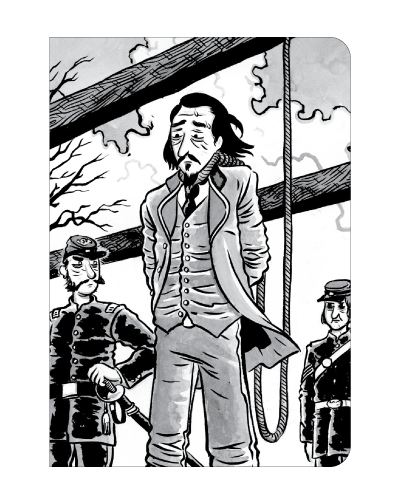
Good Ink, a new imprint of Portland’s Scout Books, have announced a new collection called American Shorts. Each pocket-sized volume in the series pairs a contemporary illustrator with a classic American short story. The first releases are An Occurrence at Owl Creek Bridge by Ambrose Bierce, illustrated by François Vigneault; Rip Van Winkle by Washington Irving, illustrated by Bwana Spoons; and The Jelly Bean by F. Scott Fitzgerald, illustrated by Vanessa Davis. (Pictured below, an illustration by François Vigneault for An Occurrence at Owl Creek Bridge).
Misery Loves Company — Edward St Aubyn, whose most recent novel At Last was released in May, interviewed in The Guardian:
The curious thing about St Aubyn’s novels is the way they counterpoint personal suffering and social comedy: it is misery lit recast by Evelyn Waugh. The upper class into which he was born and which failed to protect him is mercilessly skewered, including Princess Margaret, who does a brilliant comic turn in Some Hope, the third volume in the trilogy. “For some reason I can’t really analyse, I alternate between those two things,” St Aubyn says, “and I feel that to stay with just one of them would somehow be false. But the rhythm is completely instinctive. I’ve just had enough of the anguish, so I move on.”
Also in The Guardian: Anthony Clavane, author of Promised Land: A Northern Love Story, selects 10 novels about football (or soccer if you must).
And because it’s Friday (and an otherwise light news day), here’s Yowie and the Magpie, a great piece of animated storytelling made for Film London / UKFC Pulse Digital Shorts:
Comments closed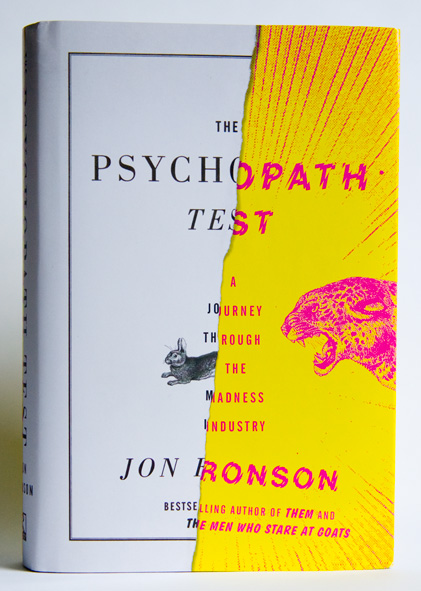
Half Crazy — Matt Dorfman on his great book cover design for The Psychopath Test by Jon Ronson, published by Riverhead Books:
Riverhead did not skimp on the production touches for this one. They sprung for a combination gritty matte finish (which covers the white paper portions of the jacket) and a shiny gloss for the yellow/magenta “crazy” half, thereby giving your sense of touch a noticeable edge if you find yourself blindly scanning your shelf for this book in a dark room (which I have done).
The Intimate Orwell — Simon Leys reviews Diaries by George Orwell, edited by Peter Davison, and George Orwell: A Life in Letters also edited and annotated by Davison, for the NYRB:
From the very start, literature was always Orwell’s first concern. This is constantly reflected in his correspondence: since early childhood “I always knew I wanted to write.” This statement is repeated in various forms, all through the years, till the end. But it took him a long time (and incredibly hard work) to discover what to write and how to write it. (His first literary attempt was a long poem, eventually discarded.) Writing novels became his dominant passion—and an accursed ordeal: “writing a novel is agony.” He finally concluded (some would say accurately), “I am not a real novelist.” And yet shortly before he died he was still excitedly announcing to his friend and publisher Fredric Warburg, “I have a stunning idea for a very short novel.”
Investigative Self-Repair — Author James Lasdun (It’s Beginning to Hurt) reviews Edward St. Aubyn’s latest semi-autobiographical Patrick Melrose novel At Last for The Guardian:
This act of investigative self-repair has all along been the underlying project of these extraordinary novels. It is the source of their urgent emotional intensity, and the determining principle of their construction. Not much gets into these books that doesn’t bear directly on Patrick’s predicament. Exposition is kept to a minimum; there are few descriptive passages, no digressions. For all their brilliant social satire, they are closer to the tight, ritualistic poetic drama of another era than the expansive comic fiction of our own.
And finally…

The General Specialist — Designer, illustrator, and letterer Jessica Hische talks to Method & Craft:
Comments closedI love learning about new things whether or not they directly connect to how I earn a living and I think that this desire to pay attention to related industries is one of the reasons why I’m a figure in the design community. It’s by learning about many things that you’re able to understand specialization—that design is broken into countless micro-industries. If you don’t understand the differences between them (or acknowledge that they exist), there is no way for you to find your own specialized niche with in it.
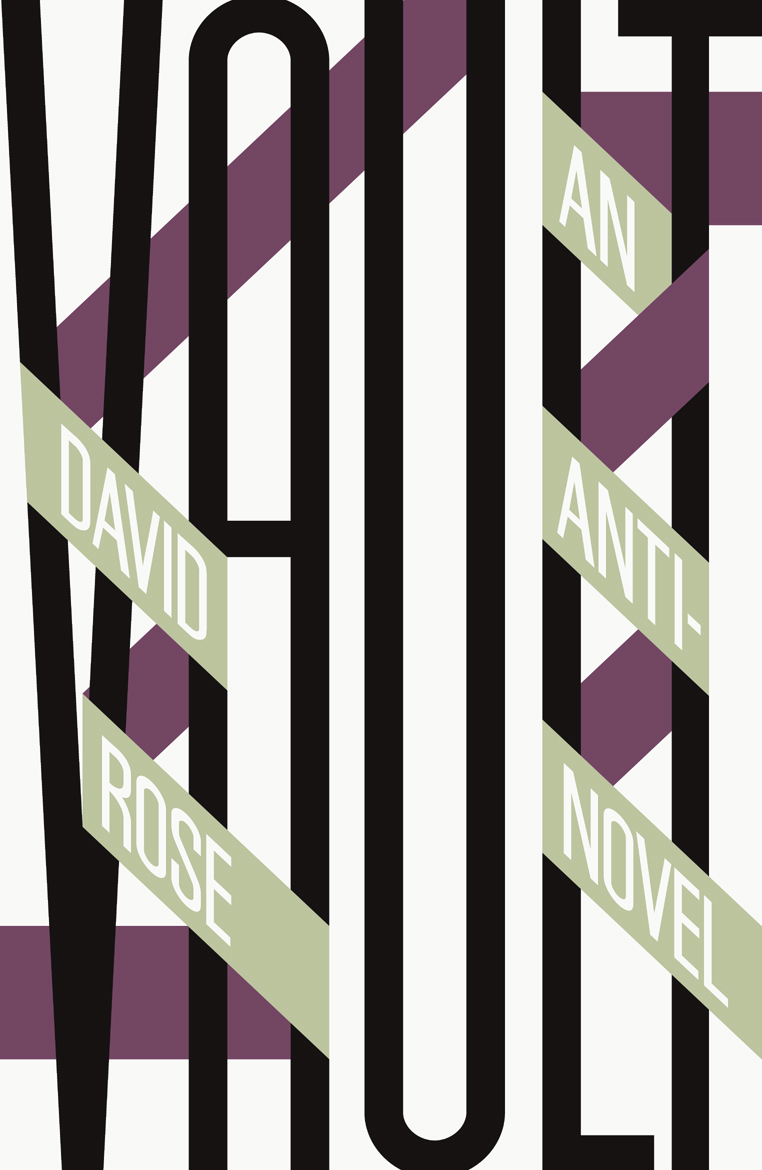
A distinctively typographic cover by David Pearson for Vault by David Rose, new from Salt Publishing.
Giving Up Irony — John Self reviews Edward St. Aubyn’s At Last:
The author’s background, like Patrick’s, is of inherited wealth; perhaps it is this which enables him to treat his characters mockingly and sympathetically at the same time. His brittle, witty prose evokes comparisons with Evelyn Waugh, whose snobbish attraction to the upper classes, looking in on them from without, contrasts with St Aubyn’s cool-eyed appraisal. The phrase “a handful of dust”, quietly slipped into At Last, could be an acknowledgement of the similarities and contrasts.
Patrick is like his creator, not just in his background, but in his stylistic weaknesses:
“It’s the hardest addiction of all. Forget heroin. Just try giving up irony, that deep down need to mean two things at once, to be in two places at once, not to be there for the catastrophe of a fixed meaning.”
The Architecture of the Secret Lair — Mark Lamster for Design Observer:
The Bin Laden compound makes an interesting contrast with the secret modern lairs created for Bond villains by the legendary production designer Ken Adam. These have routinely been described as unrealistic, insofar as they could never be built without drawing attention. It’s curious now, in retrospect, to think that it was fear that kept the local population from Dr. No’s island hideaway (which was just off British and American territory). Though Bond films make us think of visual extravagance, the most visually arresting set from the film was the rather raw interrogation room, with its cross-beam, ocular ceiling. What was in Osama’s basement?
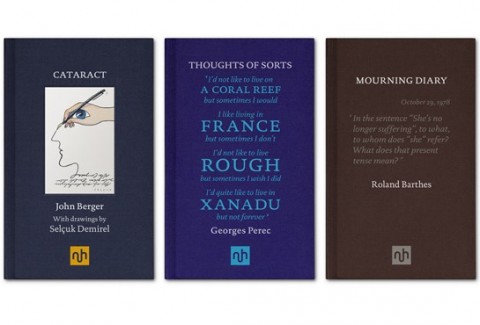 Notting Hill Editions, a new publishing imprint devoted to the essay, launches this month with books by from John Berger, Georges Perec and Roland Barthes among others. The typographic covers were designed by Garvin Hirst at Berlin-based design consultancy Flok.
And finally…
The Burden of Entertainment — Woody Allen discusses five books that still resonate with him:
The Catcher in the Rye has always had special meaning for me because I read it when I was young – eighteen or so. It resonated with my fantasies about Manhattan, the Upper East Side and New York City in general.
It was such a relief from the other books I was reading at the time, which all had a quality of homework to them. For me, reading Middlemarch or Sentimental Education was work, whereas reading The Catcher in the Rye was pure pleasure. The burden of entertainment is on the author. Salinger fulfils that obligation from the first sentence on.
Reading and pleasure didn’t go together for me when I was younger. Reading was something you did for school, something you did for obligation, something you did if you wanted to take out a certain kind of woman. It wasn’t something I did for fun. But Catcher in the Rye was different. It was amusing, it was in my vernacular, and the atmosphere held great emotional resonance for me. I reread it on a few occasions and I always get a kick out of it.