Skip to content

Tag: edward gorey

Remembering the NYRB Mailroom and Edward Gorey’s Keds

At  the New York Review of Books blog, Luc Sante, author of Low Life: Lures and Snares of Old New York, reminisces about his time at the magazine:

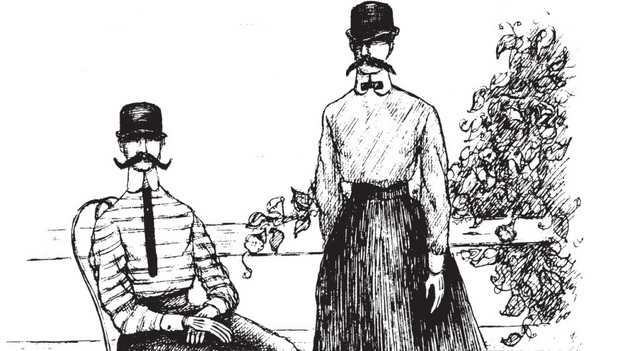
The scale of the office was intimate and I sat right in the middle of it, very self-conscious at all times but generally invisible to the great and the good who passed by. I imagined an early scene in some novel, maybe by Dreiser: the young clerk at his desk, his pen suspended in midair as he observes this or that eminence on parade. Isaiah Berlin, Lincoln Kirstein, Joan Didion, the debonair Murray Kempton, V. S. Pritchett who still sometimes turned in holograph manuscripts, Edward Gorey towering in his raccoon coat and white Keds. Not many of the names meant much to me at first; I came from another culture in another part of town.

Has Sante written anything on Gorey? It seems like a perfect match… or is that just me?

Comments closed

Q & A with Tom Gauld

Tom Gauld is a cartoonist and illustrator based in London. I first came across his work a few years ago in a book called Both published by Bloomsbury in 2003. Both (sadly now out of print) collected comics by Tom and Simone Lia originally self-published as First and Second under their imprint Cabanon Press.

Since then Tom’s book cover illustrations and literary cartoons have featured regularly here and on The Accidental Optimist. His work is funny (oh so funny) — silly even — but it combines pathos with the farcical. His heroes are unlikely or put-upon; his robots lonely, mundane or murderous; detectives are clueless; scientists baffled. Everyone (including the robots), it seems, would rather have stayed at home with a cup of tea and a good book. There is a gentle subversiveness to it all, although it is never mean-spirited. I hesitate to describe it as Pythonesque, but it is in a way. Tom’s machines all look as if they go ‘ping’. Other references include superheroes (less than you might think), adventure serials, mysteries, literary fiction, 1970’s science-fiction, Stanley Kubrick, fairy tales, and old Open University TV shows. It’s eccentric to say the least, but wonderful nonetheless.

Tom and I corresponded by email.

When did you first start drawing cartoons?

I’ve drawn for as long as I can remember and I drew a lot of cartoons when I was at school, but I suppose it was when I was studying at Edinburgh College of Art (around 1998) that I really began drawing comics and cartoons seriously.

Why did you start self-publishing your work?

I first self-published a comic called  First with my friend Simone Lia in 2001 when we were studying at the Royal college of Art in London. I’d say we did it partly because we didn’t know anyone else who would publish it, but also because I was interested in the business of designing and hand making the whole object. I had bought a self-published comic called OAF by Mat Brinkman a few years earlier and it inspired me to self-publish: it was small and hand-made and quite rough, but really unique and lovely. I suppose I’d seen self-published stuff before, but OAF really excited me.

Was the design of your books always important to you?

Yes, definitely. I think with any book, but particularly with a picture book of some kind, the experience for the reader begins before they even pick up the book. So I try to make every aspect of my own books contribute towards the story or idea. When I started, I was as much interested in designing, making and publishing a book as I was in the actual stories within.

Is Cabanon Press on permanent hiatus?

I wouldn’t want to say that Simone and I won’t ever start it up again. But we don’t have any plans to do anything with it for the moment. I’m still self-publishing things, but for Cabanon to work I think it has to be something Simone and I do together and we’re too busy with other things.

Where are your cartoons published now?

I do a weekly cartoon for The Guardian which appears in the (art and books) Review every Saturday, some of these cartoons also appear in The Believer’s comics section. I do something to accompany the The New York Times “Riff” essay every Sunday but that’s usually more an illustration than a cartoon. I also regularly put my work on my Flickr photostream.

Briefly, could you describe your working process?

I sit and think and doodle in my sketchbook until I have a good idea. Then I’ll make rough pencil sketches on copier paper till I have things worked out visually. Then I hone these sketches on paper and in photoshop till I have a rough version of the image which I can send to anyone who needs to approve it. Then I will print out the image and use a lightbox to trace an ink version which I crosshatch then scan back into the computer where I can clean it up, tweak bits and add any colour. I love using the computer but I try to stay away from it till I’ve done most of the thinking for an idea, looked at it from all sides, because I feel that once the computer is involved things are on an inevitable path to being finished. Whereas in my sketchbook the possibilities are endless.

How is illustrating a book cover different from your weekly cartoons?

It’s very different. I feel more pressure doing a book cover than almost anything else, I think “This author has probably spent years writing this book: I mustn’t mess it all up with a crap cover”. So I have to try and find a way to react to the book and make something which is suitable, but is also strong and interesting in its own way.

Are you planning any more full-length comics?

My forthcoming book Goliath is really the first time I’ve written a book-length narrative (albeit quite a short book) and I found it much harder than writing short pieces, but I’m happy with the result now. I will probably write another one, but not straight away. I’ve got a couple of shortish things I want to do, then after that I don’t know what I’ll do.

Where do you look for inspiration, and who are some of your cartooning heroes?

I listen to the radio, watch TV and films, go to museums and most of all read.

Cartooning heroes: William Heath-Robinson, Gary Larson, Roz Chast, Richard McGuire, Ben Katchor, Daniel Clowes, Chris Ware, Jochen Gerner.

How has Edward Gorey influenced your work?

I’m a big fan of Edward Gorey. I discovered his work when I was at college and immediately wanted to seek out everything he’d ever produced. I like that what he makes is unclassifiable: he makes picture books for adults which aren’t comics, many are self-published but they’re beautifully produced. I love his drawing, the odd narratives, the design of the books, the compositions, the hand drawn typography: everything really. The way I crosshatch (with small “patches” of short lines rather than long ones) I learned from Gorey.

Are you obsessed with robots?

I think I probably am a bit. I find they are very good props/characters for my stories and ideas. I like the inherent sadness in robots: they are sentient beings but also products which can break or be discarded (in my stories anyway). Also, they are much easier to draw than real people.

Who else do you think is doing interesting work right now?

Jon McNaught, Kate Beaton, Anders Nilson, Sammy Harkham.

What are a few of your favourite books?

Off the top of my head:

The Inheritors by William Golding
The Vinegar Works by Edward Gorey
Tinker, Tailor, Soldier, Spy by John le Carre
Teratoid Heights by Mat Brinkman
The Summer Book by Tove Jansson
The Stanley Kubrick Archives by Alison Castle

Are there any books you would love to illustrate? 

I’d like to do a book of fairy-tales or folk-tales.

What have you read recently?

The Thousand Autumns of Jacob de Zoet by David Mitchell
Through the Language Glass by Guy Deutscher (A fascinating book about language and colour)
The Annotated Brothers Grimm by Maria Tatar
The Cardboard Valise by Ben Katchor

What’s next for books and print?

One thing which might happen with the rise of e-books is that the books that DO get published in paper may have to justify themselves by being better made, designed and illustrated. That would make me happy.

Thanks, Tom!

For the sake of full disclosure,  I should mention that Tom’s forthcoming book Goliath, will be published by Drawn & Quarterly and distributed in Canada by my employer Raincoast Books.
7 Comments

Edward Gorey

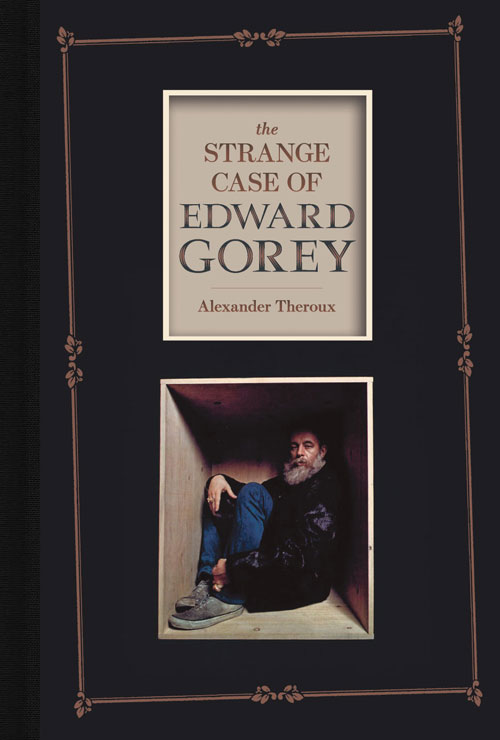
Alexander Theroux, author of The Strange Case of Edward Gorey (recently revised and republished by Fantagraphics), talks to NPR’s Weekend Edition Sunday about the writer and illustrator Edward Gorey, who would have been 86 years old today:

Violence is the essential Gorey ingredient. It is used in his books with such off-hand wit and inevitability that, having become his signature, if it were suddenly missing, you would begin to worry or at least feel you are being fobbed off by work not of the master’s hand.

NPR THE WEEKEND EDITION: THE LIFE OF EDWARD GOREY

Theroux also talks about his peculiar friend with Tom Spurgeon at The Comics Reporter:

I was telling someone the other day, there a division in the 20s and post WWI era, especially growing up in England. I think Gorey inherited this. There were the athletes, the muscular types — on one side of the tennis court, as it were. Then there were these kind of fey, bright young things on the other side of the tennis court. There has always been a kind of mocking, derisive look that they took regarding each other. I think Gorey grew out of that kind of gay interest, that fascination with ’20s movies, ’20s styles; there’s a tradition, I think. He was unhappy in the military and when he was at Harvard he was always in an artsy world. He went to the ballet every night in New York. He was almost a caricature of that Ronald Firbank type of character. He was very fey. He didn’t hide any of that.

Comments closed

Midweek Miscellany

Edward Gorey book cover set on Flickr (via This Isn’t Happiness).

15% of Immortality — Literary agent Andrew Wylie profiled in Harvard Magazine:

“The music industry did itself in by taking its profitability and allocating it to device holders. Manufacturing and distribution accounted for roughly 30 percent of the music industry’s profit. These were conveyed to Apple in the deal for iTunes. But why should someone who makes a machine—the iPod, which is the contemporary equivalent of a jukebox—take all the profit?… [Apple] couldn’t have sold the device without the music that was on it. Instead, why didn’t the music industry say to Apple, ‘We want 30 percent of your iPod sales?’ Or ‘How about paying us 100 percent of your music revenues—you keep your device profits, and give us our music profits?’ That’s not the deal that was made. And that is why the music industry hit the wall.”

“You just can’t kill us”Publisher’s Weekly looks at the future of sales reps, “the roaches of the business”:

[T]he key to the rep business may no longer be synonymous with the key to the car. Independent reps continue to call on as many stores in their territory as possible, but they also tweet, blog, e-mail, Constant Contact, and GoToMeeting, as well as phone, to stay in touch with their accounts. “If there’s a rep who can call on an account in person, it usually benefits the account,” says Kurtis Lowe, head of group for Book Travelers West, who until last year was the only rep traveling to Alaska. Now he uses what he calls “a hybridization of personalization and electronic contact”… Reps now provide stores with a mix of sales, marketing, customer service, and pretty much whatever else is needed.

“We all have our fates” — Berlin-based Bookslut Jessa Crispin talks to Ulrich Ditzen about his late father, the author Hans Fallada, and the posthumous success of his novel Every Man Dies Alone:

It was the fashion designer Diane von Furstenberg who first approached Dennis Loy Johnson at the publisher Melville House, saying it was a shame the book had never been translated into English. “She talked to the American publisher, why didn’t he publish this book, it was a fantastic book,” Ulrich said. “She was very surprised that it had never been translated. Dennis Johnson then read it and shared her opinion and proceeded to get it translated. And it was a runaway success, to my great surprise.”

And speaking of Berlin…

Because who doesn’t want a remote-controlled mountaineer’s harness to peruse their bookshelf? Dwell features the Berlin home of typographer Erik Spiekermann and his wife, designer Susanna Dulkinys:

Inside, the house has a strikingly modern look… Which is not to say that there are no luxurious touches… [E]xtras include an ingenious, if terrifying, remote-controlled mountaineer’s harness that lifts browsers to the books on the two-story-high bookshelf (though they have to be careful not to run into the Ingo Maurer Zettel’z light). To avoid clutter, almost everything is built in, with cleverly designed zippered fabric panels on the walls working to hide plugs and cords. “It’s like creating white space,” says Dulkinys, “so you can free your mind and be creative.”

2 Comments

Midweek Miscellany

The Backwards Novel Seen Backwards by Tom Gauld.

I also love Tom’s Lost Fairy Tales for a promotional concertina booklet made by his agent Heart (surely there’s a full length book to be had here?).

Ways of Reading from A Working Library:

Every book alights a path to other books. Follow these paths as far as you can.

Lovely.

Back to BasicsBooktwo.org‘s James Bridle on the Apple tablet (what else?):

I’ve spent several years urging publishers to get on board with new technologies and try new things, but equally I hope there’s space for a lot of publishers to get back to concentrating on what they do best: acquiring, editing, producing and publishing books… [W]e should probably stop scrambling to get on the latest bandwagon (vanilla Books-as-Apps, I’m looking at you), and concentrate on the basics: ebook production, metadata, integrated marketing, quality and consideration. There is a lot to be done, but this or that device will never be the be-all-and-end-all of the future of publishing.

I think James has a point. But honestly, no one I know (and that is an admittedly limited sample) believes “this-or-that device” will magically “save” publishing. Surely it is only bloggers in need of straw men and ‘journalists’ paid to hyperventilate who say that kind of shit?

Moving (swiftly) on…

Modern Myths — Will Self on H. G. Well’s The War of the Worlds in The Times:

The War of the Worlds is one of those books that demonstrates our culture’s surprising ability to continue the manufacture of myth. I say surprising, because one would think, with all the technological reproducibility of art now at our disposal — from raw print, to film, to digitisation — that there would be no room left for that hazy instability within which myth thrives.

(Pictured above: The NYRB edition of The War of the Worlds with illustrations by Edward Gorey)

And finally, completely unrelated to books…

Dear Coffee I Love You… Yes, yes, I do. (Pictured above: What I’d Rather Be Doing)

2 Comments