Skip to content

Tag: editors

There’s no one saying, “You can’t do this in a book for children.”

The New York Times profiles Julie Strauss-Gabel, the publisher of Dutton Children’s Books:

She became publisher of Dutton in 2011, and right away, it was clear this was going to be a different sort of imprint. She whittled down the list from about 50 titles a year for children of all ages, to about 10 books, with a focus on high-quality young adult fiction.

“There was nobody doing just what I do now 20 years ago,” she said. “It would have been unheard-of for a children’s publisher not to do picture books”…

…For such a small list — this year, Dutton will publish a mere eight titles — Ms. Strauss-Gabel’s books are strikingly diverse, covering science fiction and dystopian worlds, psychological suspense and works of social realism. She favors realistic, contemporary fiction, though lately she has been acquiring more memoirs and nonfiction.

“We’re in an era where the definition of a young adult book is completely up for grabs, and people are willing to reinvent it,” she said. “There’s no one saying, ‘You can’t do this in a book for children.’ ”

Comments closed

Something for the Weekend

The cover for The Disappearing Spoon designed by the amazing Will Staehle. To quote Tal Goretsky at Book Covers Anonymous:  “Holy Mother God!”. Apparently it’s printed on uncoated paper.

You can see some of Tal’s own rather nice design work here.

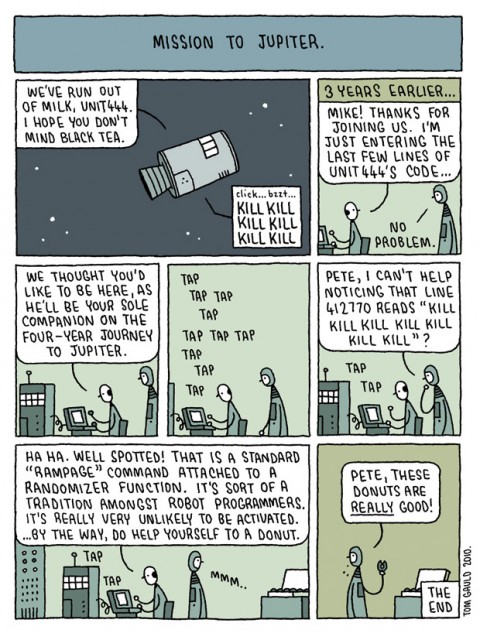
And speaking of designer’s blogs… Designer Joanna Rieke has started a new blog called UnCovered about book and magazine covers. She recently interviewed illustrator (and Casual Op. hero) Tom Gauld:

I think most literature works perfectly well without illustrations and I have seen some truly awful images put on the cover (used as illustrations) of great books. As for comics, I’m more often frustrated by comics which are too wordy than too visual. I think the balance between words and pictures is very important in a comic and though the ratio doesn’t always have to be the same, my heart sinks when I see a page which is filled with writing.

Taking a summer break from his regular illustration gig at The Guardian, Tom is currently producing a weekly comic and posting it to Flickr:

Real Editors Ship — I linked this on Twitter already, but it’s kind of great so what the hell… Paul Ford on getting stuff out the door and the value of editors (and I would suggest Production Managers):

People often think that editors are there to read things and tell people “no.” Saying “no” is a tiny part of the job. Editors are first and foremost there to ship the product without getting sued… This is not to imply that you hit every sub-deadline, that certain projects don’t fail, that things don’t suck. I failed plenty, myself. It just means that you ship…

Editors are really valuable, and, the way things are going, undervalued. These are people who are good at process. They think about calendars, schedules, checklists, and get freaked out when schedules slip. Their jobs are to aggregate information, parse it, restructure it, and make sure it meets standards. They are basically QA for language and meaning.

The Fine art of Recommending Books — Laura Miller at Salon:

Amazon and other online merchants have harnessed mighty algorithms to run their “If you enjoyed that, you might like this…” suggestion engines, but these are still crude instruments. Practically any novel you plug into Amazon’s search engines at the moment returns the robotic announcement that people who bought it also bought one of Stieg Larsson’s “Girl” thrillers — because seemingly everybody in America is buying those books. It’s not like you need the world’s most sophisticate e-commerce servers to tell you that.

And finally…

Steranko! — Jonathan Ross interviews comics legend Jim Steranko, inspiration for Josef Kavalier in Michael Chabon’s The Amazing Adventures of Kavalier and Clay,  for The Guardian:

Spend an hour with Jim Steranko and, if he’s in the mood, he’ll regale you with the most extraordinary tales. Are they true, I have asked myself more than once, or is he a fantasist? Has his love of storytelling and the creation of modern myths bled into his own life story until he can no longer tell the two apart? Well, now that I’ve met him, I believe them all to be true, just as I believe it when he tells me he still runs miles every day, pumps iron, and fornicates blissfully like a man a third his age. He is unique. He is Steranko. He is the greatest.

A slideshow of Steranko’s work is here.

Have a good weekend…

1 Comment

Less is More…

Poets & Writers magazine have just published the final installment of Jofie Ferrari-Adler’s series of interviews with publishing professionals.

The last interview in this excellent series is with Jonathan Karp, publisher and editor in chief of Hachette‘s remarkably successful Twelve imprint.

Formerly an editor at Random House, Karp founded Twelve with the objective of publishing no more than one book a month. Since their launch, 15 of Twelve’s first 30 books, including Christopher Hitchens’ God Is Not Great and Dave Cullen’s Columbine (pictured above — cover designed by Henry Sene Yee), have been New York Times best-sellers. It’s clearly a successful model, even if it is one that’s hard for start-ups to replicate (how many new imprints could have snapped up the rights to True Compass by Ted Kennedy for example?).

The interview is, of course, well worth reading in full. But here are a few passages about Twelve that stood out for me…

On founding Twelve:

I was thinking, “Okay, I want everything to be the lead title. I want to have at least a month to put it across. And I want to have the best talent. What’s the best way to do that?” It’s to make a promise to the author and to make the promise so explicit that it’s on the spine of the book: Twelve. That’s it. One a month. You get your launch and, although we can’t guarantee that the book’s going to be a best-seller, we can at least guarantee that you will have our full attention, focus, and commitment for a sustained period. We will talk about your book until people will not listen to us anymore.

On acquisitions:

I really am amazed by how often publishers decide to do something because a similar book succeeded. That is flawed reasoning. Books catch on for any number of reasons, and it’s not a mathematical formula that can be reproduced. Even more insidious is the idea that sometimes creeps into acquisition decisions in a really cynical and negative way, where people say, “Well, that nondescript work caught on, so this nondescript work could too.” I just don’t understand why you would want to go down that road. It makes no sense to me. I would think that you would feel as if you were going through your life just imitating other people, doing something you didn’t really believe in. I’m genuinely mystified by that.

On publishing fewer books:

What I do think is that the Twelve model makes a great deal of sense for unknown authors or authors who want to break out. I think that’s true. I think that this is the best way to publish a midlist author or an author who’s on the way up. Let me put it another way: I think it would behoove the major publishing houses to publish fewer books with more focus. I think that everybody would benefit from that. What I don’t know is whether the companies can meet their targets doing it. I’d have to be a CFO to know that, and it would be arrogant of me to say that a major publisher can get by without disposable books. I don’t know the answer to that. What I know is that I’m working for a company that publishes a lot less than the other major publishers with a more concentrated marketing approach and seems to be making a lot of money doing it.

On the “future of publishing”:

I have an idealistic hope that as more and more media becomes disposable, books will be increasingly regarded as the permanent expression of thought and feeling and wisdom. So publishers who can offer definitive material will thrive. Now, as I say, that’s idealistic. Plenty of publishers are going to continue to do well publishing derivative material that they don’t really believe in. But I think it’s going to be harder for them. It’s going to be harder for them to survive. I think there will be some displacement—some houses will shrink and other houses will grow. I could see some pure play digital publishers who aren’t encumbered by the weight of overhead and the history of their business relationships becoming influential factors in the publishing world. So I think it’s a transitional time and a transformative time. But it’s always been that way. I don’t think anything should be regarded as permanent. All we ultimately have is our belief in the particular books. And as long as you have that, you’re fine.

As I say, the whole interview (the whole series in fact) really is worth your time.

3 Comments

Something for Weekend, May 29th, 2009

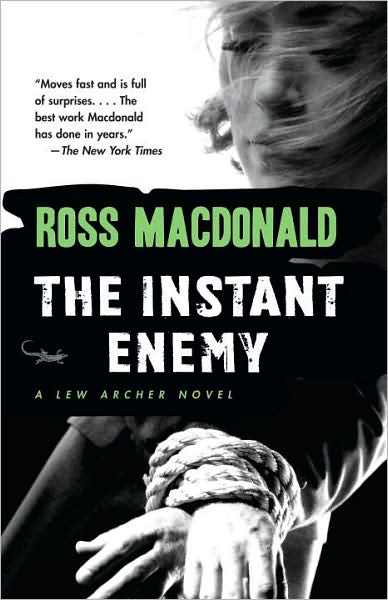
Hard-boiled — New designs for Ross MacDonald’s Lew Archer books by Joe Montgomery seen at FaceOut Books. I know I link to FaceOut just about every other week, but it’s an awesome site and the juxaposition of images in this series are great (as are some of the unused comps).

The Concierge and the BouncerPublishers Weekly report on Richard Nash (formerly of Soft Skull) and Dedi Felmen (formerly of Simon & Schuster) and their plans to “push back against the outmoded idea of publisher as cultural gatekeeper” with their new venture Round Table (announced at BEA this week):

The key is a shift from a caretaker mentality to a service mentality, from a linear supply-chain model to the idea of a free-floating, non-hierarchical “ecosystem” of readers, writers and authors… Nash and Felman’s idea of Publishing 2.0 could make a semi-professional reader, writer, editor and critic out of anyone with the desire.

Reading in a Digital World — A killer line in an otherwise blah article for Wired by Clive Thompson:

“We need to stop thinking about the future of publishing and think instead about the future of reading.”

Book Distribution in Canada — A Canadian Heritage study on book distribution in English Language Canada produced by Turner-Riggs dropped this week.

Can Editors Change Their Spots — David Hepworth’s thoughts on Robert G. Picard’s CS Monitor article ‘why journalists deserve low pay’,  and what “the new dispensation” means for  editors:

Magazine editors spend most of their time deciding what they’re *not* going to do and trying to arrive at a mix that the majority of people will like. They then find that whatever they’ve arrived at is too much for some people and not enough for others. This is made more difficult by the fact that their readers, being the most engaged in their particular area, are the people most likely to tap into other sources themselves. The people who value your mix most are also the people who would feel most qualified to mix it themselves.

The italics are mine.

Cover to Cover —  Steven Heller reviews newly released  ‘visual books’ in the New York Times with a nice accompanying  slide-show. (See image above, but hey NYT, when are you going to let people embed your slide-shows? When?).

Comments closed

Something for the Weekend, Feb 21th, 2009

Corpoetics — The text from the websites of  “well-known brands and corporations” remixed and rearranged into strangely engaging and enigmatic poetry by Nick Asbury (photo above from Ace Jet 170). I rather like the one taken from Scottish Widows:

Here in an Edinburgh coffee house,
their futures became history.
Meet the latest widow.

Copies of Corpoetics available for £5 (plus p&p) from Nick Asbury’s website, and all proceeds go to the National Literacy Trust, an independent charity dedicated to changing lives through literacy.

A Q&A With Four Young Editors — Just a fantastic, fascinating conversation between Richard Nash (Soft Skull), Lee Boudreaux (Ecco), Alexis Gargagliano (Scribner), and Eric Chinski (FSG) in the latest issue of Poets & Writers. It’s long. Make some coffee, grab a snack and devote some time to it. Well worth it. Honestly.

In Defense of Readers — Mandy Brown, Creative Director at W. W. Norton & Company,  on designing websites for readers:

Despite the ubiquity of reading on the web, readers remain a neglected audience… Readers flourish when they have space—some distance from the hubbub of the crowds—and as web designers, there is yet much we can do to help them carve out that space.

And last, but by no means least… Coralie in ConversationThe Caustic Cover Critic interviews Penguin’s super-talented book designer Coralie Bickford-Smith.

1 Comment

Monday Miscellany

A bolt of electricity: PW polls publishers on the challenges and opportunities facing their digital publishing programs. It’s a fascinating glimpse of where the likes of Random House, Simon & Schuster, and Penguin are heading… A must read I would say…

Narrative medicine: Exposure to literature can influence how young doctors approach their clinical work according to the New York Times (via Guy Kawasaki):

“The idea of combining literature and medicine — or narrative medicine as it is sometimes called — has played a part in medical education for over 40 years. Studies have repeatedly shown that such literary training can strengthen and support the compassionate instincts of doctors.”

In need of a good editor: Book Lover Cynthia Crossen laments the decline of editorial rigour in the WSJ:

“Editors are the invisible heroes of the publishing industry, and as publishing companies cut corners, they cut editors… But without strong editors, writers are like cars with accelerators but no brakes”

Comments closed

Monday Miscellany, Nov 3rd, 2008

The extraordinarily cool binding for Alfred Jarry’s Ubu Roi (Ubu the King), a collaboration between bookbinder Mary Reynolds and Marcel Duchamp, as seen at blog.rightreading (pictured).

Editor Chuck Adams interviewed in the November Poets & Writers Magazine. A very interesting–albeit very commercial–perspective:

“For too long, in New York, we’ve been in this culture of publishing what we like and not what readers want. Hopefully, we’ll come around to trying to understand what people really want to read so we can interest them in reading in the first place.

He also makes a very telling point about the problem of homogeneity of publishing:

“We don’t encourage a diversity of people in the business. We don’t. We just want more of the same because they’re the ones who can afford to work in it.”

I couldn’t agree more…

Not content with Bastards With Bookshops , Bastards With Bookshops 2,  and Yet More Bastards With Bookshops , Bookride has gleefully provided guidelines to help aspiring bastard-booksellers achieve their dream. Like they need the help… My personal favourite:

“Greet the customer with a glower, a scowl or a look of deep mistrust. If you are feeling generous a frosty ‘Good Morning! will suffice.”

Following Chapters-Indigo in Canada, Barnes and Noble have launched a social networking site ‘My B&N’ in the US.

Agent Kate Lee interviewed at HarperStudio’s 26th Story:

“I think the building or seeding of buzz online is important–as with film, music or TV, word of mouth is invaluable.  That buzz can come through building relationships with bloggers, writing posts that you then try to get linked to, starting up a social network or “fan” group, and/or creating original online content.  The main thing is just to be out there–be writing, be posting, be Twittering, be engaging in conversation with other people in the blogosphere.”

A fascinating half-hour interview with novelist John Le Carre from BBC Radio 4’s Front Row.

Comments closed