Skip to content

Tag: e-readers

New On Your E-Reader…

Used book simulation…

By Tom Gauld of course…

Comments closed

DODOcase

In yesterday’s round-up I briefly mentioned DODOcase who use traditional bookbinding techniques to produce iPad and e-reader covers locally in San Francisco. Here’s a video introduction to the company and their products:

Another reason (were one needed) to get an iPad (right after Swords & Sworcery!).

Comments closed

“E” is for Experiment (Not E-books)

Guy LeCharles Gonzalez, Audience Development Director at F+W Media, had an interesting op-ed at Publishing Perspectives last week about e-books and e-readers:

[T]here is a lot of R&D money being poured into [e-readers] — that’s how technology companies work — and one or more of them may eventually click with consumers, but right now it’s a fledgling market and the hype surrounding it has reached irrational levels in publishing circles… There are many fundamental business issues that need to be addressed related to e-books — rights, royalties, pricing, distribution, marketing — and it’s up to publishers, agents and authors to figure them out together and not be distracted by every new shiny object the technology companies come up with.

Although clearly not a big advocate for e-readers, Guy raises a lot of the question marks that I think still hang over the devices in a fairly balanced way, and the article as a whole expresses a lot of the doubts I hear from other quietly skeptical people in publishing.

Needless to say, the whole thing is worth reading and Guy has more to say on the subject at his blog loudpoet.

1 Comment

E-Reading the Tea Leaves

While The Wall Street Journal recently suggested that e-readers are more eight-track than iPod and Forrester Research predicted that B&N will steal market share from Amazon and Sony in 2010, Joe Wikert, General Manager & Publisher at O’Reilly Media, made the even bolder prediction that Amazon — in the face of stiff competition from other e-readers and multi-use devices like the iPhone — “will completely exit the Kindle hardware space within the next 3 years”.

Although predicting the future is a mug’s game (and Amazon are particularly adept at being at least 2 or 3 steps ahead of the pundits), I think that Joe — an early Kindle advocate — might actually be onto something and Amazon really might be prepared to let the device, if not the format or apps, die quietly.

Does this mean that Amazon made a mistake in launching their own e-reader?

I don’t think so.

If publishers had rushed to embrace the Kindle, Amazon would have completely pwned the distribution of e-books (and had publishers even further over the proverbial barrel).

But even though this hasn’t quite worked out, Amazon are still sitting pretty. The Kindle has undoubtedly increased the popularity of e-books and Amazon — the best known and largest online bookstore — is the natural beneficiary. Even if manufacturing the hardware becomes too much like hard work, Amazon will still sell a lot of e-books and the Kindle will surely have served its purpose as a beachhead…

Kindle and Shortcovers

And on the subject of the Kindle, it’s been interesting to see Indigo, Canada’s biggest book retailer, respond to Amazon launching their e-reader north of the border.

Joel Silver, President of Indigo, — who apparently reads on his Blackberry — discussed e-readers and e-books on Business News Network last week (there’s also an interesting follow up interview with the estimable Jason Epstein) and Michael Serbinis, President of Indigo’s e-book initiative Shortcovers, took a few (slightly uncharitable) pot-shots at the Kindle in a recent interview with The National Post.

But, as Shortcovers clearly demonstrates, Indigo have been preparing for the arrival of the Kindle for a while, and — if you have a spare hour — it worth listening to Michael Tamblyn, their VP of Content, Sales & Merchandising, re-enact his Tools of Change presentation Your Reading Life, Always With You to see where they are going…

So what do you think is the future of e-readers? Any thoughts?

Comments closed

The World’s Most Advanced E-Reader or the Worst Product Name Ever?

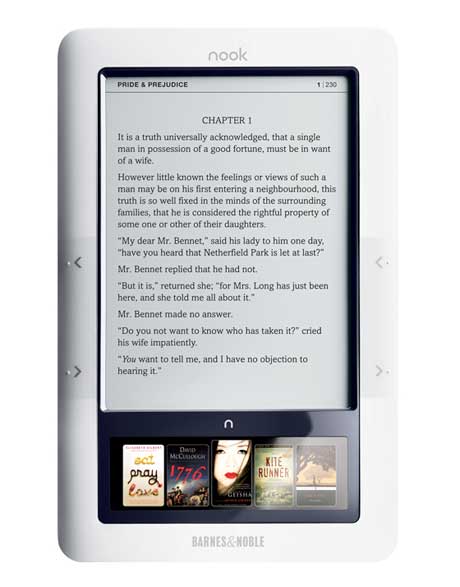
Despite being lumbered with “the worst product name in recorded history”, Barnes & Noble‘s new dual screen e-reader the ‘Nook’ is getting a lot of favourable reviews.

An appallingly kept secret, the Nook was officially unveiled earlier this week and is being widely touted as a ‘Kindle Killer’ (whatever that actually means).

Direct comparisons with Amazon’s e-reader are inevitable of course — especially given the Nook will go on sale for $259, the same price as the Kindle 2.  And, if nothing else, US publishers seem relieved that Amazon finally has some serious competition from the country’s largest bookstore chain.

As reported in Publishers Weekly and the New York Times, part of what is attractive to publishers (aside from the simple fact it is not owned by the Amazon) is that the Nook is relatively flexible and supports formats, including ePub. and — perhaps more crucially in the short term — PDFs, that can be read on other devices.

Of course, that B&N has 1,300 stores and already understands books (and the publishers that publish them) doesn’t hurt.

Much is also being made of the Nook’s promising ‘LendMe’ feature, which will let readers share their books (within limits) with others, even though some people aren’t entirely happy about it.

Unsurprisingly, B&N are describing the Nook as “The World’s Most Advanced eBook Reader”, although it is unclear whether the Nook will be available outside the US, which could be problematic in the long run (especially as Amazon and Sony both have global reach). The Guardian Technology Blog does point out, however, that the Nook’s 3G wireless is provided by AT&T, “one of the GSM [Global System for Mobile Communications] providers in the US, so from a technical standpoint, it should be easy to launch the reader internationally.”

But does B&N really have the will or the way to make the Nook available beyond its US home base? And could it do so successfully?

Ultimately perhaps, the real question though is whether there is actually a mass market — either in the US or internationally — for single purpose e-readers. Some smart people clearly think so, but given that non-proprietary formats like ePub can be read on more useful, convenient and competitively priced multi-purpose devices such as laptops and cellphones (and whatever else Apple are currently cooking up), and that books still look like the most robust, simple and elegant format — I’m not so sure…

Comments closed