Skip to content

Tag: e-commerce

Something for the Weekend, March 6th, 2009

Abecediary — Steven Heller on alphabet books (Die Flucht Nach ABECEDERIA by the French comic artist Blexbolex pictured above).

Imprints in the 21st Century — Admittedly HarperCollins new Imprint It Books is an easy target (NB use of “tap into the zeitgeist” in a sentence = fail), but Mike Shatzkin does a good job of explaining why their strategy is past its sell by date (and beginning to smell):

General trade publishers need to see, and apparently don’t,  that their legacy brands are B2B [business-to-business]. They should be exploited that way. They need brands that can work B2C [business-to-consumer], but it will require discipline, focus, and an audience-first picture of what to publish to accomplish that.

Writing for a Living — Luminaries such as Will Self, Joyce Carol Oates, and AL Kennedy (quoted below) discuss whether writing is a joy or a chore in The Guardian:

“The joy of writing for a living is that you get to do it all the time. The misery is that you have to, whether you’re in the mood or not.”

Hugh at BookOven is angry this week.  He wants to know why publishers are not selling directly to customers from their website and why they make e-books so complicated. I think Hugh underestimates the time/money/skill-deficit obstacles publishers face in regard to both problems. I suspect Hugh thinks I’m an apologist and will be first up against the wall when the revolution comes.


Book Design Made Easy — cartoonist Tom Gauld is making his genius cartoons from The Guardian available on Flickr (via Drawn!, source of so many life-improving things).

4 Comments
Midweek Miscellany, Nov 19th, 2008

“We’re from Kodak, Apple, Google, Yahoo”: The Guardian profiles Blurb — a publishing company with nobody from mainstream publishing — that specialises in high-quality, print-on-demand, photography books. Very, very, cool.

Good news and bad news for online retailers: Statcan found that more Canadians are shopping on the internet, placing almost $12.8 billion worth of orders in 2007, up 61% from 2005. ComScore, on the other hand, have just released their monthly retail e-commerce sales estimates, showing that online spending in October 2008 grew by only 1 percent over October 2007–the lowest monthly growth rate since they began tracking e-commerce in 2001.

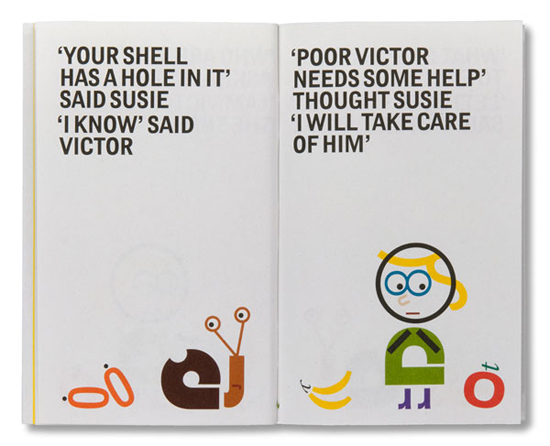
Victor & Susie: A brightly coloured “children’s book for adults” about Susie and Victor the snail, all drawn with letters and punctuation marks, published by Brighten The Corners (pictured). (via drawn)

“A kind of slow-motion suicide”: David Carr’s column for the New York Times looks at why firing their the most talented, experienced employees to cut costs backfired for Circuit City and will do the same for newspapers too:

“Right now, the consumer has all manner of text to choose from on platforms that range from a cellphone to broadsheet. The critical point of difference journalism offers is that it can reduce the signal-to-noise ratio and provide trusted, branded information. That will be a business into the future, perhaps less paper-bound and smaller, but a very real business.”

My take on this for book publishers (as it normally is): Publish less, publish better — quality matters. (via reveries)

Comments closed

Megalisters

“What fun is there in clicking… compared to the pleasure of handling a fine copy of a rare book?”

Mick Sussman examines used-book selling in the internet age for the New York Times:

[T]he state of the art in used-book selling these days seems to be less about connoisseurship than about database management. With the help of software tools, so-called megalisters stock millions of books and sell tens of thousands a week through Amazon, AbeBooks and other online marketplaces.

But, it’s not all bad news for the small dealer:

“Though the rise of the megalisters has hurt many mom-and-pop operations, the toll has been less than catastrophic. A database maintained by Susan Siegel of Book Hunter Press lists 3,968 “open shops” — as brick-and-mortar outlets are known — across the United States today, down from 4,119 in 2002. A 4 percent drop over six years might not be something to cheer about, but it would seem downright enviable to record or video store owners.”

What are smaller used-book sellers doing to survive? Using their experience, sharing “alchemical trade wisdom” in online forums, focusing on books that are rare–if not exactly collectible–and combining labour-intensive hand-selling with the selective use of e-commerce:

After the great wave of creative destruction set off by e-commerce, the more adaptable breed of used-book seller seems to have survived… Chris Volk, a store owner and the vice president of the Independent Online Booksellers Association, says her colleagues are frustrated but undaunted by the megalisters. “In the long run,” she said, “people who know what they’re doing will win out.”

Comments closed