Skip to content

Tag: diana athill

Diana Athill | Michael Salu and Rankin

Designed by the brilliant Michael Salu, the cover for Diana Athill’s forthcoming collection of letters, Instead of a Book, features a stunning portrait of the author by acclaimed British photographer Rankin (co-founder of Dazed & Confused in case you were wondering).

To coincide with the release of the new book in October, Granta are also reissuing paperback editions of Athill’s books Stet, Yesterday Morning and Instead of a Letter with cover designs incorporating Rankin’s photographs.

I don’t think I have made any secret of my love of Stet, Athill’s book about her time as an editor at Andre Deutsch. But I have always been disappointed by the discouraging cover on the tatty copy on my bookshelf, and it makes me incredibly happy to finally see an edition that seems to capture something of Athill’s personality.

Athill’s writing is unflinching and it is remarkable to see that reflected in Rankin’s stark portraits. According to Michael, who art directed series and designed all the covers, “the idea was to not to shy away from age and experience, but to celebrate it and Diana’s distinct personality.” Certainly, it is hard not to be taken by the keenness of Athill’s eyes. One gets the sense she does not suffer fools gladly. There is something of a retired headmistress about her. But I love how in the photograph for Instead of a Letter, Rankin captures Athill’s thumb hooked under her necklace. The author doesn’t appear to be particularly aware that she’s doing it, but it is beautiful and poignant touch.

The type is set in Gill Sans. Of course.

Comments closed

Midweek Miscellany

Canadian illustrator and typographer Darren Booth at From The Desks Of

There’s on more on Darren’s cover for An Object of Beauty on his blog.

Misery — Editor and author Diana Athill profiled at The Telegraph (via PD Smith):

‘I have always been a watcher,’ she says. ‘Of myself in particular. Even at times of acute unhappiness I’ve watched myself being unhappy. I also think I’m one of those people who has never been wholly involved in an emotion, but then I think a lot of writers are like that.’

Is Modernism Boring? — Rhys Tranter at The Spectator Book Blog:

If modernism means anything in Woolf or Joyce, it is the struggle for what it means to be modern. Both present us with an array of fascinatingly complex characters, seeking to question their identity and their place in the modern age. Language becomes a character, too, an all-pervading texture that sets the mood of each story, and playfully subverts the ABC plots of yesteryear. Amid a proliferation of new technologies, of political upheaval and social change, Joyce, Woolf and the literary modernists actively interrogate the way we perceive the world around us, in ways still relevant today. In this way, modernism is not something we leave on our shelves and neglect to pick up. Modernism is that which speaks to modern life.

What’s the Worst that can Happen? — Gary Shteyngart, author of the dystopian Super Sad True Love Story, interviewed at the new and great looking book blog Full Stop:

Most people don’t care anymore because they’re beyond caring. The endless cult of self-expression that makes people stream or write about themselves day in and day out without any kind of filter. If you write a novel, you’re often writing about yourself as well, but you’re clearly filtering it through a bunch of things, not least of which is technique. So it’s not an entirely plausible future, but in some ways it could be. What if all the worst things happen politically, socially, and in terms of our literacy?

Top 10 fonts of 2010 lists from You Work For Them and Fontwerk (Google Translate version here).

And finally…

The 50 best comic book covers of 2010 as chosen by Robot 6

4 Comments

Monday Miscellany, November 2nd, 2009

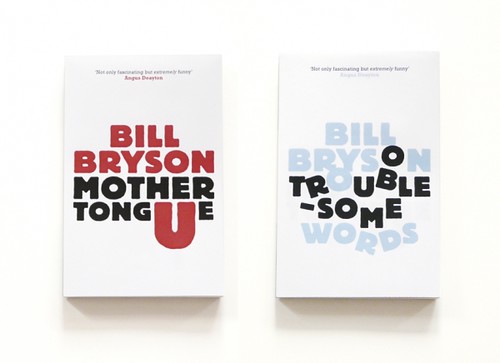
Unpublished concept jacket designs by London-based print designer Allan Sommerville for the Penguin’s Bill Bryson books (via Cosas Visuales).

Fonts — This is AWESOME: Wisconsin Public Radio’s To The Best of Our Knowledge talk fonts with Jonathan Hoefler and Tobias Frere-Jones, designers of Gotham, Matthew Carter, designer of Verdana, author Nicholson Baker, Tracy Honn, director of the Silver Buckle Press, and Kitty Burns Florey, author of Script and Scribble: The Rise and Fall of Handwriting. Listen NOW.

Many Happy Returns — Author, academic and newspaper columnist John Sutherland (The Boy Who Loved Books) on 30 years of The London Review of Books for The Financial Times:

The LRB front cover logo was “THE LONDON REVIEW of Books” – the last two words being smaller. As the typography signalled, it was the review that mattered as much as the book under review. Articles in the LRB were, and are, long: anything between 2,000 and 5,000 words. On special occasions they can run into the tens of thousands. Rates of pay seemed to me startlingly high: three or four times, in the early years at least, what the TLS paid. Miller personally appeared austerely indifferent to money. I suspect he worked for little or nothing. Nor did rises or falls in circulation appear to trouble him overmuch. Quality was all.

(There’s also a rather lovely addendum about the LRB’s personal columns, so read to the end!).

Somewhere Towards The End — A wonderful essay on editor and author Diana Athill by Ian Jack,former editor of Granta, in The Guardian:

[W]hat held me about the writing was its candour. The quality has since become an Athill trademark, though in itself candour is no guarantee of literary pleasure or interest: frank books aren’t always good books and can often be tedious by boasting of their frankness. Athill’s way of being candid is more subtle and its effect more persuasive… Part of this comes from her considerable gift as a maker of sentences, which are so lucid and direct; some of it is owed to the breaking of taboos that then surrounded female sexual behaviour; most of it, though, stems from her triumphant struggle to “get it right”, a lesson she learned from two of the writers she edited. Rhys told her that the trick of good writing was “to get it as it was, as it really was”. Naipaul said that “provided you really get it right, the reader will understand”.

The Internationalist — An all too short interview with Penguin Canada’s David Davidar, who was recently appointed CEO of Penguin’s new division Penguin International, in the Globe and Mail.

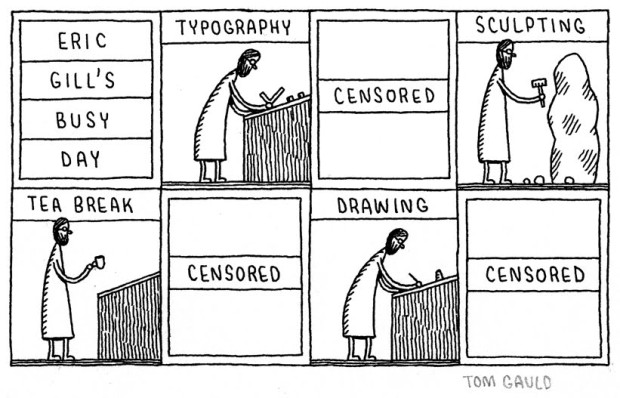
And finally… I do love Tom Gauld:

eric gills busy day

(More on Eric Gill)

Comments closed