Skip to content

Tag: design

Always in Beta

I’ve been having a few nagging design problems with The Casual Optimist, and thanks to my friend Ehren, I’m hoping to address them over the next couple of days with a new wordpress theme.

I would like to apologise in advance if things temporarily go a bit wonky.

Always in beta right? Always in beta…

Comments closed

Something for the Weekend, Feb 21th, 2009

Corpoetics — The text from the websites of  “well-known brands and corporations” remixed and rearranged into strangely engaging and enigmatic poetry by Nick Asbury (photo above from Ace Jet 170). I rather like the one taken from Scottish Widows:

Here in an Edinburgh coffee house,
their futures became history.
Meet the latest widow.

Copies of Corpoetics available for £5 (plus p&p) from Nick Asbury’s website, and all proceeds go to the National Literacy Trust, an independent charity dedicated to changing lives through literacy.

A Q&A With Four Young Editors — Just a fantastic, fascinating conversation between Richard Nash (Soft Skull), Lee Boudreaux (Ecco), Alexis Gargagliano (Scribner), and Eric Chinski (FSG) in the latest issue of Poets & Writers. It’s long. Make some coffee, grab a snack and devote some time to it. Well worth it. Honestly.

In Defense of Readers — Mandy Brown, Creative Director at W. W. Norton & Company,  on designing websites for readers:

Despite the ubiquity of reading on the web, readers remain a neglected audience… Readers flourish when they have space—some distance from the hubbub of the crowds—and as web designers, there is yet much we can do to help them carve out that space.

And last, but by no means least… Coralie in ConversationThe Caustic Cover Critic interviews Penguin’s super-talented book designer Coralie Bickford-Smith.

1 Comment

H.N. Werkman

Every day,  Eric Baker,  of Manhattan-based design firm Eric Baker Design Associates,  spends 30 minutes before work looking for “images that are beautiful, funny, absurd and inspiring”, and each Saturday he posts his selections to the Design Observer.

Eric’s selections for  14th February were all drawn from a great collection of images that Miguel Oks has posted to Flickr,  including  some amazing sets of 20th Century avant-garde books.

The covers pictured here are by the brilliant Hendrik Werkman (H.N. Werkman)  for the literary typographic journal Next Call , and are taken from the Dutch Books set.

Yale University Press published a lovely book by Alston W. Purvis on Werkman in 2004 as part of their Monographics series.

Comments closed

The Back of My Head

The Caustic Cover Critic has posted some amazing book covers by the legendary Saul Bass that are just too good not to share:

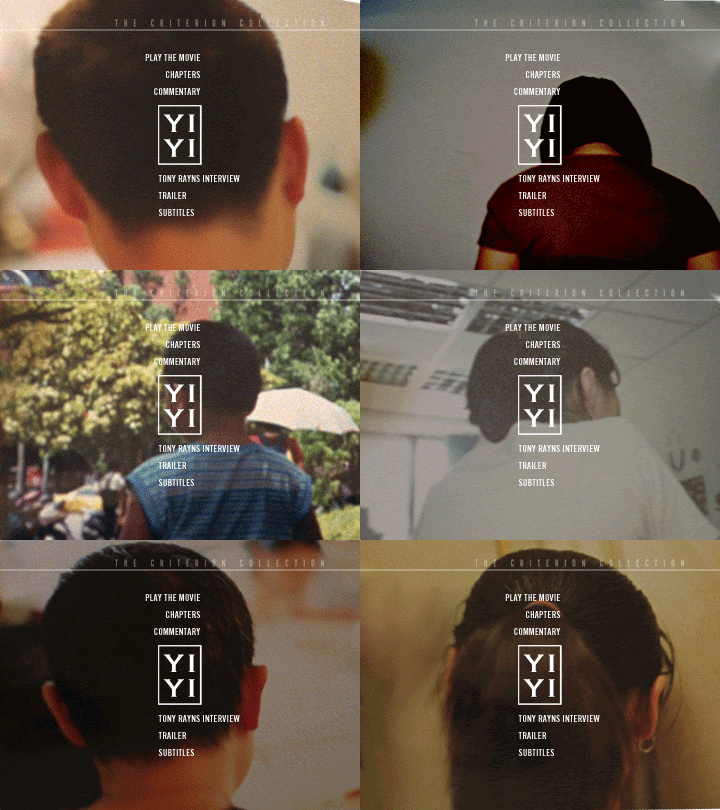
I love the covers adapted from Bass’ movie posters for the Penguin editions of Saint Joan and Anatomy of a Murder, but this cover of Preminger: An Autobiography (pictured) is less well known. And it was nice to be reminded of the movie Yi Yi in which 8-year-old Yang-Yang makes it his mission to lovingly photograph the back of people’s heads…

…And in looking an image for Yi Yi, I came across a rather lovely post by designer Eric Skillman about creating the DVD edition for Criterion Collection:

The actor who played Yang Yang was obviously no longer available, so we had find a back-of-head double. We found a photographer (the talented Andre Constantini), who led us to a young model named Brian, the back of whose head was a fine match for Yang Yang.

Eric also designs books as it turns out. His blog looks great! A day of nice finds.

3 Comments

Monday Miscellany, February 9th, 2009

“Books exist because we want and need them” — A slide show of pages from Robert Bringhurst’s new book The Surface of Meaning: Books And Book Design In Canada (pictured) published by CCSP Press in The Globe and Mail. (Disclosure: The Surface of Meaning is distributed by Raincoast in Canada).

A bookshop is a dynamite-shed — Bookride have posted a splendid John Cowper Powys rant about second-hand bookshops:

[A] bookshop — especially a second-hand bookshop — is an arsenal of explosives, an armoury of revolutions, an opium den of reactions. And just because books are the repository of all the redemptions and damnations, all the sanities and insanities, of the divine anarchy of the soul, they are still, as they have always been, an object of suspicion to every kind of ruling authority.

Pessimism Porn — Hugo Lindgren explains his addiction to nightmarish economic news  in New York Magazine:

“[E]cono-porn… feeds a powerful sense of intellectual vanity. You walk the streets feeling superior to all these heedless knaves who have no clue what’s coming down the pike. By making yourself miserable about the frightful hell that awaits us, you feel better. Pessimism can be bliss too.”

Publishing certainly has its fair share of addicts…

Visionary locations — Toby Litt on J.G. Ballard in the Guardian:

“Plenty of other writers now fictionally venture into multistorey carparks, airport hospital wards, decaying hotels, but they do so in the knowledge that they’re trespassing on Ballard’s territory. He was here first; he was the pioneer – back when these places were seen as totally unliterary. What could possibly happen on a motorway embankment that was of interest?”

Finding alternative best sellers — Toronto bookshop This Is Ain’t The Rosedale Library profiled by Brian Joseph Davis in the Globe and Mail.

Is CondéNet Dead? — Slate’s The Big Money examine how “a publishing giant failed to get the Web”. Lessons (if more were needed) for book publishers (via @jafurtado):

“To say that we’re just a magazine company in this day and age is like saying that we’re a buggy company.”

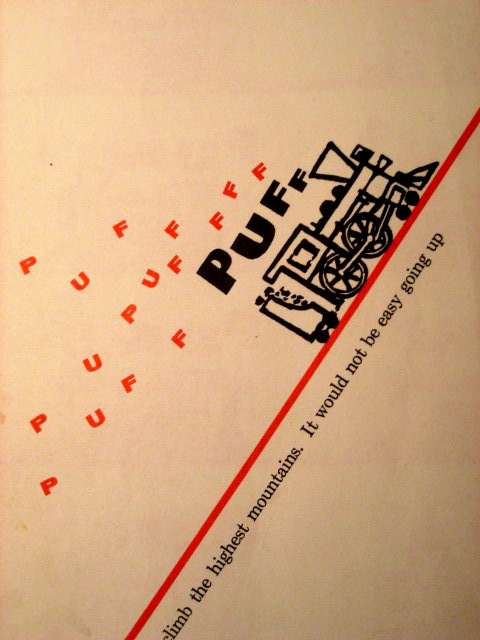
PUFF — lovely pictures of PUFF by William Wondriska (published in 1960 by Pantheon Books Inc.) at the wonderful Grain Edit (pictured above).

Image Spark— A neat image bookmarking tool. V. excited about this as you can probably imagine… (via @michaelSurtees/DesignNotes) .

1 Comment

What Are You Looking At?

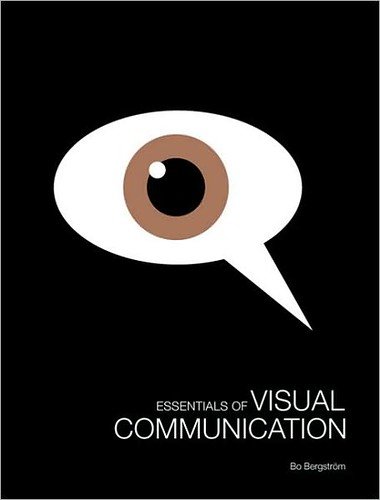
This book just arrived in our office and it’s staring right at me!

There’s more than a little something of  the late, great Paul Rand about the transfixing cover for Essentials of Visual Communication by Bo Bergstrom (published by Laurence King)  wouldn’t you say?

…which is about all the excuse I need  to post this great video:

(Full disclosure: Raincoast Books distribute Laurence King, and therefore Essentials of Visual Communication, in Canada)

3 Comments

Midweek Miscellany, February 4th, 2009

Slow Burner (above) — a rather awesome — if slightly racy — cover seen at the Bookkake Blog.

How to Publish in a Recession Part 3 — The always interesting Richard Nash, the editorial director of Soft Skull Press and the executive editor of Counterpoint, talks to Scott Esposito at Conversational Reading.

The Once and Future e-book: On Reading in the Digital Age — A fascinating article on the past, present, and future of e-books and e-book readers by John Siracusa at Ars Technica.  I think — like many —  he underestimates the challenges (such as rights issues and, on a really basic level, a lack of expertise and human resources) publishers face making their titles available as e-books, but this really is a must-read.

Book Expo Canada is officially dead. It is an ex-trade show– Surprising precisely no one. The Globe and Mail has publisher reactions and a postmortem interview with Tom Best, vice president, marketing, at H.B. Fenn. What troubles me is the belief that we need something to replace it…

There’s so much written about how publishers don’t know what they’re doing… But how do you know what to do?”The New York Observer talks to former PW editor Sara Nelson:

You’re making a bet on who’s gonna like something a year and a half from now. That’s without even getting into the economy or anything—just, ‘What’s the mood of a number of people going to be a year and a half from now?’ If you thought too much about that, you’d shoot yourself.”

“We are on the verge of an explosion in independent book publishing” — Hugh McGuire of Librivox and The Book Oven chats to Allentrepreneur.

The Google Paradox — Andrew Keen, author of The Cult of the Amateur, on two new books published (in the conventional way) about Google:

“the more Google does to kill the traditional publishing industry with the free online content from its search engine, the more books will get written about the central role of Google in our new digital economy… The irony of Elsewhere USA and What Would Google Do? is that both books rely on the five hundred year-old technology of Johannes Gutenberg’s moveable type to explain the wrenching digital transformation of the 21st century.”

Who is on twitter? — I think I fall into the cateogory of “people who are concerned about the collapse of the publishing industry.” (Thanks Sio!)

Comments closed

Midweek Miscellany, Jan 28th 2009


John Updike (pictured) has died at 76The Guardian and the New York Times look back at his life and career in pictures. Designer Observer points to ‘Deceptively Conceptual’ Updike’s astute 2005 essay on book covers for the New Yorker:

Publishing forms a minor branch of the entertainment industry, and book design is increasingly a matter of fashion—that is, of attention-getting. In the visual clamor of a bookstore, the important thing is to be different; a whisper becomes a shout, and the ugly becomes beautiful if it attracts attention. Yet an utter flaunting of conventional expectations may baffle and repel the public; when the title and the author’s name are left off the front of the book… it sends a subliminal message of contempt for the written word, the product being packaged.

Batman as jazz– Brad Mackay wins top prize for funniest headline of the week for his look at the reinvention of the Dark Knight and the genius of BatManga! in the Globe and Mail.

“Content is Free… But Curation is Sacred” — Peter Collingridge at Times Emit considers the implications of the Google settlement and what happens if/when we are flooded with unmediated free “stuff”:

[A]s the amount of content we are exposed to increases, without any discernible gauge of quality, it is the trusted curators of that content to whom we will choose to give our attention, time or money, rather then trying to filter it all out personally… the curator may be the bloke in the record shop who knows my music collection and recommends something new, the staff in my local wine merchant, or a particularly good blog I follow, my newspaper – anything. However, it is not Amazon’s recommendation algorithm; it is decidedly human, and, over time, a relationship of trust is built up. If it works, that trust leads to action, purchase, attention, refinement and more trust.

See the Web Site, Buy the Book: J. Courtney Sullivan looks at author web sites and book trailers for the New York Times.

Sara Nelson, editor in chief of Publisher Weekly has been fired is “leaving as part of a companywide restructuring”. The indefatigable Sarah Weiman has a extensive round-up of the reactions in the blogosphere.

The fabulous Book Cover Archive have recently add a couple of lovely minimalist cover designs by Gabriele Wilson (pictured above). Nice.

Comments closed

Something for the Weekend, Jan 23rd, 2009

Big Mouth Strikes Again — The Friday Project’s charming Scott Pack interviewed at North Meadow Media:

people who have dealt with me directly are pleasantly surprised that I am not the complete cunt I am sometimes made out to be. I am a bit of an arse but not quite as bad as my press would suggest.

Books Unbound — author Lev Grossman’s (much linked to) thoughts on the evolution of publishing for Time magazine. Meh.

Unhappily ever afterThe Guardian’s Nick Laird  reviews Richard Yates’ Revolutionary Road, and asks is it “too good a novel to make a great film”?:

It is a solid and noble effort that succumbs to what should be a moral of literary adaptation: bad books can make great movies, but a great book hardly ever does. And though you can see what tempted the movie men – that great dialogue! those poignant characters! – with Yates it’s the sentences themselves that are truly panoramic, and no matter what you do, they’re going to get left behind.

That may all be true, but to be honest, the wayward casting in Sam Mendes film adaptation is so catastrophically contrary to the characters in my mind that I can’t bring myself to see it anyway.

BlogTO profile one of Toronto’s best independent bookshops Ben McNally Books. Lovely bloke that Ben McNally . BlogTO have profiles of other Toronto bookstores here.

Toronto gets another new literary festival. I can hardly contain myself.

The message is the subject — Jenny Tondera interviews Dutch designer Wim Crouwel, creator of the ‘New Alphabet’ (pictured above and famously tea-leafed by Peter Saville for the album cover of Joy Division’s Substance), about the Bauhaus for Geotypografika. Jenny also interviews Michael Bierut, Experimental Jetset, Steven Heller, Paula Scher, Ellen Lupton, and Jessica Helfland.

2 Comments

Midweek Miscellany, Jan 21st, 2009

The Books are alright — Montreal’s Hugh McGuire (of LibriVox and Book Oven) on the Penguin-sponsored BookCamp in London:

If the amount of thought and enthusiasm generated that day — and evening — is any indication, I think we’re going to be OK. The book is alive and well, even if defining “book” is becoming more complicated; and the publishing business, bracing itself for the biggest shake-up since the paperback, will come out the other end, transformed certainly, but alive nonetheless.

Cuts Were Necessary — The New York Observer on Marcus Dohle the new CEO of Random House (previously described as “dapper, but mildly off-putting”):

Now, the feeling among both literary agents and executives who used to work at Random House seems to be that Mr. Dohle inherited a rotten, bloated thing when he took over last May, and though one can wish it hadn’t gone the way it did, there simply was no reversing the damage done by his predecessor, Peter Olson, without forcing the publishers who’d survived his thoughtless 10-year reign to make some hard calls.

Rotten and bloated. Nice.

How to Publish in a Recession — a wide-ranging interview with Declan Spring, senior editor at New Directions, at Conversational Reading (via Ready Steady Blog):

We’re not beholden to stock owners, our overhead is pretty small, and we always count on just a pretty small profit every year anyway. Our staff has worked here for many years, mostly the same folks for twenty years, who are devoting much of their lives to the mission of ND. We see it as a profit-making business, but we are also realistic and dedicated to the cause. That makes it easier in this climate.

And speaking of New Directions… Any excuse (really) to post another book jacket by Alvin Lustig (pictured).

Comments closed

Something for the Weekend, Jan 16th, 2009

David Mirvish Books, the best fine art bookstore in Toronto, is to close. Damn. At least the Art Gallery of Ontario’s bookstore has re-opened with a decent selection of art books.

“It’s not something you should really do unless you feel really compelled to do it” — An interesting interview with Doug Seibold about founding Chicago-based publisher Agate over at Slate’s Bizbox:

As in a lot of other businesses, there’s a bunch of giant multinational conglomerates that are the big players, and they leave a lot of waste behind them. My feeling was a company that functioned efficiently at the appropriate scale could do a lot of business by being cost-effective and opportunistic. Not too little, but not too grandiose: growing at a careful, natural pace.

Attack of the “renegade cybergeeks”: New York magazine meets the team behind the New York Times’ online operation:

[T]here is something exhilarating about watching web innovation finally explode at the Times, with its KICK ME sign and burden of authority… Despite the effectiveness of blogs, the majority still mainly provide links and commentary. The Times Online suggests what might happen when technology fuels in-depth reportage

A little up it’s own arse and not short on hyperbole (“the New York Times is less a newspaper and more an informative virus”? Really?), it’s still definitely worth a read. Gawker’s predictably acerbic response can be found here.

“Poetry is both flourishing and floundering” — Neil Astley, editor of Bloodaxe Books, argues poetry must be responsive to readers not academic cliques, in the New Statesman:

The producers of poetry aren’t in tune with the lovers of poetry. Many poets and publishers are actually hostile to the promotion of poetry… They see marketing as a dirty word instead of simply the means by which their books are made available to more readers.

“Publishers… lost control of their industry” — a somewhat melodramatic (and therefore much-linked to) “autopsy” of the book business by Jason Epstein in the Daily Beast. I have a lot respect for Epstein, who is indeed a “publishing legend”, but it is worth keeping in mind that he said most of this in Book Business, published in 2001, and in an article for  Technology Review from January 2005. He’s also the man behind the futuristic-yet-seemingly-redundant (is there a word for that? Apart from ‘segway’?) Espresso Book Machine, so he’s not an entirely dispassionate observer.

Grant Morrison talks Batman with Publishers Weekly:

I wanted to assemble all the classical tropes of the pulp noir crime genre: the diabolical mastermind, the femme fatale, the inescapable traps, the secret societies of evil…and push them beyond all reasonable limits to a kind of screaming Death Metal crescendo.

Nice.

The Pelican Project: A collection of Pelican Book covers from the 1930’s through to the 1980’s (pictured). (I was reminded of this wonderful project by the eclectically brilliant FFFFound)
1 Comment

Jules Verne Series at FaceOut Books

The featured work at FaceOut Books this week is 28-year-old Ely Sarig’s elegant–and unpublished–designs for Jules Verne’s classic 19th Century science fiction novels 20,000 Leagues Under the Sea (above), From the Earth to the Moon (below), and The Clipper of the Clouds . The designs draw inspiration from Victorian industrial design, pirate ships, WWII submarines and spacecraft. Does it get any better than that?

Link

Comments closed