Skip to content

Tag: Design & Book Covers

Midweek Miscellany, June 24th, 2009

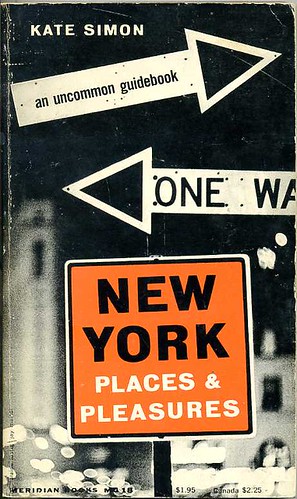
New York Places and Pleasures — Cover design by Elaine Lustig and Jay Maisel from Kyle Katz’s amazing Flickr photostream (via Design Observer).

A Very Bad Man — Douglas Wolk, author of Reading Comics: How Graphic Novels Work and What They Mean, reviews the forthcoming Darwyn Cooke comic book adaptation of The Hunter by Richard Stark (AKA Donald Westlake) — which I can’t wait to get my hands on — for the Washington Post:

Cooke has a particular gift for the space-age designs and stripped-down chiaroscuro that were in vogue a half-century ago — he previously explored them in his “DC: The New Frontier” comics — and his loose, ragged slashes of black and cobalt blue evoke the ascendancy of Hugh Hefner so powerfully you can almost hear a walking jazz bass. At times, he seems to be demonstrating how few brushstrokes it can take to communicate a precise degree of amoral machismo. Parker’s a very bad man, but it’s hard to take your eyes off him.

More stuff about  Darwyn Cooke and his Parker adaptation can be found at Almost Darwyn Cooke’s Blog (but not quite).

Buy Your Own ChainsThe New Yorker’s Willing Davidson painfully accurate observation that low industry pay and unpaid internships skew what is published (via GalleyCat):

Tiny salaries in the low ranks of publishing are miserable for the young workers, but they’re probably worse for literature… It’s a truism of the industry that most of these jobs are held by people who can afford them—people with some parental support and no student loans. Often they’ve had unpaid internships, that most pernicious example of class privilege. Their superiors are the same people, ten years later. They—we!—are smart, cultured people with good intentions, but it’s easy to see how this narrow range could lead to a blinkered view of literature.

Which leads rather nicely to…

The Intern —  Dark (and darkly funny) secrets from the lowest rung of this business we call publishing. See also Editorial Ass.

Gotham — I started with New York (and linked to The New Yorker somewhere in the middle), so I thought I’d wrap up with New York too. I came across The Mythic City: Photographs of New York by Samuel H. Gottscho, 1925-1940 a couple of weeks ago while looking for something completely different. It’s not new (it was published in 2005 to coincide with an exhibition at Museum of the City of New York), but the cover has stuck with me (something to do with the chunky cinematic type I think) and, by a happy coincidence, a copy of the book landed on my desk this week. It is beautiful. (Full disclosure: The Mythic City is published by Princeton Architectural Press who are distributed in Canada by the people who pay me).

Comments closed

Something for the Weekend, June 19th, 2009

50/50 — AIGA announce their 50 Books/50 Covers of 2008. Included in the fifty is the cover of Kenneth Hayes’ Milk and Melancholy designed by Toronto’s Underline Studio (pictured above).

Gxuu! — Linguist Arika Okrent, author of In the Land of Invented Languages, chooses her 10 favourite words from invented languages for The University of Chicago Magazine. Having been kind of fascinated with Volapük after reading William Gibson‘s  Spook Country, I was happy to see the inclusion of ‘pük’ (via the incomparable Kottke of course):

In Volapük, pük means “language.” It comes from the English word “speak” but it’s hard to tell (vol, means “world”, so Volapük is “world language.”) Unfortunately, it looks a lot like a different English word. And even more unfortunately, it shows up in various other words related to the concept of language: püked – “sentence” and pükön – “to speak.”

Nice Work — Mark Thwaite interviews novelist, critic and Emeritus Professor of English Literature, David Lodge about his new book Deaf Sentence for The Book Depository blog:

One’s ideal reader is intelligent, alert, open-minded but demanding, and equipped with what Hemingway called “a built-in shit-detector.” He/she does not actually exist. In a way you try to be that reader when you read and re-read your own work in progress, and not to kid yourself if something isn’t quite right. That’s a rather different matter from one’s “readership” which in my case, I’m aware, is probably well-educated, well-read, maybe Catholic, and getting more and more senior in years, like myself.

A Special Specimen — A lovely post by James Phillips Williams at amassblog about Paul Rand, Jan Tschichold and a very special type specimen book.

And speaking of Paul Rand, be sure to visit Daniel Lewandowski’s tribute site to the great man (via grain edit).

Comments closed

Something for the Weekend, June 5th, 2009

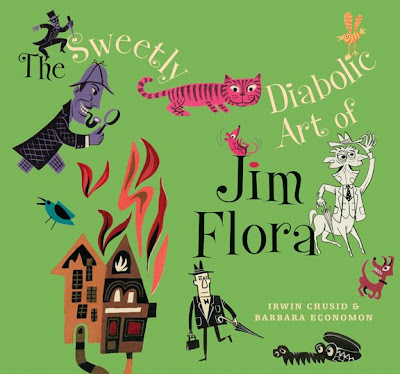
Sweetly Diabolic — A new Jim Flora compendium from Fantagraphics.

I really, truly, wasn’t going to link to any BEA autopsies — and there are plenty out there — but on the eve of BookCamp Toronto I thought Brian O’Leary’s post seem pertinent:

It would be more than nice, more than fun, more than illuminating, if we as an industry could use events like BEA as less an opportunity to predict the future and more a forum in which to examine the options. Okay, piracy is bad, but.. what if it helped sell books? Okay, we love long-form fiction and we think it should survive, but what if the people who read it now just stopped? Okay, a trade publisher provides value in choosing and curating content, but what if the world turned upside down and everyone were a writer, a publisher, a reader… Wouldn’t that be really cool?

Fingers crossed for tomorrow… Follow along on Twitter. The event account is @BookCampTO. The hash-tag is #bcto09.

Access of Evil — More on Google’s big e-book adventure at Business Week. The ‘news’ is that Google will be offering online access to e-books rather than downloads. Which, if I understand it correctly, is what Shortcovers does already. Not that anyone is giving them credit for it.

The ALPHABET chest of drawers by Kent and London, inspired by vintage printing blocks: “The perfect place to file everything from A-Z!” (via source of all good things swissmiss).

The George Orwell Archive at the BBC (via The Book Depository blog):

For two years, between 1941 and 1943, George Orwell – real name Eric Blair – was BBC staff member 9889, hired as a Talks Producer for the Eastern Service to write what was essentially propaganda for broadcast to India.

From recruitment to resignation, this collection of documents reveals the high regard in which Orwell was held by his colleagues and superiors and his own uncompromising integrity and honesty.

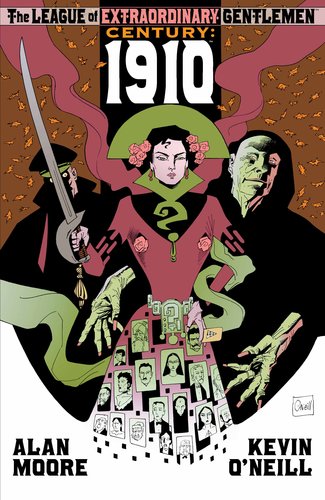
The Wickedest Man in the World — Jake Arnott, author of The Long Firm, on how the very real Aleister Crowley became the archetypal fictional 20th century villain. Sadly Arnott doesn’t mention that Oliver Haddo, W. Somerset Maugham’s literary Crowley, appears in the latest League of Extraordinary Gentlemen adventure.

The Future of Mainstream Media — a fascinating article about the success of National Public Radio (NPR) by Josh Catone for Mashable:

NPR’s amazing growth over the past 10 years prompted FastCompany magazine in March to call NPR the “most successful hybrid of old and new media,” and wonder if NPR could be the savior of the news industry. [T]hey owe that success to the culture of open access and audience participation that they’ve cultivated over the past decade.

And… OK I just can’t not link to Design Assembly‘s post about design-hero Wim Crouwel’s ISTD lecture.

Note: if you want me to link to your site, you just need to include a brilliant photograph of Wim Crouwel looking cool as f*ck and then use a genius soccer analogy:

“(For me) a grid is like a football pitch. You see a beautiful game of football, and then you see a not so beautiful one, but it all takes place on the same pitch”.

Yes. I am a cheap date.

4 Comments

Midweek Miscellany, June 3rd, 2009

I’m a little fatigued by all the inevitable post-Book Expo harping, hand-wringing and hubris, so please  forgive me if today’s links are a little light on book-book stuff…

Community Organizer — The New York Observer profiles John Freeman, the new editor of literary journal Granta:

Mr. Freeman believes in the inevitability of books—even if, as he will lay out in his forthcoming manifesto for Scribner, The Tyranny of E-Mail, the Internet is engendering in the people who use it habits that distract them from reading. This is the salve he has to offer a chapped and chafing industry. As people cry doom, he’s there to hold hands and assure them that it’s not that bad.

Cover Versions — Starting with Olly MossVideo Game Classics, Design Week looks at the trend of remixing just about everything to look like vintage 1960’s paperbacks.  What Consumes Me has a nice round-up of recent mash-ups (thx James!). And, if that wasn’t enough, Drawn! points to the another recent example: classic records reworked as classic Pelican paperbacks.

Which leads rather nicely to Emmanuel Polanco‘s Saul Bass inspired design for Moby Dick:

Throwing Down the Gauntlet — As widely reported elsewhere, Google are preparing to sell e-books according to the New York Times.

Making Mistakes — A fascinating interview with designer Paula Scher talking about creative failure at Psychology Today:

If you find yourself defending yourself and protecting yourself and being outraged about what’s around you, you’re in trouble. That doesn’t mean some things aren’t genuinely outrageous. But you have to ask yourself: Why are you outraged by something? What are you hiding from? What are you defending?

And, on a not dissimilar note…

Use It or Lose It — Indispensable creative advice from ad exec Dave Trott (via Mark McGuinness on Twitter):

If we wait for the right opportunity it won’t happen. It’ll stay in our drawer until the world has passed it by. Times will change and newer, more exciting things will be happening. Now it looks old and tired. Now it’s too late.

If we don’t find a way to make it happen, if we don’t take a chance and overcome lethargy and embarrassment to do it, it will disappear.

Students always ask me what I think they should do.

I tell them, “The answer is always the same two words: ‘everything’ and ‘now’.”

Everything and Now… Everything and Now…

Comments closed

Turning Towards Our Shelves

Ellen Lupton, author of Thinking With Type (interviewed by me here), interviews graphic designer David Barringer about his new collection of essays There’s Nothing Funny About Design over at Design Observer today.

It’s a wide ranging interview — mostly about design unsurprisingly — but a couple of paragraphs about books caught my eye:

I do think that ebooks are a step backwards, however. It’s like the fax. It’s not flexible or useful enough. Handheld computers should have greater power, and the Kindle instead has less. You should be able to access encyclopedias, dictionaries, and other searchable resources, just like we can on the computer or the iPhone. That’s where the real benefit of portable handheld units are. Who cares about downloading Twilight? I care about having access to entire online libraries of reference works, maps, and encyclopedias.

I’ve sort of come to the same conclusion. If e-readers are less convenient than cell phones, less useful than laptops, and less durable than books, what’s the point?

Anyway, David Barringer goes on to discuss our enduring emotional connection with book-books:

I’ve seen many friends who are avid readers turn toward their shelves of books and regard them as they would a photo album of their own lives. We take the contents of books into our imaginations, and our personalities are influenced by them. Looking at the books on my shelves, I feel memories bloom, my own life come back to me. Books are triggers for remembering where we have been, and who we are. A book is like a body part, and when you die and your connection to the book is broken, the book dies a little, too.

I thought that was rather touching…

Link

(NB Full Disclosure: Thinking With Type and There’s Nothing Funny About Design are published by Princeton Architectural Press, who are distributed in Canada by my employer, Raincoast Books)

Comments closed

Meanwhile, Elsewhere…

As is probably obvious, I spend a lot of time online clicking on stuff.

The things I bookmark, tag, and mentally store away that are (vaguely) about books end up here in one form or another.

But because I have eclectic interests, I bookmark a lot of photographs, illustrations, videos, and other things that just don’t have place on The Casual Optimist.

I’ve been mostly collecting these together in a digital scrapbook at Image Spark.

Image Spark has a really useful bookmarking plugin for Firefox so it’s easy to use and I really like it — despite it’s occasional  slowness.

But whilst Image Spark is great for me, I don’t think it’s so good for sharing.

I tried Tumblr and discovered I didn’t particularly like it (no offensive Tumblr — it’s not you, it’s me… Well, it’s a little bit you…), and so I have switched (at Ehren‘s suggestion) to Posterous which has a neat bookmarklet that makes it incredibly easy to post things when you see them.

So The Accidental Optimist is up and running. It’s just images and videos that I’ve stumbled upon. There’s links and tags but no commentary.

Inevitably there is some overlap with my Image Spark stuff but I don’t post everything to both, and I think the new blog will take on a personality of its own.

Anyway, like The Casual Optimist, it’s a work in progress, only it’s not about books (or anything really — which breaks about a bazillion rules of blogging).

Recent posts include a photograph of World War II airplanes in Texas, a bonkers animated music video by Mcbess and an Eric Gill quotation, so — as I say – eclectic. But maybe you’re interested? OK, maybe not…

(You can also find me — grumpy and misanthropic — on the Twitter if you care to)

Comments closed

Midweek Miscellany, May 20th, 2009

Cut It Out — Dioramas made from the covers of pulp novels by Thomas Allen, seen at We Made This (via Ingrid Paulson on Twitter).

You Can’t Be SeriousThe Guardian takes a gloomy look at fate of  non-fiction and bookselling in the UK, managing to summon up  some half-hearted optimism towards the end:

Despite decades of predictions to the contrary, the appetite for demanding non-fiction has survived the advent of newspapers, radio and television – and, in Britain, a popular culture with a particular ability to absorb talent and themes that in other countries would be channelled into grand state-of-the-nation volumes. In fact, many publishers think the noise and immediacy of the web will make slow, quiet immersion in a book seem more, not less, appealing. And books, unlike most digital media, are not directly dependent on recession-affected advertising revenues.

Boy’s Own Misadventure3:AM Magazine’s Mat Colgate gets to the heart of why volume 3 of The League of Extraordinary Gentleman Century: 1910 (published by Top Shelf)  is mildly disappointing (by Alan Moore standards). Could it really be that Moore writes better when subverting restrictions of form and genre than when he has free reign?

It’s Not Just Your Type — Priya Ganapati talks to designers, including Henry Sene Yee, about the problems of  e-book design at Gadget Lab.  (And Joshua Tallent’s commentary at TeleRead about the problems of formatting for ePub is also worth reading).

Restraint — I mentioned Marian Bantjes’ gorgeous new typeface at the weekend, and now you can download a rather lovely Restraint desktop from the folks at Typenuts (via I Love Typography on Twitter).

1 Comment

Something for the Weekend, May 15th, 2009

The Story of Goddesigner Arthur Cherry discusses his elegant design (which uses Marian Bantjes’ typeface Restraint to such brilliant effect) for the new edition of Michael Lodahlr’s book at FaceOut Books.

A Manifesto — Ted Genoways, the editor of Virginia Quarterly Review, on the future of university presses and journals:

University presidents need to see what articulate ambassadors they have in their journals and presses, what tangible, enduring records they present of the variety and vigor of their sponsoring institutions…[G]reat universities extend well beyond the edges of their campuses. They reach out to the larger world, they challenge and engage the public, and the most effective and enduring way of doing so remains the written word.

HarperCollins Wants to Be Your Friend — Leon Neyfakh looks at publishers and social media in the New York Observer. Ostensibly it’s about the ever so anodyne HarperStudio, but more interesting stuff comes from the other people interviewed:

“I don’t know if it’s a direct response to the fact that publishing is in a very uncertain period right now, or if it’s just an idea whose time has finally arrived, but people right now are really interested in experimenting,” said Ami Greko, a 29-year-old digital marketing manager at Macmillan. “There seems to be a real sense of, ‘Let’s get creative—nothing is set in stone yet, so let’s just try a whole bunch of stuff.’”

Das Buch vom Jazz — The German-language version of The Book of Jazz, illustrated by Cliff Roberts ,  found in a used-bookstore by Today’s Inspiration’s Leif Peng. The black and white illustrations are wonderful.

Moaning Eton-boys & Middle-Aged Hackettes — A great defense of blogging by Nina Power at Infinite Thøught  (via PD Smith on Twitter):

Print media suffers from a lack of space; certainly it is selective, but it is also exclusive — all the stories that don’t get told, the injustices that get covered-up. We may feel we can ‘trust’ print journalists more than bloggers… but the sheer quantity and variety of information online allows for the exposure and discussion of things that might otherwise get ignored.

And finally…

The Tyranny of Data — The New York Times on Douglas Bowman‘s decision to leave his position as top visual designer at Google, and the  limitations of crowd-sourcing design:

“Getting virtually real-time feedback from users is incredibly powerful,” said Debra Dunn, an associate professor at the Stanford Institute of Design. “But the feedback is not very rich in terms of the flavor, the texture and the nuance, which I think is a legitimate gripe among many designers.”

Adhering too rigidly to a design philosophy guided by “Web analytics,” Ms. Dunn said, “makes it very difficult to take bold leaps.”

1 Comment

Midweek Miscellany, May 6th, 2009

Vintage awesomeness — Hella Haase cover seen at the Vintage Paperbacks (Non-Penguin) Flickr Pool.

Make it Good — Jacket copy matters according to a Publishing Trends survey:

Flap copy is especially important for fiction. And title and cover impact are closely related to the impact of jacket copy. If the flap copy defies the expectation created by the cover and title—if, for instance, the cover of the book leads the reader to expect a thriller but the flap copy identifies it as horror—readers are less likely to buy it.

The Common Addiction to MediocrityGuy Kawasaki talks to Hartmut Esslinger, founder of frog design and professor at the University for Applied Arts in Vienna (lessons here for the book industry for sure):

Excellent products require more then just a good designer or a good design agency—they require humanistic and cultural vision, courage and discipline in execution.

Which leads quite nicely to Nora Young‘s podcast great conversation with filmmaker Gary Hustwit, director of Objectified and Helvetica, on CBC Radio’s Spark.

Thrift-Store Philosophy — some nice vintage book cover design finds at the always excellent Ward-O-Matic.

Instant Gratification — An interesting Q&A with Patrick Brown of Vroman’s bookstore in Pasadena (PW‘s Bookseller of the Year in 2008) on The Big Bad Book Blog:

People greatly underestimate how important browsing is for physical purchases, largely, I think, because it’s lacking in the online world. People come to an ecommerce site already knowing what they want to buy (for the most part). This isn’t so in our store, where people frequently come in for one book and end up leaving with a book that caught their eye on the way to the section or waiting in line at the register. The other thing we provide that I think is invaluable is a physical place for literary culture to happen.

Well-Aimed Typewriter Keys — After 70 years, Little, Brown and Co. have unveiled a new logo  designed by  Lance Hidy.

The Book Depository — who have a great range of books and offer free shipping world wide (and have this great live map), has launched an affiliate program. Can I humbly request someone develop a wordpress widget for it please?

And lastly, The New Yorker‘s The Book Bench blog has a sneak preview of the new Dan Clowes book.

Comments closed

Naïve: Modernism and Folklore in Contemporary Graphic Design

Published this month by Gestalten (thanks Siobhan!):

A minimalist design vocabulary is currently being reinvented by a troop of young graphic designers who are rediscovering the stylistic elements reminiscent of classic graphic design such as silkscreen printing, classical typography, hand lettering, woodcutting and folk art and integrating them into their work. Naïve documents this extraordinary renaissance of Classic Modernism, from the 1940s to 1960s, in contemporary graphic design.

1 Comment

Something for the Weekend, April 17th, 2009


Isotype — Gerd Arntz’s amazing pictograms and visual signs for the visual language Isotype at the beautifully designed The Gerd Arntz Web Archive (pictured above).

Jacket(s) — Much as I admire Chip Kidd’s book covers, most of them are just too familiar to re-post here. But I hadn’t seen this ingeniously layered design for Kenzo Kitakata’s Ashes before even though it was published by Vertical in 2003 (pictured above). Seeing it all laid out, it’s really hard to begrudge Mr. Kidd’s reputation for awesomeness.

We like to be part of something — Nick Harkaway on connections:

A paper book has a history. Somewhere, at some time, an author wrote it all down, printed it out, gave it to an editor, who also worked over it. The book was typeset – yes, on a computer, these days, but still — and finally pressed and packaged and distributed. There is a chain of physical events which leads from me to you. With old editions, it’s even more direct. With signed ones, it’s a handshake. We like to connect. And digital books feel as if they’re trapped behind glass. The book is in the machine, and we can’t open the cover and touch the pages.

Black, white and read all overCreative Review looks at Faber & Faber‘s new editions of 20th Century poetry. The books feature specially commissioned woodcut and linocut cover illustrations.  The new editions are part of the Faber’s 80th anniversary celebrations. You can see more of the cover images at designer Miriam Rosenbloom’s design:related page.

The Disappointment Brokers — I going to go out on a limb and say this is another must-read for book-industry types from Poets & Writers — Literary agents Anna Stein, Jim Rutman, Maria Massie, and Peter Steinberg have a fascinating conversation about their profession and the state of the industry:

here’s the silver lining: [The industry’s] unhealthy enough that it’s an exciting time. It’s broken enough that publishers and agents and everyone has to change. Everyone has to rethink what they’re doing. So we have a group responsibility, and an opportunity, in a way that the industry has probably never seen before.

The Legacy of ModernismSpiegel Online celebrates 90 years of Bauhaus (via @PD_Smith).

Comments closed

Something for the Weekend

The Alcuin Society announced the 2008 Awards for Excellence in Book Design in Canada this week. Utopia/Dystopia by Geoffrey James, designed by George Vaitkunas, published by Douglas & McIntyre, (pictured above) won first prize in the pictorial category. A full list of the winners is available here (PDF).

The Hidden RevolutionInside Higher Ed discusses an article (sadly not available online) by Sandy Thatcher, director of the Penn State University Press, about digital publishing at university presses:

Thatcher’s argument, in brief, is that the peculiar challenges faced by university presses have given them an incentive to use digital resources in ways that put them somewhat ahead of their peers in the world of trade or mass-market publishing. Given the small market for most scholarly titles, academic publishers were in a unique position to benefit from short-run digital publishing (SRDP) and print-on-demand (POD) technologies.

Ten Grids That Changed the WorldSwiss Legacy reviews Hannah B Higgins’ The Grid Book:

Charting the evolution of each grid, from the Paleolithic brick of ancient Mesopotamia through the virtual connections of the Internet, Higgins demonstrates that once a grid is invented, it may bend, crumble, or shatter, but its organizing principle never disappears.

Also: The Grid Book reviewed in The Guardian.

The Need for Balance — Novelist Victoria Strauss at Writer Beware on fatuous articles about self-publishing:

For most writers… the path of self-publishing offers substantial downsides and pitfalls… and successes… remain few and far between. These hard facts are way less sexy than the vision of a brave new technological world that makes it possible for (a few) authors to bypass the traditional route to success–but they are no less real. In my opinion, journalists who write about this issue have a responsibility to cover both sides.

Taking the Internet and Printing it Out — Ben Terrett (Noisy Decent Graphics and Really Interesting Group) talks about publishing Things Our Friends Have Written on the Internet — a newspaper collecting some of the best blog posts of 2008 — with Nora Young on CBC Radio’s Spark.

This week’s Spark also has a neat interview with YouTube remix genius Kutiman. If you haven’t seen/heard Kutiman’s Thru You music project, check  out The Mother of All Funk Chords.

“God Damn That’s A Good Looking Blue” — Winston Eggleston talks about his father, the photographer William Eggleston (whose work was recently used for the cover NYTBR):

Comments closed