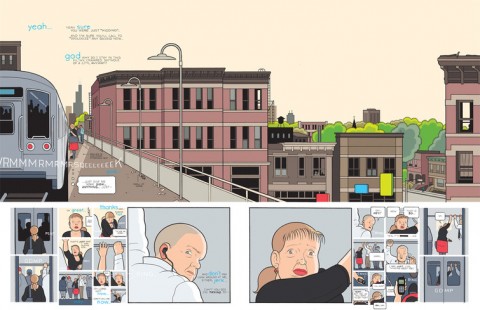
Cartoonist Chris Ware has rightly been garnering a lot of attention for his new ‘graphic novel’ Building Stories, 14 books, booklets, magazines, newspapers and pamphlets that collect a decade of comics from The New Yorker, The New York Times and McSweeney’s, as well as previously unpublished work.

Douglas Wolk, author of Reading Comics, reviews the book for The New York Times:
You will never be able to read “Building Stories” on a digital tablet, by design. It is a physical object, printed on wood pulp, darn it. It’s a big, sturdy box, containing 14 different “easily misplaced elements” — a hard-bound volume or two, pamphlets and leaflets of various dimensions, a monstrously huge tabloid à la century-old Sunday newspaper comics sections and a folded board of the sort that might once have come with a fancy game. In which order should one read them? Whatever, Ware shrugs, uncharacteristically relinquishing his customary absolute control. In the world of “Building Stories,” linearity leads only to decay and death.

Comics historian Jeet Heer is as insightful as always for a somewhat undeserving Globe and Mail:
This marriage of comics and architecture might sound surprising, but it has a long history, which Ware, deeply knowledgeable about the past, knows well. The modern skyscraper emerged at the same time as modern narrative cartooning, in the middle of the 19th century, although both forms had prehistories that extend further into the past. The classic Sunday newspaper comic strip, with many panels on the page laid out on a grid, has obvious parallels with tall many-windowed office buildings, a fact that pioneering cartoonists like Winsor McCay played with when they drew stories that used the New York skyline not just as a backdrop but as a virtual character. The drawing board of a cartoonist is not unlike the drafting table of an architect. And in both drawing comics and imagining homes, you work with grids, rectangles and cubes and need to have mastered perspective.

And Rick Moody, author of The Ice Storm, gets terribly excited at Salon:
Building Stories is a masterpiece, above all, because it cares about human beings, many of them women. It cares enough to observe human beings closely, both when they are behaving themselves, and when they are engaging in their manifold selfishnesses. It cares enough about them to depict them when they are attractive and when they are singularly unattractive. The contemporary novel, it bears mentioning, does not care this much, because the contemporary novel is so preoccupied with affirmation that it will not risk what Ware is willing to risk.
Other reviews include David L. Ulin for The LA Times, Glen Weldon for NPR, Ian McGillis for the Montreal Gazette, and Rachel Cooke in The Guardian.

The Guardian and New York Magazine also have short interviews with Ware, but there also several excellent longer ones.
At Publishers Weekly, Ware speaks to Calvin Reid:
the idea behind the book is to try to get at the way we remember things, the way we put our lives together in our memories and kind of rewrite our own memories sometimes to suit ourselves. Also to get at a sense of how when you are remembering something that’s happened to you, sometimes you can almost lose yourself in that memory to the point where you lose the sense of the world around you, maybe just for a few seconds or something like that. I had hoped that with this book, that if say you start reading one story and interpret it as the present and then move on to another part of the book and realize that it wasn’t actually the present you were reading about, it was actually the character’s past, that that that might get at a little tiny bit of that feeling. I mean, every book is about a story happening from beginning to end and somebody changing as the story goes on but I wanted to try to create something that is maybe a little more analogous to the way that it feels in my brain, which is maybe a little more three dimensional and uncertain than that…

At the The LA Review of Books, Casey Burchby:
I don’t draft or script; the drawings and stories form themselves out of the images and what they suggest as I draw them, along with the memories they might dredge up. There’s really no way I could plan these things; the connections and coincidences that occur have to happen on the page. I’ve noticed that there’s a sort of nervousness on the part of the reader as to when exactly it is that the writer or artist starts winging it, as if that information has to be taken into account when assessing whether a story is believable or not, but it seems to me that writing an outline or a script on typing paper is just as much winging it as drawing directly on the page, and the latter approach allows the composition and scale to structure and shape the story, as well – which only taking notes or making thumbnails does not do. I do erase. I also have general ideas, themes, notions — whatever you want to call them, but I think that scripts come too perilously close to turning the process into illustrating words, which overlooks the inherent power of what cartooning — essentially a key to visual memory via the structure of language — can be.
And at The New Statesman, Alex Hearn:
I’m simply trying to present life as I’ve experienced it, though admittedly in my own very shielded, first-world way. My characters suffer very little compared to someone who might’ve seen their parents killed in a genocide, or endured starvation or disaster. I don’t know why some readers or viewers don’t find it more depressing that most popular books and movies and television programs can’t seem to not be about murderers or rapists or psychopaths — as if a story simply isn’t interesting unless someone is brutally threatened or killed. Violence is always the cheapest shortcut to emotional involvement.
And finally, Debbie Millman chats with Ware for the design podcast Design Matters:
Design Matters: Chris Ware mp3
Like this:
Like Loading...