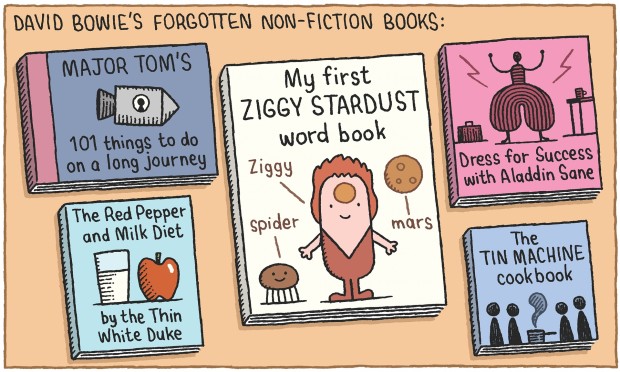
Tom Gauld for The Guardian.
(And, on a related note, if you are looking for Bowie links, Daniel Benneworth-Gray is compiling a list)
Comments closedBooks, Design and Culture
Tom Gauld for The Guardian.
(And, on a related note, if you are looking for Bowie links, Daniel Benneworth-Gray is compiling a list)
Comments closed
Excitingly Wrong — An interview with Peter Mendelsund at Porter Square Books:
I am always interested by anything graphical that strikes me as (this is difficult to put into words) excitingly wrong. There is a cool-factor to certain images that lie just on this side of disagreeable…pictorial effects that make me think “this will bother a lot of unimaginative people.” Whenever I see something like that, a piece of art or graphic design that has that special kind of wrongness about it, I think “I need to do something like this myself.” Attendant to this is always the feeling of “in the future, this will be done a lot.” In other words, today’s ugly is tomorrow’s beautiful.

Lurking Menace — Ostensibly reviewing David Bowie Is, the catalogue for the current V & A exhibition, and Bowie’s new album, The Next Day, Ian Buruma looks back at the performer’s career at the NYRB:
[Bowie] drew his inspiration from anything that happened to catch his fancy: Christopher Isherwood’s Berlin of the 1930s, Hollywood divas of the 1940s, Kabuki theater, William Burroughs, English mummers, Jean Cocteau, Andy Warhol, French chansons, Buñuel’s surrealism, and Stanley Kubrick’s movies, especially A Clockwork Orange, whose mixture of high culture, science fiction, and lurking menace suited Bowie to the ground. Artists and filmmakers have often created interesting results by refining popular culture into high art. Bowie did the opposite: he would, as he once explained in an interview, plunder high art and take it down to the street; that was his brand of rock-and-roll theater.
This Movie is About Hope — Film Comment has a transcript of Steven Soderbergh’s San Francisco International Film Festival ‘State of Cinema Address’:
The simplest way that I can describe it is that a movie is something you see, and cinema is something that’s made. It has nothing to do with the captured medium, it doesn’t have anything to do with where the screen is, if it’s in your bedroom, your iPad, it doesn’t even really have to be a movie. It could be a commercial, it could be something on YouTube. Cinema is a specificity of vision. It’s an approach in which everything matters. It’s the polar opposite of generic or arbitrary and the result is as unique as a signature or a fingerprint. It isn’t made by a committee, and it isn’t made by a company, and it isn’t made by the audience. It means that if this filmmaker didn’t do it, it either wouldn’t exist at all, or it wouldn’t exist in anything like this form.
Read the whole thing. It reminded me of William Goldman’s famous comment about Hollywood in Adventures in the Screen Trade: “nobody knows anything.”
See also: At the New York Times film critic A. O. Scott looks at Soderbergh’s ‘Twitter narrative‘ Glue.
And finally…
Just to the Right of Karl Marx — At the Financial Times, Julia Hobsbawn remembers her father, the historian Eric Hobsbawn:
Comments closedThe cemetery plot, situated as my husband Alaric wryly pointed out later “just to the right of Karl Marx”, had been freshly dug… My mum Marlene had bought the plot in an expensive and expansive act of love several years earlier. She is 81 and was my father’s unsung muse for 50 years, dealing constantly with demands on his time from students, publishers, editors and broadcasters while acting as his general reader…My dad was pleased knowing that he would end up there. Highgate Cemetery’s east wing is full of iconoclasts from the intelligentsia. I can picture him, glasses pushed up over his high forehead, peering longsightedly at the guide produced by the Friends of Highgate Cemetery Trust about its history, hoovering up the text and filleting it for us in an exact and pithy way. “Ah yes,” he might say, energised like a freshly charged battery by what he had just read, “you see what is really interesting about this is…”

City Air Sets You Free — Mark Lamster interviews P.D. Smith about his new book City: A Guidebook for the Urban Age, for Design Observer:
It was never my intention to write an architectural history. Cities are much more than the sum of their architecture or infrastructure. A city is made great by its people. Nevertheless, you cannot ignore the structures and spaces of a city. Winston Churchill once famously said: “We shape our buildings and afterwards our buildings shape us.” Our urban environments undoubtedly shape us as people. That’s why between each of the eight sections in the book there are essays on more concrete features of the urban landscape, such as the Central Station, the City Wall, the Skyscraper or even the Ruins. But I hope that even here I don’t lose sight of the people who use these architectural spaces. After all, they are the life-blood of the city.
Pop Detritus — Peter Paphides reviews When Ziggy Played Guitar by Dylan Jones, for The Observer:
For many critics, Ziggy was the last desperate act of a craven opportunist. A New Yorker writer flown to see the Ziggy shows fretted that “Bowie doesn’t seem quite real”. But, as long as music journalism has existed, performers – be it Bowie in 1972 or Lana Del Rey in 2012 – have been docked points for their apparent lack of authenticity.
And, besides, it was those very notions of authenticity with which Bowie was playing when he created Ziggy. After several hapless reinventions, the only hit he had to show for his efforts was Space Oddity, but, as Jones points out, Ziggy Stardust was the result of a decade spent sifting through pop cultural detritus and working out which bits he could use to turn him into a pop star.
Don’t Believe the Type — Estimable Jon Gray on the recently revealed cover design for J.K. Rowling’s new novel:
JD Salinger famously had a clause written into his contract stating that no imagery could appear on his covers. Günter Grass will only allow his own drawings. The classic orange Penguins, the poetry covers of Faber: they tell us nothing other than this is a book of note, a book of importance. JK Rowling’s name is the important piece of information, the quality assurance mark, and it is stated very simply and boldly in the brightest and clearest way possible.
(Needless to say, Jon’s thoughts are more interesting that the cover itself).
Material World — An interview with mighty Coralie Bickford-Smith:
I always start by asking myself ‘what is the most effective set of book covers I can produce using just standard materials which are simple but incredibly effective to be within the usual budget constraints?’ To marry design with materials in the most considered and best way possible. So in a way it always starts with the materials so I can make my design suit that method of printing. With the cloth classics its was all about creating a book that would be loved and cherished and not throw away. The materials were the starting point. The foiling was a real struggle at first, the detail of the design cant be too intricate. So the patterns were all designed with this in mind so that the printers could reproduce the design easily. Every material has its limits and its all about getting to grips with those limits to produce an end product that looks effortless and deceptively simple.
My interview with Coralie is here.
And finally…

The Long History of the Espresso Machine…
In the 19th century, coffee was a huge business in Europe with cafes flourishing across the continent. But coffee brewing was a slow process and, as is still the case today, customers often had to wait for their brew. Seeing an opportunity, inventors across Europe began to explore ways of using steam machines to reduce brewing time – this was, after all, the age of steam. Though there were surely innumerable patents and prototypes, the invention of the machine and the method that would lead to espresso is usually attributed to Angelo Moriondo of Turin, Italy, who was granted a patent in 1884 for “new steam machinery for the economic and instantaneous confection of coffee beverage.”
Great stuff… (see also: The Once and Future Coffeehouses of Vienna)
Comments closed